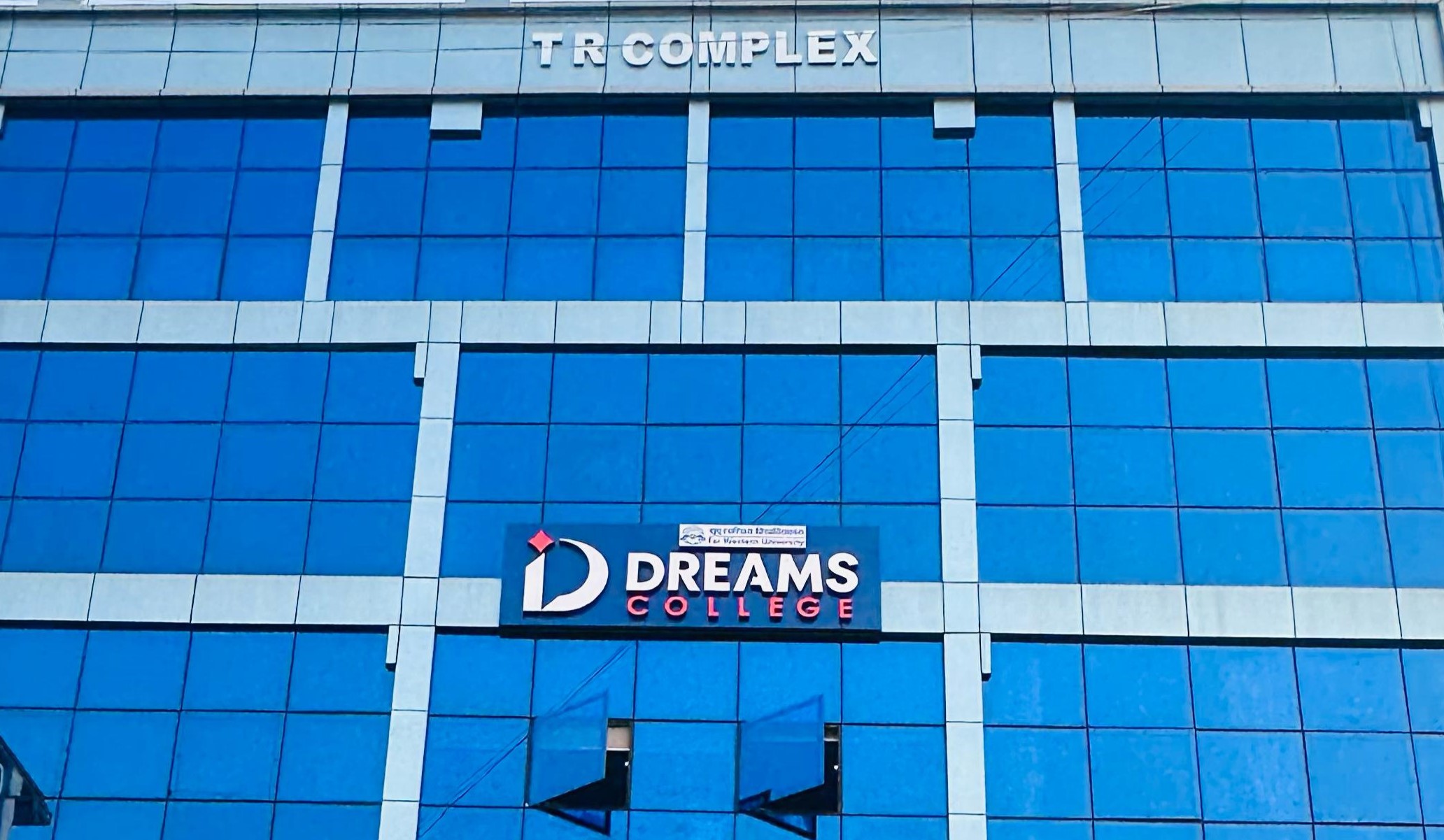
The Bachelor of Science in Computer Science and Information Technology (B.Sc. CSIT) at Dreams College is an undergraduate computing program affiliated with Far Western University. Dreams College offers the program from Bharatpur-09, Hakimchowk, TR Complex, Chitwan.
The course brings together computer science theory, programming practice, mathematical foundations, laboratory work, software development, research, project work, electives, and an internship. Its eight-semester structure moves from introductory computing and mathematics to advanced areas such as artificial intelligence, cryptography, software engineering, database systems, parallel computing, and specialised electives.
| Field | Details |
|---|---|
| Course | Bachelor of Science in Computer Science and Information Technology |
| Abbreviation | B.Sc. CSIT |
| Institution | Dreams College |
| Affiliation | Far Western University |
| Level | Bachelor’s degree |
| Academic structure | Eight semesters |
| Total credit hours | 137 |
| Location | Bharatpur-09, Hakimchowk, TR Complex, Chitwan |
| Eligibility | 10+2 or equivalent in Science with at least 50% or a ‘C’ grade in all subjects |
The B.Sc. CSIT program combines the principles of computer science with the practical use of information technology. Students begin with programming, mathematics, electronics, digital logic, data structures, and computer fundamentals before moving into software, networks, databases, algorithms, and specialised computing subjects.
Programming is introduced through C and continues through object-oriented programming with C++ and Java. Students also study web technologies, software engineering, operating systems, system analysis, artificial intelligence, computer graphics, cryptography, and database management.
The curriculum contains two minor projects and an internship. These components give students opportunities to organise technical ideas, develop practical solutions, prepare documentation, and present completed work.
The course includes study in the following areas:
Programming fundamentals and software development
Data structures and algorithm design
Computer organisation and architecture
Digital logic and microprocessor systems
Operating systems
Database management
Data communication and computer networks
Web technologies
Artificial intelligence
Compiler design
Graphics and visual computing
Cryptography
Software engineering
Research methodology
Parallel computing
E-commerce
Object-oriented analysis and design
Elective computing subjects
Project work and internship
Mathematics and statistics are also included through calculus, linear algebra, numerical methods, probability, applied statistics, and discrete structures. English and management subjects support academic communication and organisational understanding.
Dreams College supports the B.Sc. CSIT program through classroom teaching, laboratory practice, technical projects, seminars, bootcamps, and industry-related activities.
The learning facilities and academic arrangements include:
Computer laboratory
Network laboratory
Digital laboratory
Air-conditioned classrooms
Projectors in classrooms
High-speed internet access
Experienced faculty members
Seminars and bootcamps
IT-related project work
Internship opportunities in IT companies
Internship and placement support
Research and innovation activities
Students can use laboratory sessions to practise programming, networking, software applications, database tasks, and other technical work connected with their subjects. Project assignments and presentations add a practical element to regular classroom study.
Eligibility: Students must have completed 10+2 or an equivalent qualification in Science with at least 50% or a ‘C’ grade in all subjects.
The Far Western University B.Sc. CSIT curriculum consists of eight semesters and 137 credit hours. The first four semesters build foundations in computing, mathematics, electronics, programming, systems, and data management. The later semesters introduce advanced computing subjects, projects, electives, and an internship.
| Semester | Courses | Credits |
|---|---|---|
| First | CSIT.111 English Grammar and Composition; CSIT.112 Information Technology Fundamentals; CSIT.113 Calculus and Analytical Geometry; CSIT.114 Electronic Principles TH; CSIT.114 Electronic Principles PR; CSIT.115 Programming Fundamentals and C Programming | 16 |
| Second | CSIT.121 Data Structure and Algorithms; CSIT.122 Digital Logic Design; CSIT.123 Linear Algebra; CSIT.124 Mechanics and Electrodynamics TH; CSIT.124 Mechanics and Electrodynamics PR; CSIT.125 Microprocessor System | 16 |
| Third | CSIT.211 Computer Organization and Architecture; CSIT.212 Discrete Structures; CSIT.213 Introduction to Management; CSIT.214 Object Oriented Programming with C++; CSIT.215 Operating System; CSIT.216 Statistics and Probability | 18 |
| Fourth | CSIT.221 Applied Statistics; CSIT.222 Data Communication and Network; CSIT.223 Database Management System; CSIT.224 Numerical Methods; CSIT.225 System Analysis and Design; CSIT.226 Theory of Computation | 18 |
| Fifth | CSIT.311 Design and Analysis of Algorithm; CSIT.312 Artificial Intelligence; CSIT.313 Compiler Design; CSIT.314 Simulation and Modelling; CSIT.315 Graphics and Visual Computing; CSIT.316 Web Technology I | 18 |
| Sixth | CSIT.321 Introduction to Cryptography; CSIT.322 Java Programming I; CSIT.323 Research Methodology for Computer Science; CSIT.324 Software Engineering; CSIT.325 Web Technology II; CSIT.326 Minor Project I | 17 |
| Seventh | CSIT.411 E-commerce; CSIT.412 Advanced Java Programming; CSIT.413 Object Oriented Analysis and Design; CSIT.414 Minor Project II; Elective I; Elective II | 18 |
| Eighth | CSIT.421 Parallel Computing; CSIT.422 Internship; Elective III; Elective IV; Elective V | 16 |
The first year introduces the basic academic and technical foundations required for later computing subjects.
Students study English Grammar and Composition, Information Technology Fundamentals, Calculus and Analytical Geometry, Electronic Principles, and Programming Fundamentals and C Programming in the first semester.
The second semester contains Data Structure and Algorithms, Digital Logic Design, Linear Algebra, Mechanics and Electrodynamics, and Microprocessor System.
Together, these subjects introduce programming logic, hardware principles, mathematical reasoning, digital systems, data organisation, and computer components.
The third semester moves into computer systems, discrete mathematics, management, object-oriented programming, operating systems, statistics, and probability.
The fourth semester includes Applied Statistics, Data Communication and Network, Database Management System, Numerical Methods, System Analysis and Design, and Theory of Computation.
At this stage, students study how computer systems operate, how data is stored and communicated, how software requirements are analysed, and how computing problems can be represented mathematically.
The fifth semester includes Design and Analysis of Algorithm, Artificial Intelligence, Compiler Design, Simulation and Modelling, Graphics and Visual Computing, and Web Technology I.
The sixth semester covers Introduction to Cryptography, Java Programming I, Research Methodology for Computer Science, Software Engineering, Web Technology II, and Minor Project I.
These semesters give greater attention to advanced programming, software construction, research, information security, intelligent systems, web applications, and project development.
The seventh semester contains E-commerce, Advanced Java Programming, Object Oriented Analysis and Design, Minor Project II, and two electives.
The eighth semester includes Parallel Computing, an internship, and three electives. The internship carries four credit hours and forms part of the formal curriculum.
The final year allows students to apply their knowledge through project work, workplace exposure, advanced computing subjects, and selected areas of specialisation.
Far Western University recommends four elective tracks for B.Sc. CSIT students. Each track groups electives around a particular computing area.
This track concentrates on network-based programming, enterprise application development, and mobile application development.
Recommended subjects include:
Net Centric Computing
An Elective II subject
Enterprise Application Development with Java
Mobile Application Development
An Elective V subject
This track focuses on database administration, database design, distributed database systems, and related data subjects.
Recommended subjects include:
Database Administration
An Elective II subject
Advanced Database Design
Distributed Database Management Systems
An Elective V subject
This track covers system administration, network administration, wireless networks, and related computing subjects.
Recommended subjects include:
System Administration
An Elective II subject
Network Administration
Wireless Networks
An Elective V subject
This track includes image processing, neural networks, cloud computing, and related analytical subjects.
Recommended subjects include:
Digital Image Processing
An Elective II subject
Neural Network
Cloud Computing
An Elective V subject
Students select subjects from five elective groups.
CSIT.415.1 Net Centric Computing
CSIT.415.2 Database Administration
CSIT.415.3 System Administration
CSIT.415.4 Digital Image Processing
CSIT.416.1 Data Mining and Warehousing
CSIT.416.2 Geographical Information System
CSIT.416.3 Management Information Systems
CSIT.416.4 Neural Networks
CSIT.423.1 Enterprise Application Development with Java
CSIT.423.2 Advanced Database Design
CSIT.423.3 Network Administration
CSIT.423.4 Real-time Systems
CSIT.424.1 Mobile Application Development
CSIT.424.2 Distributed Database Management Systems
CSIT.424.3 Wireless Networks
CSIT.424.4 Cloud Computing
CSIT.425.1 Information Retrieval
CSIT.425.2 E-business and E-governance
CSIT.425.3 Embedded System Programming
CSIT.425.4 Human Computer Interaction
The B.Sc. CSIT curriculum includes Minor Project I in the sixth semester and Minor Project II in the seventh semester. These courses allow students to plan, develop, document, and present computing-related work.
The eighth-semester internship provides formal workplace exposure. Dreams College also includes internship opportunities in different IT companies among its course features.
Through project and internship activities, students may gain experience in:
Defining a technical problem
Planning project tasks
Writing and testing programs
Preparing technical documentation
Working independently or in teams
Presenting a completed project
Understanding workplace procedures
Connecting academic subjects with practical assignments
The university evaluation system allocates 60 marks to external evaluation and 40 marks to internal evaluation.
| Evaluation component | Marks | Main areas |
|---|---|---|
| External evaluation | 60 | End-semester examination |
| Internal evaluation | 40 | Assignments, quizzes, attendance, presentations, term papers, mid-term examination, and group work |
The internal evaluation weightage is distributed as follows:
Assignments: 10%
Quizzes: 10%
Attendance: 10%
Presentation: 10%
Term papers: 10%
Mid-term examination: 40%
Group work: 10%
Students must secure at least 50% in internal evaluation to become eligible to appear in the end-semester examination. The curriculum also requires at least 80% class attendance. Practical examinations are conducted at the end of the semester for applicable subjects.
The end-semester written examination includes multiple-choice, short-answer, and long-answer or case-study questions. The multiple-choice section does not follow negative marking.
The academic process may include:
Lectures and classroom discussions
Individual and group work
Self-study
Assignments
Student presentations
Term-paper writing
Quizzes
Guest lectures
Laboratory sessions
Project work
Internship activities
Regular participation is important because assignments, attendance, presentations, quizzes, mid-term examinations, and group work contribute to internal evaluation.
The combination of computing subjects, laboratories, projects, presentations, and internship work may help students develop skills in:
C, C++, and Java programming
Algorithm design and analysis
Data structure implementation
Database design and management
Web development
Software analysis and development
Computer networking
Information security
Object-oriented system design
Research and technical writing
Project planning
Problem-solving
Technical presentation
Team-based work
Elective choices can provide additional exposure to databases, networking, mobile applications, data mining, cloud computing, image processing, embedded systems, or human-computer interaction.
Graduates may consider entry-level and developing roles related to software, web systems, data, networks, databases, security, administration, and IT services.
Related career areas include:
Software developer
Web developer
Software programmer
Data analyst
Cybersecurity analyst
Database administrator
System administrator
IT consultant
IT project management
E-commerce and mobile commerce
Research and innovation
Career direction depends on a graduate’s technical ability, elective subjects, project experience, internship exposure, and additional professional development.
The course may suit students who are interested in programming, computer systems, software, web technologies, databases, networking, mathematical problem-solving, or information security.
It may also be relevant for students who prefer a program containing both theoretical subjects and applied components such as laboratories, projects, presentations, electives, and an internship.
Students should be prepared to work with mathematics, programming logic, technical documentation, individual assignments, group activities, and regular practical exercises.
Dreams College offers the Far Western University B.Sc. CSIT program from Hakimchowk, Bharatpur. The college’s academic arrangements include computer, network, and digital laboratories, classroom projectors, high-speed internet, seminars, bootcamps, IT-related project work, and internship support.
The college was established in 2025 AD as a privately owned higher education institution. Its current academic focus is the B.Sc. CSIT program.
B.Sc. CSIT stands for Bachelor of Science in Computer Science and Information Technology.
The B.Sc. CSIT program at Dreams College is affiliated with Far Western University.
The curriculum is organised into eight semesters.
Students must complete 137 credit hours.
Students must have completed 10+2 or equivalent in Science with at least 50% or a ‘C’ grade in all subjects.
Yes. The curriculum contains Minor Project I in the sixth semester and Minor Project II in the seventh semester.
Yes. Internship is included in the eighth semester and carries four credit hours.
The college includes a computer laboratory, network laboratory, and digital laboratory.
College: Dreams College
Address: Bharatpur-09, Hakimchowk, TR Complex, Chitwan, Nepal
Phone: +977-56-515560, +977-9855094560
Email: info@dreamscollege.edu.np
Website: www.dreamscollege.edu.np