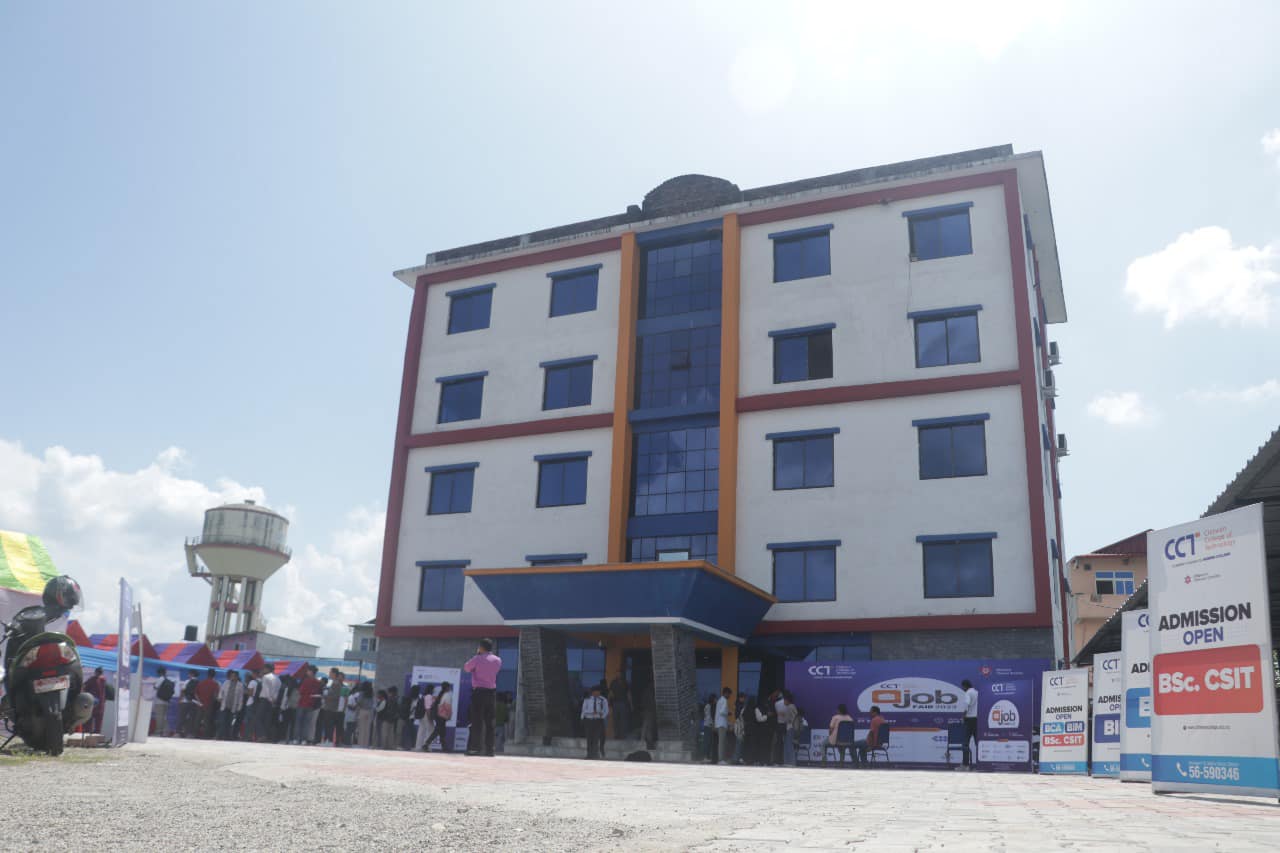
Chitwan College of Technology (CCT) is a Tribhuvan University (TU) affiliated institution based in Bharatpur, Chitwan. The college was previously known as Indreni College and later adopted its current name with a clearer institutional focus on Information Technology and computing education. The CCT is located around Aastha Chowk, Bharatpur-12, an area that is accessible for students from Bharatpur and neighboring districts.
CCT primarily serves +2 graduates who want bachelor-level study in IT inside Chitwan. The college states that it runs three TU programs — BSc CSIT, BCA, and BITM — and that the learning environment gives space for lab practice, semester projects, internships, and student-led technology activities. This profile presents the institution’s stated academic scope, admission routes, learning methods, facilities, student life, and scholarship provisions for readers who need clear, fact-based information.
College name: Chitwan College of Technology (CCT)
Earlier identity: Indreni College
Location: Aastha Chowk area, Bharatpur-12, Chitwan
Affiliation: Tribhuvan University (TU)
Academic focus: bachelor-level IT and computing
Programs listed by the college: BSc CSIT, BCA, BITM
Learning elements mentioned: computer labs, semester projects, internship and final-year project requirements under TU
Scholarship statement: opportunities that may extend up to full fee coverage for eligible students
College Network: ISMT College (Kathmandu, Butwal, Pokhara, Itahari, Biratnagar, and Chitwan), Stamford College Kathmandu (SCK), The London College, Chitwan College of Technology (CCT), and Kathmandu College of Technology (KCT).
CCT reports three TU-affiliated bachelor’s programs. Each program follows TU’s national curriculum and evaluation structure. The college also mentions internal academic support activities intended to help students connect theory with practice.
The Bachelor of Science in Computer Science and Information Technology (BSc CSIT) is a four-year, eight-semester TU program. The college describes this course as covering core computer science and applied IT areas including programming, software development, databases, networking, and other subjects set by TU. Lab work, semester projects, a mandatory internship, and final-year project work are part of the formal structure.
For +2 Science students in Chitwan who meet TU eligibility, this program can lead toward roles such as software developer, network administrator, system analyst, and IT officer. These roles exist across banks, hospitals, government offices, and private technology companies in Nepal, including growing employment spaces within Chitwan itself.
The Bachelor of Computer Application (BCA) is a four-year TU program. CCT presents BCA as an option for students from different +2 streams who meet TU’s minimum grade criteria. The stated academic direction centers on application development, where students learn to build software solutions within the scope of the university syllabus.
The college notes that the BCA curriculum includes some management and accounting-related subjects. This can help students understand client needs, project planning, and basic business communication alongside technical work. Career paths commonly linked with BCA include web development, app development, quality assurance, and other digital service roles.
The Bachelor in Information Technology and Management (BITM) combines IT and management studies across four years under TU. CCT indicates that the program includes a major share of computing subjects with a significant portion of business and management content. This structure can suit students who want to work in roles that require both technical understanding and organizational coordination.
BITM graduates may move toward roles such as IT officer, system analyst, project coordinator, or IT manager in sectors like banking, healthcare, education, tourism services, and other enterprises. For students in Bharatpur who want a management-oriented IT route without leaving the district, BITM can be a locally accessible option.
Because the college is affiliated with TU, admissions are guided by university eligibility rules and entrance processes for each program. The college text outlines general criteria and steps, while applicants should check the latest TU notices and the college’s annual intake announcement for exact dates, documents, and test formats.
CCT notes that BSc CSIT applicants must complete +2 Science with required subjects and sit for the TU entrance examination. Students generally submit the TU entrance form through a participating CSIT college, and the form is recognized across the designated campuses.
For BCA, the college lists a minimum D+ in each subject in grades 11 and 12 with an overall CGPA of 2.0 or above, or a second-division equivalent in +2, PCL, or an equivalent program. The college mentions application submission, document verification, and an interview or entrance test if conducted by the institution under TU guidelines.
For BITM, CCT states that applicants must complete twelve years of schooling or an equivalent level recognized by TU. The document also refers to minimum grades and to CMAT or another entrance process as directed by the admission office. Applicants should confirm the exact requirement for the year they apply.
CCT describes a teaching culture that discourages rote memorization and encourages problem solving, lab practice, and guided mentoring. The college presents its faculty as experienced and committed to student progress. For IT degrees, regular practice and timely feedback can shape students’ confidence in coding, debugging, documentation, and teamwork.
The college also mentions add-on sessions aligned with shorter technology cycles. While TU curricula are updated through formal university processes, supplementary workshops can help students explore tools or frameworks used in current projects within Nepal’s tech sector. The file also points to soft-skill preparation such as communication, interview practice, and collaborative habits.
Students who plan to join these sessions can benefit by building small portfolios early. Even simple semester-level products — a basic web system, a mobile prototype, or a database-backed application — can help learners understand professional expectations before the final-year project stage. This learning habit can also support internship readiness.
CCT lists the main facilities expected in an IT-focused college: computer labs, modern classrooms, and a library. The college mentions labs with high-speed internet and adequate computing resources for programming and project work, with opportunities for practice beyond standard class hours.
Classrooms are described as modern and supported by projector-based learning. The library is noted as a space for textbooks, journals, magazines, and e-resources. These facilities support routine coursework as well as research-oriented assignments and final-year projects.
The campus location around Aastha Chowk in Bharatpur is presented as convenient for daily commuting. For families comparing study options in Chitwan, location, transport access, and safety are practical factors alongside academic quality.
CCT describes student life as active and community-centered. In IT education, peer learning often plays an important role. Study groups, project teams, and informal coding support sessions can help students maintain momentum across semesters.
The college highlights student-led clubs that organize coding competitions, quizzes, hackathon-style events, and other internal programs. Such activities can help students test skills, build a visible record of participation, and develop teamwork and leadership habits that carry into internships and entry-level jobs.
According to the document, CCT conducts workshops, seminars, and guest lectures with IT professionals. Topics mentioned include cybersecurity, blockchain, data science, and related emerging areas that attract student interest and are increasingly discussed in Nepal’s technology community. These sessions can help students connect formal TU subjects with ongoing industry conversations.
The college also mentions sports and cultural programs. Such events can support wellbeing and strengthen peer relationships in a demanding academic environment. Student committees that manage events also gain experience in planning, coordination, and communication.
CCT states that it provides scholarship support for eligible students, with options that can extend to full tuition coverage. The document does not list clear categories, annual quotas, or exact coverage rules.
For this reason, applicants and guardians should ask the admission office for the most recent scholarship guideline during the intake period. It is also sensible to confirm how eligibility is assessed, including academic performance, entrance results, and financial background, where applicable.
The available material focuses more on the college’s direction and academic identity than on quantified outcomes. Even so, the document points to several clear institutional developments tied to its history and program structure.
Key milestones indicated in the document include:
The shift from Indreni College to Chitwan College of Technology shows a more defined institutional focus on computing and IT education.
Continued Tribhuvan University affiliation for BSc CSIT, BCA, and BITM reflects alignment with nationally recognized curricula and evaluation systems.
Emphasis on labs, semester projects, internships, and student-led technology activities suggests a learning environment that supports practical readiness within TU’s academic framework.
The document frames CCT as an institution created in response to Chitwan’s need for dedicated technology education. By offering TU computing programs within Bharatpur, the college supports local access to higher education in a field that is increasingly linked with public services, business growth, and youth employment.
For the district, an IT-focused campus can contribute in several practical ways. Students can develop small digital solutions for local organizations during project work, learn to work with real users, and bring new ideas into community events related to technology.
This type of engagement also helps students see how software, data systems, and networks connect with healthcare, tourism, agriculture, and education in the region.
When students compare IT colleges, they usually consider program fit, prerequisite requirements, teaching support, lab access, cost, and local opportunities for projects and internships. Based on the information provided, CCT can be relevant for students who want TU-affiliated IT degrees while studying in Bharatpur.
A simple program match may look like this:
BSc CSIT for students seeking a science-based computing degree and who meet TU’s science eligibility and entrance requirements.
BCA for students from varied +2 streams who want an application-centered IT pathway within TU.
BITM for students interested in roles that combine IT knowledge with management and organizational coordination.
For learners who prefer not to relocate to Kathmandu, studying in Chitwan can reduce living costs and allow families to remain closely involved in academic progress.
Dhruva Babu Joshi is the Principal of Chitwan College of Technology. His message highlights strong academic foundations, support from experienced teachers, and exposure to seminars, workshops, and guest sessions. The leadership message also suggests an academic culture that expects students to learn beyond routine examinations and to participate in an IT learning community.
Students who are evaluating campus culture may find it helpful to ask about mentoring practices, consultation hours, and internship coordination when they visit the college.
Chitwan College of Technology (CCT) is a TU-affiliated IT-focused college in Bharatpur that offers BSc CSIT, BCA, and BITM at the bachelor's level. The college’s change from its earlier identity as Indreni College and its continued emphasis on computing programs reflect a specialization aligned with Nepal’s expanding demand for digital skills.
CCT is located in Bharatpur, Chitwan, around the Aastha Chowk area of Bharatpur-12.
The college states that it is affiliated with Tribhuvan University.
According to the document, CCT runs TU-affiliated bachelor programs in BSc CSIT, BCA, and BITM.
The college lists eligibility that includes a minimum D+ in each subject in grades 11 and 12 with an overall CGPA of 2.0 or above, or a second-division equivalent in +2, PCL, or an equivalent program, along with the college’s admission steps under TU rules.
Yes. The document indicates that the TU entrance examination is part of the BSc CSIT admission process.
The document refers to CMAT or another entrance process as directed by the admission office. Applicants should verify the current TU rule for the year they apply.
Yes. The college states that scholarships may be available up to full fee coverage for eligible students, with details to be confirmed during admission.
Contact Chitwan College of Technology's administrative office for detailed information on the course, admissions, location, fees, scholarships, facilities, counseling, or eligibility.
Chitwan College of Technology
Bharatpur-12, Asthachok, Chitwan
Phone Number: +977-56-590346; +977-56-535246, +977-9705590346
Email Address: info@chitwancollege.edu.np
Website: http://chitwancollege.edu.np