Saptagandaki Multiple Campus (SMC) is a community campus in Bharatpur Metropolitan Ward No. 10, Chitwan, Bagmati Province, Nepal. Established in 1988 (2045 BS) and affiliated with Tribhuvan University (TU), SMC provides education from NEB 10+2 to Master’s level (BITM, BBA, BCA, B.ED, BBS, BA, BSc, BICTE, MBS, MA, M.ED) across management, humanities and social sciences, education, and information technology.
Saptagandaki Campus was founded through community effort to expand access to higher education at an affordable cost for students from underprivileged, marginalized, and middle-class backgrounds. Academic delivery runs in three shifts across the day, supported by learning facilities such as a three-storey library with an adjoining e-library, computer and science laboratories, a mass communication lab, and classrooms equipped with multimedia projectors.
College Name: Saptagandaki Multiple Campus (SMC)
Type: Community campus
Location: Bharatpur Metropolitan Ward No. 10, Chitwan, Bagmati Province, Nepal
Established: 1988 (2045 BS)
Affiliation: Tribhuvan University (TU)
Levels Offered: NEB 10+2, Bachelor’s, Master’s
NEB 10+2 Streams: Science, Management, Humanities
TU Programs (Bachelor’s): BA, BBS, B.Ed., BSc Environmental Science, BCA, BBA, BITM, BICTE
TU Programs (Master’s): MBS, MA in Rural Development, M.Ed.
Campus Land: One bigha; an additional bigha purchased for technical education
Students and Staff: 2,350 students; 70 teaching staff; 22 administrative staff
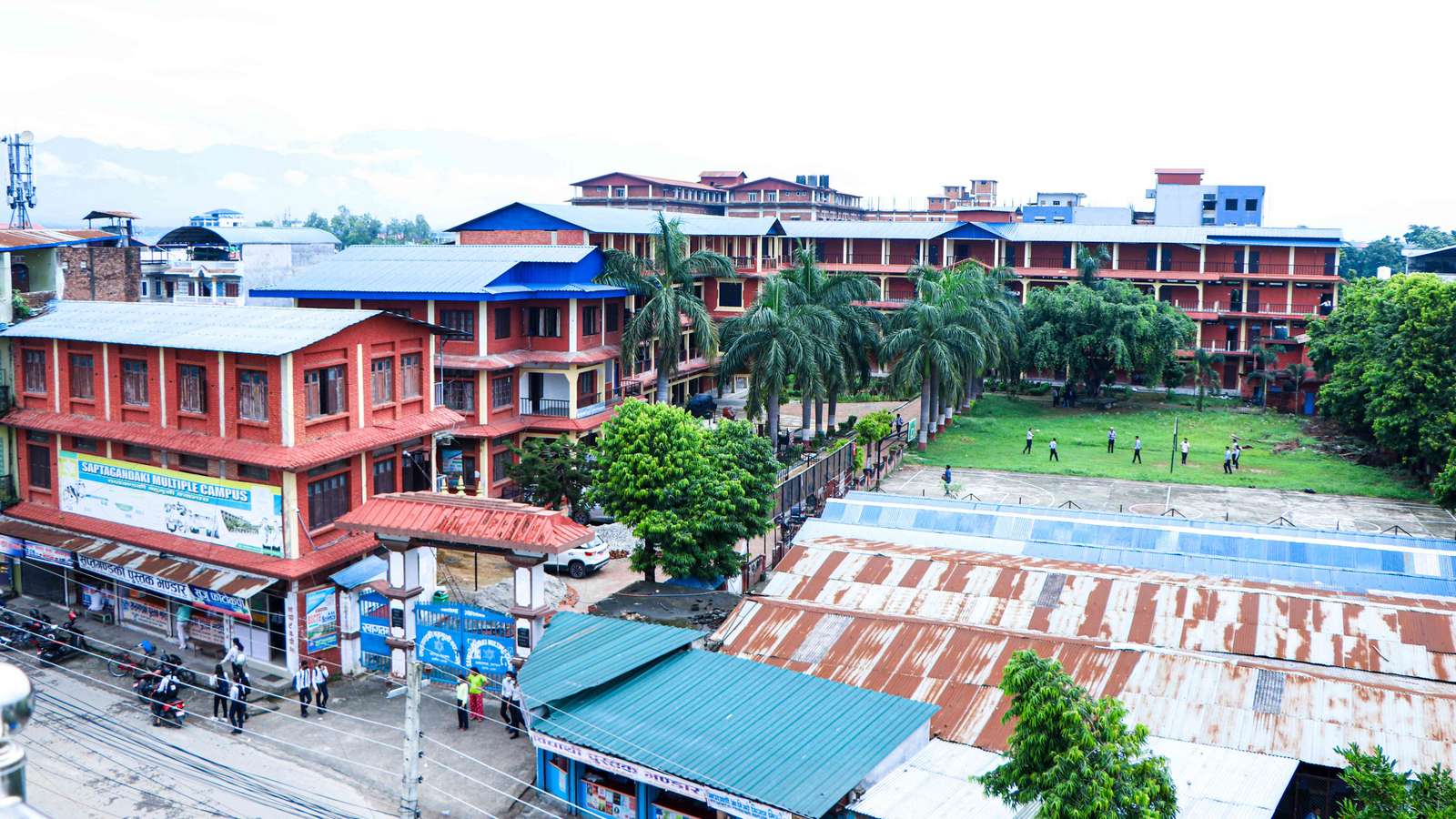
SMC was established in 1988 (2045 BS) to serve the higher education needs of Chitwan and surrounding areas. The campus grew through collective community involvement and continues to operate as a community campus affiliated with Tribhuvan University.
Its academic focus includes undergraduate and graduate programs in management, education, humanities and social sciences, and information technology, along with NEB 10+2 streams.
SMC operates academic programs in three shifts across the day. The campus occupies one bigha of land and has purchased an additional bigha for technical education.
To become an autonomous institution of higher education engaged in research and quality education.
To impart knowledge, skills, and attitudes to the youths for socio-economic transformation.
Strengthen academic standards through research-based teaching and learning practices
Build capable faculty, staff, and students
Offer in-demand academic programs at an affordable cost
Develop human resources aligned with social and national needs
SMC functions through a committee- and cell-based structure that supports academic quality, planning, campus services, and student support.
Campus Assembly
Campus Management Committee (CMC)
Construction Committee
Campus Service Commission
Academic and Administrative Quality Reform Cell
Campus Statute Review and Planning Cell
Internal Quality Assessment Committee (IQAC)
ECA/CCA Committee
Research Management Cell
Internal Audit Committee
Placement Cell
Health Service Committee
Library Committee
Budget Committee
Environmental/Social Security Safeguard Cell
EIMS Cell
Grievance Handling Committee
Campus Administrative Secretariat
Academic Administrative Secretariat
Assistant Campus Chief (Academic Administration)
Assistant Campus Chief (Staff Administration)
Programme Incharge → Department Head → Faculty Member
Planning and IT Division → Administration/Account/Examination/Library/Store Section Head → Employee
Chairman, Campus Management Committee: Dr. Ram Chandra Adhikari
Campus Chief: Khim Lal Dahal
SMC offers programs under NEB (10+2) and TU (Bachelor’s and Master’s). Program availability may vary by intake and academic calendar.
10+2 Science
10+2 Management
10+2 Humanities
Bachelor of Arts (BA)
Bachelor of Business Studies (BBS)
Bachelor of Education (B.Ed.)
BSc Environmental Science
Bachelor of Computer Application (BCA)
Bachelor of Business Administration (BBA)
Bachelor of Information Technology Management (BITM)
Bachelor in Information and Communication Technology Education (BICTE)
Master of Business Studies (MBS)
MA in Rural Development
Master of Education (M.Ed.)
Admissions follow eligibility requirements and selection procedures of NEB and Tribhuvan University, including entrance examinations where applicable and campus-level interviews.
Minimum D+ grade in each subject of Grade 11 and 12 with CGPA 2.0 or more, or
Minimum second division marks in 10+2, PCL, or equivalent in any discipline
NEB Grade 12 with at least 1.8 GPA or equivalent in the relevant discipline
NEB Grade 12 with at least 2.01 GPA or equivalent in the relevant discipline
NEB Grade 12 with at least 1.8 GPA (minimum D+ in each subject)
Entrance examination by the concerned Dean’s Office
Campus selection interview
Final decision based on merit list
NEB Grade 12 Science with at least 1.6 GPA (minimum D in each subject)
Entrance examination by the Dean’s Office of the Institute of Science and Technology
Department selection interview
Final decision based on merit list
Bachelor’s degree in the relevant discipline from Tribhuvan University
Applicants from other universities require equivalence from CDC, Tribhuvan University
Entrance examination by the concerned Dean’s Office
Final decision based on merit list
Teaching and evaluation follow the academic regulations of NEB and Tribhuvan University. Semester and annual systems apply depending on the program.
System: Semester
Total credits (4 years): 126
Computer-related credits: 96
Evaluation weight: 60% final exams; 40% internal exams and internal evaluation
BBA admissions include a written entrance test (CMAT) conducted by the Faculty of Management.
100 objective questions
Four sections: verbal ability, quantitative ability, logical reasoning, general awareness
Minimum 40% in CMAT to qualify for interview
Interview for shortlisted applicants
SMC maintains academic facilities aligned with its program areas, including library services, laboratories, and classroom infrastructure.
Mrs. Krishna Kumari Gurung Library: three-storey library facility
Collection includes course books, reference books, encyclopedias, newspapers, magazines, and journals
A separate e-library with e-resources adjoins the Master’s Degree library on the third floor
A dedicated mass communication lab equipped with a radio station and a television set for journalism practice
Computer laboratories for BCA, BITM, and M.Ed. Maths
40 computers connected to high-speed internet
Separate science labs for Physics, Chemistry, Biology, and Environmental Science
Spacious, well-ventilated classrooms with multimedia projectors
Blocks separated by faculties and levels
SMC supports student development through extracurricular participation and access to learning resources.
Regular extracurricular activities for intellectual and physical development
Participation in national and district level sports competitions, speech and quiz contests, and literary competitions
On-campus facilities include:
Volleyball court
Basketball court
Indoor table tennis court
The campus has a sustainability and safeguarding approach as follows:
building design considerations for climate conditions
safe drinking water and sanitation
waste management and e-waste handling
environmental screening for construction and compliance references to national guidelines
grievance redress mechanisms and staff training references
plantation or rooftop solar items mentioned as planned in the form narrative
Dr. Ram Chandra Adhikari, Chairman of the Campus Management Committee, welcomes students and families to SMC and acknowledges the community effort, academic staff, and administrative staff that have supported the campus since its establishment.
Khim Lal Dahal, Campus Chief, welcomes prospective students and recognizes the role of community contributors and campus staff in the campus’s growth and academic operations.
Community campus setting with TU affiliation
Programs across management, education, humanities and social sciences, and IT
Three-shift academic operation across the day
Library and e-library services
Computer labs, science labs, and mass communication lab
On-campus sports facilities and structured extracurricular activities
Applicants and families comparing options can assess SMC on factors that are as follow:
Program range and levels: NEB 10+2 plus TU-affiliated Bachelor’s and Master’s programs across management, education, humanities, and IT.
Study schedule: The campus states that it runs multiple shifts across the day.
Learning resources: Library plus e-library, computer labs, science labs, mass communication lab, and classrooms with multimedia support.
Student support systems recorded in institutional reporting: scholarships, counselling, training, and outreach counts recorded in the annual report form.
Governance and quality structures: committees and cells shown in the organogram and governance indicators listed in the annual report format.
Saptagandaki Multiple Campus (SMC) is a TU-affiliated community campus in Bharatpur Metropolitan Ward No. 10, Chitwan, established in 1988 (2045 BS). The campus offers NEB 10+2 streams and TU programs at Bachelor’s and Master’s levels, supported by academic facilities that include a multi-storey library with an e-library, computer and science laboratories, a mass communication lab, and classrooms equipped for multimedia teaching. Admissions follow NEB and TU eligibility requirements and selection processes, including entrance exams and merit-based decisions for applicable programs.
SMC is located in Bharatpur Metropolitan Ward No. 10, Chitwan, Bagmati Province, Nepal.
SMC is affiliated with Tribhuvan University (TU).
SMC offers NEB 10+2, Bachelor’s, and Master’s level programs.
SMC offers 10+2 Science, 10+2 Management, and 10+2 Humanities.
BCA requires minimum D+ in each subject of Grade 11 and 12 with CGPA 2.0 or more, or second division in 10+2/PCL/equivalent. Selection includes entrance examination and interview where applicable, followed by a merit list.
Yes. SMC has computer labs for BCA, BITM, and M.Ed. Maths, along with separate labs for Physics, Chemistry, Biology, and Environmental Science.
SMC has the three-storey Mrs. Krishna Kumari Gurung Library and a separate e-library with e-resources adjoining the Master’s Degree library on the third floor.
Contact Saptagandaki Multiple Campus's administrative offices for detailed information on the course, admissions, location, fees, scholarships, facilities, counseling, or eligibility.
Saptagandaki Multiple Campus
Email Address: saptagandaki@yahoo.com
Phone Number: +977-56-493754
Website: http://www.smc.edu.np
Location: Bharatpur, Chitwan, Nepal