Arunodaya College, Chitwan, located at Bharatpur Metropolitan City-6, Gitanagar, Chitwan, has been running bachelor-level classes in the Faculty of Management since 2058 BS (2001AD) and bachelor-level classes in the Faculty of Education since 2069 BS (2012/2013 AD) after receiving affiliation from Tribhuvan University (TU). The college has established itself as an institution that provides quality and life-relevant education in rural areas.
In the current context, while school-level education may be sufficient for character formation, quality higher education is essential for sustaining life in practical terms. As the global environment also recognizes that competitive higher-education-trained human resources are the basis for national development, I sincerely request you not to deprive your children of the positive impact of obtaining higher education through this college, which has been established through your aspirations, contributions, and needs.
A quality education can be achieved through an effective examination system, a stable academic calendar, adoption of the latest technology suited to changing contexts, effective teaching, students’ dedication and continuous hard work, effective management, and loving and appropriate parental care. I am confident that each stakeholder will play an important role from their respective positions. However, declining student attraction toward higher education, increased desire for foreign study, and the lack of employment certainty have emerged as key challenges.
| Item | Details |
|---|---|
| College Name | Arunodaya College |
| Location | Bharatpur Metropolitan City-6, Gitanagar, Chitwan (about 9 km southwest of Bharatpur) |
| Affiliation | Tribhuvan University (TU) |
| Bachelor Programs | Bachelor of Business Studies (BBS); Bachelor of Education (B.Ed) |
| Management Faculty Since | 2058 BS (2001 AD) |
| Education Faculty Since | 2069 BS (2012/2013 AD) |
| Own Premises Since | Bhadra 2075 BS (August–September 2018 AD) |
| Teaching & Staff | 16 total faculty and staff; 13 involved in teaching; all teaching staff have completed a master’s degree |
| Classroom Technology | 3 projectors; 1 smart board |
| ICT Grants and Equipment | NPR 500,000 (UGC) for computer laboratory; NPR 168,000 (Education Development Directorate, Bagmati Province) for smart board, laptops, printers, and a projector |
| Nearby Landmarks | About 20 meters from Area Police Office, Gitanagar; adjacent to Nepal Bank Limited, Gitanagar Branch; near Gitanagar market area |
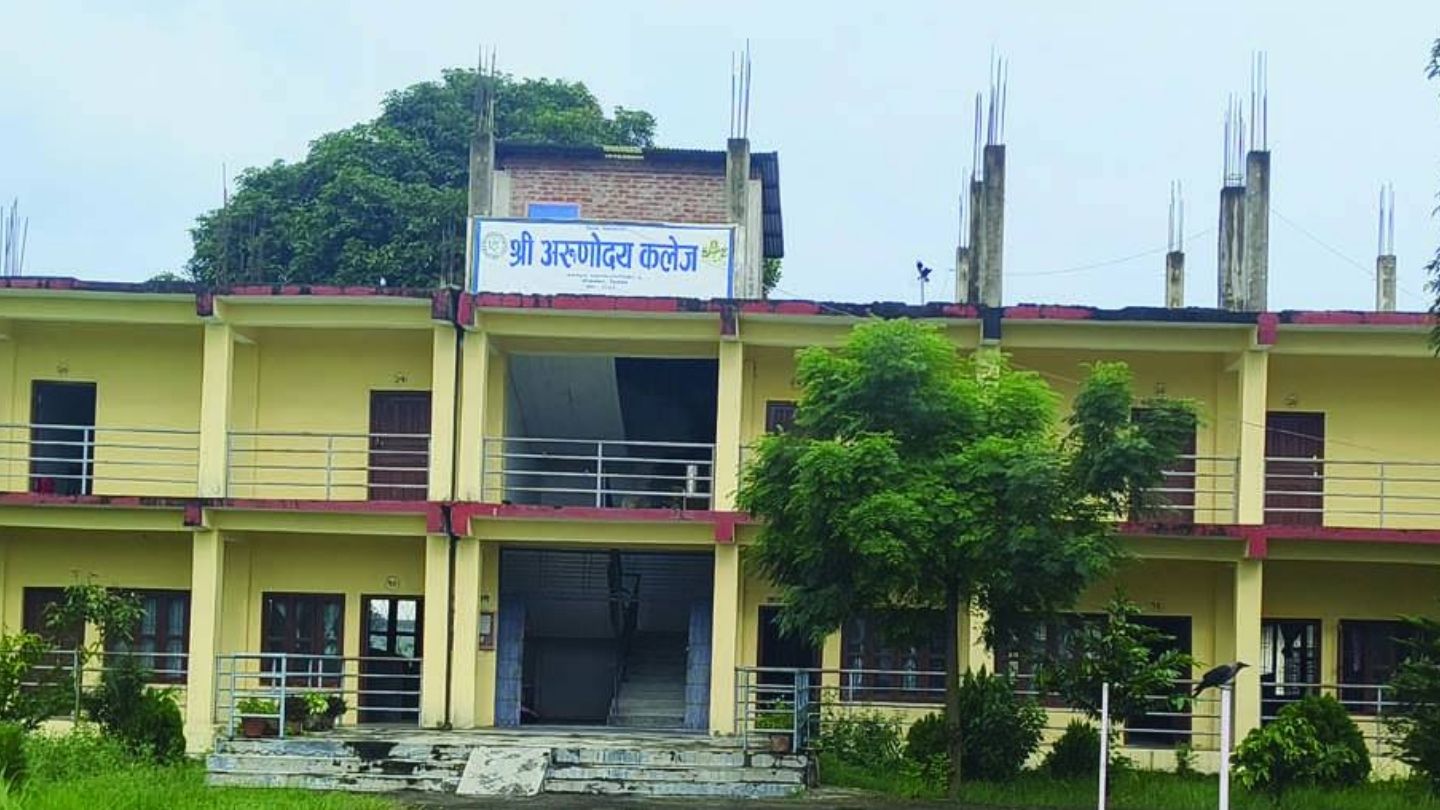
Arunodaya College, established in the former Gitanagar VDC (now Bharatpur Metropolitan City-6), is located about 9 km southwest of Bharatpur, the district headquarters of Chitwan. It is the main and only community-based higher education institution in this area, ensuring convenient and accessible access to higher education.
Geographically, the area is flat and advanced in agricultural production. It is also considered developed in terms of social awareness and education.
Although access to school-level education was widespread, the need to travel to the district headquarters for higher education had long prevented many students from starting or continuing bachelor-level study. Considering these realities, Arunodaya College was established in 2058 BS (2001/2002 AD) after continuous discussions among local intellectuals, social workers, senior political leaders, and stakeholders from various sectors, and after obtaining affiliation from TU.
Initially, bachelor-level classes were conducted under the Faculty of Management. Based on demand from parents and students, the college also obtained affiliation from the Faculty of Education in 2069 BS (2012/2013 AD) and began bachelor-level programs in Education.
Operated with active community participation and ownership, the college is committed to providing higher education at minimal fees to Dalit, Janajati, Adivasi, Sukumbasi, and economically disadvantaged students. Since its establishment, the college conducted morning classes within the premises of Arunodaya Secondary School. Later, using land received from the Khergairi Irrigation Project and support from the University Grants Commission (UGC), Nepal, various government bodies, and local organizations, the college constructed its own building and has been running regular academic programs from its own premises since Bhadra 2075 BS (August–September 2018 AD).
The college is located about 20 meters from the Area Police Office, Gitanagar, and adjacent to Nepal Bank Limited, Gitanagar Branch. As it is also close to the Gitanagar market area, the college is considered well-established in terms of academic environment, access, and infrastructure, including in comparison to colleges in urban areas.
To develop Arunodaya College into a nationally leading and well-recognized community-based educational institution in higher and technical education.
To transform society by producing technical and quality academic human resources needed by the nation and society, competitive in national and international markets, at an affordable fee.
To provide opportunities for higher education at the local level.
To support the production of capable intellectual human resources who are skilled, disciplined, and able to compete in a changing global environment.
To produce nationally competent human resources through quality academic activities.
To formulate necessary policies, programs, and strategies to improve academic results and provide quality education to students.
To increase access for students from deprived communities.
To increase employment opportunities for produced human resources.
As it operates in a rural area, regular teaching and learning are not affected by disruptions, and the college has been providing quality education for years. In the context of Chitwan, it has not only delivered strong results among community colleges, but has also been able to be listed among the top 10 community colleges nationwide.
Starting with the Faculty of Management and achieving good results, the college later obtained affiliation for the Faculty of Education in response to student demand and interest in other subjects. It continues academic operations by adding or adjusting subjects in higher education according to need.
Regular internal examinations, student awards, home visits, extracurricular activities, meetings with parents, and discussions are among the college’s key components, supporting quality education. Repeated monitoring by TU, along with faculty guidance, has kept the academic condition of the college effective.
With grant support from the UGC, a computer corridor has been developed and used effectively by integrating information technology into student-centered teaching and learning. The college also reports that grants received at different times from the UGC have helped motivate students through academic and extracurricular activities. Students who achieve the top position at the bachelor level are honored in the college’s annual program, which is intended to boost morale and support further academic achievement.
Because students often complete school education in village schools and seek subject-specific education in urban areas for higher education, it remains challenging to run all subjects in rural areas. Even so, enrollment can be considered satisfactory, as middle-class students living in rural areas face difficulties commuting daily to urban colleges, while the rural-based college provides education comparable in quality to that in urban settings.
Among the students currently studying at the college, the number of female students is relatively high. Although student attraction toward community colleges has decreased in recent years, student numbers at this college remain satisfactory due to the education provided. Active student participation in regular programs, minimal fees, local access, local professors, and quality education are described as key attractions.
With NPR 500,000 in grant support from the UGC, the college constructed a computer laboratory. At present, the laboratory has also received NPR 168,000 in grant support from the Education Development Directorate, Bagmati Province, through which the college purchased ICT materials including a smart board, laptops, printers, and a projector, and has been providing practical computer-related knowledge to students. It is expected that this will help students engage in skill-based work in various fields after completing bachelor-level education and also support postgraduate study.
After receiving affiliation from the TU Faculty of Management Dean’s Office in 2058 BS (2001/2002 AD), the college initially ran a 4-year bachelor-level program under the Faculty of Management. Later, after receiving affiliation from the Faculty of Education Dean’s Office in 2069 BS (2012/2013 AD), it ran a 4-year bachelor-level program under the Faculty of Education.
At present, in accordance with TU rules and procedures, the college regularly runs 4-year bachelor-level programs under the Faculty of Education and the Faculty of Management, including instruction in Nepali grammar subjects within both faculties. (Related program reference: Bachelor of Business Studies (BBS).)
Since 2058 BS (2001/2002 AD), classes were conducted in the morning within the premises of Arunodaya Secondary School. With grant support from the UGC, the college constructed a building on land under its ownership and has been conducting teaching and learning from its own premises since Bhadra 2075 BS (August–September 2018 AD).
All teaching faculty are reported to have expertise in their respective subjects. The college has a total of 16 faculty and staff members, of whom 13 are involved in teaching. All teaching staff have completed a master’s degree.
Even though it operates in a rural area, teaching and learning are conducted through appropriate use of necessary academic materials. To further strengthen teaching, the college purchased 3 projectors and 1 smart board and has been conducting classes effectively. From time to time, students are involved in educational tours and observation, field trips, and practice teaching as required by the affiliated curriculum. Details of the faculty and staff working at this college are presented below.
At different times, the college has received grant support from the UGC for construction and maintenance. It has also received support from Bharatpur Metropolitan City Office, the provincial government, Bagmati Province, the Ministry of Social Development, and the Parliamentarian Development Fund for physical infrastructure development. The primary source of grants for the college is the UGC, which remains the main source for infrastructure development.
For community colleges affiliated with TU, the UGC (Sanothimi, Bhaktapur) periodically calls for proposals to conduct academic and physical activities. The main source of academic support for the college is the UGC, including support for library books and for establishing computer laboratories. The college has submitted proposals at different times to purchase required textbooks and computer materials and has also received grants.
As the college is operated under full community ownership, there is active community participation. Students at the college represent a mix of different castes, languages, and religious-cultural backgrounds. A key strength of the college is that students from Adivasi Tharu community, Janajati, Dalit, Sukumbasi, and marginalized families can access higher education locally. Special scholarship programs targeted at such communities are described as a major attraction.
In addition, various supportive and extracurricular activities are regularly conducted for students’ intellectual, physical, mental, and social development. For the sustainable development of the college, a College Management Committee has been formed with representation from all communities, political parties, intellectuals, education supporters, and social workers, and the college operates under the policy guidance and leadership of that committee in its social activities.
From its establishment to the present, the college has regularly cooperated in social activities. The college’s involvement is presented in detail as follows:
Student involvement in environmental sanitation programs.
Involving B.Ed students in community health survey programs to promote reproductive health.
Involving students in research work on various health, population, and other social issues.
Exploring employment opportunities for quality human resources.
Providing funds for Gautam Buddha International Cricket Stadium.
Conducting blood donation programs with participation of the college U.R.E.S. to help prevent shortages of blood from time to time.
Social support for maintaining a peaceful academic environment.
Cooperation in environmental sanitation.
Donations from various individuals and institutions.
Establishing an endowment fund to provide scholarships for poor, disadvantaged, and meritorious students.
Increasing involvement of students, teachers, and staff in various social activities.
Holding interactions with the public to identify areas where the college can contribute to society.
Honoring contributors.
Holding regular meetings of stakeholders.
Conducting interactions to ensure active participation of neighbors in various college activities.
Arunodaya College was established to expand local access to TU-affiliated bachelor-level education in Gitanagar and surrounding communities of Chitwan. Since beginning Management programs in 2058 BS (2001AD) and Education programs in 2069 BS (2012/2013 AD), the college has operated through community ownership, affordable access, and structured academic support practices. With programs running from its own premises since Bhadra 2075 BS (August–September 2018 AD) and ICT-supported learning facilities developed through grant assistance, the college continues its role as a community-based center for bachelor-level study in the area.
Arunodaya College is located at Bharatpur Metropolitan City-6, Gitanagar, Chitwan, about 9 km southwest of Bharatpur. The campus is near the Area Police Office, Gitanagar and adjacent to Nepal Bank Limited, Gitanagar Branch.
Arunodaya College is affiliated with Tribhuvan University (TU).
The college offers Bachelor of Business Studies (BBS) under the Faculty of Management and Bachelor of Education (B.Ed) under the Faculty of Education. Both programs are four-year bachelor-level programs under TU.
Bachelor-level classes in the Faculty of Management have been running since 2058 BS (2001/2002 AD). Bachelor-level classes in the Faculty of Education have been running since 2069 BS (2012/2013 AD).
The college has been running regular academic programs from its own premises since Bhadra 2075 BS (August–September 2018 AD).
The college has 16 faculty and staff members, with 13 involved in teaching. All teaching staff have completed a master’s degree.
The college has a computer laboratory and ICT equipment developed through grant support, including a smart board, laptops, printers, and a projector, along with classroom projectors used for teaching.
Contact Arunodaya College's administrative office for detailed information on the course, admissions, location, fees, scholarships, facilities, counseling or eligibility.
Arunodaya College
Phone Number: +977-56-400301, +977-9855047207, +977-9845053916, +977-45047207
Location: Gitanagar, Chitwan, Nepal