Kathmandu College of Technology (KCT College) is an IT-focused higher education institution located in Lokanthali, Bhaktapur. The college is managed by the ISMT Group and positions itself as a learning space for students who want a structured route into computing and information technology (BCA and BSc CSIT programs).
Its academic direction is centered on Tribhuvan University (TU) programs, with an emphasis on developing capable graduates who can apply classroom learning to practical tasks and workplace expectations.
Location: Lokanthali, Bhaktapur
Management: ISMT Group
Academic base: TU-affiliated undergraduate programs in computing
Flagship focus areas: Computer Science, Information Technology, and Computer Applications
Program length: Four-year bachelor’s degrees
Student support: Scholarship schemes tied to defined eligibility and performance criteria
Learning emphasis: Theory-supported practical work, problem solving, communication, and critical thinking
KCT College currently highlights two principal undergraduate pathways under Tribhuvan University.
B.Sc. CSIT is a four-year TU program that combines core computer science subjects with information technology components.
The curriculum structure balances foundational theory with applied coursework, enabling students to study programming, data structures, algorithms, computer architecture, networks, databases, operating systems, cryptography, web technology, software engineering, and emerging electives offered by the university.
Students complete a total of 126 credit hours across eight semesters, including elective choices and an internship component in the later phase of the degree.
The program’s academic flow supports students who want to progress toward roles in software development, systems and network administration, information security, database roles, web technologies, analytics-related positions, and technical roles in both public and private sectors.
The career direction depends on individual skill-building during the degree and exposure to real projects and internships.
BCA is another four-year TU program offered by KCT College. Its focus is computer applications for business and service settings, where graduates are expected to understand software development, programming logic, database systems, networking basics, and the management context in which digital solutions operate.
The course structure includes subjects such as mathematics, programming, database management systems, software engineering, web technology, mobile programming, cloud computing, cyber law, and internship or project work across semesters. The program also offers elective choices like ERP, GIS, IT in banking, and domain-specific systems.
BCA is often suitable for students who want a clear application-oriented path into software development, web development, testing, IT support, and related roles. The program also supports graduates who plan to pursue further study in computing or management-computing intersections.
Admissions for TU-affiliated programs follow university requirements along with institutional procedures.
Applicants for B.Sc. CSIT are expected to meet TU’s eligibility rules.
+2 or equivalent in science with physics and mathematics (100 full marks each).
Minimum GPA of C or second division in each subject, based on the stated criteria.
A Level candidates need science background with physics and mathematics and minimum grade requirements as specified.
CTEVT diploma holders should have studied physics and mathematics with required marks and secure second division.
Students from foreign boards must obtain an equivalence certificate through the concerned authority.
All candidates must pass the TU entrance examination.
For BCA, the stated entry route includes:
Minimum D+ grades in both Grade 11 and 12 with CGPA 2.0 or above.
Alternative eligibility includes second division in 10+2, PCL, or equivalent.
Candidates awaiting results may apply with the requirement to submit passed certificates at admission time.
TU entrance examination is mandatory.
While the university sets core academic eligibility, students typically benefit from preparing:
Academic transcripts and certificates
Citizenship or required identity documents
TU entrance form and related records
Equivalence documents where applicable
A realistic study plan that considers the nature of computing degrees, time requirements, and skill practice outside class
KCT College emphasizes a learning approach that goes beyond lecture-only formats. The highlights practical exposure, real-world application, and the integration of soft skills and problem-solving frameworks alongside the standard TU syllabus.
This suggests a classroom culture where students are expected to engage with lab work, projects, and iterative practice rather than relying only on exam-focused study.
For IT education, this approach aligns with what students need in Nepal’s job market: the ability to translate concepts into functional solutions, communicate technical ideas, and work within teams.
The KCT provides a practical learning experience and emphasis supported by classroom and lab experiences. While detailed infrastructure lists are not specified in the shared text, the stated learning design implies access to relevant computing labs and structured spaces for applied coursework and project work.
In TU computing programs, access to functional labs, stable internet, and project-friendly learning settings often plays a meaningful role in student outcomes. Students evaluating KCT College may consider visiting the campus for a direct understanding of lab availability, class environment, and student support systems.
KCT College is located in Lokanthali, a growing educational and residential area of Bhaktapur that provides connectivity to Kathmandu’s broader learning and employment ecosystem.
A location like this can support student convenience for commuting, part-time learning opportunities, seminars, and exposure to tech communities operating in the valley.
The provided material does not outline formal ECA categories, events, or societies. Still, IT colleges in practice often encourage:
Coding and project showcases
Seminar participation
Hackathon-style problem-solving events
Skill workshops linked to web, mobile, networking, or data areas
Student-led peer learning sessions
KCT College lists scholarship options to support students who need financial help and to reward strong academic results.
There are two categories of Scholarship for the BSc CSIT program:
Eligibility: Students who studied from Class 8 to 10 in government schools
Coverage: 10% of the total intake
Purpose: To support students from public school backgrounds
Eligibility: Highest academic performance in each semester
Award pattern: One top-performing girl and one top-performing boy of the semester
Purpose: To encourage consistent academic performance
For BCA, scholarships are available under the college’s policies. Students should contact the admission office or follow official college notices for the current details and requirements.
The KCT focuses more on institutional direction, program emphasis, and student support frameworks than on year-by-year achievements.
The presence of TU-affiliated programs and multi-layer scholarship categories suggests a structured institutional model aligned with mainstream undergraduate IT education in Nepal.
Readers seeking detailed milestones such as batches graduated, internship partnerships, student awards, or research outputs may look for updated institutional reports or official announcements from the college.
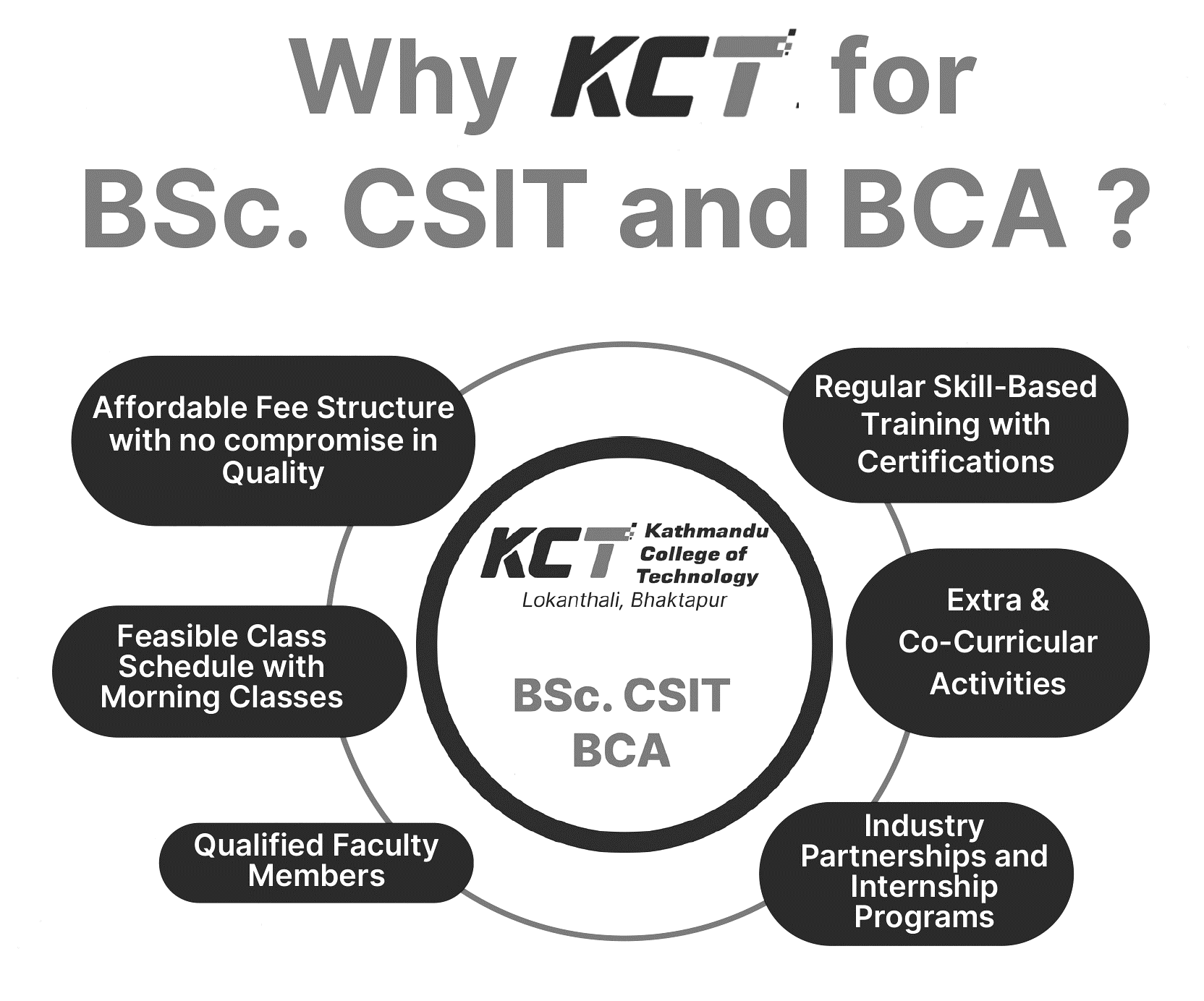
Based on the provided information, students may look at KCT College for these reasons:
TU-affiliated B.Sc. CSIT and BCA pathways in a convenient Bhaktapur location
A learning emphasis that values application alongside theory
Attention to communication, critical thinking, and problem-solving as part of overall student development
Scholarship structures that support government school backgrounds and reward academic performance
The backing of an established management group (ISMT Group)
The principal’s note presented the college’s intent to build a foundation for computing and IT learning through classroom and lab-based exposure, supported by experienced faculty and a management team. It also highlights mentoring, independent projects, and student preparation for real-world challenges as part of the academic culture. The message is attributed to Mr. Dhruba Babu Joshi, College Principal.
Kathmandu College of Technology (KCT College) in Lokanthali, Bhaktapur offers TU-affiliated B.Sc. CSIT and BCA programs for students who want to study computer science, information technology, and application-focused computing through four-year bachelor’s degrees.
KCT College is located in Lokanthali, Bhaktapur.
The college offers TU-affiliated undergraduate programs, including B.Sc. CSIT and BCA.
Both programs are four-year bachelor’s degrees.
Yes. The candidates must pass the entrance exams conducted by Tribhuvan University for both B.Sc. CSIT and BCA.
The Government School Scholarships covering 10% of intake and Semester Topper Scholarships for top-performing girl and boy each semester. Scholarship coverage may extend up to full tuition based on criteria.
Yes. Scholarships for BCA are available according to the college’s policies, and students are advised to consult the admission office for details.
Contact Kathmandu College of Technology's administrative office for detailed information on the course, admissions, location, fees, scholarships, facilities, counseling, or eligibility.