Ten Plus Two (+2) Management at Gyankunj College Banepa is offered at the higher secondary level (Class 11 and Class 12) under NEB affiliation and follows an annual examination system. The course is positioned to build a foundation in key functional areas of management and support progression to undergraduate study in management-related fields.
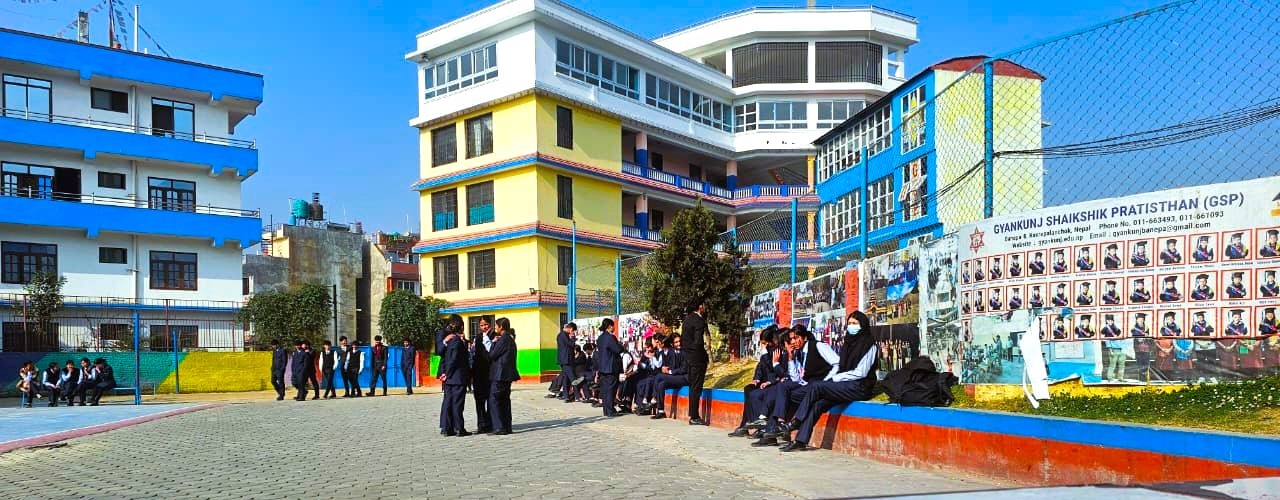
The +2 Management program is described as providing theoretical and practical knowledge in areas connected to business management and business administration. The stated objective is to impart fundamental knowledge in basic areas of management so it serves as a stepping stone for higher-level management study, introducing concepts and elementary skills across functional areas such as general management, accountancy, finance, office practices, and marketing.
A minimum average Grade Point (GPA) of 1.6 in the Secondary Education Examination (SEE) is stated as the eligibility threshold for Grade 11 enrollment. The college’s Class 11 and 12 programs follow NEB rules, guidelines, and the NEB annual calendar for admission processes, curriculum, annual examinations, and results.
The curriculum section notes an updated Class 11 and 12 curriculum approach and presents compulsory and optional subjects with subject codes.
| Class | Subjects (with code) |
|---|---|
| Class 11 | Nepali (Nep. 001); English (Eng. 003); Social Studies and Life Skill (Sol. 005) or Mathematics (Mat. 007) |
| Class 12 | Nepali (Nep. 002); English (Eng. 004); Social Studies and Life Skill (Sol. 006) or Mathematics (Mat. 008) |
Optional subjects are organized across four option groups (Option I–IV) for both Class 11 and Class 12, with multiple subject choices within each group. The optional lists include management-related subjects such as Accounting, Economics, Business Studies, Marketing, Finance, Business Mathematics, and Tourism and Mountaineering Studies, alongside a wider range of other subjects presented in the curriculum options.
The program states that students completing this level can undertake junior-level management activities. It also notes that, after completing +2 in management, students may access starting-level roles in banking institutions or administrative posts in private or public institutions, with training potentially needed depending on the job.
For further study, the program notes progression to bachelor-level options in the management stream, including pathways such as BBA, BBS, BHM, BTTM, and related programs.
Gyankunj College Banepa describes teaching methods that include lectures and tutorials alongside project work, group discussion and peer review, field visits, tours, presentations, and multimedia-supported classes. The college also lists facilities and support services such as a library, computer lab, multimedia support, counseling, scholarships, sports and recreational facilities, and ECA activities.
College: Gyankunj College Banepa
Location: Banepa-8, Kavre, Bagmati Province, Nepal
Email: gyankunjbanepa@gmail.com
Phone: +977-11-663493, +977-11-661093
Website: http://gyankunj.edu.np
It is offered in Class 11 and Class 12 and follows an annual examination system under NEB affiliation.
A minimum average GPA of 1.6 in SEE is stated as the eligibility threshold for Grade 11.
Both classes include Nepali and English, plus Social Studies and Life Skill or Mathematics, with separate subject codes for each class.
Optional subjects are presented in option groups (Option I–IV) for both Class 11 and Class 12, with multiple choices in each group.
The options list includes subjects such as Accounting, Economics, Business Studies, Marketing, Finance, and Business Mathematics, among others.
The program notes that students completing this level can undertake junior-level management activities.
Progression to bachelor-level management programs is noted, including options such as BBA, BBS, BHM, and BTTM.