




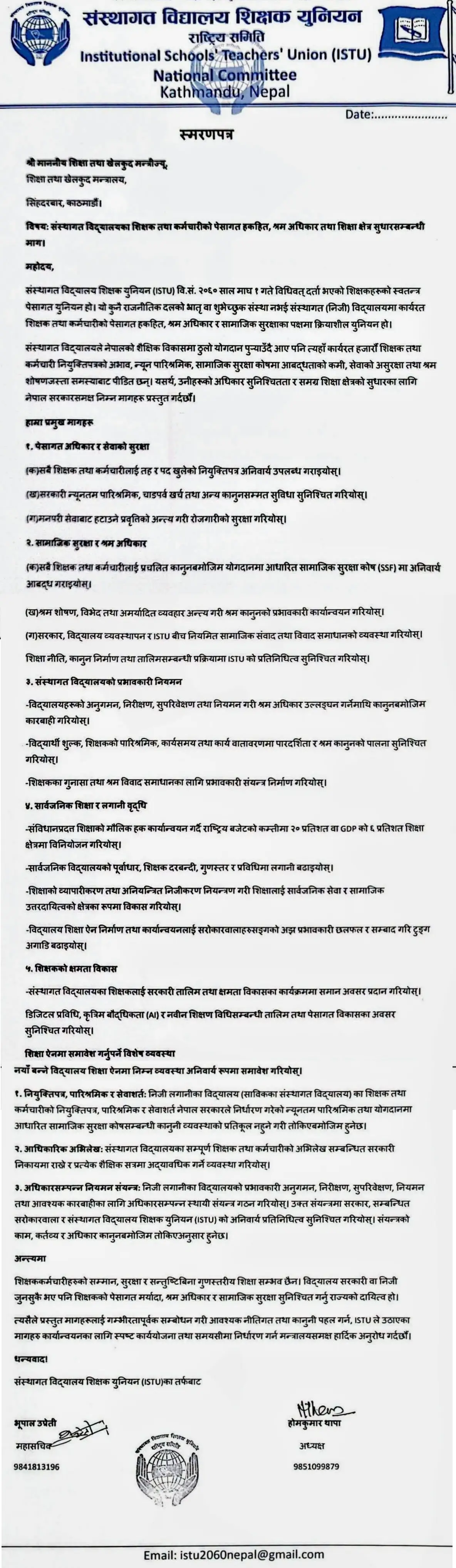
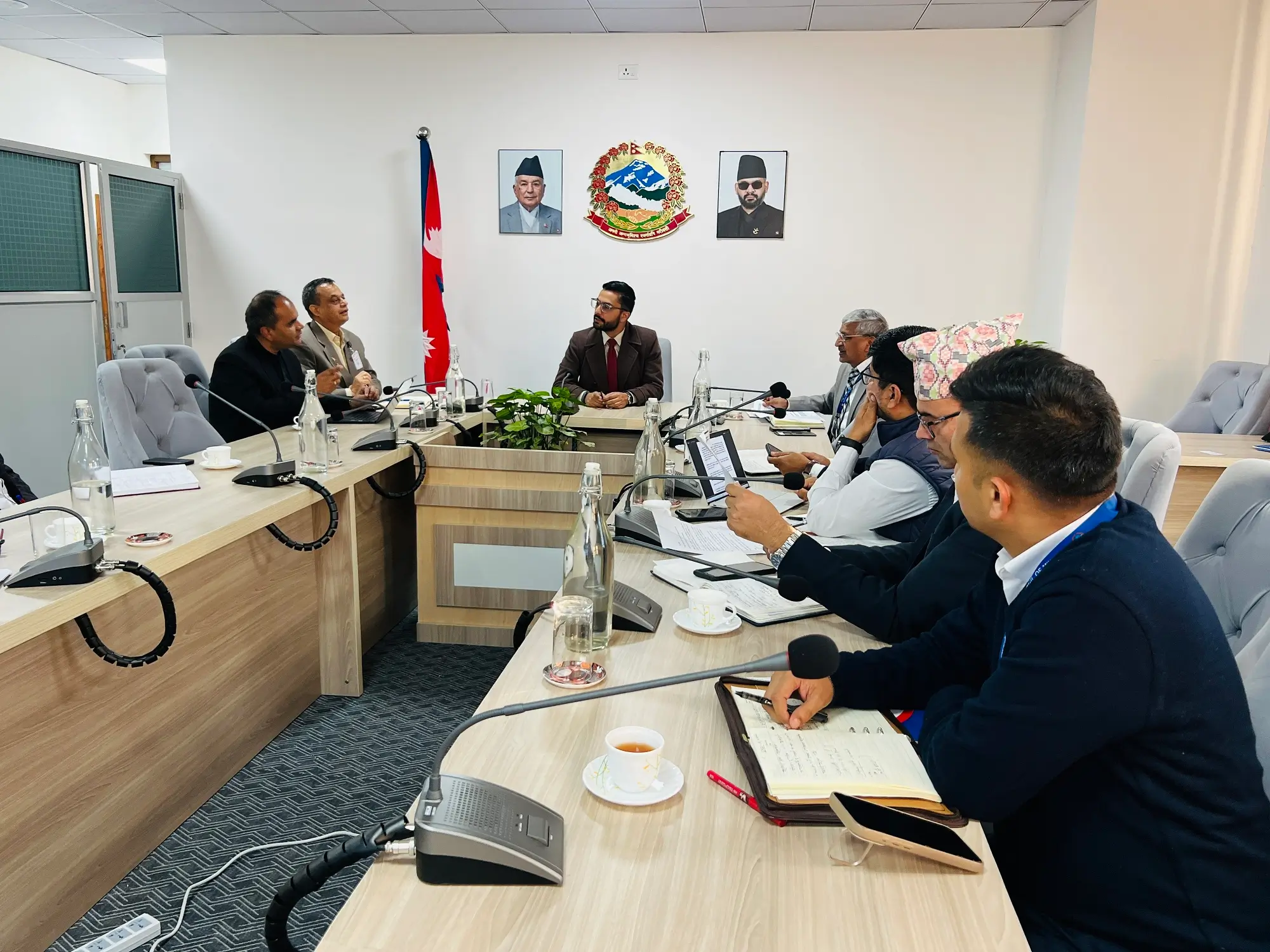
The National Committee of the Institutional Schools' Teachers' Union (ISTU) has submitted a memorandum to the Minister of Education and Sports, Singha Durbar, Kathmandu, outlining various demands concerning the professional rights, labour rights, and welfare of teachers and employees working in institutional schools, as well as reforms in the education sector.
The memorandum, signed by President Hom Kumar Thapa and General Secretary Bhupal Upreti, states that ISTU has been working to protect the rights and social security of teachers and employees of institutional (private) schools as an independent professional union formally registered on Magh 1, 2060 BS.
Although institutional schools have contributed to Nepal's educational development, the union states that thousands of teachers and employees working in these schools continue to face problems such as the absence of appointment letters, low remuneration, inadequate enrolment in the Social Security Fund, job insecurity, and labour exploitation.
Major Demands of the Union
The memorandum presents the following demands under five major headings:
1. Professional Rights and Job Security
-
Make it mandatory to provide appointment letters specifying the level and position of all teachers and employees.
-
Ensure government-prescribed minimum remuneration, festival allowances, and other legally entitled benefits.
-
End arbitrary dismissal from employment and ensure job security.
2. Social Security and Labour Rights
-
Ensure mandatory enrolment of all teachers and employees in the contribution-based Social Security Fund (SSF) in accordance with prevailing laws.
-
End labour exploitation, discrimination, and degrading treatment, and ensure effective implementation of labour laws.
-
Establish regular social dialogue and dispute resolution arrangements among the government, school management, and ISTU.
-
Ensure ISTU representation in processes related to education policy, legislation, and training.
3. Effective Regulation of Institutional Schools
-
Conduct monitoring, inspection, supervision, and regulation of schools and take legal action against those violating labour rights.
-
Ensure transparency in student fees, teachers' remuneration, working hours, and working conditions, along with compliance with labour laws.
-
Establish an effective mechanism to address teachers' grievances and resolve labour disputes.
4. Public Education and Increased Investment
-
Implement the constitutional fundamental right to education and allocate at least 20% of the national budget or 6% of GDP to the education sector.
-
Increase investment in public school infrastructure, teacher positions, educational quality, and technology.
-
Control the commercialization of education and unregulated privatization, and develop education as a public service and an area of social responsibility.
-
Advance the formulation and implementation of the School Education Act through effective consultation and dialogue with stakeholders.
5. Teacher Capacity Development
-
Provide teachers working in institutional schools with equal opportunities to participate in government training and capacity development programs.
-
Ensure training and professional development opportunities related to digital technology, artificial intelligence (AI), and new teaching methods.
Special Provisions Requested for the New School Education Act
The union has demanded the mandatory inclusion of the following three provisions in the proposed School Education Act:
1. Appointment Letters, Remuneration and Service Conditions
The appointment letters, remuneration, and service conditions of teachers and employees working in privately funded schools (formerly institutional schools) shall be as prescribed, without contravening the minimum remuneration determined by the Government of Nepal or the legal provisions concerning the contribution-based Social Security Fund.
2. Official Records
Records of all teachers and employees working in institutional schools shall be maintained by the concerned government authority and updated during each academic session.
3. Empowered Regulatory Mechanism
An empowered permanent mechanism shall be established for effective monitoring, inspection, supervision, regulation, and necessary action concerning privately funded schools.
Mandatory representation of the government, relevant stakeholders, and the Institutional Schools' Teachers' Union (ISTU) shall be ensured within this mechanism.
The functions, duties, and powers of the mechanism shall be as prescribed by law.
Request for Policy and Legal Action
Stating that ensuring the professional dignity, labour rights, and social security of teachers working in both government and private schools is the responsibility of the state, ISTU has requested the ministry to undertake the necessary policy and legal initiatives to address its demands.
The union has also requested the establishment of a clear action plan and implementation timeline.
Contact Details
The memorandum includes the following contact details:
-
Organization: Institutional Schools' Teachers' Union (ISTU)
-
Email: istu2060nepal@gmail.com
-
President: 9851099879
-
General Secretary: 9841813196



Comments 0
No comments yet. Be the first to start the conversation.