



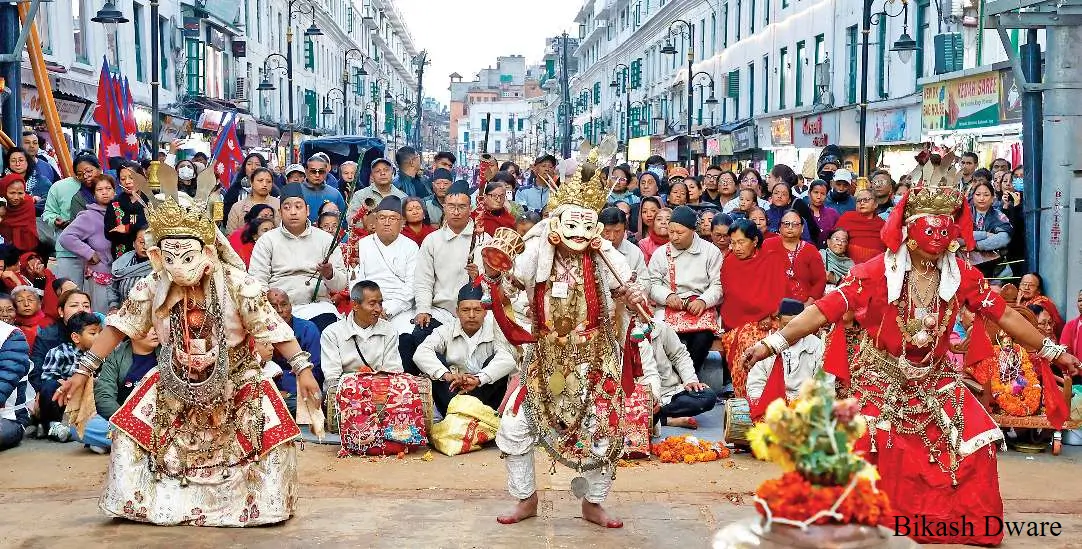
Kathmandu – The 12-year Naradevi Shwetakali (Ngatbhulu Ajima) Devi dance, an indigenous religious and cultural tradition of the Newar community passed down through generations, has brought a festive atmosphere to the historic settlements of the Kathmandu Valley.
As part of this special Devi dance, which began on Mangsir 9, performances have been taking place at various historical and religious sites across the valley.
The dance incorporates Tantric rituals, traditional musical instruments, and masks representing various gods and goddesses. As part of the current series of performances, the dance was presented at Indra Chowk Dabali in Kathmandu on Mangsir 9 and 10, 2083 BS.
The final stage of the dance has been scheduled at Nasal Chowk Dabali in Hanuman Dhoka Palace on Mangsir 11 and 12, 2083 BS. According to the committee, the 12-year Devi dance is scheduled to conclude ceremonially at Nasal Chowk on Mangsir 12, following the tradition that the festival must be concluded by the head of state.
During the latest cycle of the 12-year Devi dance, initiated in 2078 BS, performances have already been held at Naradevi Dabali, Taleju Bhawani, Kumari Ghar, and the platforms in front of Shwet Bhairav and Kal Bhairav within the Hanuman Dhoka Palace area, as well as at historic palace squares in Lalitpur, Kirtipur, Banepa, and Bhaktapur.
Historical Background and Oral Traditions
The Newar community has traditionally worshipped Naradevi as Ngatbhulu Ajima (Shwetakali).
According to historical beliefs, Nepali genealogical chronicles, and oral traditions, King Gunakamadeva is believed to have established Naradevi Shwetakali at the center of Kantipur during the latter part of the Licchavi period while expanding the city into the shape of a sword.
Oral traditions suggest that the practice of performing dances representing gods and goddesses while wearing masks began during the reign of King Amar Malla.
Another account holds that Lambakarna Bhatta, the Tantric guru of King Shiva Singh Malla, later systematized the tradition of performing secret Tantric dances dedicated to the goddess in the Naradevi area.
Tantric Rituals and Significance of the 12-Year Festival
According to Ravi Maharjan, a member of the Naradevi Shri Shwetakali Conservation and Management Society who serves as Ganesh among the ritual deity performers, the dance is associated with Tantric spiritual practices and goddess worship.
Beyond religious observances, the tradition is also associated with prayers for protection from misfortune, peace, and prosperity in society.
The dance performed annually during Paha Charhe generally represents 12 gods and goddesses. However, Maharjan explained that the special festival held once every 12 years involves additional deity performers, religious rituals such as Kshama Puja and Kalash Sadhana, and dance performances at various historical and religious sites across the valley.
“The religious belief that the divine power of the goddess descends before the commencement of the 12-year Devi dance is a distinctive feature of this festival,” Maharjan said.
He explained that, according to tradition, once signs of the descent of the goddess's divine power are received, the leaders and gurus of the dance guthi perform special Tantric worship and complete Swasti Shanti rituals. Only after these rituals is the 12-year festival formally initiated.
According to records associated with the guthi, the 12-year Devi dance was conducted according to traditional rituals until 2036 BS.
After the traditional process could not continue for an extended period, the dance was revived in 2066 BS through an extensive Kshama Puja ceremony to preserve this religious and cultural heritage. That festival formally concluded in 2074 BS.
Guthi Structure and Community Participation
Another distinctive feature of the Naradevi dance guthi is the joint participation of the Jyapu (Maharjan) and Udas (Tuladhar) communities.
The guthi comprises 64 members with designated responsibilities, including 47 members from the Jyapu community and 17 from the Udas community.
The shared responsibilities and active participation of both communities have helped sustain this tradition across generations.
Combining religious rituals, indigenous musical instruments, traditional dance, and community participation, the Naradevi Devi dance represents an important example of the Kathmandu Valley's intangible cultural heritage.
Amid changing lifestyles and social circumstances, preserving such traditions and passing them on to younger generations remains necessary.
Dance Expenses and Expectations for Heritage Conservation
Given the difficulties involved in organizing the dance, government support is being sought to cover the expenses associated with preserving the tradition.
According to the committee, organizing the dance on one occasion costs between Rs. 2 million and Rs. 2.2 million (20–22 lakh).
A committee member stated that Kathmandu Metropolitan City provided financial assistance of Rs. 1 million (10 lakh) to organize the dance this year and stressed the need to preserve the tradition.

Comments 0
No comments yet. Be the first to start the conversation.