




Kathmandu — The Private & Boarding Schools' Organization Nepal (PABSON) has expressed serious concern over what it describes as baseless, insulting, and inappropriate statements recently circulated on social media targeting private schools, school operators, and the organization itself.
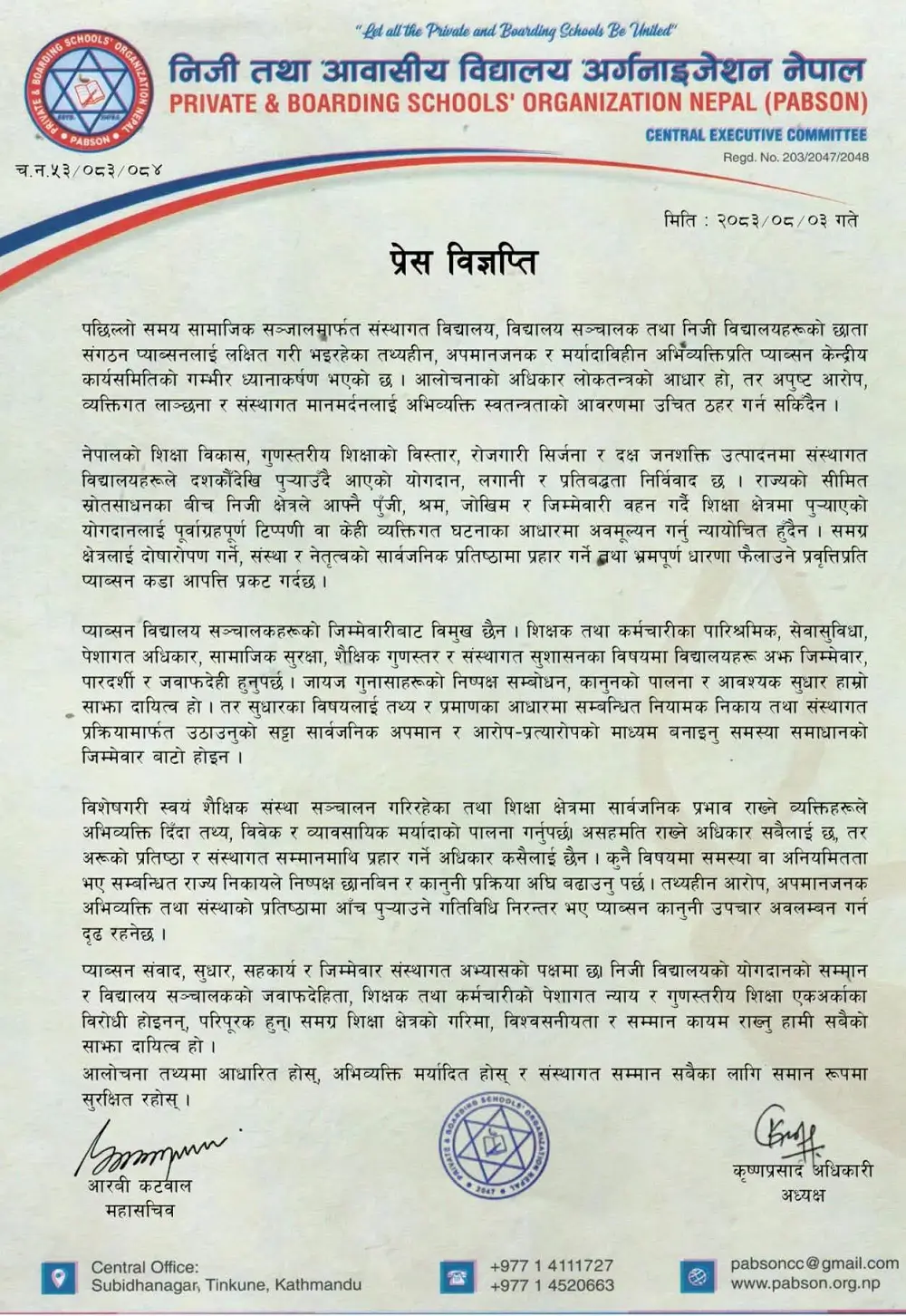
In a press statement (Dispatch No. 53/083/084) issued on Mangsir 3, 2083 (2083/08/03), PABSON Central Executive Committee President Krishna Prasad Adhikari and General Secretary RB Katwal stated that while the right to criticism is a foundation of democracy, unverified allegations, personal attacks, and attempts to damage institutional reputations cannot be justified under the protection of freedom of expression.
PABSON claimed that the contributions, investments, and commitments made by private schools over several decades toward Nepal's educational development, the expansion of quality education, employment generation, and the production of skilled human resources are beyond dispute.
The organization argued that private schools have contributed to the education sector by investing their own capital, labor, and resources while assuming financial risks and responsibilities amid the state's limited resources.
According to PABSON, it would be unfair to undermine these contributions through prejudiced comments or by generalizing a few individual incidents. The organization strongly objected to what it described as attempts to blame the entire private education sector, damage the public reputation of institutions and their leadership, and spread misleading perceptions.
PABSON also clarified that it does not seek to absolve school operators of their responsibilities. The statement acknowledged that schools must become more responsible, transparent, and accountable regarding teachers' and employees' salaries, service benefits, professional rights, social security, educational quality, and institutional governance.
The organization emphasized that the fair resolution of legitimate grievances, compliance with existing laws, and necessary institutional reforms are shared responsibilities. However, it argued that concerns requiring improvement should be raised through the relevant regulatory authorities and established institutional procedures, supported by facts and evidence, rather than through public humiliation and exchanges of accusations.
The statement particularly urged individuals who operate educational institutions themselves or hold public influence in the education sector to exercise factual accuracy, sound judgment, and professional integrity when making public statements.
PABSON maintained that everyone has the right to express disagreement, but that right does not extend to damaging the reputation and institutional dignity of others.
It further stated that if problems or irregularities arise, the relevant government authorities should conduct impartial investigations and initiate appropriate legal procedures.
PABSON warned that it would pursue legal remedies if what it considers baseless allegations, insulting statements, and activities damaging the organization's reputation continue.
Reaffirming its commitment to dialogue, reform, cooperation, and responsible institutional practices, PABSON stated that recognizing the contributions of private schools, ensuring the accountability of school operators, protecting the professional rights and fair treatment of teachers and employees, and maintaining quality education are complementary responsibilities.
The organization concluded that preserving the dignity, credibility, and reputation of the entire education sector is a shared responsibility.
It emphasized that criticism should be based on facts, public expressions should remain respectful, and institutional dignity should receive equal protection for everyone.
Published Date: Mangsir 3, 2083 (2083/08/03)




Comments 0
No comments yet. Be the first to start the conversation.