




Table of Content
- BBA Admission in Nepal: Eligibility, Entrance Exams, Fees, Seats, Scholarships, and Process
- Quick Facts About BBA in Nepal
- What Is BBA?
- Who Should Study BBA?
- BBA Admission in Nepal: How the System Works
- University-Wise BBA Admission in Nepal
- BBA Eligibility in Nepal
- BBA Entrance Exams in Nepal
- Step-by-Step BBA Admission Process
- Documents Required for BBA Admission
- BBA Seats, Quota, and Reservation
- BBA Fee Structure in Nepal
- BBA Scholarships and Financial Aid
- BBA Curriculum, Internship, and Skills
- How to Choose the Right BBA College
- BBA vs BBS vs BBM vs BITM
- How to Prepare for BBA Entrance in Nepal
- Common Mistakes Students Should Avoid
- Career Scope After BBA
- Before Taking Admission, Verify These Details
- Conclusion
BBA Admission in Nepal: Eligibility, Entrance Exams, Fees, Seats, Scholarships, and Process
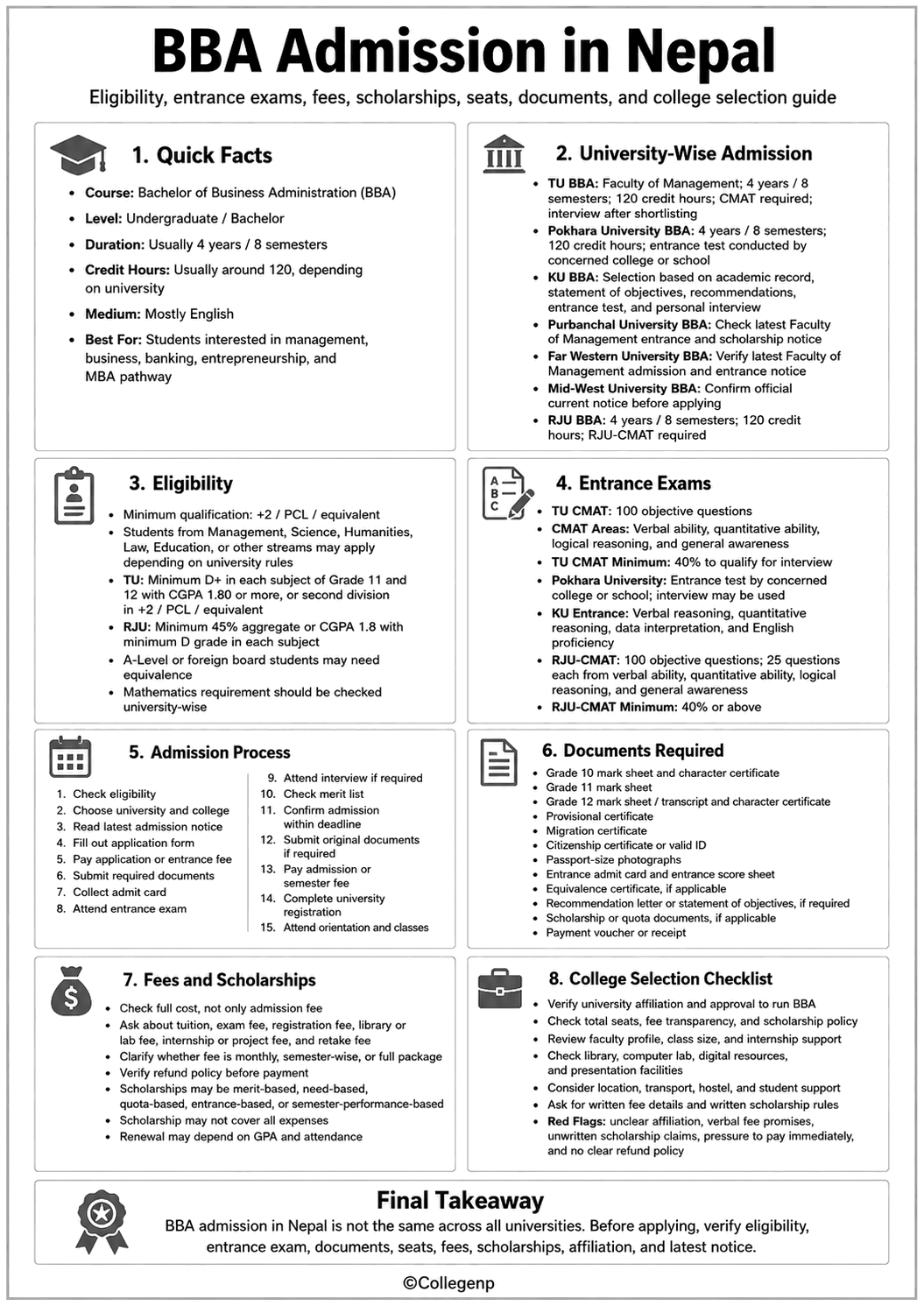
BBA admission in Nepal is a university-specific process, not one common national admission system. Students need to check the eligibility rule, entrance exam, college affiliation, admission deadline, seat policy, fee structure, scholarship terms, and required documents for the university or college they plan to apply to.
BBA stands for Bachelor of Business Administration. It is a bachelor-level management degree focused on business administration, management, finance, marketing, human resources, entrepreneurship, communication, accounting, economics, business law, information systems, and organizational decision-making. In Nepal, BBA is commonly offered as a four-year semester-based program, though credit hours, admission rules, and assessment models vary by university.
The main admission challenge is that different universities use different selection systems. Tribhuvan University uses the Central Management Admission Test (CMAT) through the Faculty of Management. Pokhara University requires an entrance test conducted by the concerned college or school. Kathmandu University School of Management uses academic records, statement of objectives, recommendations, written entrance test, and personal interview. Rajarshi Janak University uses RJU-CMAT. This article is for a student-parent admission decision guide rather than a normal course summary.
Summary
BBA admission in Nepal depends on the university. TU uses CMAT, Pokhara University uses a college or school entrance test, KU School of Management uses academic records, written test, statement, recommendations, and interview, while RJU uses RJU-CMAT. Students should verify current eligibility, entrance date, documents, total fee, seats, quota, scholarship rules, refund policy, and affiliation before confirming admission.
Key Takeaways
-
BBA admission rules differ by university and college.
-
TU BBA requires CMAT and interview.
-
Pokhara University BBA entrance is handled by the concerned college or school.
-
KU BBA admission includes written test, interview, academic record, statement, and recommendations.
-
RJU BBA admission uses RJU-CMAT.
-
Fee, seats, quota, and scholarship details should be verified from current notices.
-
Foreign-affiliated BBA programs need extra recognition and approval checks.
Quick Facts About BBA in Nepal
BBA in Nepal is usually a four-year undergraduate management degree. It is suitable for students who want structured business education with practical assignments, presentations, projects, and internship exposure.
| Topic | What Students Should Know |
|---|---|
| Course Name | Bachelor of Business Administration |
| Level | Undergraduate / Bachelor |
| Duration | Usually 4 years / 8 semesters |
| Credit Hours | Often around 120 credits, but varies by university |
| Eligibility | Usually +2 / PCL / equivalent with university-specific grade criteria |
| Entrance Exam | CMAT, college entrance, university entrance, interview, or RJU-CMAT |
| Medium | Mostly English |
| Admission Basis | Entrance score, academic record, interview, merit list, quota rules |
| Major Areas | Management, finance, marketing, HR, accounting, economics, business law, IT |
| Internship | Usually required in later or final semester |
| Best For | Students interested in management, business, entrepreneurship, banking, corporate careers, and MBA pathway |
 What Is BBA?
BBA is a full undergraduate degree in business administration. It is different from a short certificate because it includes multi-semester coursework, university examinations, internal assessment, practical assignments, projects, and often internship.
In a BBA program, students study business and management from several angles. Common subjects include principles of management, accounting, economics, business mathematics, statistics, communication, organizational behavior, marketing, finance, human resource management, business law, entrepreneurship, research methods, strategic management, and management information systems.
Pokhara University’s official BBA page says its BBA curriculum includes foundation courses, core courses, concentration courses, elective courses, project work, and internship. It also states that students need to complete 120 credit hours of coursework, project work, and internship for graduation.
Who Should Study BBA?
BBA is suitable for students who want to study business in a structured semester system. It fits students who are comfortable with presentations, assignments, group work, reading business cases, numerical reasoning, writing reports, and learning how organizations make decisions.
BBA may suit students interested in banking, finance, marketing, sales, HR, operations, business development, entrepreneurship, nonprofit administration, and MBA preparation. It can also help students who want a broader business foundation before choosing a specialization.
BBA may not suit students who want a low-assessment course, avoid English communication, dislike numerical reasoning, or prefer a broad annual-system management program with lower admission pressure. Those students should compare BBA with BBS, BBM, BITM, BBA-F, or other business-related degrees before applying.
BBA Admission in Nepal: How the System Works
BBA admission in Nepal works through separate university and college rules. Students should not assume that one university’s entrance format, GPA rule, or scholarship policy applies to all BBA programs.
For example, TU BBA and RJU BBA both use management admission tests with objective questions, but they are not the same exam. Pokhara University’s BBA entrance is conducted by the concerned college or school. KU School of Management uses a broader selection process that includes academic record, statement, recommendations, entrance score, and interview.
This means students should start with three checks: university, college, and intake notice. The university confirms academic rules, the college confirms application handling, and the intake notice confirms dates, forms, fees, seats, and documents for the admission cycle.
University-Wise BBA Admission in Nepal
University-wise checking is the most important part of BBA admission in Nepal. Each university may use a different entrance exam, minimum grade rule, assessment model, and document process.
Tribhuvan University BBA
Tribhuvan University BBA is offered under the Faculty of Management. TU’s BBA curriculum states that candidates must have completed twelve-year schooling or equivalent recognized by TU, with minimum D+ in each subject of Grade 11 and 12 and CGPA 1.80 or more, or at least second division in 10+2, PCL, or equivalent.
TU uses the Central Management Admission Test (CMAT). The curriculum states that CMAT includes verbal ability, quantitative ability, logical reasoning, and general awareness. It has 100 objective questions, with 25 questions from each section, and students must secure at least 40% in CMAT to qualify for interview. Shortlisted applicants are interviewed and selected for admission.
TU’s BBA program is run through the semester system. The regular program is completed in eight semesters, and the degree requires 120 credit hours. TU also states that students must attend at least 80% of required classes and activities to qualify for semester examination.
Pokhara University BBA
Pokhara University BBA is a four-year, eight-semester program. The official BBA page states that a student needs to complete 120 credit hours of coursework, project work, and internship for graduation.
For admission, Pokhara University requires Intermediate, Higher Secondary level, PCL, or equivalent recognized by the university. The student must also pass the entrance test conducted by the concerned college. The college scrutinizes applications, informs eligible candidates about the entrance test date and time, and may interview candidates for final selection.
Pokhara University also states that students are normally admitted in the Fall Semester, that minimum attendance is 80% of classes held, and that internal and external evaluations are both used.
Kathmandu University BBA
Kathmandu University School of Management offers BBA Emphasis and BBA Honours routes. KU’s central program page states that BBA Emphasis requires 50 courses equivalent to 130 credits, while BBA Honours requires 54 courses equivalent to 142 credits, with higher CGPA requirements for the honours route.
KUSOM’s admission page states that admission is based on academic records, statement of objectives, recommendations, entrance test scores, and personal interview. The entrance test assesses verbal reasoning, quantitative reasoning, data interpretation, and English proficiency.
KUSOM also states that eligibility criteria may change during admission time. Students should treat the current KUSOM notice as the source for eligibility, dates, fees, application fee, and document requirements.
Purbanchal University BBA
Purbanchal University and Pokhara University are different universities, even though both may be shortened as “PU.” Students should avoid applying under one university while reading admission rules for the other.
The Purbanchal University entrance portal lists Faculty of Management resources, including the list of colleges offering bachelor programs under PUFOM and a unified entrance and scholarship procedure. This means current eligibility, seats, scholarship process, college list, and application rules should be verified from the latest Purbanchal University notice.
Far Western University BBA
Far Western University publishes BBA-related management notices through its Faculty of Management. The FWU Faculty of Management notice page lists BBA admission and BBA entrance result notices, including BBA and BBS admission notices and BBA entrance results from recent cycles.
FWU also published a Management Admission Test result for the BBA Program in 2024 through the Faculty of Management, Office of the Dean. This confirms that students should check the faculty notice page for current entrance and result details rather than relying on old third-party information.
Mid-West University BBA
Mid-West University BBA details should be verified from the current university, faculty, or campus admission notice before publication. Students should ask for written confirmation of duration, eligibility, entrance process, approved campuses or colleges, fee, scholarship rules, and seat intake.
When official current material is not available, avoid using old seat numbers, old fee details, or social media claims as admission evidence.
Rajarshi Janak University BBA
Rajarshi Janak University’s BBA curriculum states that the program is a four-year, 120-credit-hour bachelor degree program in management.
RJU uses RJU-CMAT. The curriculum states that RJU-CMAT has 100 objective questions with a total weight of 100 marks. The areas are verbal ability, quantitative ability, logical reasoning, and general awareness, with 25 questions in each area. Selection for admission is based on entrance examination score.
Students should verify the current RJU notice for application deadline, form process, fee, seat distribution, and scholarship rules.
Foreign-Affiliated BBA Programs in Nepal
Foreign-affiliated BBA or BBA (Hons) programs are different from BBA programs affiliated with Nepali universities. Degree title, awarding university, duration, credit system, grading, tuition fee, assessment model, transfer rule, and recognition process may differ.
Students should verify Ministry of Education, Science and Technology permission, awarding university status, college authorization, total fee, examination model, refund policy, credit transfer rules, and degree equivalence process. Ekantipur reported in 2026 that Nepal’s Ministry of Education had made public a list of 56 foreign-affiliated colleges operating higher education programs in Nepal, which shows why permission status should be checked before admission.
Do not compare foreign-affiliated BBA and domestic university BBA in one ranking table unless the affiliation type, awarding university, fee model, and recognition route are clearly separated.
BBA Eligibility in Nepal
BBA eligibility in Nepal usually starts with +2, PCL, or equivalent qualification. The minimum GPA, grade, division, and entrance condition depend on the university.
| University | Minimum Academic Requirement | Entrance Requirement |
|---|---|---|
| TU | +2/PCL/equivalent; D+ each subject and CGPA 1.80, or second division | CMAT + interview |
| Pokhara University | +2/PCL/equivalent recognized by Pokhara University | Entrance by concerned college/school |
| KU | +2/intermediate/equivalent; criteria may change by notice | Entrance + interview + documents |
| RJU | +2/equivalent; verify current notice for intake-specific details | RJU-CMAT |
| Purbanchal University | Check latest Faculty of Management notice | Entrance/scholarship procedure |
| Far Western University | Check latest Faculty of Management notice | Faculty-issued entrance notice |
Students from Management, Science, Humanities, Law, Education, and other streams may apply where the concerned university accepts their qualification. Mathematics should not be generalized as compulsory or not compulsory across all universities. Students from A-Level, foreign boards, or foreign high school systems should check equivalence requirements before applying.
BBA Entrance Exams in Nepal
BBA entrance exams in Nepal test readiness for undergraduate management study. The most common areas are English, verbal reasoning, quantitative ability, logical reasoning, general awareness, and data interpretation.
For TU, CMAT is conducted by the Faculty of Management. It has 100 objective questions across verbal ability, quantitative ability, logical reasoning, and general awareness, and students need at least 40% to qualify for interview.
For Pokhara University, the concerned college or school conducts the entrance test. The college scrutinizes the application and informs eligible applicants about the entrance test date and time. An interview may be used for final selection.
For KU, the written entrance test assesses verbal and quantitative reasoning, data interpretation, and English proficiency. KUSOM also evaluates academic records, statement of objectives, recommendations, and personal interview performance.
For RJU, RJU-CMAT has 100 objective questions in verbal ability, quantitative ability, logical reasoning, and general awareness, with 25 questions in each area.
Step-by-Step BBA Admission Process
The BBA admission process should be followed in sequence. Missing a deadline, failing to submit documents, or delaying payment can cancel admission.
-
Check your eligibility.
-
Choose preferred universities and colleges.
-
Read the latest admission notice.
-
Fill out the application form.
-
Pay the entrance or application fee.
-
Upload or submit required documents.
-
Collect admit card.
-
Attend entrance exam.
-
Attend interview or group discussion if required.
-
Check merit list.
-
Confirm admission within the deadline.
-
Submit original documents if required.
-
Pay admission or semester fee.
-
Complete university registration.
-
Attend orientation and begin classes.
Students should keep copies of forms, payment vouchers, admit cards, entrance results, and admission letters until university registration is completed.
Documents Required for BBA Admission
Document requirements differ by university and college. A practical checklist includes Grade 10 mark sheet, Grade 10 character certificate, Grade 11 mark sheet, Grade 12 mark sheet or transcript, Grade 12 character certificate, provisional certificate, migration certificate, citizenship certificate or valid ID, passport-size photographs, entrance admit card, entrance score sheet, equivalence certificate if applicable, recommendation letter if required, statement of objectives if required, scholarship or quota documents, and payment voucher.
KUSOM’s admission page lists Grade 10, Grade 11, and Grade 12 mark sheets, Grade 12 admit card for result-waiting applicants, bank voucher, and admission processing fee among manual submission requirements for its BBA admission process.
BBA Seats, Quota, and Reservation
BBA seats differ by university, college, program, and intake year. Students should use the current notice for seat numbers instead of old brochures or old admission posts.
Quota may include open merit, inclusive categories, scholarship seats, institutional seats, full-fee seats, or other categories depending on university policy. Scholarship quota and admission quota are not the same in every system.
Before applying under any quota, students should check total seats, open seats, scholarship seats, inclusive seats, college-wise distribution, required documents, minimum score conditions, and whether quota applies before or after entrance score.
BBA Fee Structure in Nepal
BBA fee structure in Nepal varies by university, college, location, facilities, and affiliation type. Students should compare the full cost rather than only the admission fee.
| Cost Type | What Students Should Ask |
|---|---|
| Admission Fee | Is it one-time or annual? |
| Tuition Fee | Monthly, semester-wise, or package? |
| Exam Fee | Included or separate? |
| Internship Fee | Included or separate? |
| University Registration | Paid once or per semester? |
| Library/Lab Fee | Included in tuition or separate? |
| Retake Fee | How much is charged for back-paper or retake exams? |
| Scholarship | Merit-based, need-based, quota-based, or entrance-based? |
| Refund | What happens if the student withdraws? |
KUSOM’s page lists a BBA package fee and also states that the amount is subject to change without prior notification. Students should treat current fee notices and written college fee sheets as the reliable basis for payment planning.
BBA Scholarships and Financial Aid
BBA scholarships may be merit-based, need-based, quota-based, entrance-topper-based, university-level, college-level, semester-performance-based, or supported by local, provincial, private, or nonprofit sources.
Students should check what the scholarship covers. Some scholarships cover tuition only. Some exclude admission fee, exam fee, registration fee, transport, hostel, internship, or study materials. Some scholarships require students to maintain a minimum GPA or attendance record.
KUSOM states that financial assistance is provided as a tuition fee waiver for needy and deserving students who have been accepted for admission.
BBA Curriculum, Internship, and Skills
BBA curriculum builds business knowledge across management, accounting, economics, communication, finance, marketing, HR, law, entrepreneurship, operations, research, and information systems.
Common learning activities include lectures, assignments, case studies, class presentations, group discussions, field visits, project work, report writing, and internships. Pokhara University’s BBA page specifically lists case studies, group discussions, project assignments, field visits, presentations, project work, and internships as part of the learning model.
TU’s BBA curriculum also includes internship in the final semester and states that each student prepares an individual project report based on assigned organizational work.
How to Choose the Right BBA College
The right BBA college is the one that fits the student’s eligibility, university preference, budget, location, academic expectations, internship needs, and support requirements.
Students should verify university affiliation, current approval to run BBA, total seats, written fee details, scholarship policy, faculty profile, class size, internship support, placement or career support, alumni network, exam pass record, library, digital resources, computer lab, presentation facilities, location, transport, hostel, student counseling, industry visits, guest lectures, academic calendar discipline, refund policy, and transfer policy.
Red flags include unclear affiliation, verbal fee promises, unwritten scholarship claims, no faculty details, no university registration clarity, overpromising job placement, pressure to pay immediately, “limited seats” pressure without official notice, no refund policy, and claims of abroad transfer without written evidence.
BBA vs BBS vs BBM vs BITM
BBA is not the right choice for every student. Students should compare it with related management programs before admission.
| Program | Best For | Main Difference |
|---|---|---|
| BBA | Students seeking structured business administration with semester learning | More professional and admission-competitive |
| BBS | Students seeking broader and often more affordable management study | Widely available and usually less selective |
| BBM | Students focused on business management and managerial roles | Similar to BBA, but curriculum structure differs |
| BITM | Students interested in management plus information systems | Stronger IT-management blend |
| BBA-F | Students focused on finance | More finance-oriented than general BBA |
The better option depends on budget, entrance readiness, preferred university, learning style, subject interest, and further-study plan.
How to Prepare for BBA Entrance in Nepal
BBA entrance preparation should focus on English, quantitative ability, logical reasoning, general awareness, data interpretation, and interview readiness.
Students should revise Grade 10–12 mathematics basics, practice objective questions, read business and current affairs news, improve English vocabulary and grammar, practice time management, take mock tests, prepare a short personal introduction, and be ready to explain why they want to study BBA.
For interviews, students should know the university, college, program structure, personal academic strengths, career interests, and fee or scholarship conditions.
Common Mistakes Students Should Avoid
Common BBA admission mistakes include applying without checking eligibility, confusing Pokhara University and Purbanchal University, believing every college follows the same rule, missing entrance deadlines, not checking affiliation, not asking for written fee details, ignoring scholarship conditions, choosing only by advertisement, ignoring commute and living cost, submitting incomplete documents, not keeping payment receipts, and assuming admission is confirmed after filling out the form.
A safer approach is to create a simple admission file with notices, forms, receipts, admit card, result sheet, transcripts, citizenship copy, photos, and written fee details.
Career Scope After BBA
BBA can support entry-level pathways in banking, finance, sales, marketing, HR, operations, business development, administration, entrepreneurship, nonprofit management, and further study such as MBA. It does not guarantee employment.
Employability depends on communication skills, Excel and data skills, accounting basics, writing ability, presentation skill, internship experience, project work, networking, interview readiness, and academic performance. Students should build a portfolio of internship reports, presentations, research projects, event work, volunteering, business plans, or relevant part-time experience.
Before Taking Admission, Verify These Details
Students should verify the latest admission notice, university affiliation, eligibility criteria, entrance exam date, entrance syllabus, application deadline, total fee, scholarship policy, seat quota, required documents, refund policy, university registration process, class start date, and contact person at the college.
For foreign-affiliated programs, students should also verify Ministry permission, awarding university, degree title, assessment system, equivalence process, credit transfer rules, and refund terms.
Conclusion
BBA admission in Nepal requires careful checking because universities follow different admission systems. A student should not rely on a single college advertisement, old fee list, or informal advice. The better approach is to compare university rules, entrance exam format, eligibility, documents, fee structure, scholarship conditions, seats, quota, affiliation, and recognition.
Before paying the admission fee, students should read the current notice, collect written fee details, confirm university registration, understand scholarship renewal rules, and keep all payment records. BBA can support business, banking, corporate, entrepreneurial, and MBA pathways, but outcomes depend on skills, internships, college quality, and student performance.
BBA Admission Admission Guide Nepal