



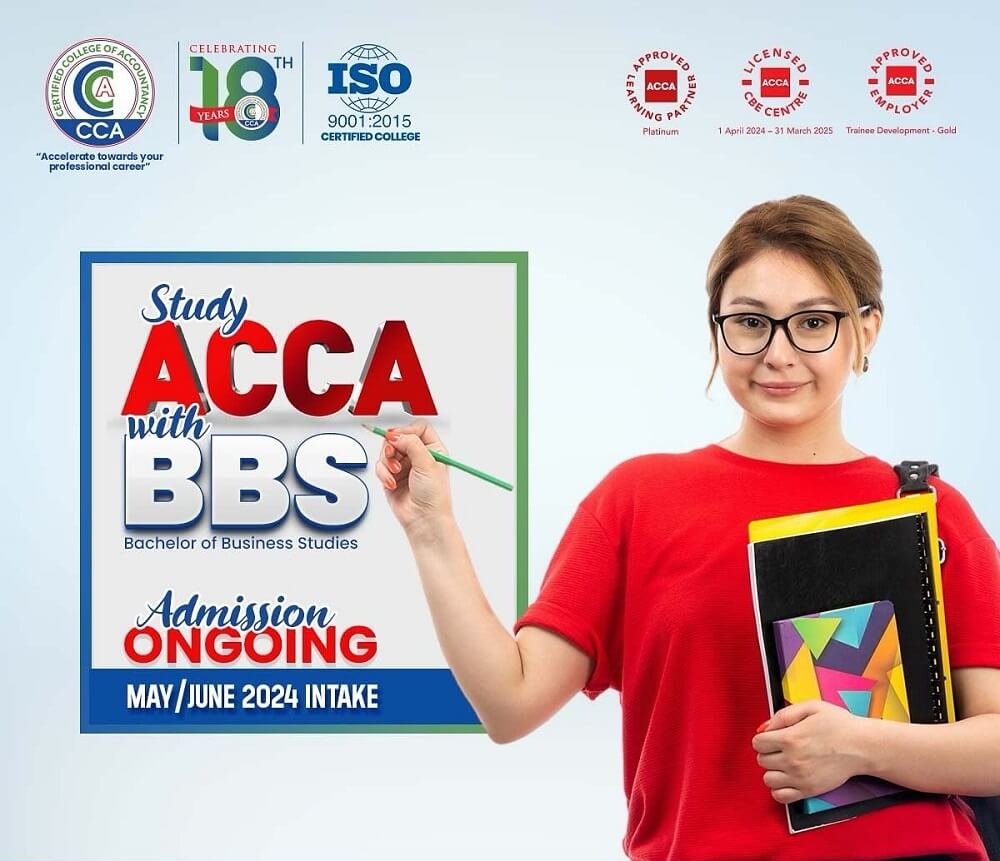
Study ACCA With BBS at CCA
Students who want a career in accounting, audit, taxation, finance, or business management often look for a study pathway that gives them both professional and academic grounding. At Certified College of Accountancy (CCA), students can study the ACCA qualification alongside the Bachelor of Business Studies (BBS), helping them combine professional accountancy training with a Tribhuvan University business degree. CCA’s BBS page describes the program as a four-year degree focused on management, finance, marketing, business operations, and related business areas.
ACCA is a professional accountancy qualification, while BBS is an undergraduate academic degree. Studying them together may help students build technical accounting knowledge, business understanding, and broader career flexibility. However, students should also consider workload, exam planning, cost, and practical experience requirements before choosing this route.

Summary
Studying ACCA with BBS at CCA can be useful for students who want both a professional accounting qualification and an academic business degree. ACCA focuses on accounting, audit, tax, finance, reporting, ethics, and professional skills, while BBS provides broader business knowledge. This combination can support careers in accounting, finance, audit, tax, consulting, and business management, but outcomes depend on student performance, work experience, and employer requirements.
Table of Content
- Study ACCA With BBS at CCA
- Why Study ACCA With BBS?
- What ACCA Adds to BBS
- What BBS Adds to ACCA
- Key Benefits of Combining ACCA and BBS
- Career Areas Students May Explore
- What Students Should Check Before Enrolling
- Final Takeaway
Why Study ACCA With BBS?
Studying ACCA with BBS can give students two different types of learning. ACCA develops professional accounting and finance competence, while BBS provides a broader academic foundation in business studies.
This combination may be useful for students who want to keep career options open. Some students may later enter audit or accounting firms. Others may work in corporate finance, banking, taxation, business operations, management, or consulting support roles.
CCA states that students can pursue BBS and ACCA together and offers a two-month intensive BBS crash course before final exams. Students should confirm the latest course structure, schedules, and academic requirements directly with CCA before enrolling.

What ACCA Adds to BBS
ACCA gives students a professional route into accounting and finance. It covers areas such as financial accounting, management accounting, taxation, audit and assurance, financial reporting, financial management, ethics, and strategic business topics.
ACCA’s official qualification structure includes exams, an Ethics and Professional Skills module, and a Practical Experience Requirement. Students progressing toward ACCA membership must also complete relevant practical experience, not only exams.
For BBS students, ACCA can add more technical depth in accounting, audit, tax, and financial decision-making.
What BBS Adds to ACCA
BBS gives students a wider academic understanding of business and management. CCA describes BBS as a program that develops knowledge in management, finance, marketing, business operations, and related fields.
This can help ACCA students understand business beyond accounting entries and exam papers. For example, BBS may support understanding of organizational management, marketing decisions, business planning, and general management functions.
For students who do not want to limit themselves only to accounting roles, BBS can add useful academic breadth.
Key Benefits of Combining ACCA and BBS
Broader Knowledge Base
ACCA focuses strongly on accounting and finance, while BBS covers wider business subjects. Together, they can help students understand both financial information and business decision-making.
Better Career Flexibility
A student with ACCA knowledge and a BBS degree may be able to explore roles in accounting, audit, tax, finance, banking, business management, consulting support, or entrepreneurship. This does not guarantee employment, but it can give students a wider base for career planning.
Professional and Academic Balance
ACCA is a professional qualification. BBS is an academic degree. Studying both may help students meet different expectations from employers, universities, and professional pathways.
Stronger Practical Understanding
ACCA develops technical accounting and finance skills. BBS adds business and management context. This can help students connect accounting information with business decisions.
Wider Peer and Professional Network
Students studying both programs may interact with classmates, faculty members, ACCA learners, BBS students, and industry professionals. A useful network can support learning, internships, and career awareness, but students still need individual effort and performance.
Career Areas Students May Explore
Studying ACCA with BBS may support preparation for career areas such as:
-
Accounting and bookkeeping
-
Audit and assurance
-
Taxation and compliance
-
Financial reporting
-
Management accounting
-
Banking and finance
-
Business analysis
-
Risk and compliance support
-
Consulting support
-
Business management
Senior roles such as finance manager, financial controller, or chief financial officer require more than qualifications. They usually require experience, leadership ability, technical competence, communication skills, and strong professional judgment.
What Students Should Check Before Enrolling
Before choosing ACCA with BBS, students should review the full study commitment. ACCA requires professional exams and practical experience, while BBS has university-level academic requirements.
Students should check:
-
ACCA entry requirements and exemptions
-
BBS admission requirements
-
Class schedules for both programs
-
Exam timelines and workload
-
Tuition, exam, registration, and other fees
-
Available study support
-
Practical experience opportunities
-
Local employer expectations
-
Recognition requirements for regulated roles such as audit or tax practice
ACCA provides official minimum-entry guidance, and students should use official sources or consult CCA directly before making a final decision.
Final Takeaway
Studying ACCA with BBS at CCA can be a practical option for students who want both professional accounting training and an academic business degree. ACCA can strengthen technical skills in accounting, audit, tax, finance, and reporting, while BBS can provide broader knowledge of business and management.
This pathway is best suited for students who are ready to manage a demanding study schedule and plan their career carefully. Before enrolling, students should verify admission requirements, class schedules, fees, exam timelines, exemptions, and practical experience expectations with CCA and official ACCA sources.








Comments 0
No comments yet. Be the first to start the conversation.