




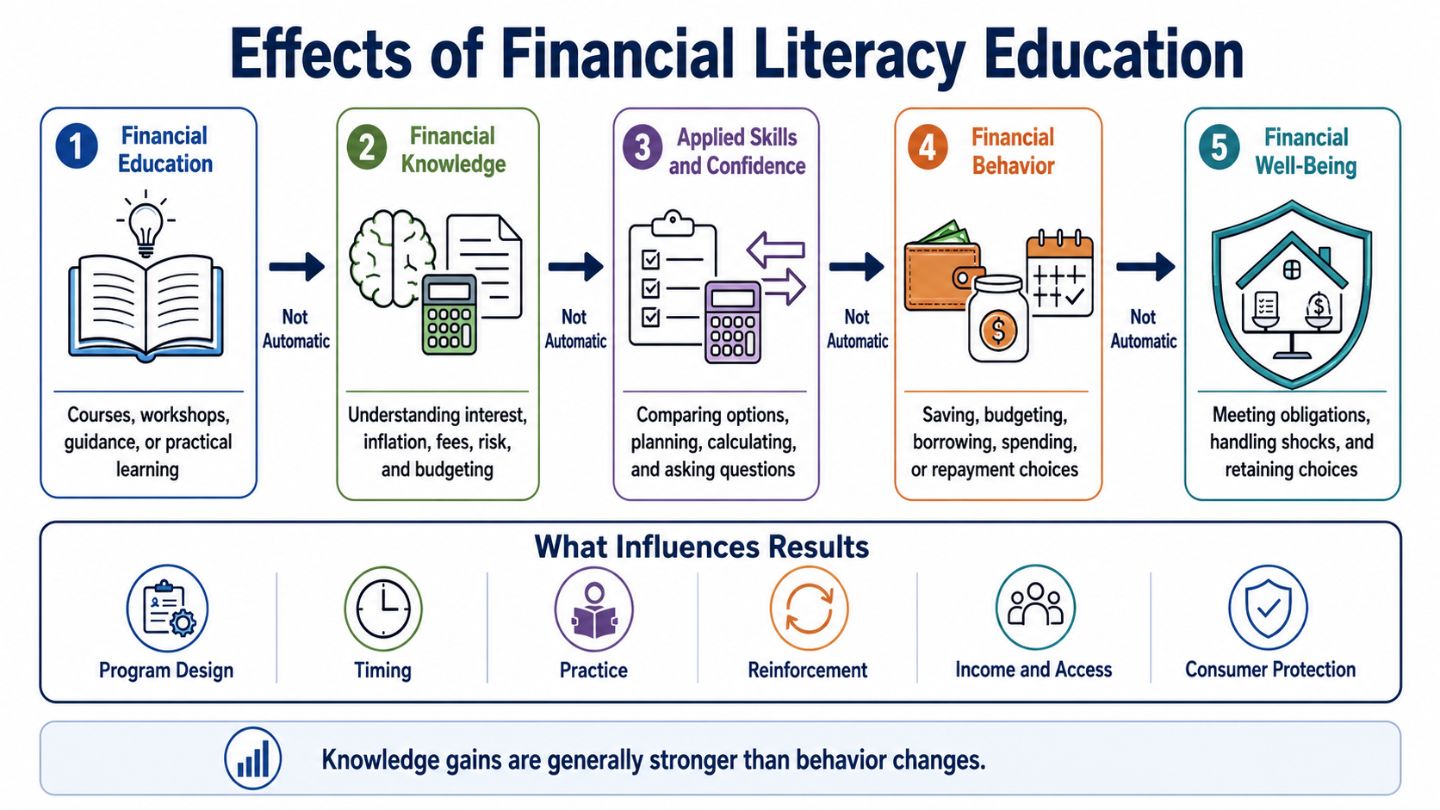
Financial literacy education is often assessed through one central question: does teaching people about money lead to better financial decisions? Research supports a qualified yes. Education tends to improve financial knowledge and can improve behavior on average, but behavioral effects are smaller, less consistent, and more dependent on context.
This distinction matters for students, parents, educators, employers, nonprofit organizations, and policymakers. A learner may understand interest, inflation, loan fees, budgeting, or risk while still facing limited income, unsuitable financial products, an emergency expense, or an unfair contract. Education can improve the quality of a decision, but it does not control every condition surrounding that decision.
Programs also differ in purpose and delivery. A semester-long school course is not equivalent to a workplace seminar, community workshop, counseling session, or digital lesson delivered before a financial choice. Their results depend on the population, subject matter, teaching time, delivery quality, outcome measured, and follow-up period.
| Answer Summary: Financial literacy education improves financial knowledge most consistently and produces smaller positive changes in financial behavior on average. Results vary across learners, programs, countries, and financial outcomes. Programs are more defensible when they connect lessons to real decisions, include active practice and reinforcement, and measure outcomes beyond immediate test scores. Education can support informed choices, but it cannot guarantee saving, debt reduction, wealth, or financial security. |
Table of Content
- What Is Financial Literacy Education?
- Does Financial Literacy Education Work?
- Effects on Financial Knowledge
- What School-Based Research Shows
- Effects on Financial Behavior
- Effects on Confidence and Financial Well-Being
- How Long Do the Effects Last?
- What Makes Financial Education More Effective?
- Required Versus Voluntary Programs
- Who Benefits, and Where Is the Evidence Mixed?
- What the Evidence Can and Cannot Show
- Why Education Alone Is Not Enough
- Practical Implications
- Conclusion
- Sources Used
Key Takeaways
-
Knowledge gains are the most consistent outcome.
-
Behavioral effects are positive on average but smaller.
-
Saving, debt, and credit outcomes vary by context.
-
Immediate test gains do not prove lasting behavior change.
-
Timing, teaching intensity, practice, and follow-up matter.
-
No delivery model works equally well in every setting.
-
Education complements rather than replaces consumer protection.
What Is Financial Literacy Education?
Definitions vary, but financial literacy generally refers to the knowledge, skills, attitudes, and capacity needed to understand and use financial information. Financial education refers to the instruction or intervention intended to develop those capabilities.
Financial Literacy Is an Outcome
Financial literacy may include understanding:
-
Simple and compound interest
-
Inflation and purchasing power
-
Financial risk and diversification
-
Credit terms and repayment obligations
-
Fees and the total cost of borrowing
-
Budgeting and cash-flow planning
-
Saving and consumer rights
A literacy score shows what a person knows or can demonstrate. It does not identify by itself how the person gained that knowledge or whether it will influence later decisions.
Financial Education Is an Intervention
Financial education can be delivered through:
-
School or university courses
-
Workplace programs
-
Community workshops
-
Individual or group counseling
-
Digital learning modules
-
Simulations and practical exercises
-
Information provided near a financial decision
A budgeting course and a loan-comparison lesson target different decisions. Their outcomes should be measured differently.
Why the Difference Matters
Studies often find that people with stronger financial literacy report different saving or borrowing behavior. Such relationships do not prove that a particular course caused the difference.
Randomized controlled trials provide stronger causal evidence because participants are assigned to an education or comparison group. Well-designed quasi-experiments can also support causal conclusions when they use a credible policy change or comparison. Observational studies are useful for identifying relationships but require more cautious language.
Does Financial Literacy Education Work?
The strongest recent synthesis supports a qualified yes. A 2022 Journal of Financial Economics meta-analysis examined 76 randomized experiments involving more than 160,000 people. It found positive average causal effects on financial knowledge and downstream financial behavior. The findings remained after several checks for publication bias, study quality, statistical power, and differences among programs.
A positive average does not mean every intervention succeeds. Meta-analysis combines programs that differ in audience, length, content, setting, and measurement. Some individual programs produce clear gains, while others show small, null, or mixed results.
| Outcome | General evidence pattern | Main caution |
|---|---|---|
| Financial knowledge | Most consistent positive effect | Often measured soon after instruction |
| Applied skill | Can improve with practice | A test may not reflect a real decision |
| Confidence | May improve | Confidence does not always equal competence |
| Saving and budgeting | Positive in some settings | Income and opportunity affect action |
| Credit and debt | Mixed and outcome-specific | Product terms and financial shocks matter |
| Financial well-being | Less settled | Wider economic conditions remain important |
| Long-term persistence | Uncertain | Delayed follow-up is less common |
Effects on Financial Knowledge
Knowledge is the clearest and most consistently measured effect of financial education. Learners may become better able to calculate interest, understand inflation, compare fees, identify risk, read credit terms, or organize income and expenses.
These gains matter because people cannot apply concepts they have not learned. Knowledge remains an intermediate outcome, however. It must be remembered, recognized as relevant, and used at the point of decision.
An immediate post-course test answers a narrow question: did participants learn the material? It does not show whether they applied the lesson months later or whether their financial position improved.
What School-Based Research Shows
School programs generally produce larger gains in knowledge than in behavior. A 2020 meta-analysis examined 37 experimental and quasi-experimental school studies involving more than 115,000 students.
Across the full group of studies, the estimated average effect was 0.33 standard deviations for financial knowledge and 0.07 for financial behavior. In the 18 randomized experiments, the estimates were about 0.15 and 0.07 respectively.
A standard deviation is a statistical comparison measure, not a percentage-point increase. The figures indicate measurable learning while also showing that transferring classroom knowledge into daily action is harder.
Students may have limited income, no access to credit, or little responsibility for household bills. Some behavior cannot be observed until later. This makes school-based outcomes harder to measure and prevents a simple comparison between students and financially independent adults.
Effects on Financial Behavior
Financial education can change behavior, but the result depends on the behavior being studied. Tracking expenses, opening a savings account, comparing a loan, and avoiding delinquency involve different constraints.
Behavioral measures also vary in quality. Some studies use self-reported answers, while others use account records, credit files, or observed transactions. Self-reported improvement does not always match administrative data.
Saving and Budgeting
Saving and budgeting are common program targets. Education may help participants:
-
Identify fixed and irregular expenses
-
Plan how income will be allocated
-
Track actual spending
-
Compare savings products
-
Set a defined financial goal
-
Review whether a plan worked
These skills do not create disposable income. A participant may understand a saving strategy but lack enough money to use it consistently. Claims that education automatically increases saving overlook this constraint.
Programs are more useful when participants work with realistic income and expense patterns, test a plan, and review the result later.
Credit, Debt, and Repayment
Debt outcomes are harder to change. Borrowing is influenced by income, emergencies, interest rates, existing obligations, contract terms, and the availability of affordable alternatives.
Financial education may help a person compare annual costs, repayment schedules, penalties, and loan terms. It cannot remove a financial emergency or create a suitable product where none exists.
A 2017 World Bank Economic Review meta-analysis of 126 impact evaluations found larger effects on financial literacy than on behavior and substantial variation across populations and programs. It reported that debt-related behavior was among the more difficult outcomes to influence. It also found stronger results for more intensive programs and education delivered near a relevant decision.
Statements such as “financial education reduces debt” are too broad unless they identify the population, intervention, type of debt, comparison group, outcome, and follow-up period.
Spending and Product Choice
Education can improve some decisions while leaving others unchanged or producing an unintended result. This is why evaluations should examine several outcomes rather than report only the measures that improved.
A large randomized evaluation in Brazil covered six states, 892 schools, and about 25,000 students. The program improved financial proficiency, saving, and budgeting and produced positive spillovers to parents. It also increased students’ use of expensive credit for consumer purchases.
This case does not show that financial education generally causes harmful borrowing. It shows that one program can improve some outcomes while worsening another. Mixed findings are valuable because they reveal risks that a benefits-only evaluation may miss.
Effects on Confidence and Financial Well-Being
Some programs measure financial confidence or perceived capability. Greater confidence may make learners more willing to compare products, ask questions, or make a plan. Confidence should not be treated as proof of competence.
Applied exercises are more informative than satisfaction surveys. A learner who feels informed may still misunderstand a fee, repayment condition, or investment risk.
Financial well-being is broader than knowledge or one behavior. It may include meeting current obligations, absorbing a financial shock, feeling secure, and retaining choices about the future. Definitions and measurement tools differ across studies.
Education may contribute to these outcomes through better understanding and decision processes. The evidence is less established than it is for knowledge, and financial well-being is also shaped by wages, employment, housing costs, health expenses, family responsibilities, financial access, and product fairness.
Education should not be presented as a complete solution to poverty, inequality, financial stress, or harmful products.
How Long Do the Effects Last?
Long-term persistence remains uncertain. Some studies detect effects after a program ends, while others find smaller estimates when more time passes before measurement.
The 2022 randomized-trial meta-analysis did not find evidence supporting rapid decay. The authors also stated that their results did not establish the sustainability of long-run effects.
The school meta-analysis found that longer delays between instruction and measurement were associated with smaller effect estimates. That relationship does not prove that every learner forgets the material at the same rate. It shows why delayed follow-up matters.
Programs should measure results at more than one point when resources allow. Refreshers, reminders, repeated practice, and lessons tied to later decisions may help learners retrieve knowledge when it becomes relevant.
What Makes Financial Education More Effective?
No single program design works across every country, age group, or delivery setting. Research supports several practical principles, but none should be treated as a universal formula.
Teach Near Relevant Decisions
Information is easier to apply when it connects with a real choice. Credit education may be more useful before a learner compares loans. Budgeting may have more meaning when a student begins earning income or managing regular expenses.
Foundational education and decision-timed instruction serve different purposes. One builds general understanding; the other supports immediate application.
Include Active Practice
Learners should do more than listen or read. Useful activities may include:
-
Comparing the total costs of two products
-
Calculating interest and repayment
-
Reading a financial disclosure
-
Preparing and revising a budget
-
Identifying misleading or incomplete information
-
Explaining the reason for a choice
-
Reviewing the result after a decision
Practice helps show whether learners can apply a concept rather than repeat a definition.
Provide Sufficient Teaching Time
The 2017 global review and 2020 school review found stronger effects from more intensive education, although added teaching time produced diminishing gains.
More time is not automatically better. Additional lessons need relevant content, suitable sequencing, and opportunities to apply the material.
Support Instructors and Monitor Delivery
Curriculum design, instructor preparation, class conditions, attendance, and delivery quality may influence outcomes. The school meta-analysis noted that available studies could not isolate several of these factors precisely.
Program teams should document what was taught, how instructors were prepared, whether learners attended, and whether planned activities were delivered. Without this information, a weak result is hard to interpret.
Match Measurement to the Program
A program designed to teach concepts should assess knowledge and applied skill. One designed to change borrowing should examine borrowing behavior over a suitable period.
Attendance, satisfaction, and immediate test scores cannot substitute for evidence about later financial behavior.
Required Versus Voluntary Programs
Research does not establish that required or voluntary financial education is always better.
Required courses can reach learners who would not enroll independently. Voluntary programs may attract participants with stronger motivation. This selection difference makes comparison difficult.
The 2017 review tentatively found weaker effects for mandatory programs across its broad evidence base. Other school studies have found advantages for required delivery in particular settings. These findings should remain context-specific. Program quality, audience, delivery, and measurement matter more than the label alone.
Who Benefits, and Where Is the Evidence Mixed?
Average effects can hide differences by age, baseline knowledge, income, country, financial access, program intensity, and outcome.
Students and Young Adults
Students tend to show measurable knowledge gains. Behavioral effects are harder to observe because many young people have limited income or financial independence.
A school program should use age-appropriate outcomes. For younger learners, applied knowledge and simulated decisions may be more suitable than credit or debt measures.
Adults and Workplace Learners
Adult and workplace programs may address immediate decisions such as retirement enrollment, borrowing, benefit selection, or household budgeting. Their effectiveness depends on whether the content fits the decision and whether participants have realistic options.
Evidence from one workplace, country, or financial product should not be generalized to every adult-learning setting.
Low-Income Learners
Evidence for low-income participants is mixed. The 2017 review reported weaker effects among low-income clients and in low- and lower-middle-income economies. The 2022 randomized-trial synthesis did not find a difference between low-income and general populations.
The disagreement may reflect different studies, methods, populations, program designs, and outcomes. It does not support a simple claim that financial education either works or fails for all low-income learners.
What the Evidence Can and Cannot Show
Research can estimate average effects for the populations and programs studied. It can compare knowledge with behavior, identify variation, and reveal null or adverse outcomes.
It cannot show that:
-
One country’s result applies worldwide
-
One course works for every learner
-
A short-term test gain creates lifelong financial security
-
Education alone reduces poverty or inequality
-
A financial literacy score proves that education caused a behavior
-
One curriculum or delivery model is universally superior
Before accepting a strong claim, ask:
-
Who participated?
-
What was taught?
-
What comparison group was used?
-
Was the behavior self-reported or observed?
-
How long after the program was it measured?
-
Were null and adverse outcomes reported?
Why Education Alone Is Not Enough
Financial decisions occur within systems. Income, employment, financial access, product design, disclosure quality, consumer protection, and regulation affect what choices are available.
Education may help people understand terms and identify trade-offs. It cannot make an unaffordable loan affordable, remove discriminatory barriers, compensate for inadequate income, or correct an unfair contract after the fact.
A balanced policy approach combines education with:
-
Clear and understandable product information
-
Fair contract terms
-
Suitable financial services
-
Accessible complaint systems
-
Consumer protection
-
Enforcement against deceptive practices
-
Qualified advice when needed
This framing avoids blaming individuals for outcomes shaped partly by structural conditions.
Practical Implications
For Learners and Families
Use financial education to improve questions, comparisons, and planning. Check total costs, read terms, compare independent information, and revisit concepts when circumstances change.
Educational material does not replace individualized financial, legal, tax, or investment advice for decisions involving significant risk.
For Educators
Define the intended outcome before selecting lessons. Connect concepts with realistic tasks, provide enough practice, and assess whether learners can apply the material.
Avoid treating course satisfaction or an immediate quiz as evidence of lasting behavioral change.
For Employers and Community Programs
Focus on decisions relevant to the participants. A general information session may be less useful than a program connected with benefits, budgeting, credit, or another immediate need.
Participation data, completion rates, applied assessments, and delayed follow-up can help determine whether the program reached its intended outcome.
For Policymakers and Funders
Judge programs by evidence quality, relevance, reach, delivery, and measured outcomes. Require reporting of null and adverse findings rather than only positive results.
Financial education should be part of a wider approach that includes consumer protection, access, clear products, and credible evaluation.
Conclusion
Financial literacy education has a defensible role in schools, workplaces, community settings, and adult learning. Its clearest effect is improved financial knowledge. Financial behavior also improves on average, but the gains are smaller and vary across outcomes, populations, and programs.
Stronger programs connect lessons to real decisions, include active practice, provide sufficient teaching time, support delivery, and assess outcomes beyond immediate tests. Education can help people understand choices and act with better information, but it cannot guarantee financial security or replace fair financial systems.
Sources Used
-
Kaiser, Tim; Lusardi, Annamaria; Menkhoff, Lukas; and Urban, Carly J. “Financial Education Affects Financial Knowledge and Downstream Behaviors.” Journal of Financial Economics, 2022.
-
Kaiser, Tim, and Menkhoff, Lukas. “Financial Education in Schools: A Meta-Analysis of Experimental Studies.” Economics of Education Review, 2020.
-
Kaiser, Tim, and Menkhoff, Lukas. “Does Financial Education Impact Financial Literacy and Financial Behavior, and If So, When?” The World Bank Economic Review, 2017.
-
Bruhn, Miriam; Leão, Luciana de Souza; Legovini, Arianna; Marchetti, Rogelio; and Zia, Bilal. “The Impact of High School Financial Education: Evidence from a Large-Scale Evaluation in Brazil.” American Economic Journal: Applied Economics, 2016.







Comments 0
No comments yet. Be the first to start the conversation.