



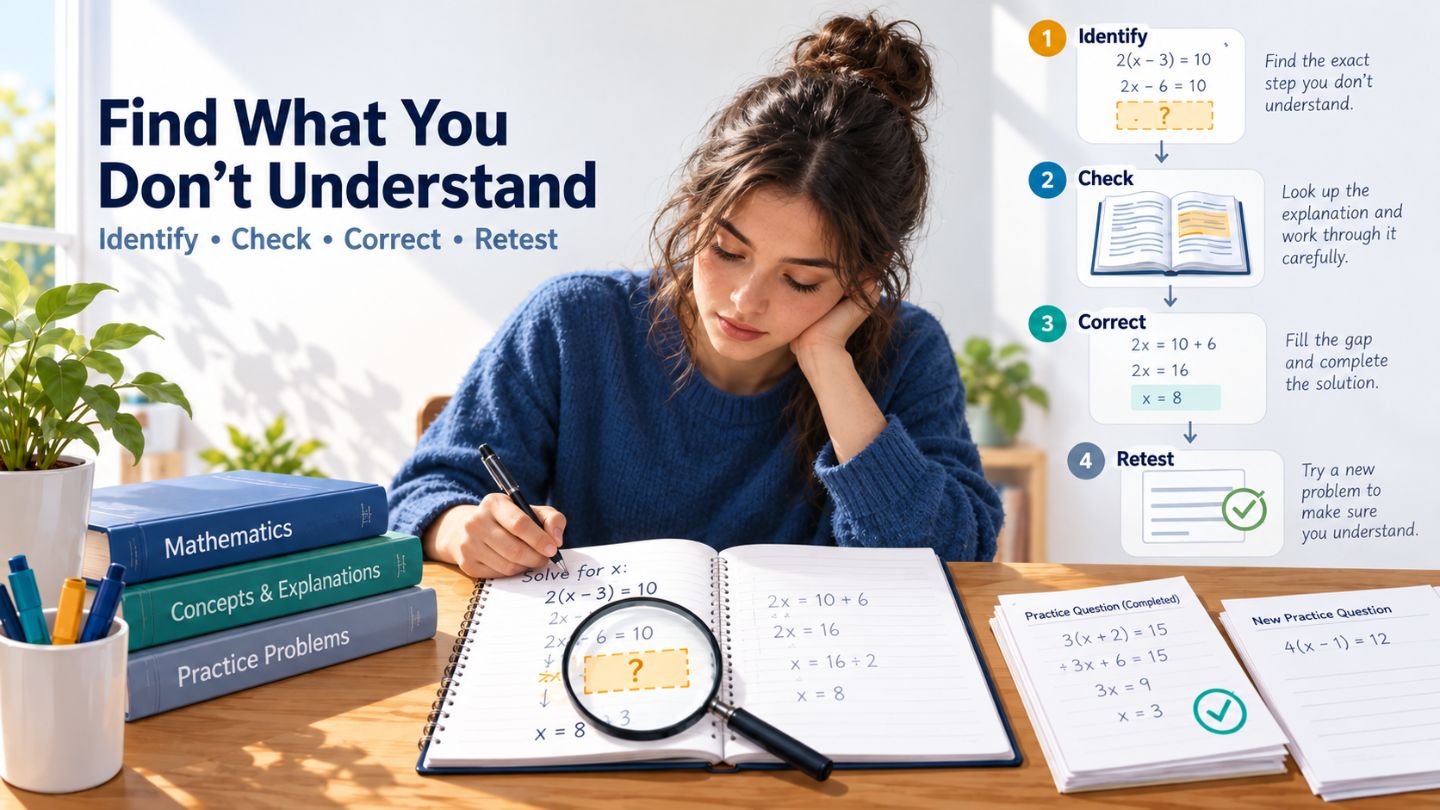
To identify what you do not understand while studying, try to recall, explain, solve, or apply the material without the answer in front of you. Compare your attempt with a reliable answer, explanation, or marking guide. The point where your reasoning stops, becomes uncertain, or differs from the correct approach is the part you need to investigate.
This sounds straightforward until you try it. You may finish reading a chapter and feel familiar with every heading. You remember following the examples, and the explanations seem reasonable. Yet when someone asks a question without showing the notes, you cannot decide where to begin.
The frustrating part is not necessarily finding an incorrect answer. It is being unable to tell why the answer is wrong or which part of the chapter needs more attention.
Learning researchers study this problem through metacognition, which includes monitoring your own knowledge and learning. Research by Koriat and Bjork (2005) shows how information visible during study can influence judgments about what a person will remember later.
The practical response is to gather evidence from your own work. Instead of reviewing an entire topic because something feels uncertain, identify what you can do independently, where your attempt breaks down, and what kind of difficulty the mistake reveals.
Answer Summary: A useful understanding check has six parts: choose a specific learning task, attempt it without unnecessary support, identify the first point of difficulty, compare your work with a reliable standard, name the gap, and recheck after targeted review. Different problems require different responses. Forgetting a term, misunderstanding a relationship, choosing an incorrect method, and struggling with a new application do not necessarily indicate the same weakness.
Key Takeaways:
-
Familiarity with a textbook or explanation is not sufficient evidence of independent understanding.
-
Test the exact skill you need: recalling, explaining, solving, or applying.
-
Find the earliest point where your reasoning breaks down.
-
Distinguish forgetting from conceptual, procedural, and application difficulties.
-
Compare your work with a reliable answer or assessment standard.
-
Review the specific gap, then test it with a different question or example.
Why Is It Difficult to Notice What You Do Not Understand?
A topic can appear clear when the information needed to understand it is already visible. The difficulty often becomes apparent when that support disappears.
Consider what happens when you read a worked mathematics solution. The question is written out, the relevant method has already been selected, and each calculation follows the previous one.
You may understand every displayed step. But when you face a similar question without the solution, you must decide which information matters, select an appropriate method, and carry out the calculations yourself.
Those are additional demands. Understanding someone else's solution does not automatically establish that you can produce one independently.
The same problem appears in reading-based subjects. A student can recognize the causes of a historical event in a textbook paragraph but struggle to explain how those causes interacted without referring to the page.
Koriat and Bjork (2005) examined a related difficulty in judgments of learning. Their experiments used paired-associate memory tasks and showed that information available during study can influence confidence about later recall, even when that information will be absent during testing.
The research does not establish that familiarity is meaningless or that every confident student misunderstands the material. It shows why familiarity alone is an unreliable basis for deciding what you know.
This distinction matters when choosing what to revise. If you rely entirely on how familiar a chapter feels, you may spend time reviewing material that already works while overlooking a smaller weakness that prevents you from answering questions independently.
First, Decide What Understanding Should Look Like
Before testing yourself, identify what the material requires you to do. Different learning goals need different evidence.
Knowing a definition is useful when an assessment asks for that definition. It provides less evidence when the task requires an explanation, comparison, calculation, or unfamiliar application.
When you need to remember information
If the goal is to recall dates, vocabulary, terminology, formulas, or factual sequences, test whether you can produce the required information without seeing it.
For example, cover the labels on a biology diagram and name the structures.
If you recognize the names when they are visible but cannot retrieve them independently, memory retrieval is one area to investigate.
That result does not, by itself, establish whether you understand each structure's function.
When you need to explain a concept
If the goal requires understanding relationships, ask why or how something happens.
A student studying an economic concept may remember its definition but struggle to explain how changing one condition affects another.
A useful check asks for the relationship, not merely the definition.
You can also compare two concepts that seem similar. The differences you cannot explain may reveal the precise area of confusion.
When you need to solve a problem
If you are studying mathematics, physics, chemistry, accounting, or another problem-solving subject, attempt a fresh problem without copying a worked solution.
Pay attention to more than the final answer.
Can you identify the relevant information? Choose a suitable method? Carry out the procedure correctly? Explain why each major step is appropriate?
A difficulty at any of these points suggests a different next action.
When you need to apply knowledge
If the task requires using a concept in a new situation, change the example or context.
For instance, remembering the explanation of a scientific principle is different from deciding how that principle applies when an experimental condition changes.
An application question helps reveal whether you understand the principle well enough to use it beyond the example you studied.
The important rule is to match the check to the learning goal. A vocabulary test cannot establish readiness for a complex problem-solving task, and one difficult application question cannot measure every part of a student's knowledge.
Remove the Support That Makes the Material Feel Familiar
One practical way to check what you know is to attempt the relevant task before looking at the answer.
This may involve closing your notes, covering a diagram, hiding a worked solution, writing an explanation from memory, or answering a question without checking the textbook.
Cornell University's Learning Strategies Center describes a related method as Blank Page Testing. Students begin with an empty page and reconstruct information they have studied. What they can and cannot produce helps identify areas requiring further attention.
This is a form of retrieval practice: bringing information to mind rather than reviewing it while it remains visible.
Research on retrieval practice supports its value for learning. Dunlosky and colleagues (2013), in their review of common study techniques, rated practice testing highly because of evidence across different learning conditions and tasks.
Karpicke and Blunt (2011) also found benefits of retrieval practice on comprehension and inference questions in experiments using science-related texts.
For identifying gaps, the value is practical: attempting an answer without unnecessary cues shows what happens when you must rely on your own knowledge.
However, closed-note testing should reflect what you are preparing to do.
If your actual task requires open-book analysis, the aim is not necessarily to memorize every detail. Instead, check whether you can locate appropriate evidence, interpret it correctly, select the relevant method, and construct an answer using the resources permitted.
The useful question is whether you can perform the task independently under appropriate conditions.
A student comparing active recall and re-reading should also remember that rereading has a role. It can clarify unfamiliar material, resolve uncertainty, or help verify an answer. Its limitation arises when familiarity during review becomes the main evidence that learning is secure.
Find the First Point Where Your Thinking Breaks
A wrong answer tells you that something needs checking. It does not automatically explain what went wrong.
The more useful task is to trace your attempt until you identify the earliest meaningful difficulty.
Suppose you are studying a mathematics chapter. You can carry out calculations after seeing the formula, but when given a new question, you do not know which formula applies.
Repeating calculations may not address that problem. You need to investigate how to recognize the conditions that determine method selection.
Now consider a history question asking why a particular event occurred.
You remember the sequence of events and can name several contributing factors. But your explanation does not show how one factor influenced another.
The weakness lies in the causal explanation rather than necessarily in the facts you remembered.
When reviewing an unsuccessful attempt, examine where you stopped, guessed, misread a condition, confused terms, omitted a relationship, or chose a method without knowing why it applied.
It helps to leave your first attempt visible while checking the answer. If you immediately erase and replace incorrect work, you lose evidence about your original reasoning.
Look beyond the final answer
Two students can give the same incorrect answer for different reasons.
One may understand the method but make a calculation error. Another may calculate correctly using a method that does not fit the problem.
Their final answers may look equally unsuccessful, but the appropriate corrections differ.
The reverse is also possible. A student may reach the correct answer through a guess, memorized pattern, or unsuitable reasoning.
For tasks involving explanation or problem solving, inspect how the answer was reached rather than treating the final result as sufficient evidence.
Identify the Type of Learning Gap
Once you locate the difficulty, decide what it suggests. The categories below are practical ways to investigate a problem, not a formal psychological diagnostic test.
| What happens during your attempt? | Gap to investigate | What to check next |
|---|---|---|
| You recognize information when shown but cannot recall it independently | Retrieval | Try producing the answer without cues and check what is missing |
| You remember facts but cannot explain why or how they connect | Conceptual understanding | Explain the relationship and compare it with a reliable source |
| You know which method applies but repeatedly make errors while carrying it out | Procedure | Work through the steps and identify the first incorrect operation |
| You can follow a solution but cannot choose how to begin a new question | Method selection | Compare different problem types and explain which method fits each |
| You answer familiar examples but struggle when the context changes | Application or transfer | Apply the principle to a changed example |
| An explanation depends on terms or earlier ideas you cannot explain | Prerequisite knowledge | Identify and review the missing foundation |
| Your confidence repeatedly differs from checked performance | Confidence calibration | Record confidence and correctness across several representative questions |
Several of these difficulties can occur together. A student may both forget a formula and misunderstand the conditions under which it applies.
There is also a distinction between a recurring knowledge problem and an occasional execution error.
For example, misreading one instruction does not establish that you misunderstand the topic. Repeatedly misunderstanding similar instructions, however, gives you a specific pattern to investigate.
Avoid drawing conclusions about a whole chapter from one question. Look for the same difficulty in more than one appropriate attempt.
Use Self-Explanation to Find Missing Relationships
Self-explanation is useful when you know the individual parts of a topic but are uncertain about how they fit together.
Instead of repeating the textbook paragraph, explain the idea using your own reasoning.
Research by Chi and colleagues (1994) examined prompted self-explanation among eighth-grade students learning about the human circulatory system. In that study, students prompted to explain material demonstrated stronger gains in understanding than the comparison group.
The findings support self-explanation in the studied setting. They should not be treated as proof that explaining any topic aloud establishes mastery.
For a practical understanding check, ask questions that require relationships:
-
Why does this happen?
-
How does one step lead to the next?
-
What assumption does this explanation depend on?
-
Under what conditions would this rule no longer apply?
-
How does this idea differ from a similar one?
-
What changes when a relevant variable changes?
Consider an illustrative example from biology.
A student remembers the main stages of a process but cannot explain why one stage is necessary for the next.
Repeating the stage names may strengthen recall while leaving the connection unclear.
A more relevant task is to reconstruct the process, identify what each stage contributes, and compare that explanation with an authoritative textbook or instructional resource.
A clear explanation can still be incorrect
Being able to speak confidently about a topic is not sufficient evidence that the explanation is accurate.
You may omit an important condition, connect two events incorrectly, or use a familiar term in the wrong way without noticing.
After explaining, compare your account with a dependable source. Check whether it contains the required relationships, conditions, and distinctions.
If your explanation differs, identify the specific difference rather than rewriting the entire answer immediately.
Use New Practice Questions to Test Independent Understanding
Fresh questions help distinguish independent problem solving from remembering how a previous solution was completed.
If you work through the same exercise immediately after reading its answer, the earlier solution may still guide your choices.
That attempt can be useful for practising a procedure, but it offers limited evidence about whether you can select and apply the method independently.
Change an element of the question when appropriate. Use different numbers, wording, conditions, or examples. For subjects with several related methods, mix problem types rather than presenting a sequence in which every question uses the same procedure.
For example, a student practising algebra may complete several exercises correctly when the worksheet heading identifies the method.
A mixed exercise removes that clue. If the student now struggles, the difficulty may concern recognizing the problem type rather than performing the calculation.
A language learner may remember a grammatical rule but apply it incorrectly when a sentence changes.
A history student may answer a direct factual question but struggle with a question asking for comparison or causal analysis.
These are illustrative situations, not documented student cases. Their purpose is to show how changing the question helps locate different demands within a subject.
Cornell University's guidance on practice exams recommends using conditions that resemble the intended assessment, including the resources permitted and, where relevant, time constraints.
For diagnosing understanding, inspect the reasoning after completing the attempt. A score alone may indicate an area needing attention, but it rarely explains the cause.
Compare Your Work With a Reliable Standard
An explanation can feel convincing even when it is wrong. Checking against an external standard helps reduce dependence on that feeling.
A suitable standard depends on the task.
For factual recall, use a reliable textbook, verified reference, or official course material.
For mathematics and other procedural tasks, compare the steps with a correct worked solution.
For essays, reports, and extended responses, use the assessment rubric, marking criteria, or instructor feedback where available.
For scientific explanations, check whether your account includes the necessary relationships, assumptions, and conditions.
Research supports the value of external criteria for monitoring performance. Janssen and Lazonder's (2024) meta-analysis of interventions for monitoring accuracy in problem-solving found that interventions using external standards were among those associated with improved monitoring accuracy.
Feedback research also requires a distinction between receiving information and using it effectively. Hattie and Timperley (2007) reviewed how the impact of feedback depends on its type and how it is provided.
In practical terms, being told that an answer is wrong gives less direction than identifying which part does not meet the requirement and why.
For example, an essay comment such as “insufficient analysis” becomes useful when you compare your paragraph with the rubric and identify whether you have provided evidence without explaining its significance.
If two apparently reliable sources disagree, do not choose whichever explanation makes your answer seem correct. Check whether they use different definitions, assumptions, levels of detail, or assessment conventions.
If the conflict remains unresolved, ask an appropriate instructor or subject specialist.
Check Whether Your Confidence Matches Your Performance
Confidence can help you decide what to study, but it should be compared with actual results.
A student who feels uncertain about every answer may repeatedly revisit material that is already reasonably secure. Another student may feel confident because the material is familiar, while practice questions expose recurring errors.
You can check this without creating a complicated record.
Before checking several representative answers, mark your confidence as low, medium, or high. Then record whether each answer was correct, partly correct, or incorrect, including the reason.
Look for patterns across the attempts.
If high-confidence answers are repeatedly incorrect, inspect the reasoning behind those answers. A misconception, mistaken condition, or poorly understood rule may be contributing.
If low-confidence answers are repeatedly correct, consider whether further review of that material is necessary compared with other areas showing clearer weaknesses.
One confident mistake is not enough to establish a recurring judgment problem, and one uncertain correct answer does not prove you are prepared for every variation.
This comparison is known as calibration: examining how closely judgments about your performance match the available evidence.
The goal is not to eliminate uncertainty. It is to make better study decisions using both your experience and checked results.
Turn Vague Confusion Into a Specific Study Question
A broad statement such as “I do not understand this chapter” gives you little direction.
A more useful statement identifies what you can already do and what you cannot yet do.
Consider these examples.
Instead of “I do not understand integration,” a student might identify the problem as: “I can integrate simple powers, but I cannot reliably identify when substitution is appropriate.”
Instead of “I do not understand photosynthesis,” the gap may be: “I can name the main stages, but I cannot explain how the proton gradient is connected to ATP production.”
Instead of “I am confused about this historical event,” the student may recognize: “I remember the contributing factors, but I cannot explain how they influenced one another.”
Each revised statement gives you a narrower question to investigate.
It also helps when seeking assistance. Someone reviewing your work can respond more precisely when you show what you already understand and where the explanation stops making sense.
This is where self-reflection for academic growth connects with the diagnostic process: reflection becomes useful when it identifies evidence from your work and informs the next study action.
Repair the Gap Without Reviewing the Whole Topic Again
After identifying the difficulty, choose a response that addresses its likely cause.
If the problem is forgetting
Return to the relevant information, verify it, and practise retrieving it without cues.
Revisit it after an interval rather than relying entirely on immediate repetition.
Dunlosky and colleagues (2013) found substantial support for both practice testing and distributed practice across the learning conditions considered in their review.
A failed recall attempt does not necessarily indicate a missing conceptual explanation. First determine whether the information becomes available when you see an appropriate cue or definition, then check whether you can use it accurately.
If the problem is understanding a relationship
Return to the explanation connecting the ideas.
Compare the relevant parts, reconstruct a causal sequence, or draw a diagram that shows how the components relate.
Then explain the connection without looking and check its accuracy.
The aim is not to memorize a longer paragraph. It is to identify the relationship that was missing from your reasoning.
If the problem is carrying out a procedure
Find the earliest step you perform incorrectly.
Study a correct example of that operation and practise it in a similar problem before returning to the full task.
If the procedure contains several dependent steps, checking them separately may help determine whether the difficulty is local or extends across the process.
If the problem is choosing a method
Compare different problem types.
Identify the features that make one approach appropriate and another unsuitable.
Before calculating or writing the full response, state which method you would use and why.
This targets a different skill from performing a method after someone has selected it for you.
If the problem is applying an idea
Start with a familiar example and change one relevant condition.
Ask what remains valid, what changes, and why.
Then attempt a different application without referring to the original answer.
If you cannot explain the changed result, the difficulty may involve a missing relationship or condition in the underlying concept.
If the problem is missing background knowledge
Identify the prerequisite you need.
For example, a student struggling with an advanced algebraic procedure may first need to review an earlier operation used within it.
Returning to that prerequisite is more targeted than repeating an entire advanced chapter without understanding what is blocking the work.
Recheck Whether the Gap Has Closed
Understanding an explanation immediately after reviewing it does not establish that you can reproduce or apply it independently.
After targeted review, try another prompt.
A useful recheck changes something relevant while preserving the underlying learning goal.
You can answer a question with different wording, solve a problem with changed values, explain the same principle using a new example, or compare situations requiring different methods.
For material you need to retain, checking again after a delay provides information that an immediate repeat may not reveal.
There is no universal number of practice questions or fixed interval that establishes understanding across every subject.
The evidence you need depends on the task. Remembering a terminology list, applying a scientific model, and writing a critical essay require different kinds of performance.
A practical decision is to continue reviewing while a relevant error persists, and broaden the check when you can answer the familiar version correctly.
If you can repeatedly meet the relevant criteria across representative variations, you have stronger grounds for moving attention to another topic.
That remains a judgment based on evidence, not a guarantee of future performance.
Keep a Small Record of the Gaps You Find
A brief gap record can prevent the same uncertainty from sending you back through an entire chapter.
It does not need to become a detailed study diary. Record the topic, the evidence from your attempt, and the next useful check.
| Topic or task | Evidence of the difficulty | Next check |
|---|---|---|
| Choosing an algebra method | Can complete a worked procedure but cannot select the method in a mixed question | Compare related problem types, then select methods in fresh questions |
| Explaining a historical cause | Remembers events but omits the relationship between contributing factors | Write a causal explanation and compare it with the source |
| Using a grammar rule | Recalls the rule but applies it incorrectly when sentence structure changes | Compare contrasting sentences and create a new example |
These entries are illustrative examples of how to record diagnostic information.
The record should tell you what action to take when you return to the topic. If it contains only labels such as “weak,” “difficult,” or “revise again,” it has not yet identified a useful next step.
When Your Self-Check Is Not Enough
There are limits to diagnosing your own understanding.
You may be unable to identify the first incorrect step because the solution uses unfamiliar reasoning.
You may understand the separate concepts but remain unsure why they produce a particular conclusion together.
An essay may receive a low score without feedback detailed enough to explain the problem. A textbook example may also leave out a step that its author assumes the reader already understands.
These situations call for better evidence, not endless repetition of the same exercise.
Ask a teacher, tutor, instructor, or knowledgeable peer to examine the exact point of uncertainty.
Show your attempt, identify where you became stuck, and explain what result you expected.
For example:
“I understand how the first two steps work, but I cannot see why the third step requires this method instead of the one used earlier.”
That question provides a clearer starting point than asking for the entire topic to be explained again.
If errors persist despite reviewing the prerequisite material and checking several examples, outside guidance may help reveal an assumption or misunderstanding you have not noticed.
Common Mistakes That Make Understanding Harder to Judge
Some study checks produce misleading evidence because they test a different skill from the one you need.
One mistake is treating recognition as recall. Recognizing a definition among answer choices may not establish that you can produce it independently.
Another is testing only familiar examples. Repeating an answer you recently saw may reflect memory for that answer rather than the ability to handle a new version.
A third is interpreting every wrong answer as conceptual misunderstanding. Forgetting, misreading, arithmetic mistakes, method selection, and missing prerequisite knowledge require different investigation.
The opposite error is treating a correct answer as proof that all the relevant reasoning is secure. An accurate answer reached through a guess or unexplained pattern may warrant another check.
Students can also overinterpret hesitation. Taking time to recall or reason does not automatically indicate poor understanding. The more informative evidence is whether the eventual answer is accurate, whether the reasoning is sound, and whether performance holds across relevant tasks.
Finally, repeatedly reviewing an entire chapter can obscure the point that needs attention. Once you have identified a specific gap, focus on that part and test whether the correction works.
A Quick Understanding Check You Can Use While Studying
When a topic feels familiar but you are unsure whether you can use it, try this short routine:
-
Choose one narrow concept, relationship, or problem type.
-
State what you need to be able to do with it.
-
Remove the answer or worked solution and attempt the task independently.
-
Mark the first point where you stop, guess, or become uncertain.
-
Compare your work with a reliable answer, explanation, or rubric.
-
Identify the smallest gap and review that specific point.
-
Test again with a fresh question, changed example, or later attempt.
This is a practical self-check, not a standardized assessment.
Its value lies in what it helps you notice. A topic that once felt broadly confusing can become a specific problem involving a forgotten term, missing relationship, incorrect step, unfamiliar application, or mistaken assumption.
Conclusion
Identifying what you do not understand requires more than noticing that studying feels difficult or that a question was answered incorrectly.
The useful evidence comes from attempting the right task independently, examining where performance breaks down, and comparing your reasoning with an appropriate standard.
Not every difficulty means you lack conceptual understanding. You may need to retrieve forgotten information, learn a missing prerequisite, practise selecting a method, correct a procedural error, or apply an existing idea in an unfamiliar situation.
The next time a chapter feels familiar but your understanding remains uncertain, choose one representative question and work through it without unnecessary support. Find the precise point where your answer no longer meets the requirement.
That gives you something more useful than a general judgment about how well you know the chapter: a specific learning problem and a reasonable way to investigate it.
References
-
Koriat, A., & Bjork, R. A. (2005). Illusions of competence in monitoring one's knowledge during study. Journal of Experimental Psychology: Learning, Memory, and Cognition, 31(2), 187–194.
-
Dunlosky, J., Rawson, K. A., Marsh, E. J., Nathan, M. J., & Willingham, D. T. (2013). Improving Students' Learning With Effective Learning Techniques: Promising Directions From Cognitive and Educational Psychology. Psychological Science in the Public Interest, 14(1), 4–58.
-
Karpicke, J. D., & Blunt, J. R. (2011). Retrieval practice produces more learning than elaborative studying with concept mapping. Science, 331(6018), 772–775.
-
Chi, M. T. H., de Leeuw, N., Chiu, M.-H., & LaVancher, C. (1994). Eliciting self-explanations improves understanding. Cognitive Science, 18(3), 439–477.
-
Janssen, N., & Lazonder, A. W. (2024). Meta-analysis of Interventions for Monitoring Accuracy in Problem Solving. Educational Psychology Review, 36, Article 96.
-
Hattie, J., & Timperley, H. (2007). The Power of Feedback. Review of Educational Research, 77(1), 81–112.
-
Cornell University Learning Strategies Center. Effective Study Strategies. Guidance on retrieval practice, Blank Page Testing, and related learning activities.
-
Cornell University Learning Strategies Center. What To Do With Practice Exams. Guidance on representative practice conditions and reviewing performance.







Comments 0
No comments yet. Be the first to start the conversation.