



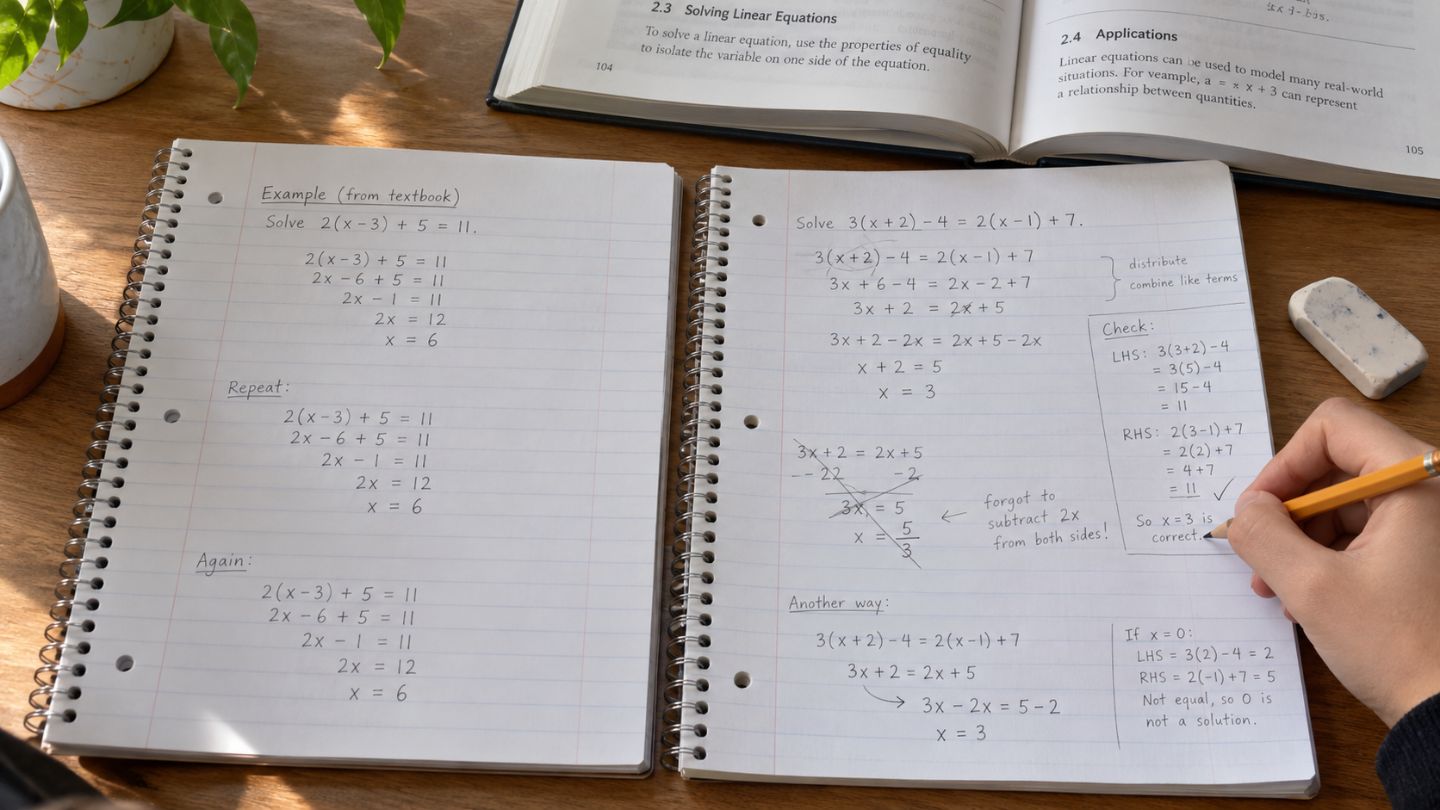
A student may solve ten mathematics questions correctly during revision, then struggle with an examination question based on the same concept. The numbers have changed, the wording is unfamiliar, or the expected formula is no longer obvious. Despite spending hours studying, the student cannot decide where to begin.
This situation illustrates an important difference between remembering how a particular question was solved and understanding how to solve a problem independently.
Memorizing solutions can help students reproduce familiar answers. Problem-solving requires additional abilities: recognizing relevant information, identifying the principle involved, choosing an appropriate method, and evaluating whether the result makes sense.
The distinction matters beyond mathematics. In science, students must decide which principles apply to unfamiliar situations. In programming, they need to understand why an approach works rather than reproduce code from an example. In everyday decisions, people encounter circumstances that rarely match previously learned examples exactly.
However, treating memorization and problem-solving as opposing abilities creates another misunderstanding. Effective reasoning depends on remembered knowledge, including facts, concepts, formulas, and procedures.
The practical challenge is learning how to use that knowledge without becoming dependent on memorized answers.
Answer Summary: Problem-solving matters more than memorizing individual solutions when learners face unfamiliar questions requiring independent reasoning or adaptation. Remembering a procedure helps with familiar tasks, while understanding why it works helps learners recognize when and how to apply it. Effective learning combines foundational knowledge, guided examples, explanation, independent practice, and feedback. The aim is not to avoid memorization but to develop knowledge that remains useful when a question changes.
Key Takeaways:-
Remembering a completed solution does not establish that a learner understands the reasoning behind it.
-
Problem-solving requires recognizing when a method applies, not merely remembering its steps.
-
Memorized facts, formulas, and procedures provide essential foundations for reasoning.
-
Worked examples help beginners understand unfamiliar procedures before independent practice.
-
Explaining solutions, comparing methods, and practising varied questions can develop more flexible understanding.
-
Feedback and delayed practice help identify learning gaps that repeated reading may conceal.
Memorizing Solutions Is Not the Same as Understanding Problems
Memorizing a solution means retaining an answer or sequence of operations. Understanding a problem means recognizing its underlying relationships and knowing why particular operations are appropriate.
Both involve memory, but they require different levels of independent judgment.
Knowing the Steps Is Different From Knowing Why They Work
Consider two algebra questions:
\(3(x+2)=15\)
\(3x+2=15\)
The expressions look similar, but they are not equivalent.
In the first equation, multiplication applies to everything inside the brackets. Its solution is \(x=3\).
In the second equation, multiplication applies to \(x\), while 2 is added separately. Its solution is \(x=13/3\).
A student who follows the appearance of a familiar question may overlook this distinction.
A student who understands how brackets, multiplication, and equality work can recognize why the equations require different treatment.
The important knowledge is not a fixed sequence of operations. It is the principle that valid operations must preserve equality.
This understanding also allows different approaches. A learner may simplify an expression first or perform an equivalent operation on both sides, provided the reasoning remains mathematically correct.
Why Repeatedly Reading Solutions Can Feel Like Learning
Reading a completed solution removes several decisions that students must make when working independently.
The example identifies which information matters, selects the method, and displays the steps in the correct sequence.
Following those steps may feel straightforward because the reasoning is already available.
However, recognizing an explanation while reading it is different from retrieving the necessary knowledge without assistance.
A student may recognize every line of a textbook solution but struggle when asked to solve a related question with the answer hidden.
That difficulty does not necessarily mean the original explanation was misunderstood. It may indicate that the student has not sufficiently practised retrieving, selecting, or applying the method independently.
Research on study techniques has found stronger general support for practice testing and distributed practice than for rereading. This does not make rereading useless. It means that familiarity with material should not be treated as sufficient evidence of lasting understanding.
Rereading can clarify an unfamiliar explanation. Its limitation appears when students repeatedly consult an answer without checking whether they can solve a question independently.
Why Problem-Solving Matters When Questions Change
Problem-solving becomes important when learners must decide which knowledge is relevant rather than reproduce a known response.
A method that works for one question may also work for another, but identifying that connection requires understanding what the questions have in common.
Recognizing the Underlying Principle
Questions can look different while requiring the same reasoning. They can also look similar while requiring different methods.
Consider a student studying percentages.
One question asks for 20% of a price. Another gives the discounted price after a 20% reduction and asks for the original price.
Both involve percentages, but they require different calculations.
In the first question, the student calculates a percentage of a known amount.
In the second, the learner must recognize that the discounted price represents 80% of the original amount and work backward.
Memorizing the calculation used in the first example does not automatically explain how to solve the second.
The student needs to understand the relationship between the original amount, the percentage change, and the resulting amount.
Similar difficulties occur in physics when learners remember a formula but cannot determine whether the given information satisfies its conditions.
Problem-solving therefore includes choosing a method, not merely performing it.
Applying Knowledge to New Situations
Using previously learned knowledge in another situation is known as transfer of learning.
Transfer occurs when knowledge or skills developed in one context contribute to performance in another. The new context may involve different numbers, wording, representations, or practical conditions.
For example, understanding ratios in mathematics may help a learner interpret proportions in a science experiment.
However, transfer is not automatic.
A student may understand a mathematical relationship but struggle to recognize it in a word problem. Another may know a scientific principle without possessing enough background knowledge to apply it to a complicated experiment.
The degree of similarity between the original learning situation and the new task matters.
A question involving changed numbers may require relatively limited adaptation. A question combining several concepts may require additional knowledge and reasoning.
This distinction prevents an important overstatement: understanding a concept does not guarantee that someone can apply it successfully to every unfamiliar problem.
Choosing Among Different Methods
Independent problem-solving also involves evaluating alternative approaches.
Two methods can produce the same correct answer while differing in the calculations required, the assumptions involved, or how easily errors can be checked.
For example, a student solving a system of linear equations may use substitution or elimination.
Understanding both approaches allows the student to recognize which method is convenient for a particular arrangement of equations.
Memorizing both procedures without understanding their purpose offers less help when the question changes.
A 2007 experiment involving 70 seventh-grade students examined the effect of comparing alternative algebraic solution methods.
Students who compared methods showed greater gains in procedural knowledge and flexibility than those who reflected on the same methods separately. Gains in conceptual knowledge were comparable between the groups.
The finding supports the educational value of comparing methods in the algebra-learning context studied. It does not establish that learning multiple approaches is necessary for every problem.
The useful activity is examining why different methods work and when their differences matter.
Why Memorization Still Matters
Memorization remains important because problem-solving depends on knowledge that learners can retrieve and use.
Students cannot reason effectively about concepts they have not learned. Repeatedly reconstructing foundational information can also make complex tasks unnecessarily demanding.
Remembering Facts and Procedures Supports Reasoning
Basic mathematical facts, scientific definitions, formulas, and established procedures form part of the knowledge used during problem-solving.
A student who knows multiplication facts can concentrate on the relationships within a more complicated mathematical question instead of repeatedly calculating elementary operations.
Similarly, someone who remembers the meaning of scientific variables can devote more attention to interpreting a problem.
Procedural fluency matters because recognizing the correct method is insufficient if the learner cannot execute it reliably.
Mathematical proficiency includes conceptual understanding, procedural fluency, strategic competence, and other connected abilities.
These abilities support one another.
A learner may understand why a procedure works but still require practice performing it accurately. Another may perform the procedure quickly yet struggle to identify when it applies.
Neither difficulty is resolved by rejecting memorization.
The meaningful distinction is between remembering knowledge that supports reasoning and depending entirely on a remembered answer.
Worked Examples Are Important for Beginners
Students learning an unfamiliar concept often benefit from seeing how a problem is solved before attempting the entire solution independently.
A worked example demonstrates the procedure, connects it to relevant concepts, and provides a reference for checking reasoning.
Expecting beginners to discover unfamiliar methods without sufficient explanation can impose demands that interfere with learning.
The amount of guidance needed depends on what the learner already knows.
Research-based instructional guidance recommends alternating worked examples with problem-solving exercises rather than relying entirely on either approach.
A practical learning sequence may begin with a clear explanation and a completed example. The student then attempts a related question with some guidance before moving toward independent practice.
There is no universal point at which every learner should stop consulting examples.
Someone encountering algebra for the first time may require detailed explanations. A student who understands the relevant procedures may benefit more from questions requiring independent method selection.
The purpose of a worked example is to support understanding, not to become a permanent substitute for reasoning.
What Research Shows About Learning Beyond Memorization
Research on explanation, comparison, worked examples, and retrieval provides useful evidence about developing understanding.
These findings should be interpreted within their limits. Different investigations examine different subjects, learners, and learning outcomes. No single study technique is superior for every educational task.
Explaining a Solution Helps Reveal Understanding
Self-explanation involves describing why a step is appropriate or how it relates to an underlying principle.
For example, rather than stating that a number was subtracted from both sides of an equation, a learner explains that the operation preserves equality while helping isolate the required variable.
Research published in 1989 examined students studying worked mechanics examples.
Students who generated more useful explanations of the underlying principles demonstrated stronger understanding and relied less heavily on the original examples during subsequent problem-solving.
The study examined students' explanations and learning behaviour. Its findings should not be interpreted as proving that self-explanation alone causes identical improvements in every learning environment.
For practical study, the implication is to examine the reasoning behind important steps rather than concentrating exclusively on reproducing them.
Comparing Methods Can Develop Flexibility
Comparing valid solutions encourages learners to notice which features of a problem influence the choice of method.
The benefit comes from examining meaningful differences rather than collecting additional sequences of steps.
For instance, students may compare two approaches to solving an equation and ask why one requires fewer calculations or is easier to check.
This can help them understand that a correct answer does not necessarily depend on following one fixed procedure.
Comparison is most useful when learners possess enough background knowledge to understand the methods being examined.
Introducing several unfamiliar approaches without explanation may increase confusion rather than clarify the underlying concept.
Retrieval Practice Tests What Learners Can Remember
Retrieval practice requires learners to recall or use information without immediately consulting the original material.
Solving a question after hiding its answer is one example.
Returning to a topic after time has passed provides another opportunity to test whether the relevant knowledge remains accessible.
A 2010 investigation involving four experiments compared repeated testing with repeated studying.
Participants who completed repeated tests demonstrated stronger retention and transfer on later assessments, including questions requiring new inferences.
The experiments involved learning from prose passages. They do not establish that repeated testing alone develops complex mathematical reasoning.
Retrieval is more useful when combined with understanding, appropriate problem selection, and feedback.
How to Develop Problem-Solving Skills Instead of Copying Answers
Students can move from memorizing completed solutions toward independent problem-solving by changing how they use examples and evaluate their understanding.
The following approach combines principles from learning research with practical study guidance. It is not a fixed routine that every student needs to follow.
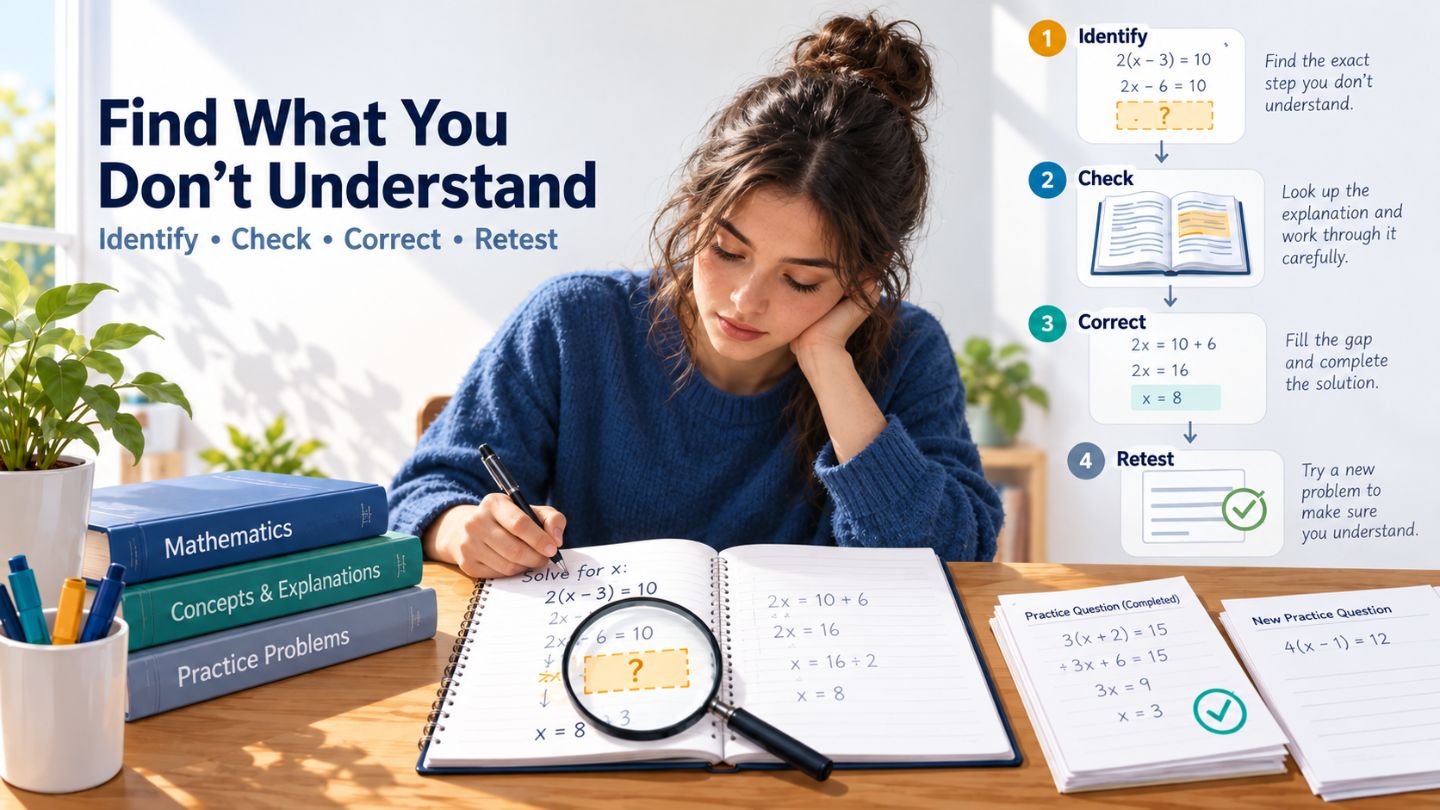
1. Identify the Concept Before Following the Method
Before studying a completed solution, determine what the question is testing.
For an algebra problem, this may involve equality, expressions, factors, or linear equations.
For a science problem, it may involve a physical law, a chemical relationship, or the interpretation of experimental information.
Identify what is given, what must be found, which concepts are relevant, and what conditions must hold for a particular method to work.
If the underlying concept is unfamiliar, begin with an explanation rather than attempting to memorize the complete solution.
This matters because repeated practice cannot reliably correct a misunderstanding that the learner has not identified.
2. Explain Important Steps in Your Own Words
While studying a worked example, identify the purpose of each significant step.
It is unnecessary to write a lengthy explanation for every elementary calculation.
Concentrate on decisions that determine the approach, such as selecting a formula, transforming an equation, or choosing a representation.
When solving a linear equation, explain why an operation preserves equality and how it helps isolate the required variable.
If a step cannot be explained, revisit the relevant concept before repeating the procedure.
A brief explanation can reveal whether the learner understands the reasoning or is following a familiar pattern.
3. Attempt a Related Question Without the Solution
After studying an example, hide the answer and attempt a related problem.
Begin with a question using the same underlying principle but containing changed details.
The goal is to determine whether the learner can identify the method and complete the procedure without seeing the original answer.
If the attempt becomes difficult, identify where the difficulty begins.
A student who understands the method but makes an arithmetic mistake needs different support from someone who cannot determine which method applies.
When necessary, return to the example or request a limited hint. Then attempt another related question independently.
Using guidance when needed is part of learning. It does not make independent reasoning less important.
4. Practise Choosing Between Different Methods
Once individual methods are familiar, practise selecting among them.
A textbook exercise containing one type of equation can provide useful procedural practice. However, the surrounding lesson often reveals which method is expected.
A mixed exercise changes that condition.
Students must recognize the mathematical structure before choosing a procedure.
For example, after learning substitution and elimination separately, a student can practise systems of equations that require deciding which method is more convenient.
Writing a brief reason for that choice can make the decision explicit.
Mixed practice is most appropriate after the relevant methods have been introduced and understood. Combining several unfamiliar procedures too early may make it harder to identify what the learner needs to study.
5. Check the Reasoning, Not Only the Final Answer
Checking an answer involves more than comparing it with the textbook solution.
A correct numerical result does not establish that every step was justified. An incorrect result may arise from a calculation mistake even when the method was appropriate.
Review the attempt to identify whether the difficulty involved understanding the question, selecting the method, applying a principle, performing a calculation, or interpreting the result.
The corrective action depends on the source of the error.
A calculation mistake may call for procedural practice. Choosing an unsuitable formula may require reviewing its conditions of use. Misunderstanding the question may require closer attention to definitions and relationships.
In mathematics, substituting a proposed solution into the original equation can sometimes help verify the result.
In science, checking units, assumptions, and the reasonableness of an answer can reveal additional errors.
The appropriate checking method depends on the task.
6. Return to the Topic After a Delay
Revisit previously studied concepts through questions that are not exact copies of the original examples.
This allows learners to assess whether they can retrieve and apply the knowledge without relying on recent exposure.
When reviewing an earlier topic, include a question requiring a decision about which method applies.
If the method has been forgotten, review the relevant explanation and attempt another problem.
If the method is remembered but the procedure remains unreliable, practise the specific operation causing difficulty.
Delayed practice can reveal weaknesses that remain unnoticed when learners repeatedly study the same answer in one sitting.
How to Recognize and Correct Learning Gaps
Different problem-solving difficulties require different responses.
A learner who remembers procedures but cannot select them needs different practice from someone who understands the appropriate method but makes repeated calculation errors.
|
Learning Difficulty |
More Useful Response |
|---|---|
|
Remembering steps without understanding why they work |
Review the underlying principle and explain the steps |
|
Knowing several methods but selecting the wrong one |
Compare question types and their conditions of use |
|
Choosing the correct method but making calculation errors |
Practise the relevant procedure and check intermediate steps |
|
Solving immediately after revision but forgetting later |
Return to the topic through delayed practice |
|
Being unable to begin an unfamiliar question |
Identify missing prerequisite knowledge and study a guided example |
These distinctions help students interpret mistakes more accurately.
Why Understanding an Example May Not Be Enough
Understanding one worked example does not establish readiness for every related question.
A new problem may involve a principle the original example did not cover.
It may use unfamiliar wording, present information differently, or require several concepts to be combined.
A learner who cannot determine where to begin may benefit from comparing the new question with a previously solved example and identifying what the questions have in common.
If that comparison does not reveal a suitable approach, additional explanation or guided practice may be necessary.
The difficulty may concern recognizing the relevant method rather than performing it.
Treating these as separate learning needs helps students avoid spending time repeating exercises that do not address the source of confusion.
What Students Can Learn From Incorrect Answers
An incorrect answer provides useful information when the learner can identify what went wrong.
For example, a student who chooses the wrong formula may need conceptual clarification. Another who uses the correct formula but substitutes the wrong value may need practice interpreting the information given.
Simply copying the correct solution does not distinguish between these problems.
Students can review an error by identifying the first point at which their reasoning differed from a valid solution.
When that point is unclear, a teacher, tutor, or worked explanation can help establish what needs to change.
The aim is not to eliminate errors from practice. It is to make corrections understandable and useful for later questions.
When Independent Problem-Solving Is Less Effective
Independent problem-solving is not the most useful starting point when learners lack the knowledge required to make sense of a task.
There is a difference between a challenging question that encourages reasoning and one that requires concepts the student has not yet learned.
Difficulty Does Not Automatically Produce Understanding
A demanding problem can encourage learners to examine assumptions, test possible approaches, and connect relevant ideas.
However, encountering difficulty does not establish that productive learning is occurring.
If students lack essential knowledge or receive insufficient feedback, repeated unsuccessful attempts may offer limited understanding.
Guided instruction, worked examples, and partial solutions can provide a more appropriate starting point.
As learners develop relevant knowledge, they can take greater responsibility for selecting and applying methods independently.
The appropriate balance depends on the learner's experience and the nature of the task.
Some Learning Tasks Require Accurate Recall
Certain educational tasks depend heavily on recalling established information or following defined procedures.
Students preparing for timed examinations may need sufficient procedural fluency to perform familiar calculations efficiently.
Similarly, scientific and technical activities may require following specified methods accurately rather than developing alternative procedures.
Independent reasoning remains important for recognizing when a procedure applies, interpreting results, and identifying its limitations.
Routine practice and memorization are not inferior forms of learning when they serve a legitimate purpose.
The concern arises when reproducing familiar responses becomes the learner's main preparation for tasks requiring independent decisions.
Understanding Does Not Remove the Need for Guidance
Even students with strong conceptual understanding may encounter questions requiring knowledge they have not yet acquired.
A learner who understands ratios may need additional scientific knowledge to interpret a complicated experiment.
A student who understands an algebraic procedure may still require instruction before applying it to a substantially different mathematical topic.
Strong problem-solving ability does not mean solving every unfamiliar task without assistance.
Recognizing what is known, identifying missing information, and seeking appropriate guidance are also parts of responsible problem-solving.
References
1. National Research Council. (2001). Adding It Up: Helping Children Learn Mathematics. National Academies Press.
2. National Research Council. (2000). How People Learn: Brain, Mind, Experience, and School: Expanded Edition. National Academies Press.
3. Pashler, H., Bain, P. M., Bottge, B. A., et al. (2007). Organizing Instruction and Study to Improve Student Learning. Institute of Education Sciences, US Department of Education.
4. Chi, M. T. H., Bassok, M., Lewis, M. W., Reimann, P., and Glaser, R. (1989). Self-Explanations: How Students Study and Use Examples in Learning to Solve Problems. Cognitive Science, 13(2), 145–182.
5. Rittle-Johnson, B., and Star, J. R. (2007). Does Comparing Solution Methods Facilitate Conceptual and Procedural Knowledge? An Experimental Study on Learning to Solve Equations. Journal of Educational Psychology, 99(3), 561–574. DOI: 10.1037/0022-0663.99.3.561
6. Dunlosky, J., Rawson, K. A., Marsh, E. J., Nathan, M. J., and Willingham, D. T. (2013). Improving Students' Learning With Effective Learning Techniques: Promising Directions From Cognitive and Educational Psychology. Psychological Science in the Public Interest, 14(1), 4–58.
7. Butler, A. C. (2010). Repeated Testing Produces Superior Transfer of Learning Relative to Repeated Studying. Journal of Experimental Psychology: Learning, Memory, and Cognition, 36(5), 1118–1133.






Comments 0
No comments yet. Be the first to start the conversation.