




A chapter can feel clear while the page is open and become surprisingly difficult to explain once you close it. Notes look familiar. A worked example seems obvious. You may even predict that you will remember the material later.
Then you try to produce it without the book, slides, or answer key, and important parts disappear.
The problem is often not that nothing was learned. It is that familiarity during study can be mistaken for the ability to retrieve knowledge later. Seeing an answer again and producing it without the source place different demands on memory.
Research on learning points to a more useful study pattern: understand a manageable amount of material, retrieve it without looking, check the attempt, correct errors, and return to the material in later sessions. Retrieval practice and spacing have been studied across laboratory and educational settings, and reviews identify both as well-supported approaches for improving later retention.
Answer Summary: To remember what you study for longer, learn a small unit for meaning, close the source and retrieve it, check and correct your response, then retrieve it again in later spaced sessions. Match the retrieval task to the material: recall facts, explain concepts, solve fresh problems, reconstruct diagrams, or build arguments. There is no universal review calendar; useful spacing depends on the retention goal, material, and how successfully it is being recalled.
Table of Content
- Why Familiar Material Can Still Be Hard to Remember
- The Retention Loop: Understand, Retrieve, Check, Space, Repeat
- What Active Recall Actually Looks Like
- How to Space Review Without a Fixed Calendar
- Match the Retrieval Method to the Material
- Where Self-Explanation and Interleaving Help
- What Rereading, Highlighting, and Notes Are Still Useful For
- Why Active Recall Sometimes Gives Weak Results
- How to Tell Whether Learning Is Becoming Durable
- A Repeatable Study Session
- A Final Self-Test Before You Call Something Learned
- Conclusion
- Reference
Key Takeaways:
-
Familiarity with material does not prove that you can retrieve it independently.
-
Retrieval practice requires producing an answer before looking at the source.
-
Checking matters because retrieval attempts can be incomplete or wrong.
-
Spacing distributes practice across time rather than concentrating it in one sitting.
-
There is no single evidence-based review schedule that fits every learner and subject.
-
Retrieval should resemble the kind of thinking the final task requires.
-
Self-explanation and interleaving can help in appropriate situations, but neither replaces retrieval and spaced practice.
Why Familiar Material Can Still Be Hard to Remember
Material can feel well learned while the source is visible because the source itself provides cues. Closing it removes those cues and gives you a better test of what can be produced independently.
Recognition is not the same as retrieval
Suppose you reread a definition three times. Each pass becomes easier because you have seen the wording before. That increased familiarity can feel like progress.
Now close the book and define the term without looking. If the answer becomes vague, the earlier ease did not fully reflect your ability to retrieve it.
A similar problem occurs with worked examples. Following a completed mathematics solution can create a clear sense of understanding because each step is already supplied. Solving a comparable problem independently requires you to decide what information matters, select an approach, and carry it out.
Retrieval practice directly exercises the ability to bring previously learned information back to mind. In a 2021 systematic review, Pooja Agarwal, Ludmila Nunes, and Janell Blunt screened nearly 2,000 abstracts and analysed 50 classroom experiments involving 5,374 learners. Most of the reported effects favoured retrieval practice, although the authors also noted that only a small share of the experiments came from non-WEIRD countries. The evidence therefore supports retrieval practice across many educational settings without establishing that its effects are identical for every learner, subject, or culture.
The practical lesson is not that recognition is useless. Recognition helps during learning. It is simply a weaker test of whether you will be able to produce the knowledge later.
Forgetting cannot be reduced to one percentage
Claims such as “you forget a fixed percentage of what you learn after 24 hours” should not be treated as universal rules.
Forgetting depends on many factors, including the material, prior knowledge, how it was learned, whether it was retrieved later, and how long the delay is. A single percentage cannot describe all of those conditions.
A more useful question is measurable at the individual level: after some time has passed, what can you still retrieve accurately without the source?
That question turns forgetting from an abstract prediction into information you can use when planning the next study session.
The Retention Loop: Understand, Retrieve, Check, Space, Repeat
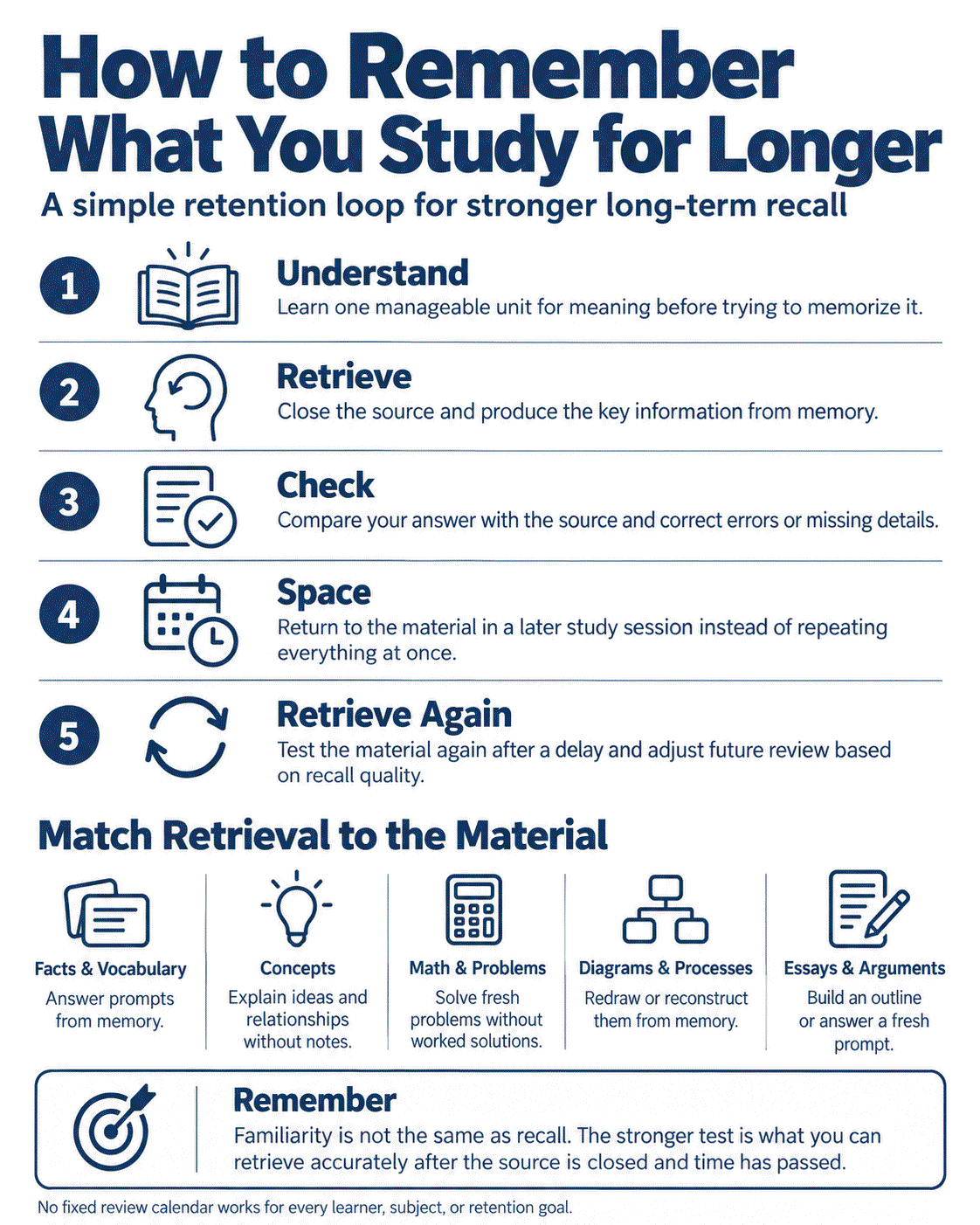
A practical system for long-term retention has five parts: understand, retrieve, check, space, and retrieve again.
The sequence is useful because each stage addresses a different weakness. Understanding develops meaning. Retrieval tests access. Checking protects accuracy. Spacing moves practice beyond the immediate study context. Later retrieval tests whether the knowledge survived the delay.
1. Understand a manageable unit
Begin with a small enough section that you can understand and test it properly.
That might be:
-
one textbook concept;
-
one group of related definitions;
-
one process or sequence;
-
one formula and the conditions under which it applies;
-
one worked example;
-
one part of a larger argument.
The goal is not to memorise every sentence. Identify the main idea, how its parts connect, and what you would need to explain or do with it.
For conceptual material, ask what the idea means and why it matters.
For quantitative material, examine why each step in an example is valid rather than simply copying the procedure.
For a process, identify the stages and how one stage leads to another.
Do not wait until you have read an entire long chapter before checking what survived. Smaller units make gaps easier to diagnose.
2. Close the source and retrieve
Once the material makes sense, remove the source.
Do not look at the answer while trying to remember it. Instead, produce as much as you can from memory.
Depending on the subject, retrieval might mean:
-
writing what you remember on a blank page;
-
answering questions without notes;
-
explaining a concept aloud;
-
solving a problem without a worked example;
-
drawing and labelling a diagram;
-
reconstructing a sequence;
-
outlining an argument.
This is retrieval practice, commonly called active recall in student study advice.
The important feature is not the tool. It is the act of producing information from memory before the answer is shown. A flashcard therefore becomes retrieval practice only when you genuinely attempt the answer before turning it over.
A broad review by Carpenter, Pan, and Butler summarises evidence for retrieval practice and spacing across different learning domains and educational applications.
For a more focused comparison, see active recall vs rereading.
3. Check the answer and repair errors
After the retrieval attempt, reopen a reliable source and compare it with what you produced.
Separate the result into three categories:
-
correct;
-
incomplete;
-
incorrect.
This makes the next study action much clearer.
If a definition was incomplete, identify the missing condition. If a diagram had two labels reversed, correct those labels. If a calculation went wrong, locate the step where the reasoning changed. If an explanation lacked an important causal link, add that relationship rather than rereading the entire chapter.
Retrieval without checking can leave misconceptions or factual errors unresolved. Feedback is therefore part of the learning cycle, not an optional final step.
Checking also prevents an unproductive version of active recall in which a learner repeatedly guesses at material without establishing what the correct answer actually is.
4. Return after a delay
After the initial learning and checking, return to the material in another study period.
Spacing means distributing learning or retrieval events across time rather than completing all repetitions in one concentrated block.
Research does not support one universal sequence such as reviewing everything after exactly one day, then three days, then seven days. In a large spacing study involving more than 1,350 participants, Nicholas Cepeda and colleagues found that the gap associated with stronger later performance varied with the length of the final retention interval. Longer retention goals generally called for longer useful study gaps.
That finding is more useful than a rigid calendar because it establishes a principle rather than a fixed timetable: review timing should relate to how long the information needs to remain available.
For a deeper explanation of review scheduling, see spaced repetition for long-term memory.
5. Retrieve it again in later sessions
When you return, begin with retrieval rather than rereading.
Try the question, explanation, diagram, or problem first. Then check it.
If the response remains accurate after a delay, it has passed a harder test than immediate recall. If major parts are missing, correct them and bring the material back sooner.
Researchers sometimes describe an integrated approach of achieving correct retrieval and then repeating successful retrieval across spaced sessions as successive relearning. The concept is useful because it combines two important ideas: recall should eventually be correct, and it should succeed more than once across time.
The goal is not endless repetition. It is to keep testing material until it remains accessible at the level required for the task.
What Active Recall Actually Looks Like
Active recall is not a synonym for flashcards. Retrieval can be adapted to almost any subject as long as you first remove the answer and attempt to produce the relevant knowledge or skill.
Use free recall for connected ideas
Free recall is useful when a topic contains several linked points.
After studying a section, close the material and write everything important you can reconstruct. Then compare your response with the source.
For a history topic, that may include events, causes, consequences, and relationships.
For a science chapter, it may include the major concepts, mechanisms, and conditions.
For a theory-based subject, it may include the central claim and the reasoning that supports it.
The advantage of free recall is that it reveals structural gaps. You may remember individual terms but discover that you cannot explain how they fit together.
Use question-and-answer prompts for bounded knowledge
Some material is naturally suited to short prompts:
-
terminology;
-
vocabulary;
-
dates;
-
symbols;
-
formulas;
-
rules;
-
classifications.
The prompt should require you to produce the answer rather than simply recognise it.
For richer concepts, move beyond a copied textbook heading. Instead of asking only “What is X?”, also ask questions such as:
-
Why does X happen?
-
Under what conditions does X apply?
-
How is X different from Y?
-
What would change if this condition changed?
A good prompt tests the knowledge you are expected to use later.
Solve problems without the worked solution
For mathematics, statistics, physics, chemistry, economics, programming, and similar subjects, retrieval often involves performing a procedure rather than recalling a sentence.
Worked examples are useful while learning. They become less useful as a test when the solution remains visible.
After studying an example:
-
hide the solution;
-
attempt a comparable problem independently;
-
choose the method yourself;
-
complete the steps;
-
compare your work with the correct solution.
Later, mix different types of problems so that the appropriate method is not announced in advance.
This distinction matters because knowing how to perform a method after being told which one to use is not the same as recognising when that method applies.
Reconstruct diagrams and sequences
For visual or ordered material, reproduce the structure rather than rereading its labels.
You might:
-
redraw a biological process;
-
label an anatomical diagram;
-
reconstruct a circuit;
-
reproduce a map;
-
arrange stages of a cycle;
-
write a procedure in the correct order.
Then compare your reconstruction with the source.
The comparison reveals exactly what disappeared from memory: a stage, label, direction, position, or relationship.
How to Space Review Without a Fixed Calendar
The most useful spacing plan is adaptive rather than rigid.
Two questions matter most: how long do you need to retain the information, and how successfully can you retrieve it now?
Match spacing to the retention goal
If knowledge needs to remain available for a longer period, reviews must eventually extend across longer intervals.
Cepeda and colleagues found that spacing and final retention interact: the study gap associated with stronger performance changes depending on when the final test occurs.
This is why a schedule copied from another student or an app should not be treated as a universal law.
A schedule can organise your work. It cannot remove the need to check whether recall is actually succeeding.
Use recall quality as practical feedback
After each attempt, ask what happened.
Did you retrieve the answer accurately?
Did you remember the main idea but miss important detail?
Did you need a cue?
Was the response mostly absent?
Did you retrieve something incorrect?
Those results can guide the next review. Material that remains accurate across delays can usually be revisited less frequently than material that repeatedly disappears.
This is a practical study heuristic rather than a scientifically fixed timing formula. There is no evidence-based point at which every learner can say, “This amount of difficulty means the next review must occur in exactly this many days.”
The purpose is simply to use performance, rather than habit alone, to guide attention.
Match the Retrieval Method to the Material
Retrieval works best when the practice requires the kind of knowledge or performance you will eventually need.
| Material | Retrieval method | What to check |
|---|---|---|
| Facts and vocabulary | Answer a prompt from memory, then verify it | Accuracy and meaning |
| Concepts and textbook theory | Explain the idea and its relationships without the source | Missing links, causes, conditions |
| Mathematics and quantitative work | Solve without viewing the worked solution | Method choice, steps, calculation |
| Diagrams and processes | Redraw, relabel, or reconstruct from memory | Order, position, labels, relationships |
| Essays and argument-based subjects | Build an outline or answer a fresh prompt | Claim, evidence, reasoning, structure |
The principle is not that practice must copy an examination perfectly. It is that practice should include the mental operation the final task requires.
If you need to write an argument, practise constructing arguments.
If you need to solve unfamiliar problems, practise deciding how to solve problems rather than merely recognising finished solutions.
If you need precise factual recall, use prompts that demand precise factual responses.
Where Self-Explanation and Interleaving Help
Self-explanation and interleaving can strengthen particular parts of learning, but neither should be presented as a universal study rule.
Self-explanation helps build relationships
Self-explanation means explaining to yourself why something works, how ideas connect, or what reasoning justifies a step.
A meta-analysis by Bisra and colleagues found an overall learning benefit from prompting self-explanation across a variety of learning conditions.
Useful questions include:
-
Why does this step follow?
-
What principle explains this result?
-
How does this idea connect to something learned earlier?
-
What changes if one assumption changes?
-
Why is this example different from the previous one?
Self-explanation is especially useful when you can repeat a statement but cannot explain its logic.
It supports understanding and organisation. It does not eliminate the need to retrieve the material later without the source.
Interleaving can help when distinctions matter
Interleaving means mixing related categories or problem types instead of completing a long block of one type before moving to another.
Its effects depend on the material.
A 2019 meta-analysis by Matthias Brunmair and Tobias Richter found an overall benefit for interleaved learning but substantial variation across tasks. Effects were stronger under some conditions, particularly when learners needed to distinguish relatively similar categories. Mathematical tasks showed a smaller positive effect, while some other materials produced weak, ambiguous, or even opposing results.
For a mathematics learner, interleaving might mean mixing several types of problems so the learner has to determine which method applies.
That is different from randomly mixing unrelated material. The educational value comes from practising useful distinctions, not from disorder for its own sake.
What Rereading, Highlighting, and Notes Are Still Useful For
Rereading, highlighting, and note-taking are not automatically poor study activities. Their role simply differs from retrieval.
Use passive review to support understanding
Rereading can be useful when:
-
a passage was difficult the first time;
-
terminology is unfamiliar;
-
you need to clarify a misunderstanding;
-
you are locating an important section before deeper study.
Highlighting can help identify definitions, evidence, claims, or relationships that deserve attention.
Note-taking can help organise material, particularly when you select, reformulate, and connect ideas rather than copying everything verbatim.
The problem is using these activities as proof that the material has been retained.
Reading the same notes repeatedly tells you how familiar the notes have become. It does not directly tell you whether the information can be retrieved when those notes are absent.
A stronger sequence is:
-
read for meaning;
-
make useful notes if needed;
-
close the source;
-
retrieve;
-
check;
-
correct;
-
retrieve again later.
For broader study-strategy context, see effective learning strategies for college students.
Why Active Recall Sometimes Gives Weak Results
Retrieval practice is not automatically effective simply because a learner labels an activity “active recall.” The quality of the prompt, feedback, timing, and task all matter.
Your cue gives away too much
A prompt that contains most of the answer can make recall artificially easy.
If the final task requires explanation or application, prompts should eventually require more than filling in an obvious missing word.
You look before making a genuine attempt
Checking the source is necessary. Checking it before attempting the answer is different.
First try to retrieve. Then verify.
If you cannot remember, that failure is useful information. It identifies what needs to be relearned.
You do all your retrieval in one sitting
Immediate practice can help establish and check newly learned material, but several successful attempts within one short session do not show that the information will remain accessible later.
Return in another session.
Spacing gives you information that massed practice cannot: whether recall survives time away from the material.
You do not correct mistakes
If an answer is wrong, do not simply move on.
Check the correct information, understand the discrepancy, and make the corrected version the target of future retrieval.
A study system that records only whether you attempted an answer, rather than whether the answer became accurate, misses an important part of the process.
You memorise wording without understanding relationships
Some learning requires exact wording, but many tasks require more.
A student may memorise a definition and still struggle when asked to:
-
apply it to an example;
-
compare it with another concept;
-
explain why it matters;
-
identify its limitations;
-
use it to solve a problem.
When application matters, add explanatory and problem-based retrieval alongside factual recall.
Your practice does not match the final task
A collection of single-fact flashcards may help with facts but will not by itself train essay construction.
Rereading programming code does not substitute for writing or debugging code.
Reviewing completed calculations does not substitute for solving unfamiliar problems.
The more complex the final performance, the more important it is to practise producing that performance rather than only its component facts.
For further classroom-focused examples, see retrieval practice in daily lessons.
How to Tell Whether Learning Is Becoming Durable
A useful test of learning removes support and introduces time.
Three questions can reveal whether knowledge is becoming more stable.
Can you retrieve it after a delay?
Return in a later session without reviewing first.
Write, explain, solve, or reconstruct what you remember. Then compare the result with the source.
The important evidence is what you produced before reopening the material.
Can you use it in a new question?
For knowledge that needs to transfer beyond exact repetition, try a fresh problem or prompt.
Do not change everything at once. The new task should be different enough to require genuine use of the concept while still testing what you studied.
If you can answer only examples that closely resemble the original, the learning may still depend heavily on those original cues.
Can you explain it accurately without notes?
Explain the topic in your own words without the source.
Then check the explanation.
Where does it become vague? Which connection is missing? Did you leave out an important condition? Did you introduce something that is not true?
Those gaps give the next session a specific purpose.
These tests are diagnostic. Passing them once does not prove that knowledge is permanent. They simply provide stronger evidence of learning than familiarity alone.
A Repeatable Study Session
You do not need a complicated system to apply these principles.
A study session can follow this sequence:
-
Study one manageable unit until its basic meaning is clear.
-
Close the source.
-
Retrieve the main ideas, steps, or relationships.
-
Check the response against a reliable source.
-
Correct specific errors or omissions.
-
Continue with other material instead of endlessly repeating the same item.
-
Return in a later session and retrieve the earlier material before reviewing it.
-
Adjust future attention according to what remained accurate and what was lost.
Example: a textbook chapter
Read one meaningful section rather than the whole chapter at once.
Close the book and write the main claim, important supporting points, and relationships from memory.
Reopen the text and compare.
Mark only the gaps.
Later, return to the section and retrieve it again before rereading.
Example: mathematics or another quantitative subject
Study a worked example until you understand why its steps are used.
Hide the solution.
Solve a comparable problem independently.
Check your method and answer.
In a later session, include that type of problem among other problem types so that you must also decide which method applies.
Example: vocabulary or definitions
Use a question or cue.
Produce the answer before viewing it.
Check exact meaning rather than accepting an answer simply because it sounds close.
Return to missed items sooner and continue testing stronger items after longer intervals.
The visible activity differs across subjects, but the underlying logic remains the same: understand, retrieve, check, space, and retrieve again.
A Final Self-Test Before You Call Something Learned
Before ending revision on a topic, remove the notes and ask:
-
Can I produce the central information without seeing it?
-
Can I explain how the important parts relate?
-
Can I identify what I am still uncertain about?
-
Can I correct my answer from a trustworthy source?
-
Can I retrieve the material again after time has passed?
-
Can I use it in the form required by the real task?
A “no” does not mean the entire topic must be studied again from the beginning.
It identifies the next target.
That is one of the practical advantages of retrieval: it does not only strengthen learning. It also reveals where learning remains incomplete.
Conclusion
Remembering what you study for longer is less about increasing the number of times you see the material and more about changing what happens after the first exposure.
Learn a manageable unit for meaning. Remove the source and retrieve it. Check what you produced. Correct errors. Return later and retrieve it again.
Then adapt the form of retrieval to the knowledge itself. Use short prompts for bounded facts, explanations for connected concepts, fresh problems for procedures, reconstruction for diagrams and sequences, and practice outlines for arguments.
No method eliminates forgetting, and no fixed review schedule works equally well for every learner and task. A stronger standard is whether knowledge remains accurate and accessible after the source is gone and time has passed.
That gives you something more useful than the feeling that studying went well: evidence of what you can actually retrieve.
Reference
-
Carpenter, S. K., Pan, S. C., & Butler, A. C. (2022). The Science of Effective Learning With Spacing and Retrieval Practice. Nature Reviews Psychology, 1, 496–511.
-
Agarwal, P. K., Nunes, L. D., & Blunt, J. R. (2021). Retrieval Practice Consistently Benefits Student Learning: A Systematic Review of Applied Research in Schools and Classrooms. Educational Psychology Review, 33, 1409–1453.
-
Cepeda, N. J., Vul, E., Rohrer, D., Wixted, J. T., & Pashler, H. (2008). Spacing Effects in Learning: A Temporal Ridgeline of Optimal Retention. Psychological Science, 19(11), 1095–1102.
-
Bisra, K., Liu, Q., Nesbit, J. C., Salimi, F., & Winne, P. H. (2018). Inducing Self-Explanation: A Meta-Analysis. Educational Psychology Review, 30, 703–725.
-
Brunmair, M., & Richter, T. (2019). Similarity Matters: A Meta-Analysis of Interleaved Learning and Its Moderators. Psychological Bulletin, 145(11), 1029–1052.





Comments 0
No comments yet. Be the first to start the conversation.