



Table of Content
- What After SEE?
- Educational Options After SEE
- Studying Under Plus Two (+2)
- Technical Education and Vocational Training (CTEVT - Diploma Course)
- Cambridge A-Level (Cambridge GCE A-Levels)
- A Comparative Snapshot
- Busting the Myths
- Who Should Choose Which Path? Practical Suggestions for Students and Parents
- Conclusion
What After SEE?
The Secondary Education Examination (SEE) is an extremely important and decisive point in shaping a student’s future within Nepal’s educational structure. Until about a decade ago, the SLC was called the “iron gate,” but today’s SEE has evolved into a “guiding crossroads” that measures a student’s learning level and interests while helping determine the direction of the future. Once students sit for the SEE, a major question arises in the minds of both students and parents: “What should I study next?”
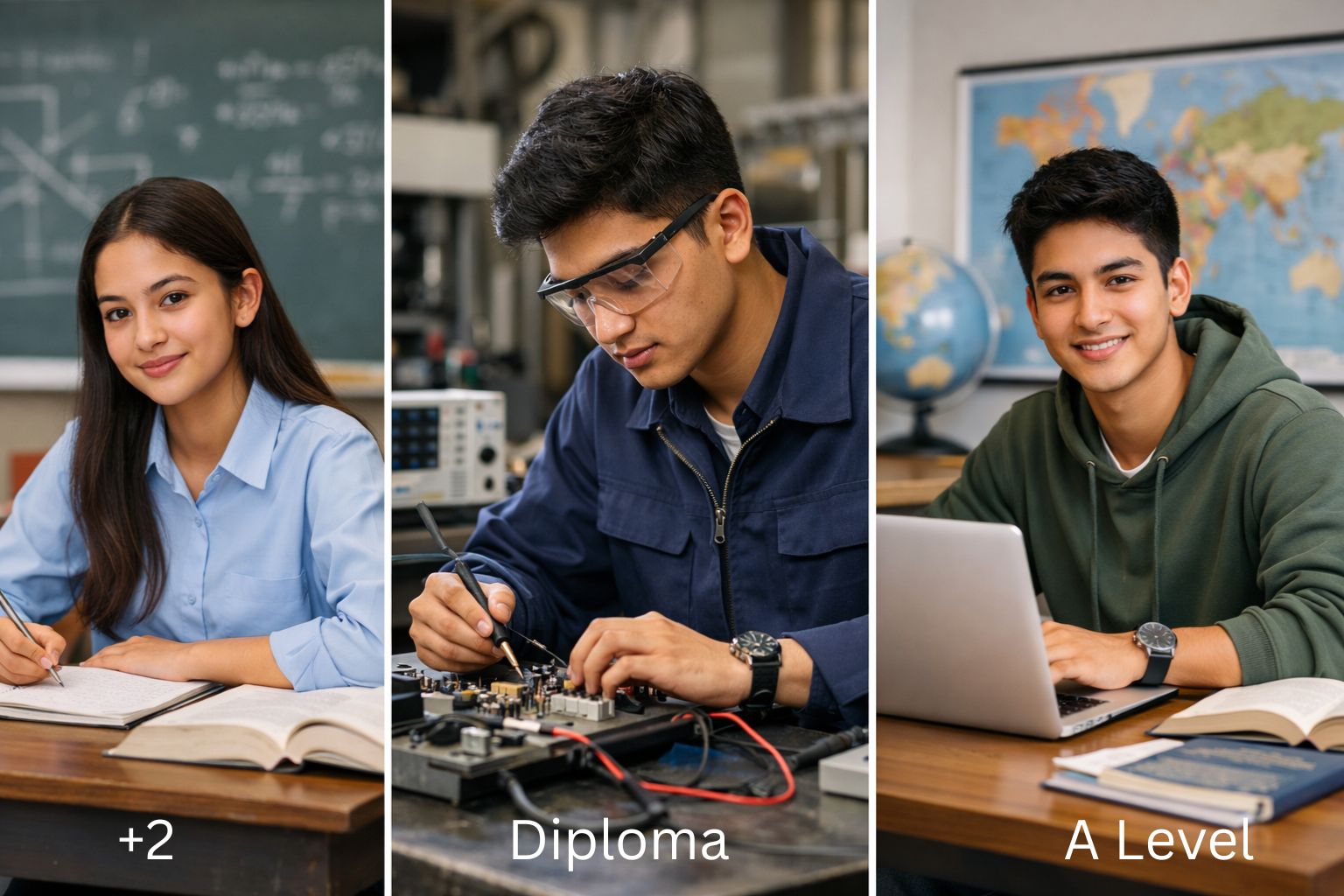
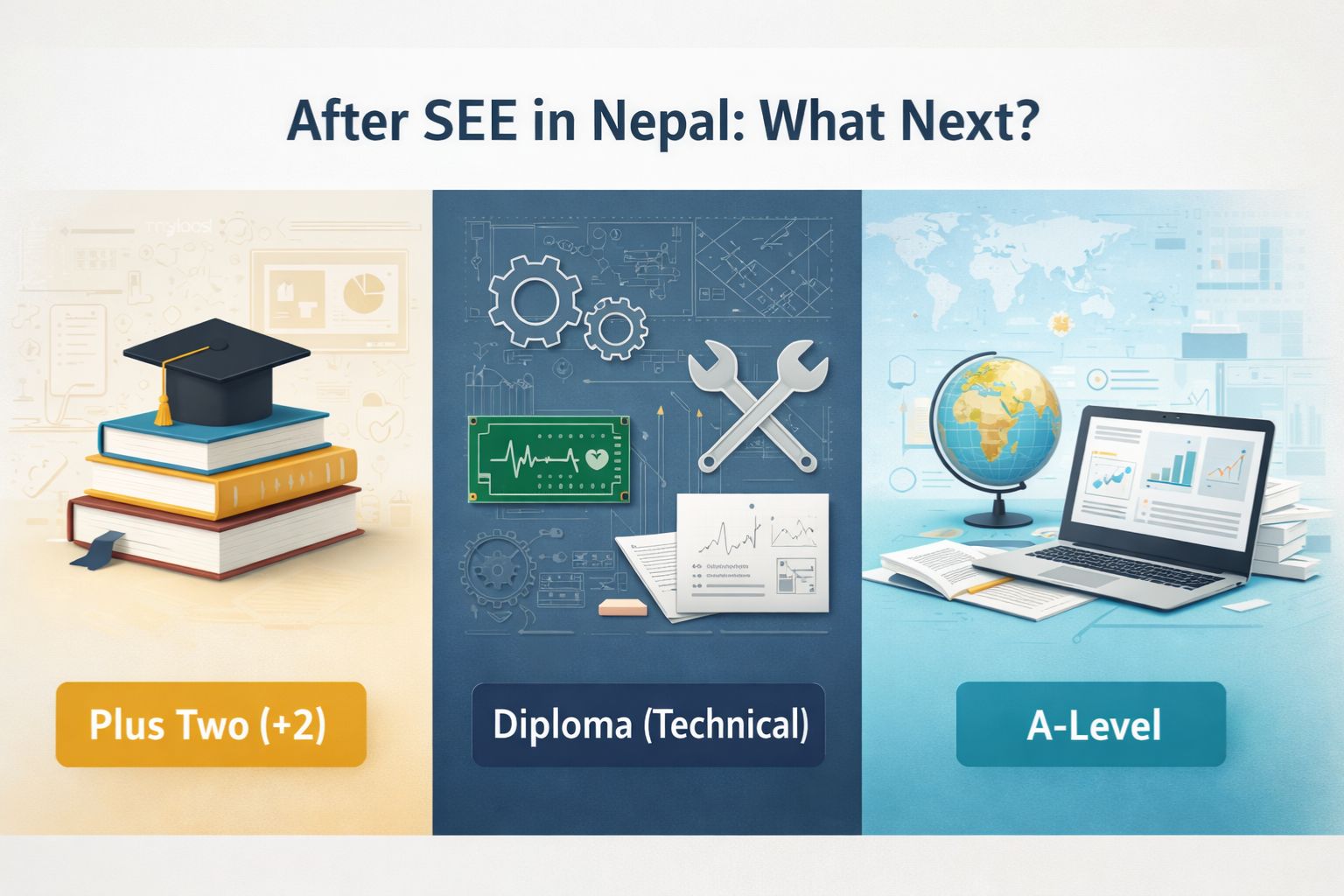
In Nepal’s current education landscape, students mainly have three strong and popular options:
1) Plus Two (+2) under the National Examination Board (NEB),
2) Three-year diploma courses under the Council for Technical Education and Vocational Training (CTEVT), and
3) The internationally recognized A-Level (GCE A-Levels) under Cambridge.
Each of these three academic pathways has its own nature, study style, financial investment, and future destination. The question of which path to choose does not depend on a right or wrong answer; rather, it depends on the student’s personal interests, abilities, family financial situation, and future goals.
In this detailed article, we will present an objective analysis of the overall structure of Plus Two (+2), technical education (Diploma), and A-Level, along with their strengths and weaknesses, estimated costs, employment prospects, and pathways to Nepali and foreign universities.
Educational Options After SEE
A few years ago, the Government of Nepal restructured school education and recognized Grades 9 to 12 as the secondary level. Technically, “Plus Two” (+2) is now an integral part of secondary education itself. However, in common Nepali usage and educational practice, Grades 11 and 12 are still viewed as a distinct stage.
On the other hand, as demand for skilled human resources has increased in both national and international labor markets, the importance of technical education (CTEVT) has been rising rapidly. In the age of globalization, A-Level has been providing an attractive international platform for students who want easier access to universities abroad.
Each of these streams aims to produce different kinds of human resources needed by society, the job market, and university research. Therefore, it is necessary to understand these options in depth before making a decision.
Studying Under Plus Two (+2)
In Nepal’s educational context, more than 80 percent of students enroll directly in Grade 11 after SEE, commonly known as Plus Two. Nepal’s National Examination Board (NEB) conducts the curriculum, examinations, and evaluation for Grades 11 and 12. It is a two-year program that builds a strong foundation for students to move on to the bachelor’s level.
Previously, Plus Two had a rigid division into separate faculties such as Science, Management, Humanities, and Education. However, under the new national curriculum, students now study compulsory subjects such as Nepali, English, and Social Studies/Life Skills Education, while choosing optional subjects from a list according to their interests rather than being strictly limited by a “stream” or faculty. Even so, in common practice, faculties are still largely identified on the basis of the main optional subjects.
Science Group
Students who choose the science stream after SEE study subjects such as Physics, Chemistry, Biology, Computer Science, and Mathematics.
This is almost a compulsory route for students who want to study medicine in the future, including MBBS, BDS, and Nursing, or engineering fields such as Civil, Computer, and Architecture, as well as Agriculture and Forestry. This stream requires a great deal of hard work, dedication, and a high level of practical effort.
Management Group
Management is the first choice for students who want to build a career in business, banking, entrepreneurship, Chartered Accountancy (CA), and hotel management. It includes subjects such as Accounting, Economics, Business Studies, Finance, and Travel and Tourism.
Because managerial human resources are in high demand worldwide, this group carries broad employment potential, especially for students interested in management studies after Grade 12.
Law Group
In recent years, the practice of taking Law as a subject from Grade 11 itself has grown significantly in Nepal. For those who want to become legal professionals, lawyers, judges, or legal advisors in the future, this provides an excellent foundation.
Humanities and Education Group
Students who are interested in language, literature, political science, sociology, mass communication, and the teaching profession may choose Humanities and Education. Those who study these subjects have opportunities to become scholars, researchers, journalists, and capable figures at the policy-making level, with diverse career options in humanities.
Strengths
-
Compatibility with Nepal: This system is designed entirely for the Nepali context and aligns closely with the entrance examinations of universities in Nepal, such as Tribhuvan University and Kathmandu University.
-
Low cost: Compared to the other options, it is much more affordable. Plus Two can be completed at a very low fee in government schools, and even private colleges offer a range of fee levels.
-
Subject flexibility: It is difficult for students of around 16 years of age to make an immediate lifelong professional decision. Students who complete Plus Two retain a considerable degree of freedom to change disciplines at the bachelor’s level. For example, a student from Science may move into Management later.
Challenges
-
Rote-learning culture: Nepal’s educational system has still not been fully freed from a theoretical and memorization-based style of learning.
-
Limited immediate employability: It can be difficult to gain practical skills directly linked to employment while studying Plus Two alone, so students may need to wait until at least the bachelor’s level to access stronger job opportunities.
Technical Education and Vocational Training (CTEVT - Diploma Course)

For students who want to acquire technical skills immediately along with academic qualifications right after secondary education, the three-year diploma courses under CTEVT are an excellent option.
These programs are designed to produce middle-level manpower capable of working directly according to immediate market demand. Students who meet the criteria set by the government based on their SEE scores can take the entrance examination and gain admission to these courses.
In Nepal, the major three-year diploma programs currently in operation are mainly divided into health, engineering, agriculture/forestry, and hospitality. Students interested in technical and skill-based education under CTEVT often consider the following areas:
Engineering
Diploma in Civil, Computer, Electrical, Mechanical, Automobile, and Geomatics (Survey) Engineering. After completing these courses, students become qualified to work as sub-engineers or overseers.
Health Sciences
This includes Health Assistant (General Medicine - HA), Staff Nurse (PCL Nursing), Pharmacy, Lab Technology (CMLT), Radiography, and Dental Hygienist. Because demand for middle-level health manpower remains consistently high across Nepal and abroad, these subjects are considered highly competitive.
Agriculture and Forestry
Diploma in Agriculture, including plant and animal science, and Diploma in Forestry.
Other Skill-Based Fields
Hotel Management, Entrepreneurship, and Information Technology.
Strengths
-
Quick path to employment: Immediately after completing the three-year diploma, students can become self-employed or begin jobs in the government or private sector with attractive salaries at the age of 19 or 20.
-
Recognition by the Public Service Commission: After passing a diploma, students can directly compete in Public Service Commission examinations for fifth-level government positions, such as Nayab Subba or Sub-Engineer posts.
-
Earn While You Learn: Those who complete this level can work and support themselves while pursuing a bachelor’s degree. Because strong emphasis is placed on practical classes, the learning is not limited to textbook knowledge.
Challenges
-
Longer duration: Plus Two is completed in two years, but this course requires three years, and in some cases about three and a half years including practical components.
-
Some technical hurdles in higher education: Although universities such as Tribhuvan University now fully allow diploma graduates to pursue related bachelor’s programs such as B.E., B.Sc. Nursing, and B.Sc. Ag, some credit-matching issues may arise if a student wants to shift to a different faculty.
-
Higher cost: Compared with general subjects in Plus Two, technical education, especially in health and engineering, can be quite expensive. Competition in entrance examinations is also extremely high.
Cambridge A-Level (Cambridge GCE A-Levels)
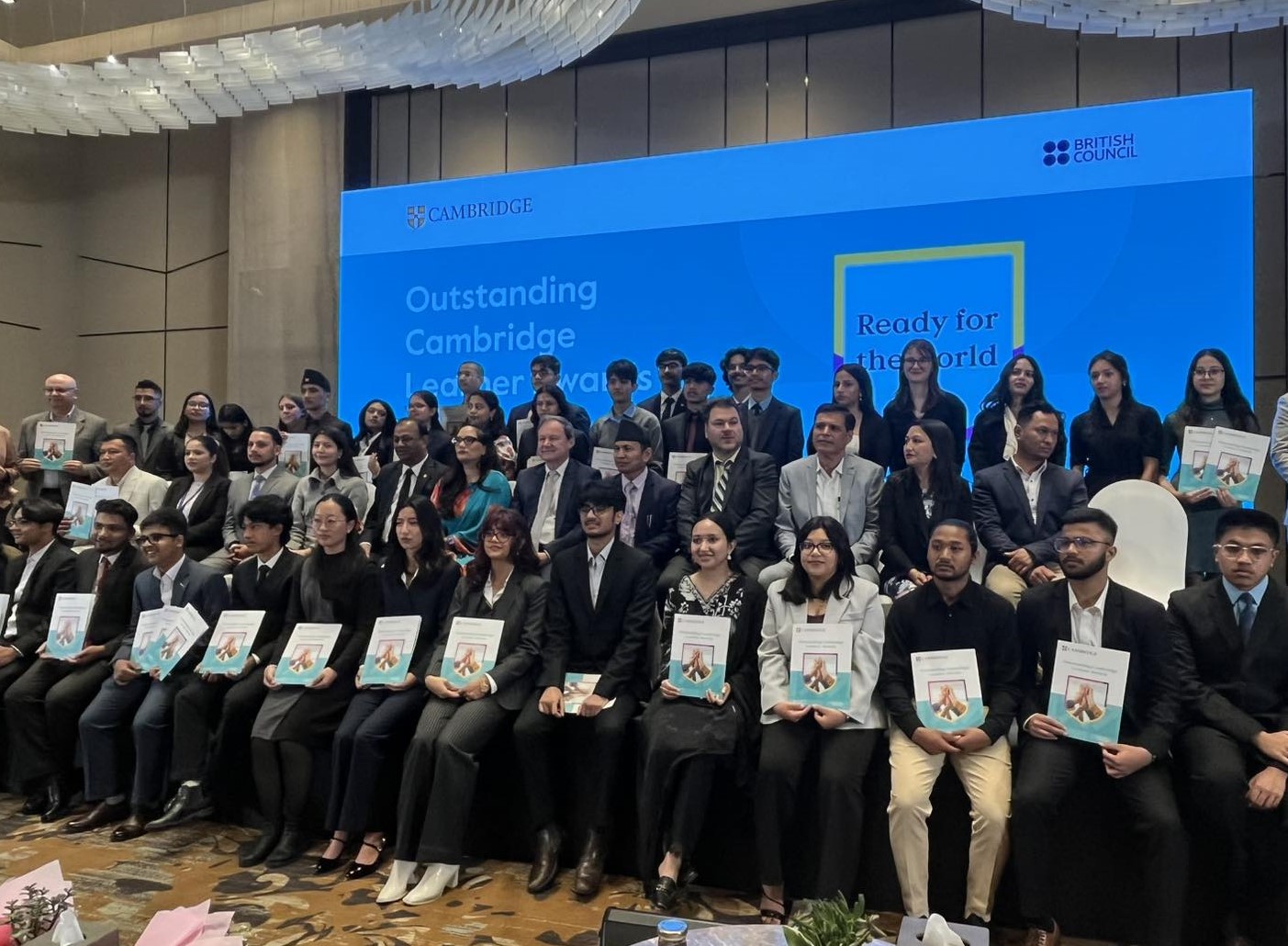
If a student wants to move beyond the framework of the Nepali curriculum and pursue an international secondary education that is creative, research-oriented, and widely recognized around the world, then A-Level is an excellent choice. The A-Level course, conducted by Cambridge Assessment International Education (CAIE), is a two-year program.
Its first year is called the AS Level and the second year is called the A2 Level. At the end of both years, question papers are prepared under Cambridge’s direct regulation, examinations are held simultaneously across the world, answer sheets are checked in the UK, and results are issued in grades. In Nepal, dozens of prestigious schools offer A-Level in cooperation with the British Council.
Study Style and Subject Choice
The greatest attraction of A-Level is the subject freedom it offers. Students are not confined to one specific faculty or stream. Apart from the compulsory General Paper, students may take 3 or 4 optional subjects. For example, depending on personal interest, a student may combine Mathematics or Physics with Art, Music, Psychology, or Economics.
Strengths
-
Ease in university admission: Top universities such as Oxford, Harvard, MIT, as well as leading universities in Australia and Canada, give high priority to A-Level. It can be especially beneficial for undergraduate admission and scholarships abroad.
-
An end to rote learning: This curriculum is designed to promote critical analysis of concepts and logical answers rather than simple memorization of facts.
-
Recognition within Nepal as well: It receives equivalence to Plus Two at universities such as Tribhuvan University and Kathmandu University. There are many examples of A-Level students successfully sitting for and qualifying in the IOE and IOM (IOE / MECEE) entrance examinations.
Challenges
-
Very expensive: Because foreign university fees are often calculated in dollars or pounds, and lab and examination fees are also high, A-Level can be financially very expensive for ordinary citizens.
-
High academic rigor: Since this course is based not only on study but also on research, it demands a great deal of independent learning. Many Nepali students who come only from a rote-learning background may find it very difficult to understand its pattern in the initial months.
A Comparative Snapshot
To clearly understand what each course is like, it is effective to compare them on the basis of several standards.
1. Duration
Plus Two takes two years, and A-Level is also basically completed in two years. However, a CTEVT diploma requires three years. If a student plans to go abroad for higher education, this fact becomes very important in terms of age and study-year calculations.
2. Cost and Scholarships
The cheapest and least financially burdensome option is Nepal’s own Plus Two structure. In government and community schools, Plus Two can be completed at zero or minimal cost.
In the case of CTEVT as well, the government sets aside seats every year under classified free scholarships, allowing thousands of students to study technical subjects completely free of cost on the basis of entrance examinations, which is a major support for poor and targeted groups. However, studying technical subjects such as HA or Nursing in private colleges may cost several hundred thousand rupees.
A-Level is the most expensive in this sense, though some major colleges also provide full scholarships to the best students across Nepal.
3. Curriculum Approach
Plus Two emphasizes the traditional Nepali classroom culture and teaches a broad range of content. Diploma education, however, is based on 60 percent practicals and 40 percent theory, which directly teaches work skills.
In A-Level, students study fewer subjects in greater depth through research-oriented case studies and project work, which develops critical thinking and analytical ability.
Busting the Myths
While choosing a career, students in Nepali society are highly likely to become victims of certain misconceptions or myths. To make the right decision, these misunderstandings must be broken.
Myth 1:
“Students with good marks should study Science, those with average marks should study Commerce or Management, and weak students should study Arts, Humanities, or technical education.”
Reality: This is one of the most dangerous and absurd misconceptions deeply rooted in Nepal. The choice of academic subject should be determined by a student’s interest and the nature of the work they want to do in the future, not by marks alone. Many students with excellent grades have become top Chartered Accountants in the world, while Humanities remains outstanding for leadership in fields such as linguistics, law, policy-making, and sociology. Therefore, dividing subjects into a “grade hierarchy” is completely wrong.
Myth 2:
“Students who study a CTEVT diploma cannot go abroad or pursue a bachelor’s degree.”
Reality: In universities such as Tribhuvan University, Kathmandu University, and Pokhara University, diploma graduates have already been given legal recognition to enroll in bachelor’s programs through entrance examinations. For example, a student who studied Diploma in Civil Engineering can fully pursue a B.E. in Civil Engineering. They also go abroad after credential evaluation.
Myth 3:
“Without studying A-Level, you cannot enter top universities in Europe or America.”
Reality: Yes, A-Level does make the admission process somewhat easier, and because the Cambridge syllabus closely matches the learning model of Western countries, A-Level students often adjust more quickly. However, every year, hundreds of thousands of students who completed Plus Two under the Nepal Board also study at excellent universities in countries such as the United States, the United Kingdom, and Australia, often on scholarships.
Who Should Choose Which Path? Practical Suggestions for Students and Parents
Every student has their own aptitude and family background. Therefore, one student should not blindly imitate another just because someone else’s child chose a certain field. It is appropriate to make a subject choice only after serious discussion within the family based on the points below.
A. For those who want to build a strong theoretical and technical base in Nepal
If you have a firm goal of becoming an excellent engineer, doctor, banker, or government officer in Nepal in the future, and if you want to move ahead with moderate financial investment, then studying Plus Two under the National Examination Board (NEB) is the best option without any hesitation.
Since many questions in Nepal’s entrance examinations are based on the Nepali curriculum, Plus Two students often prove strong in competition.
B. For those who want quick employment, skills, and self-reliance
If you prefer learning by directly working with tools, patients, farmland, or computer coding rather than merely memorizing textbook content, or if you want to become self-reliant by gaining skills or a paying job immediately after three years of study, then the three-year diploma under CTEVT may be one of the best decisions of your life.
For those who may not have the possibility of spending many years in university due to moderate or weak financial conditions, the diploma level is a targeted employment path. It is also a shortcut route for those interested in government employment.
C. For those who want global exposure, wider learning, and deep academic inquiry
If you have the energy for rigorous study, enjoy combining different and even unrelated subjects, such as Science together with Art or Music, and if your family can afford to spend several hundred thousand rupees on a foreign curriculum, then you can confidently choose A-Level.
Those who want to develop understanding and problem-solving skills rather than rote memorization can gain maximum benefit from A-Level. Likewise, if there is already a firm plan to pursue higher education in a developed country under any condition, this transition can be very helpful.
A Special Appeal to Parents
Children aged 16 to 17 who have just passed SEE are often under strong peer pressure. The belief that “my friend is studying this subject in that college, so I will do the same” is a normal and realistic feature of adolescent psychology. Therefore, parents should not impose decisions or issue commands.
Instead, they should arrange discussions with career counselors, seniors who have already studied the subject successfully, or college experts. Children should also be given time to explore on their own and reflect before deciding.
Conclusion
In conclusion, there is no single path after SEE that is simply “bigger” or “better” than the others. A subject or course that is good and suitable for one student may prove boring, financially burdensome, and inappropriate for another.
Nepal Board’s Plus Two is a reliable and broad highway from which multi-lane roads open toward all kinds of fields, both within Nepal and abroad.
The technical diploma is that specialized trail which can take a person to the destination the fastest, placing skills in the hands, expertise in life, and income in the pocket.
And A-Level is that expressway which creates direct intellectual alignment with global academia and international thinking.
The important question is not only which vehicle you boarded, but whether you have a clear map of the destination you want to reach. At this crucial moment of building your future, do adequate research, understand your strengths, and move forward on the educational path that suits you best while staying grounded in reality. Success is waiting for you.







Comments 0
No comments yet. Be the first to start the conversation.