Overview
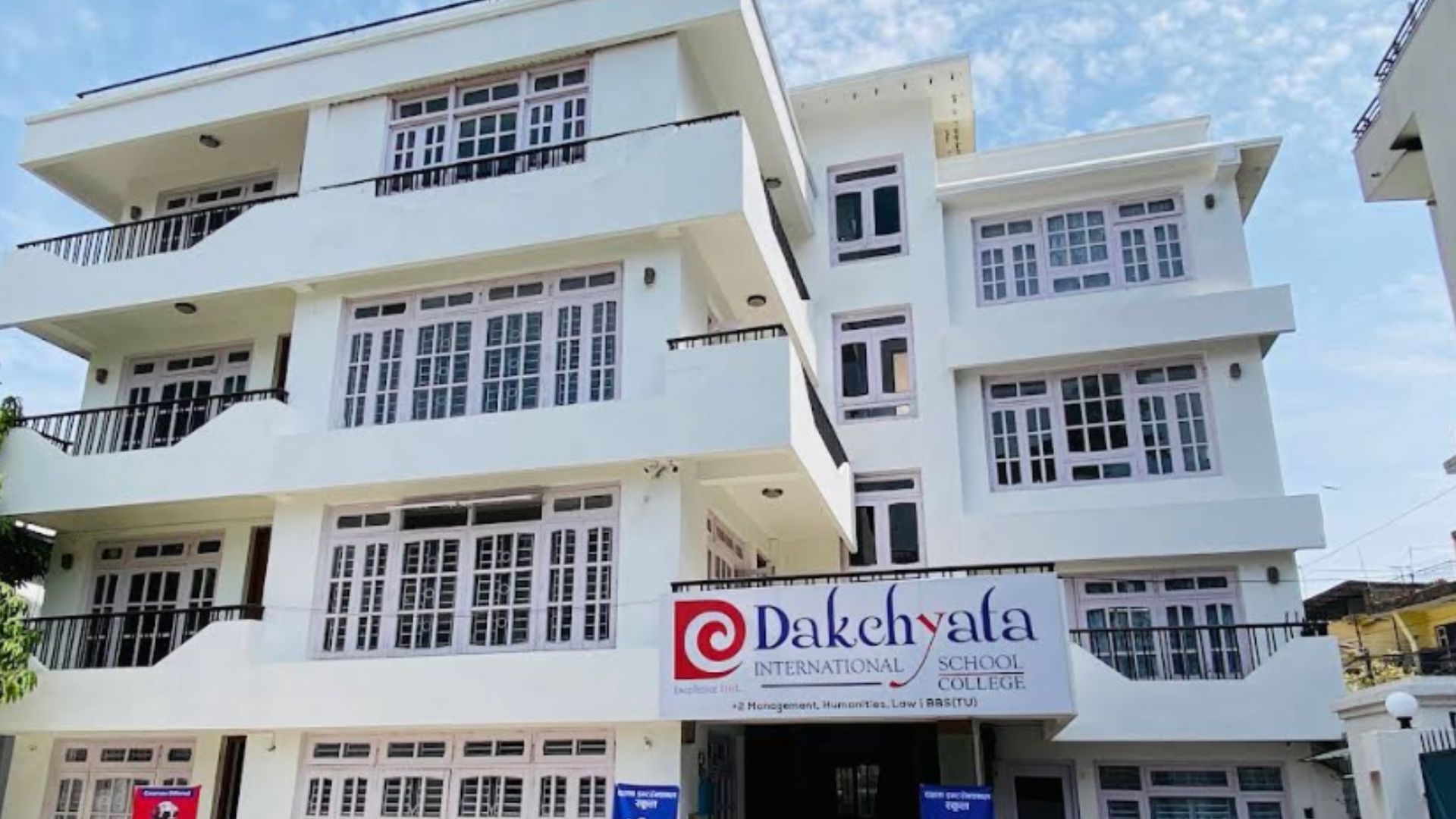
Dakchyata International School/College is a co-educational institution located at TB Hospital Marg, Kalimati-13, Kathmandu. It runs classes from Playgroup (PG) to Grade 12 and offers a Bachelor of Business Studies (BBS) program at the undergraduate level.
The institution follows the national curriculum prescribed by the Government of Nepal, with Ten Plus Two (+2) programs in Science, Management, Humanities, and Law under the National Examinations Board (NEB) and the BBS program affiliated with Tribhuvan University (TU).
Dakchyata International School/College positions itself as a place where classroom study is linked with real-life learning. Current public information highlights a focus on experience-based activities, entrepreneurship awareness, and life skills alongside regular academics.
Highlights
-
Location: TB Hospital Marg, Kalimati-13, Kathmandu, Nepal
-
School Level: Playgroup to Grade 10 (PG–10)
-
Higher Secondary: Ten Plus Two (+2) in Science, Management, Humanities, and Law (NEB)
-
Bachelor’s Program: Bachelor of Business Studies (BBS) affiliated with Tribhuvan University
-
Type: Co-educational, day school/college
-
Scholarship Linkages: Included in Kathmandu Metropolitan City scholarship lists for Grade 11 management stream.
-
Learning Focus: Reality-based learning, entrepreneurship orientation, life skills, and co-curricular activities.
Academic Programs Offered
Dakchyata International School/College delivers a continuous academic pathway from early childhood to undergraduate study. Program structures follow national and university standards, which helps students plan their schooling and higher education in a coherent way.
School Level (Playgroup to Grade 10)
From Playgroup to basic and lower secondary grades, the school follows the national framework issued by the Curriculum Development Centre and NEB. Students study core subjects such as Nepali, English, Mathematics, Science, and Social Studies, together with age-appropriate project work, creative arts, and foundational ICT exposure, as indicated in national guidelines.
At this level, Dakchyata International School/College encourages classroom activities, group tasks, and interaction-based lessons that help children develop study habits, communication skills, and early social responsibility. Regular classroom assessments and terminal examinations align with NEB expectations for progression to the SEE level.
Ten Plus Two (+2) Programs (NEB)
The college runs Ten Plus Two (+2) programs in four streams under the National Examinations Board: Science, Management, Humanities, and Law.
-
+2 Science: Follows the national science curriculum with Physics, Chemistry, Biology/Mathematics, and Computer Science or other optional subjects as permitted by NEB. The stream suits students aiming for medical, engineering, technology, or pure science studies.
-
+2 Management: Covers Accountancy, Economics, Business Studies, and other management-related subjects, preparing students for business, management, and social science disciplines.
-
+2 Humanities: Focuses on subjects such as Sociology, Population Studies, Major English or Nepali, and related fields, which are relevant for social science, education, media, and development studies.
-
+2 Law: Introduces students to fundamental legal concepts, civic understanding, and social justice issues, aligned with NEB’s Law stream structure, creating a base for future LL.B and legal studies.
Bachelor of Business Studies (BBS)
Dakchyata International School/College offers the Bachelor of Business Studies (BBS), a four-year program under Tribhuvan University’s Faculty of Management.
The TU BBS curriculum includes foundation courses (English, statistics, economics), core management subjects (accounting, finance, marketing, organizational behavior, human resource management), and specialization options in areas such as finance or marketing in later years. The program structure aims to build analytical ability in business, practical accounting and financial reporting skills, and understanding of Nepal’s business environment.
BBS graduates can move into entry-level roles in business, banking, NGOs, and local enterprises, or continue into MBS, MBA, or professional certifications, as recognized across TU-affiliated colleges.
Admission Process
Admission procedures are guided by NEB and TU regulations as well as local education directives from Kathmandu Metropolitan City.
Admission to School Level
For Playgroup and basic grades, children are generally admitted on the basis of age, interaction with teachers, and available seats. Parents submit an application form, birth certificate, and previous school records (for transfer cases).
The school follows the national calendar, so new intakes usually align with the beginning of the academic session announced by the Ministry of Education, Science, and Technology (MOEST).
Admission to Ten Plus Two (+2)
Admission to Grade 11 is based on SEE results and the NEB minimum eligibility criteria. National guidelines specify that:
-
Students need at least GPA 1.6 in SEE to join Grade 11.
-
For Science, students generally require higher GPA and at least C+ in Science and Mathematics with D+ or better in English, Nepali, and Social Studies.
-
For Management, Humanities, and Law, GPA 1.6 with minimum D+ in required subjects is accepted under national criteria used by most NEB institutions.
Admission to BBS
For BBS, Tribhuvan University’s Faculty of Management requires applicants to:
-
Complete 10+2 or equivalent from a recognized board.
-
Achieve at least D+ in all Grade 11 and 12 subjects with a minimum CGPA of 1.8, or secure second division (about 45%) in the previous qualifying exam, in line with TU guidelines.
Dakchyata International School/College follows TU rules on eligibility and may add college-level screening such as form review, short interview, or orientation before final enrollment.
Teaching Faculty and Learning Methodology
Public information indicates that Dakchyata International School/College is managed by experienced academicians and professionals with backgrounds in education and business. Teachers at the school and college levels are expected to meet NEB and TU qualification norms, with subject-wise specializations for science, management, humanities, and law-related courses.
Teaching and learning across levels combine classroom lectures with:
-
Project work and assignments linked to local issues.
-
Group discussions, seminars, and student presentations.
-
ICT-supported lessons and multimedia materials.
-
Exposure visits and practical sessions at external institutes, such as hospitality training centers in Kalimati that have hosted Dakchyata students for hands-on activities.
This mix helps students connect theory with practice, improve communication skills, and understand how classroom topics relate to work, enterprise, and community life.
Infrastructure and Learning Facilities
The campus stands on TB Hospital Marg in Kalimati, a location with road connectivity and access to public transportation inside Kathmandu Metropolitan City.
Core infrastructure includes:
-
Classrooms arranged for school, +2, and bachelor-level sections.
-
Basic science laboratories and ICT facilities to support practical work in NEB Science and computer-related courses, in line with national curriculum requirements.
-
Library resources that cover NEB textbooks, TU BBS references, question banks, and reading materials related to management and social sciences.
-
Seminar and activity spaces used for orientations, student programs, and external sessions with partner organizations.
The campus environment aims to be safe and supportive, with a focus on disciplined conduct, regular attendance, and parent–school communication.
Student Life and Campus Experience
Student life at Dakchyata International School/College extends beyond formal periods in the classroom. Social media updates show celebrations of Teacher’s Day, farewell events for graduating classes, and various cultural activities.
From lower grades to bachelor level, students participate in assemblies, awareness programs, and events where they can present speeches, songs, or performances. Such experiences help learners develop confidence, public speaking ability, and a sense of connection to their peers and teachers.
Extracurricular Activities (ECA)
The institution gives space to extracurricular and co-curricular activities as a regular part of school life. Available information highlights:
-
Sports and games events, often linked with inter-house or inter-class competitions.
-
Literary and creative programs, including debates, quizzes, poetry, and art-related activities.
-
Field visits and exposure programs, such as practical sessions at hospitality institutes in Kalimati.
These activities support teamwork, time management, and leadership traits that are essential for higher education and work environments.
Scholarships and Financial Support
Dakchyata International School/College appears in Kathmandu Metropolitan City scholarship quota lists for management stream students at the secondary level, which confirms its participation in the municipal scholarship scheme.
In addition, the college publicizes scholarship tests and merit-based opportunities through its official social media. For example, a scholarship test for Grade 11 was announced for the academic year 2082 to identify deserving students.
Scholarship categories typically include:
-
Merit-based support based on SEE or internal exam performance.
-
Quotas linked to KMC scholarship selection lists.
-
Limited need-based concession determined through interaction with the college administration.
Exact scholarship amounts and seats vary each year, so prospective students are advised to contact the college office directly.
Achievements and Institutional Milestones
Being listed in official documents of Kathmandu Metropolitan City as a secondary school with scholarship quota indicates that Dakchyata International School/College meets local regulatory and quality requirements.
External partners such as hospitality training institutes in Kalimati have acknowledged visits from Dakchyata students for practical sessions, which reflects active collaboration with the local skills and training ecosystem.
Regular admission notices for +2 and BBS programs also show that the college continues to operate as an NEB- and TU-affiliated institution in the Kalimati education cluster.
Why Choose Dakchyata International School/College?
For learners in Nepal and abroad who are exploring options in Kathmandu, Dakchyata International School/College offers:
-
A full schooling pathway from Playgroup to Grade 12 on a single campus.
-
Four NEB streams (+2 Science, Management, Humanities, Law) with a BBS program under Tribhuvan University, suitable for students who plan to remain in the management and social science track.
-
An emphasis on reality-based and life skills-oriented education, where classroom lessons are connected with practical exposure and entrepreneurship themes.
-
Participation in Kathmandu Metropolitan City scholarship mechanisms, supporting inclusion of students from diverse school backgrounds.
-
A location in Kalimati that is accessible from various parts of the city, which helps day scholars commute without long-distance travel.
Conclusion
Dakchyata International School/College in Kalimati provides a structured academic route from school level to a Tribhuvan University BBS degree. Its NEB-affiliated +2 programs, connection with KMC scholarship frameworks, and emphasis on practical, reality-based learning give it a distinctive place among community- and private-sector schools in the Kalimati area.
Frequently Asked Questions (FAQ)
1. Where is Dakchyata International School/College located?
Dakchyata International School/College is situated on TB Hospital Marg, Kalimati-13, Kathmandu, within Kathmandu Metropolitan City.
2. Which boards and universities is the college affiliated with?
The school and +2 level are affiliated with the National Examinations Board (NEB), while the Bachelor of Business Studies (BBS) program is affiliated with Tribhuvan University’s Faculty of Management.
3. What streams are available at Ten Plus Two (+2)?
Dakchyata International School/College offers +2 Science, Management, Humanities, and Law. These streams follow NEB curricula and grading rules, and they meet national eligibility criteria for Grade 11 admission.
4. What are the general eligibility requirements for +2 admission?
Under NEB guidelines used across Nepal, students who have completed SEE with at least GPA 1.6 can enroll in Grade 11. Science usually requires GPA 2.0 with C+ in Science and Mathematics and D+ or better in English, Nepali, and Social Studies, while Management, Humanities, and Law accept GPA 1.6 with D+ in required subjects. Individual colleges may set higher cut-offs.
5. What are the eligibility requirements for BBS at Dakchyata International School/College?
As a TU-affiliated college, Dakchyata follows TU rules for BBS entry. Applicants must have completed 10+2 or equivalent from a recognized board and obtained at least D+ in all subjects with CGPA 1.8 or second division (around 45%) in their qualifying examination, along with other conditions set by the Faculty of Management.
6. Does the college provide scholarships?
Yes. Dakchyata International School/College appears in Kathmandu Metropolitan City scholarship quota documents and also runs its own scholarship tests for Grade 11, especially in the management stream. The exact categories and amounts vary each year, so applicants should check current notices or contact the college office.