KU City School/College, also known as Kathmandu Unified City Secondary School and KU City College, is a private educational institution located in Saraswatinagar, Chabahil, Kathmandu. It was founded in 2010 by a group of educationists, business professionals, education-management consultants and social activists who wanted a school and college that link classroom learning with real life in a disciplined, student-centred environment.
The institution runs school, Ten Plus Two (+2) and bachelor-level programs on a single campus. From early secondary grades to bachelor studies, students move through one academic community with consistent guidance, shared values and close monitoring. The college aims to help young people grow into responsible, skilled and socially aware citizens who can face academic and workplace challenges at local, national and international levels.
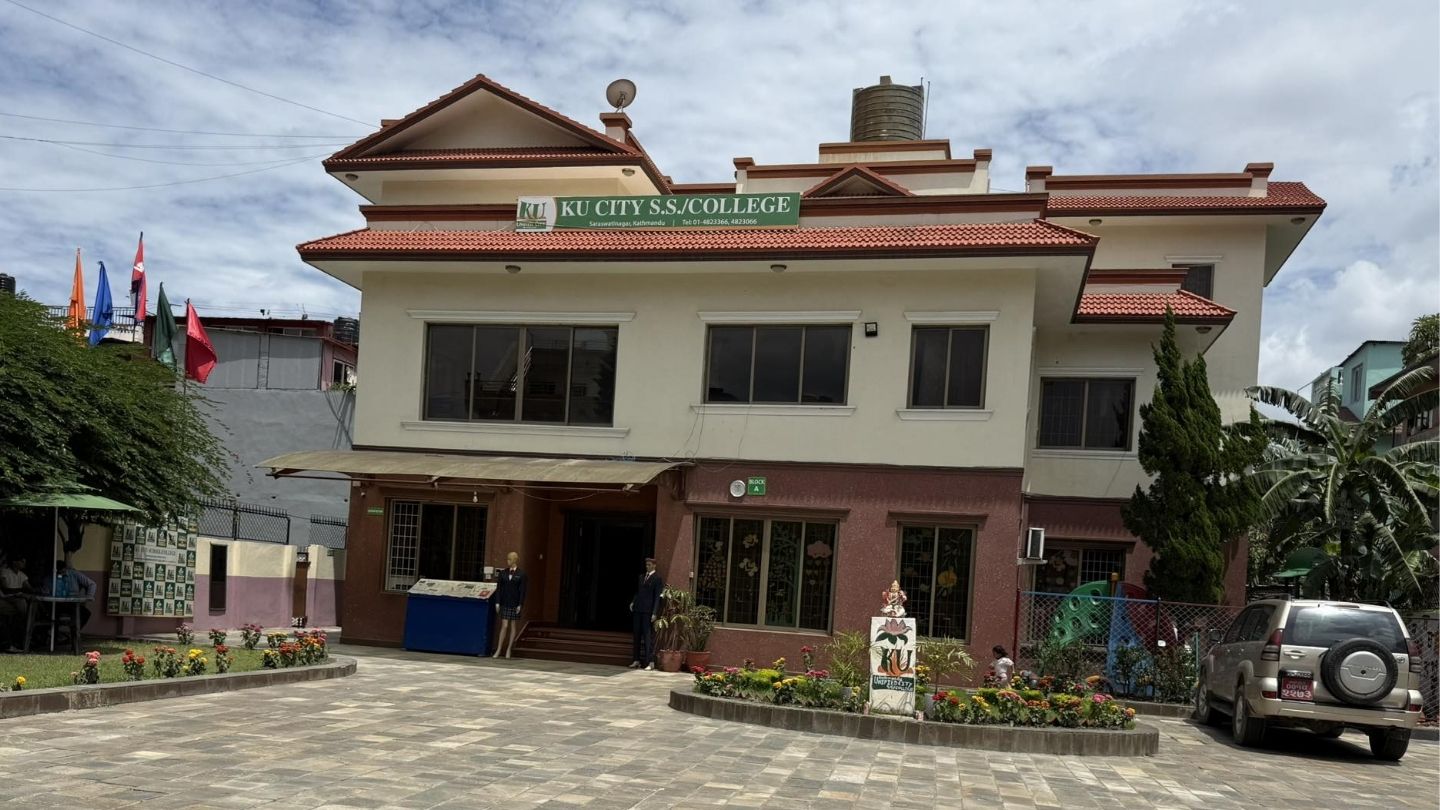
Location: Saraswatinagar, Chabahil, Kathmandu, Nepal
Established: 2010 (school and college run under a single management)
Institutional name: Kathmandu Unified City Secondary School / KU City College
Academic levels: School level, Ten Plus Two (+2), and bachelor programs
Main boards and universities:
Ten Plus Two streams: Science, Management, Humanities, Law
Bachelor programs: Bachelor of Business Studies (BBS), Bachelor of Social Work (BSW), Bachelor of Computer Application (BCA)
Key facilities: library, science laboratories, computer lab, IT center, seminar and conference hall, separate hostels for boys and girls, canteen, playground and sports facilities, music and dance studio, transportation services
Governance: managed by a team with long experience in school and college administration in Kathmandu valley
The Ten Plus Two section follows the national curriculum of the National Examinations Board (NEB). The aim is to prepare students for higher education while building a strong foundation in analytical thinking, language skills and social awareness.
The Science stream is suitable for students interested in medicine, engineering, information technology, agriculture, environmental science and other technical fields.
Students study core subjects such as English, Nepali, Physics, Chemistry and Mathematics, along with optional subjects like Biology or Computer Science. Daily practical classes in physics, chemistry and biology help students connect theoretical concepts with hands-on experiments in the laboratory.
The school encourages students to build problem-solving habits through assignments, project work and group tasks so that they can handle competitive entrance examinations and university-level science courses with greater confidence.
The Management stream introduces students to business, finance and organizational studies. It suits learners who plan to continue into BBS, BBA, hotel management, travel and tourism, banking or entrepreneurship.
The course includes Compulsory English and Nepali, Accountancy, Economics or Mathematics, Business Studies, Computer Science, Business Mathematics, Marketing, Travel and Tourism or Hotel Management.
Classroom learning is supported by basic case discussions, numerical exercises and exposure visits to banks or business organisations when possible, helping students relate theory to real financial and managerial practices.
The Humanities stream focuses on society, culture and communication. It is relevant for students who wish to move towards social science, journalism, literature, psychology, linguistics or public administration.
Key subjects include Compulsory English and Nepali, Sociology, Contemporary Society, Mass Communication, Economics, Mathematics, Optional English, Computer Science and Music.
Through reading, writing tasks, presentations and media-related activities, learners build skills in critical reading, social analysis and effective communication, which are essential for research and public-facing careers.
The Law stream is a two-year NEB program for students who wish to understand legal systems and public justice from an early stage.
The curriculum covers English, Nepali, Social Studies, Life Skill Education, Jurisprudence and Legal Theory, Nepalese Legal System, Procedural Law, Constitutional Law, Civil and Criminal Law and Justice, Human Rights and General Law.
Students learn about the evolution of the Nepali legal system, major codes and the role of law in protecting rights and resolving conflicts. The program is suitable for those planning to study BALLB, BSW, public administration or other law-related disciplines.
KU City College runs three bachelor programs under Tribhuvan University: BBS, BSW and BCA. These courses follow TU curricula and examinations, while day-to-day teaching and student support are handled on campus in Saraswatinagar.
The Bachelor of Business Studies is a four-year program focusing on business, management, economics and accounting. It builds a gradual progression from foundational subjects to advanced areas of business decision-making.
The course structure includes Business English, Business Statistics, Microeconomics, Accounting for Financial Analysis and Principles of Management in the first year. Later years add Business Communication, Macroeconomics, Cost and Management Accounting, Fundamentals of Marketing, Human Resource Management, Business Environment and Strategy, Financial Management, Business Law, Taxation and Auditing, Organizational Behavior, Entrepreneurship and Enterprise Development, Business Research Methods and concentration papers in areas such as finance or marketing.
Graduates can move into entry-level roles in banking, accounting, administration, sales, insurance, entrepreneurship or further postgraduate studies in management and commerce.
The Bachelor of Social Work is intended for students interested in community development, social justice, counselling, child rights, health, gender studies and related areas. At KU City College, BSW follows the TU curriculum, combining classroom study with fieldwork and community visits as prescribed by the university.
Students learn the basics of sociology, psychology, social policy, social work theories, community organisation and research methods. Field placement and project work help them observe real social issues in schools, communities, NGOs or local bodies, strengthening their capacity to work with vulnerable groups and development organisations after graduation.
The Bachelor of Computer Application prepares students for careers in software development, databases, networking and general IT services. The program is TU-affiliated and follows the national BCA curriculum.
Typical subject areas include programming concepts, data structures, web technologies, operating systems, database management systems, computer networks, software engineering principles, mathematics for computing and IT project work. The college uses its computer lab and IT center to support practical sessions so that students work with programming tools and applications, not only theory.
For Grade XI, KU City School invites applications from students who have completed SEE or an equivalent examination. New intake usually takes place in May–June. For other school grades (kindergarten to Grade IX), admission generally opens in March.
Applicants sit for a written test that checks subject knowledge, mental aptitude, problem-solving and related skills. Short-listed candidates and their parents or guardians attend an interview, which allows the school to understand the student’s readiness, motivation and support system at home. Final selection is based on combined performance in the entrance test, interview and previous academic record.
For bachelor programs, applicants must have completed Ten Plus Two or an equivalent level from a recognized board, meeting the minimum grades required by Tribhuvan University for the respective program. Exact eligibility criteria, entrance requirements and quotas may change with TU and NEB regulations, so prospective students are advised to confirm current rules directly with the college administration.
The principal and management at KU City School/College stress that education is not only preparation for future life but also life itself, drawing inspiration from John Dewey’s philosophy.
Teachers regularly draw from learning theories such as behaviorism, cognitivism, constructivism and connectivism. Classroom practice focuses on student-centred teaching, where learners are encouraged to participate, question, discuss and work on tasks rather than passively listen. Activities like project work, group discussion, presentations, field observation and practical classes are used to connect ideas with real situations.
Alongside subject teaching, the college tries to nurture qualities such as self-discipline, resilience, self-motivation and diagnostic thinking so that students can handle pressure, reflect on their progress and adjust their learning strategies. Regular tests, terminal examinations, assignments and counselling sessions help track growth and provide feedback to both students and parents.
The campus has a range of facilities designed to support academic learning and personal growth.
Library: A well-stocked library with textbooks, reference books, newspapers, magazines, journals and other reading materials. Students receive original textbooks each academic session and return them to the library, which helps maintain a shared resource system.
Science laboratories: Separate laboratories for physics, chemistry and biology help students perform experiments and understand scientific concepts through observation and practice. Management, Humanities and Law students also receive practical sessions where relevant.
Computer and IT facilities: The IT center supports teaching and learning with hardware and software required for digital classes, computer practicals and BCA coursework.
Seminar and conference hall: Used for workshops, training, guest lectures and club activities, giving students exposure to professionals and external experts.
Hostels: Separate hostels for boys and girls provide residential facilities for students from outside Kathmandu, with staff responsible for daily care and academic supervision.
Canteen: Provides regular meals and snacks with attention to balanced diet and hygiene.
Playground and sports facilities: Space for basketball, volleyball, badminton, table tennis and arrangements for football, cricket and futsal in larger grounds outside the main compound.
Music and dance studio: Equipped with musical instruments and space for dance practice, guided by music and dance instructors.
Transportation: School buses and vehicles support daily commuting and educational tours, excursions, field visits and picnics.
Student life at KU City School/College is structured around regular classes, practical sessions, assignments, sports, arts and social activities. The environment is intended to be disciplined yet supportive, with close communication between teachers, students and parents.
Students participate in internal competitions, educational tours, project exhibitions, club programs and celebrations of national and cultural events. These activities give space for public speaking, teamwork, leadership and creative expression beyond the syllabus.
Residential students in the hostel follow a daily routine that balances study hours, extra reading, revision, games and rest. Counselling and guidance services are available when students need help with academic planning, subject choice or personal concerns.
The sports department encourages regular physical exercise through games such as basketball, volleyball, badminton and table tennis inside the campus. For football, cricket, futsal and larger sports events, the college collaborates with nearby playgrounds. Tournaments and friendly matches help students learn discipline, teamwork and fair play.
Music and dance are part of campus life. Students can learn instruments, vocal performance and different dance styles in the dedicated studio. Cultural programs, annual functions and inter-house competitions give them opportunities to perform on stage and gain confidence.
With programs like BSW and Law, students are encouraged to understand community issues, social justice and public service. Participation in awareness campaigns, visits to social organisations and volunteering programs (when arranged) help them connect classroom learning to real social contexts.
KU City School/College provides scholarships and concessions in line with national policies and its own internal rules. Merit-based support is generally linked to SEE grades, NEB results or strong performance in entrance tests, while some seats may be reserved for students from disadvantaged backgrounds as required by regulations.
Because scholarship schemes, quotas and criteria may change from year to year, students and parents should request the latest scholarship notice from the college administration or visit the official website before applying.
KU City School/College can be a suitable option for students who want school, +2 and bachelor-level study in one academic setting. Key strengths include:
A single campus offering NEB Ten Plus Two and TU bachelor programs in business, social work and computer application
Location in a relatively quiet residential area of Saraswatinagar, with access to main roads and public transport in Chabahil
Emphasis on student-centred learning and active participation, guided by the educational philosophy outlined by the principal
Practical focus in science, management and law through regular lab work and applied assignments
Supporting facilities such as hostel, library, sports ground, IT center, music and dance studio, seminar hall and transportation
Principal and Director Shree Bhadra Sigdel explains that KU City School views education as an active process where students learn by doing, thinking and engaging, not only by listening. He refers to John Dewey’s idea that education is part of life itself, not only a preparation for later years.
According to his message, the school tries to unite different learning theories and keep teaching methods centred on students. Creativity, innovation, critical thinking, self-motivation and self-control are seen as important qualities for learners who must face rapid changes in society. The principal also highlights the role of experienced and committed teachers, strong facilities and close cooperation with parents and stakeholders in maintaining a purposeful learning environment.
KU City School and College at Saraswatinagar, Chabahil, serves as a combined school and college campus that links school education, Ten Plus Two and bachelor studies under NEB and Tribhuvan University. With its mix of Science, Management, Humanities and Law at +2 level, and BBS, BSW and BCA at bachelor level, the institution offers clear study pathways for students interested in business, social sciences, law and information technology.
Q1. Where is KU City School/College located?
KU City School/College is located in Saraswatinagar, Chabahil, within Kathmandu Metropolitan City.
Q2. Which boards and universities are the programs affiliated with?
Ten Plus Two programs in Science, Management, Humanities and Law run under the National Examinations Board (NEB). Bachelor programs BBS, BSW and BCA are affiliated with Tribhuvan University (TU).
Q3. What levels of study are available at KU City School/College?
The institution offers school education (lower grades), NEB Ten Plus Two (+2) programs and three TU-affiliated bachelor programs: BBS, BSW and BCA.
Q4. How does the admission process work for Grade XI?
Applicants who have passed SEE or an equivalent exam submit an application form, sit for a written entrance test and attend an interview with their parents or guardians. Selection is based on overall performance in these stages and previous academic records.
Q5. Are hostel facilities available?
Yes. KU City School operates separate hostels for boys and girls, with staff responsible for student care and discipline.
Q6. What types of extracurricular activities are offered?
Students can participate in sports (basketball, volleyball, badminton, table tennis, football, cricket, futsal), cultural programs, music and dance, tours, field visits and community-oriented activities linked to social work and law.
Q7. Does KU City School/College provide scholarships?
Yes. The college offers scholarships and financial support based on merit and, where applicable, social criteria, in line with national rules and its internal policies. Applicants should contact the administration for the latest scholarship details.
Contact KU City College's administrative office for detailed information on the course, admissions, location, fees, scholarships, facilities, counseling, or eligibility.