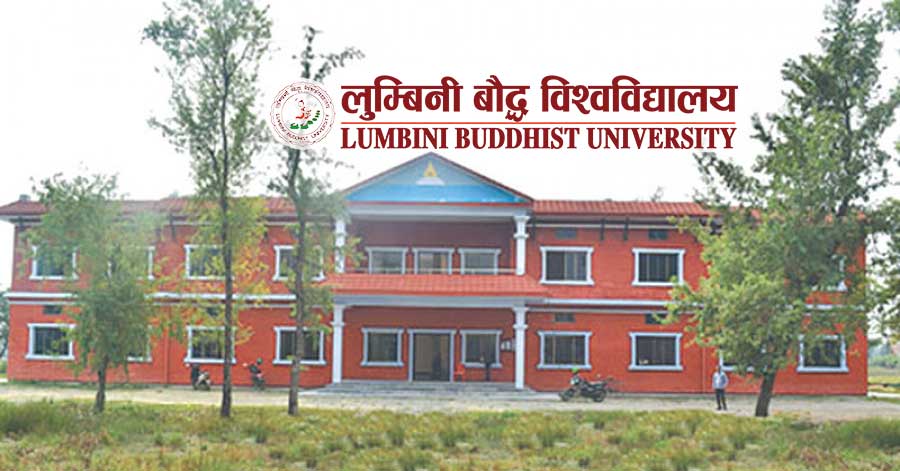
Lumbini Buddhist University (लुम्बिनी बौद्ध विश्वविद्यालय) was conceived at the First World Buddhist Summit held in Lumbini in 1998 AD. Its establishment was initiated with the promulgation of the LBU Ordinance in 2004 AD preceding the Second World Buddhist Summit. The LBU Act was endorsed by the Parliament in 2006 AD (Vikram Samvat 2063).
Accepting and following the teachings of Lord Gautam Buddha, the University is dedicated to World Peace through the operation of institutions of higher education for teaching-learning and research in the areas of Buddhist Philosophy, Literature, Education and Culture to inspire, Shanti, Bandhutva, Maitr' and Sadbhava (peace, empathy, friendship, and compassion).
The university is expected to provide a focus for uniting all for world peace; expected to function as an international hub for Buddhist Studies generating activism for world peace.
VISION:
University for World Peace, Harmony and Prosperity
MISSION:
Academic Excellence and Research for Promoting Buddhist Concept of Peace, Compassion, Virtuous and Sustainable Development.
MOTTO
Buddha Knowledge and Wisdom, Dharma Ethics with Compassion, and Sangha Virtuous Society.
GOALS
Establish as a center of excellence for Research, Learning, and Innovation in the areas of Buddhist Philosophy, History, Literature, Arts, Culture, Education, and other areas relevant to promoting peace, natural environment, and sustainable development viz., Development Studies and Applied Sciences
Produce proactive graduates with knowledge and skill for promoting peace, harmony, and sustainable development.
Develop a system of academia — societies interface for ensuring quality and relevance of knowledge generation and use in the current as well as emergent contexts.
Develop a national and international network for academic exchanges and knowledge sharing
GENERAL STRATEGY
# Promote, institutionalize and develop already established areas of Buddhist Philosophy and knowledge (viz., Mahayana, Theravada, Vajrayana) to reinvigorate Nepal as the center of those schools of Philosophy and knowledge; promote research, discourses, and academic exchanges to contextualize them to the current milieu.
With Buddhist Philosophy, knowledge, and teachings as the main thrust, develop innovative academic programs relevant to socioeconomic development and current aspirations of youths for the profession (e.g., agroforestry, development studies, culture and tourism, environmental studies, and applied sciences that promote peace, harmony, sustainable development, and nature conservation).
Promote the development of a Knowledge-based society by enhancing the virtuous culture and traditions of Buddhist Societies in the country through society—academia interface.
Mobilize Buddhist scholars for creating centers of excellence for research, discourses, and for academic exchanges and networking locally as well as globally.
PROGRAM STRATEGY
Academic programs, research, and innovative activities for highlighting Buddhist Philosophy and knowledge
Innovative academic programs are relevant to socioeconomic development and current professional development trends.
Mobilizing Buddhist societies and organizations for the development of university-society interface and collaborations.
Partnership and Trustees:
Trustees (Board of Trustees).
INNOVATIVE INITIATIVES
1. Project Devadaha — Based on community forest, develop research-based academic programs in the areas of Agro-forestry, Sustainable Development, and Environmental Studies (environmental design and nature conservation).
2. Project Traditional Medicine and Health Practices — Preserve and promote traditional medicine and health practices, develop research-based programs on traditional medicine and health practices (e.g., Traditional Vaidya, Sowarigpa, Yoga, and Meditation)
3. Project Greater Lumbini — With the cooperation of national initiatives/projects for archeological exploration and conservation develop research-based academic programs on archeology, museology, management of heritages; Develop institutions of core Buddhism, and contemporary Applied Buddhism focused on community development (sustainable development) at Lumbini.
4. Project Kathmandu Valley — with the cooperation of national initiatives/projects for the conservation of unique national heritages in the valley develop research-based academic programs on archeology, museology, management of tangible as well as intangible heritage, art and culture, and sustainable development.
5. Project Himalayan Region — with the cooperation of national and international initiatives/projects for the conservation of the unique heritage of the Himalayan Region management of tangible as well as intangible heritage, art and culture, and sustainable development.
6. Project Buddhist Library — with the cooperation of the National Archives, Department of Archaeology, Lumbini International Research Institute (LIRI), Asha Safukuthi, Monasteries, Viharas, and Vahis develop a research library network.
7. Project Karuna — starting from core Lumbini development area undertake action research for the social and economic transformation of village communities (for economic development, social development, and connecting with the conservation of Lumbini)
CURRENT ACADEMIC PROGRAMS
FORTHCOMING NEW PROGRAMS
FACULTIES AND COLLEGES
Instead of College
Affiliated College:
Contact Details:
Lumbini, Rupandehi, Lumbini Pradesh, Nepal
Phone: +977-71-404088, +977-71-404080, +977-71-404070
Email: info@lbu.edu.np
Website: www.lbu.edu.np