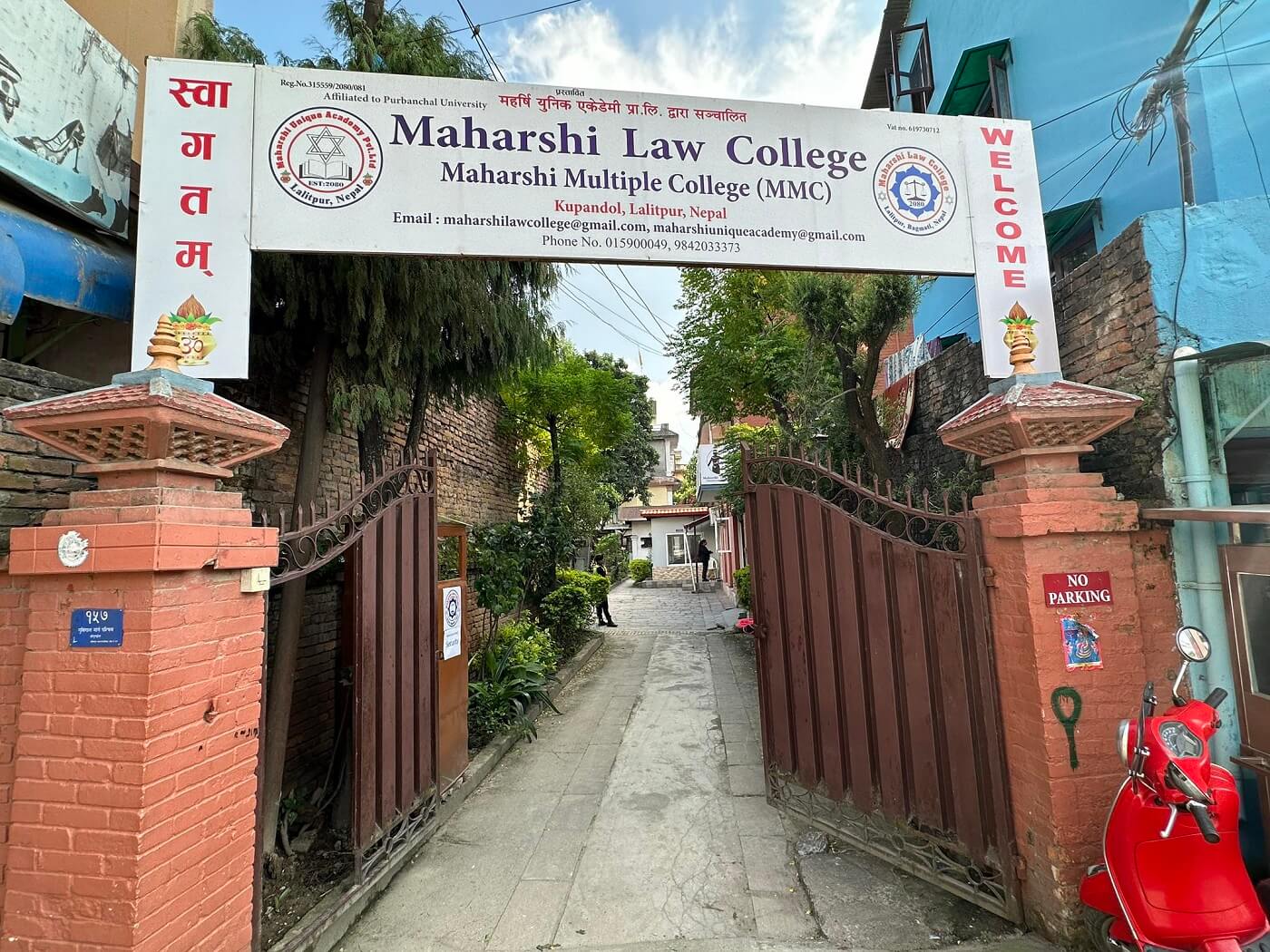
Maharshi Law College (MLC) is a Purbanchal University–affiliated law college located in Kupondole (Kupandol), Lalitpur, in the Kathmandu Valley. Established in 2023, the college offers legal education through an integrated five-year BA LL.B. program and frames learning around class teaching, legal writing, research work, and practice-based activities linked with Nepal’s legal system.
Established: 2023
College: Maharshi Law College (MLC)
Affiliation: Purbanchal University
Location: Lalitpur-10, Gusingal Marga, Kupondole (Kathmandu Valley)
Program: BA LL.B. (five-year integrated)
Class shift: Morning
Medium: English (with academic support for language needs)
Academic focus areas: Business Law, Criminal Law, Constitutional Law, Environment & Development Law
Contact: Phone 01-5400040, 9851407964, Email maharshilawcollege@gmail.com, Web maharshilawcollege.edu.np
Maharshi Law College operates as a specialised institution for undergraduate legal education in Nepal. With its university affiliation and an integrated BA LL.B. structure, the college targets students who want a structured pathway into legal study right after +2 or an equivalent qualification. The program combines social science foundations with core law subjects, then gradually adds stronger legal reasoning, statutory interpretation, research skills, and practice-oriented components.
The location in Kupondole, Lalitpur places students within practical reach of key legal institutions, courts, law offices, and public bodies within the Kathmandu Valley. For law students, this matters because regular exposure to court processes, filings, arguments, and legal services builds understanding that cannot come from textbooks alone.
The main academic program is the five-year integrated BA LL.B. under Purbanchal University. It is presented as open to students from different streams (Arts, Science, Commerce) who have completed +2 or an equivalent level.
The integrated structure means students study both general social science subjects and law subjects across five years. Early years focus on building the language and academic base needed for legal study, then later years focus on core fields of law, procedural understanding, and applied learning through clinical and practical components.
The college has also shared plans for an LL.M. program as part of its future academic direction. If you plan for postgraduate study, confirm the current approval status, intake timeline, and entry requirements through official notices and the university’s formal channels.
A five-year BA LL.B. is not only about passing subjects. Students usually need three parallel abilities:
reading and understanding statutes and cases
writing clearly (legal English and legal Nepali)
applying law to facts through argument, research, and ethical practice
MLC’s year-wise subject structure follows this natural progression.
The first year focuses on building academic foundations and introducing core legal concepts. Students study social science and foundational courses such as political theory, economics, and sociology-related content, alongside introductory law components like basic concepts and principles of law and legal reasoning. Early clinical work supports discipline in reading, writing, and structured thinking.
This stage is where students learn how to approach legal texts, identify issues, and form arguments in a systematic way.
In the second year, the academic focus expands into Legal English and Legal Nepali, along with subjects connected to Nepal’s legal and governance environment such as international relations and diplomacy, legislative principles and law-making processes, and procedural law. Criminal law also appears at this stage.
A key feature in the second year is practice exposure through structured clinical activities, including visits and reporting tasks linked with sentencing systems and reforms. These tasks train students to observe carefully, write structured reports, and relate real practice with classroom learning.
The third year includes International Human Rights Law, interpretation of statutes, law of evidence, public international law, constitutional law and constitutionalism, legal research, and professional ethics. Students also continue clinical legal education focused on legal writing and community outreach.
This year often becomes a turning point for many students. They move from learning “what the law says” to learning how law is interpreted, applied, and argued.
The fourth year includes advanced jurisprudence and major applied areas such as contract law, company law, and administrative law. Clinical education continues through community outreach and rural law advocacy service.
At this stage, students are expected to read more independently, connect legal principles with case facts, and build a deeper writing habit through assignments and presentations.
The final year lists subjects such as legal philosophy, agrarian law, labour law, international humanitarian law and conflict resolution, conservation law, private international law, advocacy-focused practical courses, and a dissertation. Optional subjects are also offered in grouped areas.
The dissertation and advocacy-related work matter for students who want to develop research capability, policy writing skills, and legal argument structure before graduation.
MLC highlights four academic focus areas:
Business Law
Criminal Law
Constitutional Law
Environment & Development Law
The optional subject groups follow these themes. Students interested in corporate practice often look for subjects like banking and insurance, trade, intellectual property, and taxation. Those leaning toward criminal practice may look for criminology-related and fiscal or organised crime topics. Constitutional interest students often focus on governance, electoral law, torts, consumer protection, and law related to gender and disadvantaged sections. Students interested in environment and development themes often seek environment law, water and river law, energy law, tourism and civil aviation law, and related regulatory subjects.
A practical tip for students: before selecting optional subjects, map them to your likely pathway after graduation—court practice, corporate work, public service, NGO/INGO legal work, research, or postgraduate study.
Admission is based on completion of +2 or an equivalent level qualification. The college has also indicated a minimum 2.0 GPA requirement for entry in the BA LL.B. program, along with no age limit.
Admission selection is described as being based on an entrance assessment. The process may include:
written test
group discussion
personal interview
Students should confirm the exact format for the current intake cycle because entrance methods and timelines can vary by academic year and university requirements.
For BA LL.B. entrance and early semesters, students usually benefit from strengthening:
reading habit (news, legal topics, governance issues)
basic writing (clear paragraphs, summary writing)
general understanding of Nepal’s constitution, courts, and legal terms
confidence for group discussion and interview
MLC presents teaching as being led by a combination of experienced teachers and legal practitioners. This mix matters in legal education because it links classroom concepts with professional reality: court processes, client counselling, drafting, ethics, and the routine discipline needed in legal work.
Teaching methods shared by the college include:
lectures and seminars
term papers and presentations
case study discussion
group discussion and guided debate
moot court and mock trials
legal aid clinic activities
visits to courts and prisons with follow-up reporting and presentation
For students, the key value of these methods is skill-building: legal reading, legal writing, argument structure, professional conduct, and research discipline.
The college maintains a library and resource center with textbooks and reference materials, along with legal resources such as statutes and case law references. Regular reading access to national dailies and magazines is also included as part of the learning environment.
The college has shared that it provides computer and internet access to support learning and research. It has also indicated an intention to strengthen research-related access, including online databases and repositories, which can help students with legal research and dissertation writing.
A dedicated moot court room supports practical training linked with trial and advocacy learning. Moot court practice helps students learn court etiquette, argument structure, case preparation, and time-bound presentation skills.
The college describes quiet study areas and a calm study environment, with outdoor seating and a garden space for reading breaks. A canteen is also available for students during regular college hours.
The BA LL.B. program is run in the morning shift. The stated medium is English, with academic support for students who face language barriers.
For many Nepali students, this support can shape day-to-day learning outcomes. Legal study requires confidence in reading, note-making, writing, and speaking. Support in English medium settings becomes meaningful when it is connected with structured practice through legal writing tasks, presentations, and guided feedback.
Student messages included by the college describe an environment where students can ask questions, seek guidance, and learn through seminars and practical exposure. A healthy law classroom culture usually includes discussion, respectful debate, and structured feedback on writing. Students who take advantage of these habits often progress faster in legal reasoning and writing.
MLC has shared several activity areas that connect legal education with the community and the wider legal sector:
guest sessions involving legal professionals, human rights advocates, judges, and academics
a legal aid clinic plan that allows students to learn through real case exposure under guidance
outreach activities on selected legal issues in specific communities
research and publication work through a journal and research-oriented writing
For students, these activities support skills that matter after graduation: client communication, issue spotting, drafting practice, ethical awareness, and public-facing legal literacy work.
Scholarship and financial support details are not clearly specified in the provided material. Since policies can change across academic years, students should confirm:
scholarship categories (merit, need-based, other)
eligibility rules and required documents
renewal conditions across semesters/years
fee payment schedule and installment rules, if available
If you share the college’s official scholarship and fee notice, I can integrate it into this section in a clean, audit-friendly way.
Since the college was established in 2023, its milestones focus on program operation, academic structures, and planned academic services. The college has also shared focus areas such as research and publication work, human rights and justice-related engagement through a dedicated center, and practice-based learning through moot court and planned clinic activities.
For researchers and education planners, the most useful future indicators will be visible outputs such as journal issues, outreach reports, clinic activity records, and dissertation themes produced by graduating batches.
A neutral way to decide on a law college is to check whether it matches your personal study plan and career direction. Here are practical evaluation points.
If your target is an integrated BA LL.B. under Purbanchal University, confirm the current intake and academic calendar, then compare the course structure with your long-term goals.
A five-year law program requires consistent reading and writing. Morning shift scheduling can help students plan internships, reading time, or family responsibilities later in the day. Still, law study demands daily discipline, not only exam-time preparation.
Legal education becomes stronger when students practice:
legal writing and structured argument
case reading and issue spotting
court observation and reporting
moot court participation
research and dissertation discipline
Ask how these activities are scheduled across the academic year and how students receive feedback.
If your goal includes public service, policy work, academic research, or postgraduate study, check the support for:
research training
dissertation guidance
academic writing and referencing
publication opportunities
Even small, regular research assignments can build strong habits over five years.
Students benefit when a college supports learning needs such as language improvement, writing feedback, mentoring, and academic guidance. Confirm how support works in practice: office hours, mentoring, feedback cycles, and writing support sessions.
MLC has shared messages from leadership and academic roles that reflect its stated academic direction. These messages point toward legal education linked with Nepal’s governance context, ethics in legal practice, social responsibility, and the value of practical exposure alongside classroom teaching.
For students, the practical meaning of such direction depends on daily teaching routines—course delivery, writing feedback, practical sessions, research mentoring, and student guidance.
Maharshi Law College, established in 2023 in Kupondole, Lalitpur, offers a five-year integrated BA LL.B. program under Purbanchal University affiliation. The program structure combines social science foundations with core legal subjects and repeated clinical components such as legal writing, outreach activities, court-related exposure, moot court practice, and dissertation work. The college also presents an academic focus across Business Law, Criminal Law, Constitutional Law, and Environment & Development Law.
For applicants and parents, the best next step is to confirm current intake notices, entrance assessment format, fee and scholarship rules, and the academic calendar through the college’s official communication and the university’s formal processes.
It was established in 2023.
The college is affiliated with Purbanchal University.
The main running program is the five-year integrated BA LL.B.
Students who have completed +2 or an equivalent qualification can apply. A minimum 2.0 GPA requirement has also been stated, along with no age limit.
Admission is based on an entrance assessment. The process may include a written test, group discussion, and/or personal interview, depending on the intake cycle.
Classes are conducted in the morning shift.
The medium is English, and academic support is stated for students who face language barriers.
The stated focus areas include Business Law, Criminal Law, Constitutional Law, and Environment & Development Law, supported by optional subject groups in later years.