Manthali Sahid Smriti Multiple Campus (मन्थली सहिद स्मृति बहुमुखी क्याम्पस, रामेछाप) is a community campus in Manthali, Ramechhap, Bagmati Province, Nepal. Established in 2057 BS, the campus was founded to make higher education available within the district and to serve students from Ramechhap as well as nearby districts. It is affiliated with Tribhuvan University and recognized by the University Grants Commission of Nepal.
The campus runs bachelor’s programs in Bachelor of Arts (BA), Bachelor of Education (B.Ed.), and Bachelor of Business Studies (BBS), along with a master’s program in Master of Education (M.Ed.). Over time, it has expanded its academic base, built an administrative and departmental structure, added academic support systems, and completed the Quality Assurance and Accreditation (QAA) process. Its profile combines community ownership, local access to university education, scholarship support, and a steadily developed teaching and learning environment.
Location: Manthali Municipality, Ramechhap, Bagmati Province, Nepal
Institution Type: Community campus
Affiliation: Tribhuvan University
Recognition: University Grants Commission of Nepal
Established: 2057 BS (2000 AD)
Academic Levels: Bachelor’s and master’s
Programs: BA, B.Ed., BBS, M.Ed.
Scholarship Support: Available for deserving students, including full and partial scholarships under prescribed criteria
Major Facilities: Library, sports, computer lab, multimedia, classrooms, conference hall, counseling, journal activities, internet, e-library, canteen, health and first aid support
Contact: +977-48-540003, +977-48-540053 | mssmcampus@mssmc.edu.np
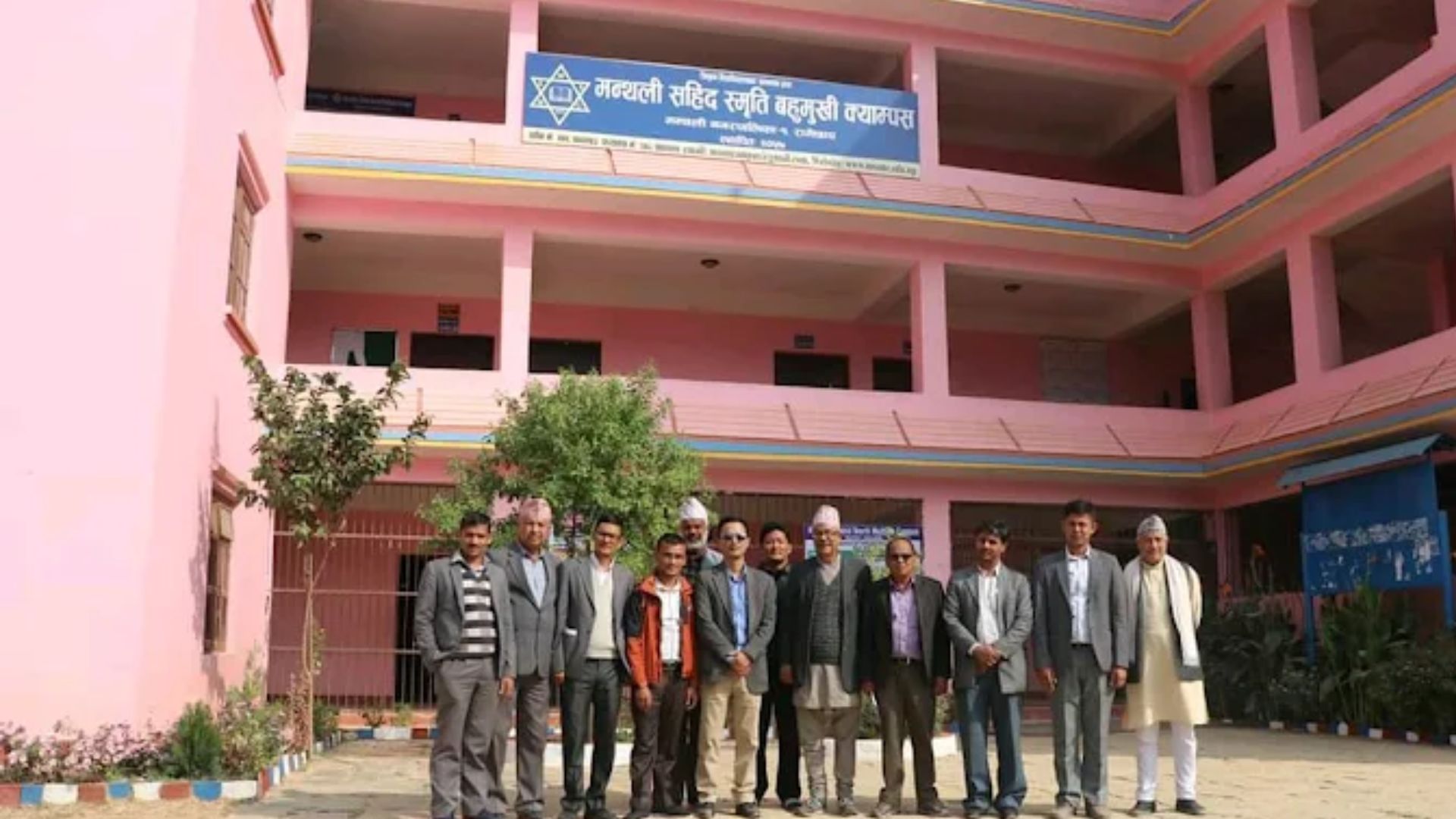
Manthali Sahid Smriti Multiple Campus was established with the purpose of bringing university education closer to students in Ramechhap. The institution grew from a local initiative shaped by education-focused community members who wanted higher studies to be available within the district rather than requiring students to travel elsewhere. Its community character remains central to its identity, and its development is closely tied to public participation, local commitment, and stakeholder involvement.
The campus is located in Manthali, the district headquarters of Ramechhap. This location has made it an important access point for higher education in the district. The campus has also served students from neighboring districts such as Dolakha, Okhaldhunga, and Sindhuli. In this sense, its role extends beyond the immediate municipality and reaches a wider regional student population.
Historical academic notes linked to the campus show that teaching began at the bachelor’s level in the Faculty of Humanities in 2057 BS. The Faculty of Education was added in 2059 BS, and the Faculty of Management began BBS classes in 2064 BS. From 2067 BS, postgraduate study in education was introduced, with references to Nepali and EPM under the master’s level. This progression shows a gradual expansion from a single academic stream to a broader multi-faculty campus.
The campus has also been associated with the local need for postgraduate study. The introduction of the master’s level reduced the need for students and working educators in the district to leave the area for further study. This was especially relevant in a setting where advanced academic qualifications were needed for lecturers and teaching personnel in schools and colleges across the district.
The campus is affiliated with Tribhuvan University, one of Nepal’s major public universities. Its academic programs operate within that university framework, and its institutional profile is linked to TU’s bachelor’s and master’s level structures. The campus is also recognized by the University Grants Commission of Nepal.
One of the important institutional milestones in its development is the completion of the Quality Assurance and Accreditation process. The campus received QAA certification on 28 Poush 2076 BS. The certification is presented in the campus record as a major institutional achievement tied to academic, administrative, and organizational development.
The QAA process described in campus records was not a single-step event. It involved consultation with the University Grants Commission, preparation of a self-review report, revisions after feedback, observation visits, and further work to address recommendations. The process began around 2070 BS, with a revised submission sent in 2074 BS, followed by continued institutional work before accreditation was granted in 2076 BS. This sequence indicates sustained administrative follow-up and formal engagement with academic quality processes.
Recognition through QAA is linked in the campus record to several areas: academic work, financial processes, physical infrastructure, student participation, extra activities, research orientation, and record-based institutional management. The accreditation journey also appears to have strengthened internal systems, including result analysis, technology use, and regularization of academic support practices.
Manthali Sahid Smriti Multiple Campus offers bachelor’s programs in Bachelor of Arts, Bachelor of Education, and Bachelor of Business Studies. It also offers a master’s program in Master of Education. The campus material presents these programs as the core academic structure of the institution.
The early academic base of the campus was in humanities. Bachelor’s level teaching in the Faculty of Humanities began first, establishing the institution’s initial academic presence. With the addition of education in 2059 BS, the campus widened its relevance for students interested in teaching, education studies, and related subjects. The launch of BBS in 2064 BS added management studies and further diversified the campus.
The academic development record also refers to postgraduate study in education from 2067 BS. Nepali and EPM are named in relation to that stage of development. More recent campus notes also mention the launch of BICTE under the education faculty. This suggests that the education stream has continued to develop in response to changing academic needs.
Subject listings connected to the campus point to a wider teaching spread within the main programs. In the education stream, references include English, Health and Physical Education, Nepali, Mathematics, Population, and BICTE. In humanities, RD and Sociology are mentioned. In management, Finance, Account, and Marketing are listed in connection with BBS. The master’s level in education is connected with EPM and Nepali in historical academic notes.
This range of programs is important in the context of Ramechhap because it provides students with options across humanities, education, and management within the district. It also shows that the campus has developed as a multi-faculty institution rather than remaining limited to one academic area.
The campus record points to a structured teaching and learning environment supported by subject departments, internal examinations, academic feedback, remedial support, and periodic orientation programs. Academic activities are conducted according to the campus annual calendar, and both monthly and internal examinations are reported as part of regular academic practice.
Result publication and answer-sheet analysis are also part of the academic process described for the campus. These activities connect assessment with follow-up rather than treating examinations as isolated events. Timely feedback, subject-wise attendance, and counseling are linked to efforts to improve student learning and examination performance.
The campus has reported extra classes and remedial classes for students who need additional support. It has also organized seminars, discussions, workshops, and orientation programs. Guest lecturers are mentioned in relation to providing subject-based knowledge and exposure to contemporary teaching methods.
The teaching environment is supported by faculty members with qualifications including M.A., M.Ed., MBS, M.Phil., and PhD. The staff structure in the campus records includes a campus chief, an assistant campus chief, readers, lecturers, and assistant lecturers across humanities, education, management, Nepali, English, mathematics, sociology, health and physical education, and related areas.
The campus also adapted teaching during the COVID-19 period by conducting online classes. This is noted in student remarks and in the broader description of technology use. The shift to online teaching suggests an effort to maintain continuity in teaching during disruption and to use digital tools in academic delivery.
The institution has an identifiable departmental structure. The Department of Humanities, Department of Education, and Department of Management are listed in the campus record, each with a head of department and members drawn from the teaching staff.
This departmental arrangement helps organize teaching responsibilities and academic management by subject area. It also supports a more formal internal structure for planning, teaching allocation, and academic follow-up. The education department appears to be the largest in terms of listed members, which fits the campus’s broader development of B.Ed. and M.Ed. programs.
Academic administration extends beyond teaching departments. The campus organizational chart includes admission, examinations, practical tests or teaching practice, record keeping, academic operations, and departmental heads under a broader academic wing. This indicates that the campus has separated instructional work from administrative and support functions while keeping them connected within an institutional hierarchy.
The same chart also shows the presence of a Research Management Cell and EMIS-related work. These features suggest that academic management is not limited to classroom teaching but also includes documentation, reporting, research-linked functions, and information systems.
The campus has a range of physical and academic support facilities. The listed salient features include a library, sports, computer lab, multimedia support, journal activities, counseling, scholarships, classrooms, conference hall, tours, and extra-curricular activities.
Additional features mentioned in academic notes include a media hall, internet use for administrative and statistical work, an e-library, and technology-supported teaching through computers and projectors. The campus has also reported free computer learning for students, which links infrastructure with practical academic support.
Student remarks connected to the campus mention a playground, clean classrooms, drinking water, library access, canteen services, and internet facilities. These details add to the picture of a campus that combines formal academic facilities with basic student support infrastructure.
The campus record also refers to four buildings used for different faculties and teaching purposes, including two main buildings, one media hall, and one computer lab. It further states that the campus owns 15 ropani of land. These details indicate that the institution has a defined physical base rather than functioning in a temporary or limited arrangement.
Environmental development also appears in the campus features. Tree plantation and work toward a cleaner and greener educational setting are mentioned as part of campus development over several years. This suggests that infrastructure growth has included attention to campus surroundings as well as buildings and equipment.
Scholarship support is an established part of the campus structure. The campus provides scholarship schemes for deserving students and also reports full and partial scholarships for male and female students at bachelor’s and master’s levels under prescribed criteria from internal resources.
Student welfare is also built into the organizational structure. Scholarship administration, extra-curricular activities, and student welfare functions appear under the academic wing. Counseling is listed among salient features, and periodic interaction with parents is mentioned as part of the campus’s academic support approach.
The campus record also refers to students from needy, Dalit, backward, indigenous, marginalized, and educationally disadvantaged communities. This shows that the institution has served a socially mixed student base and has had a local access role for groups that may face barriers in reaching distant campuses.
There are also references to weekly activities for value-based education, yoga, meditation, and counseling. These activities suggest a student support model that includes personal development and guidance alongside formal coursework.
Preparation classes for teacher licensing, teacher service, and Public Service Commission examinations are another notable support feature. These classes broaden the academic function of the campus by linking it with professional preparation relevant to the local education and public service context.
The governance structure presented for the campus begins with the Campus Assembly, followed by the Campus Management Committee and the Campus Chief. This layered structure shows a formal management arrangement with institutional oversight and executive leadership.
The administrative side of the campus includes employee administration, staff records, leave records, public relations, general administration, store management, purchasing, maintenance, registration, cleaning, gardening, security, health and first aid, and canteen services. This range of functions reflects a campus operation that goes beyond classroom teaching and requires coordinated day-to-day management.
The academic wing includes finance, fee collection, payments, salary processing, library services, student welfare, scholarships, and extra-curricular activities. This brings together academic delivery and the support systems required for student administration and institutional functioning.
Campus records also note that the institution is operated through regular annual grants from the University Grants Commission, other grants, support from the local municipality and provincial government, and fees collected from students. This financial base reflects the public and community-linked character of the institution.
The campus leadership listed in the institutional record includes Ujwal Subedi as Chair Person of the Campus Management Committee, Dr. Bharat Kumar Shrestha as Member Secretary and Campus Chief, and Rita Dahal Subedi as Assistant Campus Chief. Their presence in the academic and governance tables shows a close connection between administrative leadership and academic responsibility.
The vision of the campus centers on academic excellence, the development of student capability, and the preparation of students to face challenges through higher education. Its motto is “Learning today ... leading tomorrow.”
Its mission focuses on building physical infrastructure, managing human resources, supporting research-based work, and developing the campus through public participation. The institutional goal is to produce skilled human resources through a participatory educational model.
The objectives listed for the campus provide a more detailed picture of institutional direction. These include strengthening the capacity and standards of lecturers and staff, developing the campus as a resource center for learning, improving documentation, research, and publication, and managing e-library and laboratory services more effectively.
Other objectives include support for gender sensitivity and inclusion, transparency and good governance, the addition of science and technical education, infrastructure development, efficient use of resources, stronger stakeholder ownership, sustainable economic sources, and extended relations with local bodies, government agencies, NGOs, INGOs, and other organizations connected with academic development.
Taken together, these statements show that the campus sees itself as a community-based higher education institution with academic, administrative, social, and infrastructural goals rather than as a campus limited only to routine classroom delivery.
Manthali Sahid Smriti Multiple Campus has played a district-level role by making bachelor’s and master’s study available in Ramechhap. Its location in the district headquarters has made it accessible to students from local communities as well as nearby districts.
The campus record links its growth to support from faculty members, non-teaching staff, parents, stakeholders, government bodies, and the wider public. This community link is a recurring part of its institutional narrative and helps explain both its establishment and its later development.
Academic notes associated with the campus mention that it has produced mid-level and higher-level human resources who have served within the district and neighboring districts. The campus has also reported more than 660 graduates since establishment and an annual enrollment of more than two hundred students in one institutional account. These figures indicate steady educational activity over time.
The campus has also maintained student organizations and participation structures such as the Free Student Union, Youth Red Cross Circle, Student Quality Circle, and activity-based committees. These suggest that student life includes organization and participation beyond formal classes.
Campus Name: Manthali Sahid Smriti Multiple Campus
Email: mssmcampus@mssmc.edu.np
Phone: +977-48-540003, +977-48-540053
Website: https://mssmc.edu.np
Location: Manthali Municipality, Ramechhap, Bagmati Province, Nepal
Manthali Sahid Smriti Multiple Campus is a community campus. It was established to provide higher education at the local level in Ramechhap and continues to operate with public participation and community support.
The campus is located in Manthali Municipality, Ramechhap, in Bagmati Province, Nepal. Manthali is the district headquarters of Ramechhap.
The campus is affiliated with Tribhuvan University.
Yes. The campus is recognized by the University Grants Commission of Nepal and received Quality Assurance and Accreditation on 28 Poush 2076 BS.
The campus offers Bachelor of Arts, Bachelor of Education, Bachelor of Business Studies, and Master of Education. Academic notes also refer to postgraduate study in Nepali and EPM under education and to BICTE within the education stream.
Yes. The campus provides scholarship support for deserving students and reports full and partial scholarships under prescribed criteria for students at bachelor’s and master’s levels.
The campus provides library services, sports facilities, a computer lab, multimedia support, classrooms, a conference hall, counseling, internet, an e-library, journal activities, canteen services, and health and first aid support.
The campus has departments in Humanities, Education, and Management. Its academic system also includes admission, examinations, teaching practice, internal assessment, record keeping, and research management functions.
Contact Manthali Sahid Smriti Multiple Campus's administrative office for detailed information on the course, admissions, location, fees, scholarships, facilities, counseling, or eligibility.
Manthali Sahid Smriti Multiple Campus
Email Address: mssmcampus@mssmc.edu.np
Phone Number: +977-48-540003, +977-48-540053
Website: https://mssmc.edu.np
Location: Manthali-2, Ramechhap, Nepal