Bachelor of Education (B.Ed) at Manthali Sahid Smriti Multiple Campus is offered under the Faculty of Education at a community campus in Manthali Municipality, Ramechhap, Bagmati Province, Nepal. The campus is affiliated with Tribhuvan University and recognized by the University Grants Commission of Nepal. B.Ed began at the campus in 2059 BS and remains part of its core bachelor’s level academic structure alongside BA and BBS.
The course is taught within a campus environment that includes regular academic planning, internal examinations, feedback systems, library and computer facilities, counseling, scholarship support, and technology-based teaching practices.
Course: Bachelor of Education (B.Ed)
College: Manthali Sahid Smriti Multiple Campus
Faculty: Education
Location: Manthali Municipality, Ramechhap, Bagmati Province, Nepal
Affiliation: Tribhuvan University
Recognition: University Grants Commission of Nepal
B.Ed Commencement at Campus: 2059 BS
Subjects Mentioned: BICTE, English, Health and Physical Education, Nepali, Mathematics, Population
Institution Type: Community campus
Academic Support: Annual academic calendar, monthly and internal examinations, feedback, answer-sheet analysis, remedial classes, counseling, seminars, and orientation programs
Facilities: Library, computer lab, multimedia support, classrooms, conference hall, internet, e-library, sports facilities, and canteen
Scholarship Support: Available under prescribed criteria
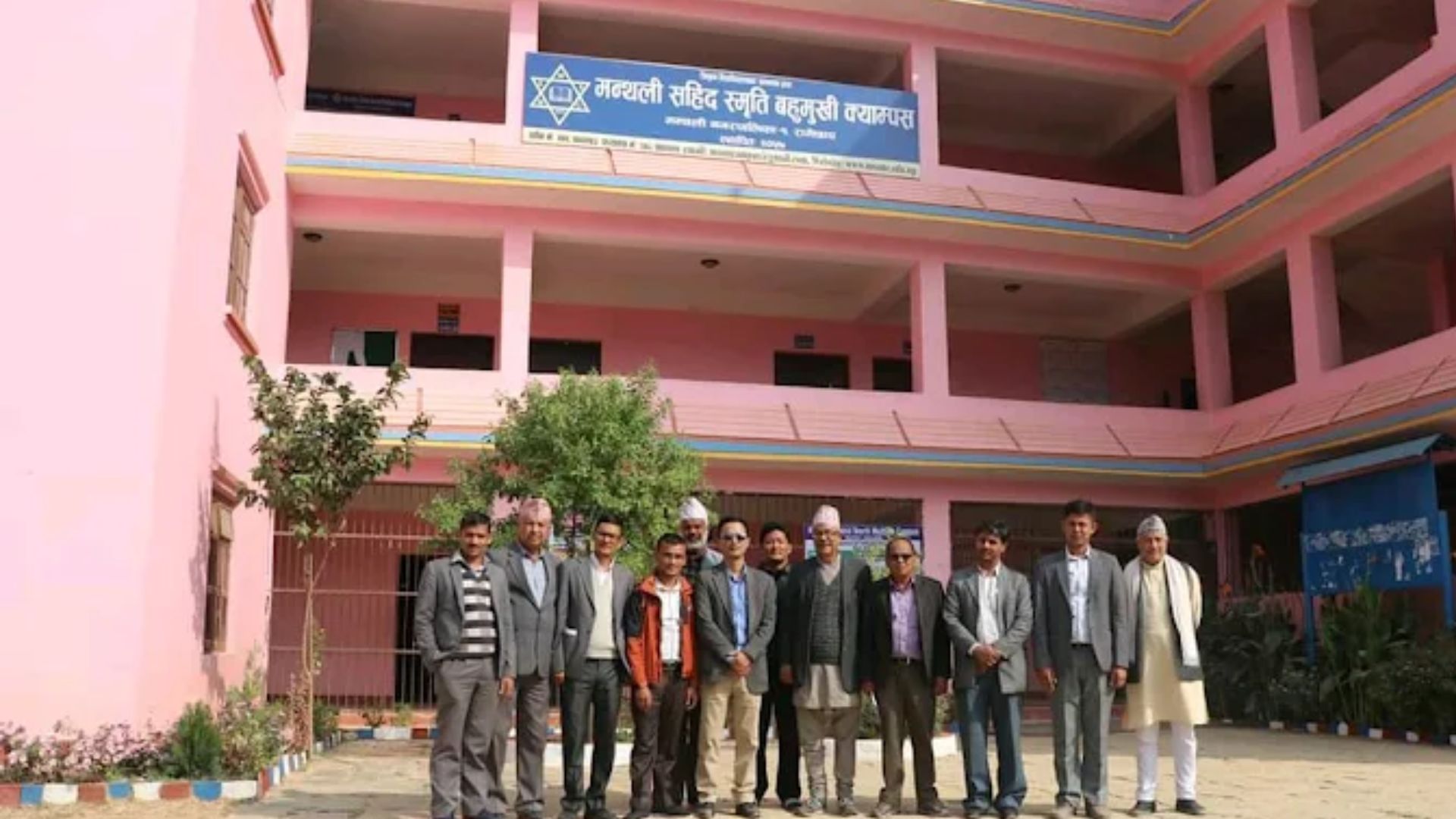
The B.Ed program at Manthali Sahid Smriti Multiple Campus is part of the campus’s multi-faculty academic structure in humanities, education, and management. Within that structure, B.Ed represents the education stream and gives students in Ramechhap and nearby districts access to university-level study in education at the local level.
The course is closely connected with the growth of the campus. After bachelor’s level teaching began in humanities, the addition of B.Ed in 2059 BS expanded the academic scope of the institution and strengthened its role in teacher education and education-related study within the district.
The education stream connected with the campus includes BICTE, English, Health and Physical Education, Nepali, Mathematics, and Population. These subject areas place B.Ed within a defined academic setting and show the range of education-related study available through the campus.
B.Ed is offered within a campus that has organized departments in Humanities, Education, and Management. This departmental structure gives the course a formal academic base and supports coordination of teaching, academic administration, and faculty-level activities.
The campus also maintains systems related to admission, examinations, teaching practice, academic records, and academic operations. For B.Ed students, this means the course is part of an institution with established academic procedures rather than a limited single-program setup.
The academic structure also includes research-related and information-management functions. This adds to a course environment in which teaching is connected with institutional record-keeping, academic monitoring, and organized campus administration.
The B.Ed program is conducted in a campus environment shaped by regular academic planning and continuous follow-up. Academic and related activities are carried out through the annual calendar. Monthly and internal examinations are part of the academic process, along with feedback, answer-sheet analysis, and record-keeping.
The campus also provides extra classes and remedial support for students who need additional academic help. Subject-wise attendance, timely counseling, and orientation programs are part of the same learning support system. These practices connect classroom teaching with academic follow-up and student guidance.
Seminars, discussions, workshops, and guest lectures are also part of the academic environment. These activities add discussion-based and subject-focused learning opportunities within the course setting.
Teaching is supported through computer and projector methods, and the campus also conducted online classes during the COVID-19 period. This shows that the institution has used both classroom-based and technology-supported methods to continue academic work.
B.Ed students are part of a campus system that includes scholarship support, counseling, student welfare, and co-curricular activities. Scholarship schemes are available for deserving students, and the campus also provides full and partial scholarships under prescribed criteria.
The support structure goes beyond financial assistance. Counseling is part of the student support environment, and the campus also conducts interaction with parents, value-based activities, yoga, meditation, and campus-level orientation programs. These services contribute to the overall academic and personal support available to students.
For students in education-related study, one practical feature of the campus is the provision of free preparation classes conducted from time to time for teacher license, teacher service, and Public Service Commission examinations. This places the B.Ed course within an academic setting that also supports preparation connected with teaching and public sector pathways.
B.Ed students use the facilities shared across the campus. These include a library, sports facilities, computer lab, multimedia support, classrooms, conference hall, internet access, e-library services, and canteen facilities.
The campus also has a media hall and uses technology in teaching and administration. Free computer learning is part of the wider student support environment, which adds practical value to the academic setting for education students.
Basic campus services such as clean classrooms, drinking water, playground space, library access, and internet facilities contribute to the day-to-day learning environment. Educational visits are also arranged according to subject need and time context, adding another academic support element to campus life.
The B.Ed program is part of a campus established in 2057 BS to expand access to higher education within Ramechhap. With the addition of B.Ed in 2059 BS, the campus strengthened its role in education studies and widened local access to bachelor’s level programs.
The campus later added BBS in 2064 BS and M.Ed in 2067 BS, developing into a bachelor’s and master’s level institution. It also received Quality Assurance and Accreditation on 28 Poush 2076 BS. As a result, B.Ed is offered within a campus that has developed academic systems, facilities, and formal institutional processes over time.
Because the campus serves students from Ramechhap as well as nearby districts, the B.Ed program also functions as a local university-affiliated option for students seeking education studies within the region.
College: Manthali Sahid Smriti Multiple Campus
Location: Manthali Municipality, Ramechhap, Bagmati Province, Nepal
Affiliation: Tribhuvan University
Email: mssmcampus@mssmc.edu.np
Phone: +977-48-540003, +977-48-540053
Website: https://mssmc.edu.np
B.Ed stands for Bachelor of Education.
The B.Ed program is offered under the Faculty of Education.
The campus began B.Ed in 2059 BS.
The B.Ed program is offered at a campus affiliated with Tribhuvan University.
The education stream connected with B.Ed includes BICTE, English, Health and Physical Education, Nepali, Mathematics, and Population.
B.Ed students study in a campus environment that includes monthly and internal examinations, feedback, answer-sheet analysis, remedial classes, counseling, seminars, workshops, and orientation programs.
Students can use the library, computer lab, multimedia support, classrooms, conference hall, internet, e-library, sports facilities, and canteen services.
The campus provides scholarship support for deserving students, including full and partial scholarships under prescribed criteria.