Nepal Academy of Tourism and Hotel Management (NATHM), Bardibas operates at Bardibas-14, Mahottari, and conducts the Bachelor in Hospitality Management (BHM) in partnership with Kathmandu University (KU).
The undergraduate program runs for four years across eight semesters and carries 132 credit hours, with 30 seats. Eligibility, admission, entrance requirements, curriculum, examinations, evaluation, academic completion, and degree award follow the rules and regulations of Kathmandu University. The curriculum combines hospitality operations with management, communication, accounting, tourism, research, service management, and related academic areas.
| Particular | Details |
|---|---|
| Institution | Nepal Academy of Tourism and Hotel Management (NATHM), Bardibas |
| Location | Bardibas-14, Mahottari |
| Academic partnership | Kathmandu University (KU) |
| Program | Bachelor in Hospitality Management (BHM) |
| Program level | Bachelor's degree |
| Duration | 4 years / 8 semesters |
| Total credits | 132 credit hours |
| Seats | 30 |
| Academic regulations | As per Kathmandu University rules and regulations |
| Phone | 044-550146 |
| bardibas@nathm.edu.np | |
| Website | nathmbardibas.edu.np |
NATHM Bardibas is a branch of Nepal Academy of Tourism and Hotel Management, an institution established by the Government of Nepal in 1972. NATHM originally began as the Hotel Management and Tourism Training Centre (HMTTC), with technical support from the United Nations Development Programme and the International Labour Organization. Its establishment was connected with preparing trained human resources for Nepal's tourism and hospitality sector.
NATHM later expanded into degree-level hospitality and tourism education. Bachelor-level hotel management education was introduced in 1999, followed by the Bachelor of Travel and Tourism Management in 2003 and the Master of Hospitality Management in 2011.
Alongside academic programs, NATHM has conducted short-term training in areas such as tourist guiding, trekking guiding, food production, food and beverage service, barista training, homestay management, local guiding, and small hotel and lodge management.
The academy subsequently expanded its institutional presence beyond NATHM Kathmandu. Bardibas became one of its branch locations, along with Birtamod and Nepalgunj. At Bardibas, the academic partnership with Kathmandu University provides the framework for the Bachelor in Hospitality Management.
NATHM's academic and training activities are centered on tourism and hospitality. Its institutional objectives include preparing trained personnel for the hotel and tourism sector, conducting higher-level academic programs for managerial preparation, and undertaking research, surveys, and consultancy related to tourism.
This background connects directly with the academic direction of NATHM Bardibas. The Bachelor in Hospitality Management is not limited to operational hotel subjects. Its curriculum also covers management, communication, finance, tourism, research, law, organizational studies, marketing, entrepreneurship, and service management.
NATHM's wider institutional network includes organizations associated with tourism, travel, hospitality, government, and education. These include the Hotel Association of Nepal, Trekking Agencies Association of Nepal, Nepal Association of Tour and Travel Agents, Nepal Tourism Board, government agencies, and several international academic and hospitality organizations.
These institutional relationships form part of NATHM's broader academic and professional environment. They do not represent a guarantee of individual employment, internship, or placement.
The Bachelor in Hospitality Management at Bardibas is conducted through NATHM's partnership with Kathmandu University (KU).
Kathmandu University was established by an Act of Parliament in December 1991 as an autonomous, not-for-profit, self-funding public institution. Its academic governance includes the Senate, Academic Council, Executive Council, schools, faculty boards, research committees, and subject committees.
The Academic Council has responsibility for academic matters including teaching and learning standards, curricula, examinations, evaluation methods, class size, and admission requirements.
For the BHM at NATHM Bardibas, Kathmandu University rules and regulations govern:
eligibility for admission;
admission procedures;
entrance requirements;
curriculum and academic structure;
examinations and evaluation;
academic completion requirements; and
degree award.
NATHM Bardibas serves as the location where the program is conducted, while the academic requirements remain governed by Kathmandu University's regulatory framework.
NATHM Bardibas offers the following Kathmandu University bachelor's program:
| Program | Duration | Seats |
|---|---|---|
| Bachelor in Hospitality Management (BHM) | 4 years / 8 semesters | 30 |
The BHM comprises 132 credit hours distributed across eight semesters.
Students seeking course-specific information can visit the Bachelor in Hospitality Management (BHM) at NATHM Bardibas.
The Bachelor in Hospitality Management is an undergraduate program focused on hospitality operations and management. Its academic structure combines practical hospitality subjects with management and supporting business disciplines.
The curriculum begins with core areas such as room division, food production, food and beverage service, hospitality and tourism, management and leadership, and English for hospitality.
As students progress through the program, the subject range extends into financial management, hospitality software, business communication, beverage knowledge, sustainability, ethics, safety and security, managerial accounting, hospitality law, organizational behaviour, research, marketing, entrepreneurship, destination management, customer relations, and service management.
Several operational subjects include practical credit components. The curriculum therefore gives students exposure to both the operational and managerial sides of hospitality education.
The first semester establishes the foundation of hospitality operations and management. Subjects include:
The Contemporary Hospitality and Tourism Industry;
Room Division Operation I;
Food and Beverage Service Operation and Management I;
Fundamental of Hospitality Management and Leadership;
Food Production Operation and Management I; and
English for Hospitality.
The second semester continues core operational study through Food and Beverage Service Operation and Management II, Food Production Operation and Management II, and Room Division Operation II.
Students also study Travel and Tourism Service Operation, Food Science Nutrition and Sanitation, and Success Skills (Professionalism in Hospitality).
The third semester includes Food Production Operation and Management III alongside Financial Management in Hospitality Industry, Hospitality Business Software Applications, Business Communication and Writing Skills, and Oenology and Beverage Knowledge.
An International Foreign Language is also included, with Chinese, German, French, and Spanish identified as language options.
The fourth semester introduces a stronger management and organizational component. Its subjects include Sustainable Hospitality Environment, Ethics and Fair Society, Property, Safety and Security Management, and Managerial Accounting for Hospitality Industry.
A specialization component is also included at this stage. The listed specialization areas include:
Food and Beverage Operation and Management Advanced;
Room Division Operation and Management;
Management of Function and Events;
Tourism Product Development;
Airlines Operation and Management; and
Adventure Tourism.
The fifth semester includes Hospitality Industry Law, Behavioral Economic, Organizational Behavior and Productivity Management, Research Methodology and Statistics, and Marketing and Sales for Hospitality Business.
The sixth semester includes Research Project and Diploma Paper, Entrepreneurship for Hospitality, Tourism Destination Management, Managing Productivity through People, and Service Quality Management.
The curriculum also contains hospitality-focused areas related to e-marketing, tourism development, information technology, hospitality brand management, and social media.
Across eight semesters, the curriculum progresses from operational hospitality subjects toward management, accounting, research, marketing, entrepreneurship, tourism, and service-related study.
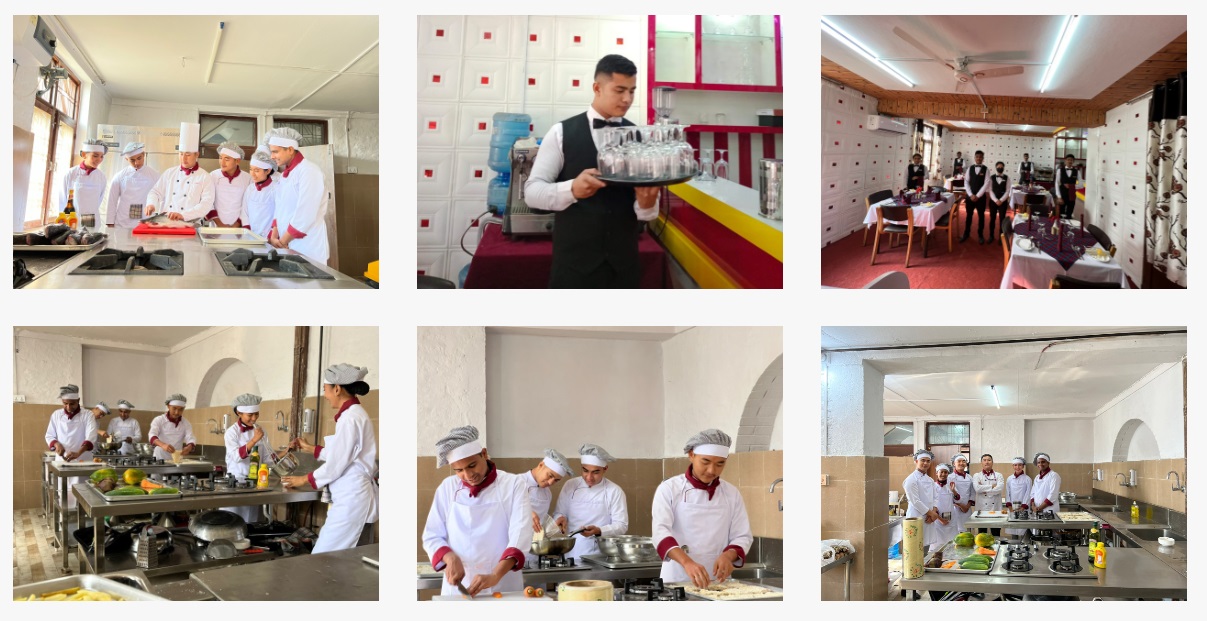
The BHM curriculum includes practical components in several operational subjects.
Food production courses carry practical credit components across the early semesters. Food and beverage service and room division subjects also combine theory with practical study. Hospitality Business Software Applications introduces software-related learning within a hospitality setting.
This academic structure places practical work alongside classroom-based study in subjects where operational knowledge forms part of the curriculum.
Students also move beyond direct hotel operations into tourism services, financial management, communication, foreign-language study, safety and security, law, organizational behaviour, research, marketing, entrepreneurship, destination management, and service quality.
The combination allows the program to address different functions within hospitality organizations rather than concentrating on a single operational area.
The BHM curriculum covers a broad set of hospitality-related academic areas, including:
hotel and hospitality operations;
food production;
food and beverage service;
room division;
hospitality management and leadership;
tourism services and destination management;
financial and managerial accounting;
hospitality software and information technology;
communication;
foreign-language study;
safety and security;
ethics and hospitality law;
marketing and customer relationship management;
organizational behaviour and productivity;
research and project work;
entrepreneurship; and
service management.
The structure therefore combines operational preparation with management-oriented academic study.
Admission to the Bachelor in Hospitality Management at NATHM Bardibas is governed by Kathmandu University rules and regulations.
Eligibility: Eligibility requirements follow the Kathmandu University regulations applicable to the Bachelor in Hospitality Management program.
Admission: Admission procedures are conducted according to Kathmandu University rules and the requirements applicable to the program.
Entrance: Entrance requirements and related procedures follow Kathmandu University regulations.
The BHM program at NATHM Bardibas has 30 seats.
The BHM curriculum at NATHM Bardibas follows the academic framework governed by Kathmandu University.
Kathmandu University's Academic Council is responsible for academic matters that include curricula, standards of teaching and learning, examinations, evaluation methods, class size, and admission requirements.
Students complete their courses, academic assessments, examinations, practical components, and other program requirements according to the rules applicable to the Kathmandu University BHM program.
Course requirements, credits, examinations, evaluation, academic progression, and completion requirements remain subject to Kathmandu University regulations.
The Bachelor in Hospitality Management degree is awarded according to Kathmandu University rules and regulations.
Students must complete the academic requirements prescribed for the program. Curriculum, examinations, evaluation, academic completion, and degree administration remain within the Kathmandu University academic system.
NATHM has institutional connections with organizations from Nepal's tourism, hospitality, travel, aviation, government, and education sectors.
Its national network includes organizations such as:
Hotel Association of Nepal;
Trekking Agencies Association of Nepal;
Nepal Association of Tour and Travel Agents;
Nepal Tourism Board;
Nepal Airlines;
Civil Aviation Authority of Nepal;
National Planning Commission; and
government ministries and departments connected with tourism, finance, and labour.
NATHM also has international associations and academic connections involving institutions and hospitality organizations in Thailand, China, and other international networks.
These connections form part of NATHM's wider institutional setting in tourism and hospitality education. They should not be interpreted as guaranteed internship, employment, or overseas placement arrangements for individual students.
NATHM Bardibas is located at Bardibas-14, Mahottari.
| Contact | Details |
|---|---|
| Address | Bardibas-14, Mahottari |
| Phone | 044-550146 |
| bardibas@nathm.edu.np | |
| Website | nathmbardibas.edu.np |
The academic arrangement at NATHM Bardibas brings together NATHM's hospitality-focused institutional setting and Kathmandu University's academic regulations.
The BHM requires 132 credit hours across eight semesters. Its early semesters concentrate substantially on hospitality operations, including food production, food and beverage service, and room division. Later coursework expands into management, accounting, law, organizational behaviour, research, marketing, entrepreneurship, tourism management, and service management.
The program is therefore structured for students undertaking bachelor's-level study specifically in hospitality management, with both operational and management subjects forming part of the curriculum.
NATHM Bardibas offers the Bachelor in Hospitality Management (BHM) in partnership with Kathmandu University.
The Bachelor in Hospitality Management at NATHM Bardibas has 30 seats.
The program runs for four years across eight semesters.
The Bachelor in Hospitality Management consists of 132 credit hours.
Eligibility requirements follow the rules and regulations of Kathmandu University applicable to the BHM program.
The admission procedure follows Kathmandu University rules and regulations.
Entrance requirements and procedures are governed by Kathmandu University regulations.
The curriculum, examinations, evaluation, and related academic requirements follow Kathmandu University rules and regulations.
The curriculum includes food production, food and beverage service, room division, tourism services, hospitality management, accounting, communication, hospitality software, foreign-language study, law, marketing, research, entrepreneurship, destination management, and service management.
NATHM Bardibas is located at Bardibas-14, Mahottari.
The listed telephone number is 044550146, and the email address is bardibas@nathm.edu.np.