



Kathmandu University (KU) is an autonomous, not-for-profit, self-funding public institution established by an Act of Parliament in December 1991. Its central administration is in Dhulikhel, Nepal, while its seven university schools operate across Dhulikhel and Lalitpur.
KU organizes its academic work through schools, departments, councils, directorates, divisions, research committees, and administrative units. Its academic areas include arts, education, engineering, law, management, medical sciences, science, technology, social sciences, and research.
For prospective students, the university is best understood through its school-based structure. Each school manages specific academic areas, and admission procedures, fees, scholarships, academic schedules, and selection requirements may differ by program and academic cycle.
| Field | Information |
|---|---|
| University | Kathmandu University (KU) - काठमाण्डाैं विश्वविद्यालय |
| Established | December 1991 |
| Institution type | Autonomous, not-for-profit, self-funding public institution |
| Central administration | Dhulikhel, Nepal |
| University schools | 7 |
| Academic locations | Dhulikhel and Lalitpur |
| General email | info@ku.edu.np |
| P.O. Box | 6250 |
Kathmandu University was established in December 1991.
KU is an autonomous, not-for-profit, self-funding public institution.
Its central administration is in Dhulikhel.
The university operates through seven academic schools.
KU schools are located in Dhulikhel and Lalitpur.
Academic offerings extend across certificate, bachelor's, master's, M.Phil., Ph.D., research, and selected short-course levels.
Fall, from July to September, is the normal intake period for undergraduate and most graduate programs.
Admission procedures depend on the relevant school and program.
KUCAT-CBT applies to undergraduate admission pathways under the School of Engineering and School of Science.
KU has several scholarship and financial-support categories.
The university maintains a Directorate of Research, Development and Innovation.
Student support includes Student Welfare, library services, hostels, student activities, guidance, and counselling.
External institutions under affiliated and extended programs are separate from KU's seven university schools.
Kathmandu University was established by an Act of Parliament in December 1991. The university combines public institutional status with autonomous administration, a not-for-profit structure, and a self-funding model.
The university's mission is “to provide quality education for leadership.” Its vision is “to become a world-class university devoted to bringing knowledge and technology to the service of mankind.” KU also uses the idea of taking knowledge and skills “from the campus to the community” as part of its institutional direction.
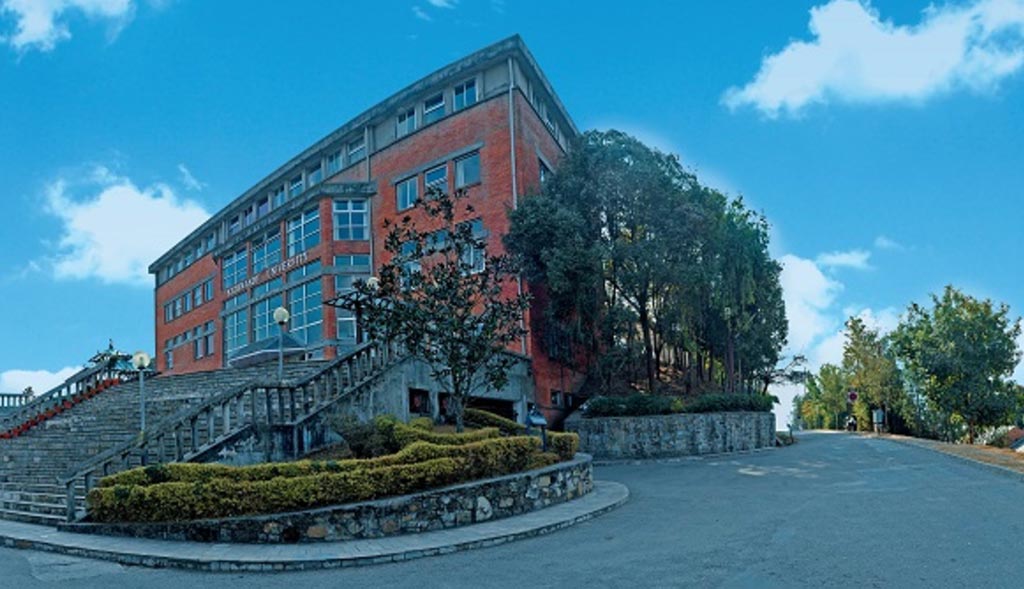
Its academic organization is based on schools, departments, programs, faculty boards, research committees, and subject committees. Each school is headed by a Dean and operates within the wider academic and governance structure of the university.
As of June 2023, Kathmandu University had produced 41,275 graduates. Institutional information from the same period recorded more than 200 long-term and short-term academic programs and courses from intermediate to Ph.D. levels.
KU has also associated several programs with early introduction in Nepal. These include Business Administration, Pharmacy, Environmental Science, Biotechnology, Human Biology, Mechanical Engineering, Computer Engineering, Electrical and Electronics Engineering, Geomatics Engineering, Development Studies, Social Work, Technical Education, Media Studies, Civil Engineering with Specialization in Hydropower, Landscape Management and Heritage studies, Doctor of Medicine (DM) in Gastroenterology, DM in Neurology, and MS by Research in Glaciology.
The university marked 2016 as its Silver Jubilee Year. During the Silver Jubilee period, the then Vice-Chancellor Prof. Dr. Ram Kantha Makaju Shrestha presented the Silver Jubilee Initiatives – Vision 2030. The initiative focused on quality, innovation, equity, identity, impact, and global engagement as areas of long-term institutional development.
Kathmandu University's central administration is in Dhulikhel, Nepal. Its seven schools, however, operate across Dhulikhel and Lalitpur.
The School of Arts and School of Education are based in Hattiban, Lalitpur. The School of Management operates from Balkumari, Lalitpur. The Schools of Engineering, Law, Medical Sciences, and Science are based in Dhulikhel.
| School | Location |
| School of Arts | Hattiban, Lalitpur |
| School of Education | Hattiban, Lalitpur |
| School of Engineering | Dhulikhel, Kavre |
| School of Law | Dhulikhel |
| School of Management | Balkumari, Lalitpur |
| School of Medical Sciences | Dhulikhel, Kavrepalanchok |
| School of Science | Dhulikhel |
This multi-location structure makes the responsible school an important part of program planning. Students admitted to programs under the School of Management, for example, study within the Balkumari setting, while programs under the School of Arts and School of Education are connected with Hattiban.
School-level organization also affects admission communication, academic schedules, departmental coordination, student services, and program administration.
Kathmandu University's seven schools form the core of its academic structure. Each school covers specific disciplines and academic levels.
The School of Arts is located in Hattiban, Lalitpur. Its academic areas include arts and design, development studies, economics, languages and mass communication, and music.
Its offerings include undergraduate, graduate, doctoral, and selected short-course or school-run programs. The school brings together creative, social, cultural, communication, economic, and development-related areas within one academic unit.
The School of Education is also located in Hattiban, Lalitpur. Its academic areas include development education, language education, educational leadership, STEAM education, school counselling and wellbeing, and inclusive education and early childhood development.
Its programs include bachelor's, postgraduate diploma, master's, M.Phil., and Ph.D. levels. The school therefore covers multiple stages of academic and professional study in education-related fields.
The School of Engineering is based in Dhulikhel, Kavre. Its academic areas include architecture, artificial intelligence, chemical science and engineering, civil engineering, computer science and engineering, electrical and electronics engineering, environmental engineering, geomatics engineering, health informatics, and mechanical engineering.
Undergraduate admissions under the School of Engineering include the KUCAT-CBT pathway. Selection and eligibility requirements depend on the specific program and admission cycle.
The School of Law operates in Dhulikhel and is one of Kathmandu University's seven academic schools.
Admission requirements, intake arrangements, academic eligibility, and selection procedures are applied at the program level. Law applicants therefore need to follow the conditions set for the particular program they intend to study.
The School of Management is located in Balkumari, Lalitpur. Its academic areas include finance, economics and accounting; human resources and general management; management informatics and communication; management science and information; marketing and entrepreneurship; and public policy and management.
These academic areas cover business, organizational management, economics, information-related management, entrepreneurship, and public policy.
The School of Medical Sciences operates in Dhulikhel, Kavrepalanchok. Its academic work covers medical and health-science education.
Programs within medical and health sciences follow program-specific admission and academic requirements. Eligibility, entrance arrangements, and selection procedures vary according to the relevant academic program.
The School of Science is based in Dhulikhel. Its departments include agriculture, biotechnology, environmental science, mathematics, pharmacy, and physics.
The school offers undergraduate, graduate, research, M.Phil., and Ph.D. programs across these academic areas. Undergraduate admission pathways under the School of Science include KUCAT-CBT.
Kathmandu University offers academic programs across several levels. These include certificate, bachelor's, master's, M.Phil., and Ph.D. study, along with research and selected short-term or school-run programs.
The university's academic range spans arts, education, law, management, engineering, medical sciences, science, technology, and related interdisciplinary areas.
Program structure is managed through the relevant school and department. Duration, eligibility, curriculum, selection process, and academic requirements are therefore connected with the individual program rather than one university-wide format.
Students researching an academic program can begin by identifying:
The exact program name
The responsible KU school
The department or academic unit
The applicable admission process
The program location
The relevant academic intake
This school-based approach is useful because two programs within the same university may operate under different academic and administrative arrangements.
Kathmandu University also maintains a separate category known as “Affiliated and Extended Programs.” External institutions within this category deliver specified programs associated with KU.
These institutions are separate from the university's seven internal academic schools.
A recorded list contained 32 institutions under affiliated and extended programs. Their academic areas included medicine, dentistry, nursing, business, information technology, social work, education, hospitality, public health, and other fields.
The distinction between university schools and external affiliated institutions is important. Kathmandu University itself has seven schools. An external institution delivering a KU-associated program does not become another KU school.
Students applying through an external institution need to identify:
The name of the institution
The exact KU-associated program
The relevant academic relationship
The admission process for that program
The academic and financial conditions linked with the intake
An external institution's relationship with KU applies to the program or programs associated with that institution rather than automatically covering every course it may offer.
Kathmandu University follows a broad admission framework, while eligibility, application dates, screening methods, and selection procedures depend on the relevant school and program.
There is no single admission deadline or one eligibility condition that applies to every KU program.
Fall, from July to September, is the normal annual intake period for all undergraduate and most graduate programs.
Some graduate and postgraduate programs may follow different schedules under the relevant school or department.
Depending on the program, the admission process may include one or more of the following:
Paper-based entrance test
Computer-based entrance test
Analytical essay writing
Group discussion
Personal interview
These methods are used according to program requirements and are not common mandatory components across all KU programs.
KUCAT-CBT is associated with undergraduate admission pathways under the School of Engineering and School of Science.
Applicants to other KU schools follow the admission arrangements set for their respective programs rather than assuming that KUCAT-CBT applies university-wide.
Prospective students generally need to identify the following program-level information before applying:
Exact program title
Responsible school and department
Application opening and closing dates
Academic eligibility
Entrance or selection requirements
Required application documents
Applicable fee structure
Scholarship conditions
School contact information
Program location
Program-level requirements take priority over general university information when students are preparing an application.
Kathmandu University does not have one permanent fee amount that applies to every student or academic program.
Fees differ according to the school, program, academic batch or fiscal period, and applicable fee schedule. KU maintains fee structures for its schools and programs, including a fee structure.
| Fee Consideration | Relevance |
| School and program | Charges can differ across academic programs |
| Batch or fiscal year | Fee schedules may change over time |
| Admission cycle | Payment conditions may differ between intakes |
| Applicable fee structure | Determines the charges associated with a program |
A fee figure associated with one school, program, or academic period cannot be treated as a general KU fee for all students.
Historical financial information also records student fees as an important part of KU's self-funding model. At the time of that financial description, student fees accounted for 60 percent of financial management, while other sources covered 40 percent and government support accounted for 10 percent.
Kathmandu University maintains several categories of scholarships and financial support.
These include:
Merit-based scholarships
Need-based scholarships
UGC Formula Funding Scholarship
Local scholarships
Staff or faculty family scholarships
Loan scholarships
Endowment-based scholarships
Named scholarship funds
School-specific scholarships and assistantships
Scholarship eligibility may depend on academic performance, financial circumstances, the relevant school or program, available funding, supporting documents, and the conditions attached to the particular scheme.
Several named scholarship funds are associated with KU.
| Scholarship | School or Coverage |
| Hinu Ramesh Nath Dhungel Scholarship Fund | School of Arts and School of Science |
| Dr. Mahesh Nath Parajuli Scholarship Fund | School of Education |
| Dr. Bipin Adhikari Scholarship Fund | School of Law |
| Judda Bahadur Scholarship Fund | School of Management |
| Shilva Shrestha Scholarship Fund | School of Management |
| Dr. Nhuchhe Ratna Tuladhar Scholarship Fund | School of Medical Sciences |
| Late Bikash Adhikary Scholarship Fund | School of Science |
| Bidhya Acharya Scholarship Fund | School of Science, Department of Pharmacy |
| Madhuri & Mohan Man Sainju Scholarship Fund | Different Schools |
The School of Science also has scholarship support directed toward academically strong and financially needy undergraduate students. Continuation under the cited scheme is linked with annual academic review and a minimum total GPA of 3.0.
KU also maintains endowment funds that can support scholarships, student financial assistance, research and development, faculty development, facilities, and other purposes specified by donors.
Research is an established part of Kathmandu University's academic organization.
The university maintains a Directorate of Research, Development and Innovation, along with research centers, projects, policies, publications, research committees, and academic research structures within its schools.
Each school has a research committee headed by the respective Dean. Subject committees are chaired by the Head of Department of the concerned subject.
KU's research activity spans different disciplines represented across its seven schools, including science, engineering, medicine, education, arts, management, and law.
The university also maintains national collaborations involving public institutions, universities, hospitals, municipalities, research organizations, professional institutions, businesses, and development organizations.
Examples include:
Dhulikhel Hospital
International Centre for Integrated Mountain Development
Government ministries
Local governments
The purpose of each collaboration depends on the individual agreement. Relationships may involve academic cooperation, research, technical work, scholarships, training, community activities, or specific institutional projects.
Kathmandu University maintains a Global Engagement Division under the Office of the Vice-Chancellor for international academic and institutional engagement.
Its international activities include institutional agreements and academic relationships with organizations in different countries.
One recorded account of KU's international collaboration activities reported more than 284 MoUs, relationships spanning more than 41 countries, and more than 5,660 international graduates.
International engagement can involve institutional cooperation, research relationships, faculty or student activity, joint academic work, and project-based agreements.
The scope of participation depends on the specific program, agreement, or academic initiative.
Kathmandu University provides several student services and support arrangements connected with academic and campus life.
These include:
Student Welfare
Student activities
Hostel information
Central Library
Library services at school locations
Guidance and counselling
Canteen services
Information systems
Event and general services
Security management
The Central Library is associated with the university's central premises, while library services are also connected with other school locations.
Student Welfare and guidance services form part of the university's support structure, while accommodation and other campus services operate according to the relevant location and academic arrangement.
Kathmandu University's administrative structure includes offices, directorates, divisions, sections, and management services responsible for academic and institutional operations.
Major units include:
Office of the Controller of Examinations
Directorate of Admissions, Equivalence Scholarship and Alumni
Directorate of Research Development and Innovation
Directorate of Human Resource Management
Directorate of the Students Welfare
Finance Division
Treasury and Account Management Section
Human Resources Division
Information and Library Division
Central Library and Documentation Section
Information System and Management Section
Management Services Division
Canteen Services
Event Management and General Services
Inventory and Property Management
Procurement and Land Management
Security Management
These units divide responsibility for examinations, admissions, scholarships, alumni relations, research, human resources, student welfare, finance, library services, information management, logistics, procurement, and campus administration.
For students, different matters may therefore be handled by separate offices rather than through one central administrative unit.
Kathmandu University's governance structure includes the Senate, Academic Council, Executive Council, Board of Trustees, Deans, Faculty Boards, research committees, and subject committees.
The Senate is the university's apex governing body.
The Senate includes university authorities and representatives from education, government, affiliated institutions, industry, teaching, and the student community.
The Prime Minister, as Chancellor of the university, chairs the Senate. The education minister serves as Pro-Chancellor.
The Senate deals with major institutional matters, including academic programs, degrees, affiliations, annual programs, budget proposals, audited reports, staffing provisions, and university-level committees.
The Academic Council is the university's main educational and academic authority.
Its responsibilities include:
Standards of teaching and learning
Curricula
Teaching materials
Examinations
Evaluation methods
Class size
Admission requirements
Research policy
Honorary degrees
Minimum qualifications for teachers
The Academic Council therefore provides the wider academic framework within which KU's schools and departments operate.
The Executive Council carries out decisions and directives of the Senate and manages executive matters within the university.
Its responsibilities include annual programs, budgets, progress reports, audited reports, grants and donations, funds and property, program oversight, institutional rules, personnel appointments, and terms of service.
The Board of Trustees has responsibilities related to long-term planning, institutional resources, guidance, and the process connected with the selection of the Vice-Chancellor.
Schools are the main centers of educational activity and are headed by Deans.
Each school has a faculty board and a research committee headed by the respective Dean. Subject committees operate under the relevant Head of Department.
This arrangement places academic responsibility across university-wide governing bodies and school-level structures.
Kathmandu University's self-funding structure makes tuition income an important part of its financial management.
Historical institutional information reported that student fees accounted for 60 percent of KU's financial management. Other sources accounted for 40 percent, while government support represented 10 percent.
The same institutional account also stated that about 10 percent of students at different levels received scholarships, apart from educational loan facilities and sponsoring schemes from different organizations.
These figures belong to the financial context in which they were recorded and are separate from current program-level fee and scholarship conditions.
The university's scholarship framework includes both centrally available and school-specific arrangements, creating several possible channels of financial support depending on the student's program and eligibility.
Kathmandu University maintains a broad range of institutional agreements within Nepal.
Its collaborations include arrangements with organizations such as:
Nepal Police Hospital
Nepal Children's Organization
Panauti Municipality
Department of Mines and Geology
Gandaki University
Lalbandi Municipality
Bethanchowk Gaunpalika
Far Western University
Nepal Academy of Tourism and Hotel Management
Nepal Electricity Authority
Nepal Academy of Science and Technology
Dhulikhel Hospital
Alternative Energy Promotion Centre
University Grants Commission
B.P. Koirala Institute of Health Sciences
National Youth Council
International Centre for Integrated Mountain Development
The university also has agreements involving businesses, professional groups, research bodies, government agencies, municipalities, education institutions, and development organizations.
These collaborations reflect the range of academic, research, technical, scholarship, institutional, and community relationships maintained across KU's areas of work.
Students considering Kathmandu University can organize their decision around the specific school and program rather than relying only on general university information.
Useful points to review include:
Exact program name
Responsible school
Department or academic unit
Program location
Academic level
Intake period
Eligibility requirements
Entrance or selection process
Application documents
Fee structure
Scholarship conditions
School contact details
Affiliated or extended-program status where applicable
A clear understanding of the responsible school helps students separate university-wide information from program-specific academic and administrative requirements.
Bachelor
Bachelor of Craft & Design
Bachelor of Fine Arts
Master
Master in Development Studies
Master in Human and Natural Resources Studies
Master in Urban Studies (MUS)
Bachelor
Bachelors in Economics
Master
Masters in Economics
Certificate
Short Term Course
Bachelor
Bachelor in Media Studies
Bachelor of Arts in English, and Mass Communication and Journalism
Master
Master in Film Studies
Master in Media Studies (MMS)
Doctor of Philosophy
PHD
Bachelor
Bachelor in Ethnomusicology (B.Mus)
Master
Master in Ethnomusicology (M.Mus)
Certificate
Confucius Institute at KU
Kathmandu University-Nepal Centre for Contemporary Studies (KU-NCCS)
PhD in School of Arts
Disability Research Center
Center for Buddhist Studies
Bachelor
Bachelor in Community Development
Bachelor in Yogic Science and Well-being
Bachelor in Social work
Bachelor in Environment Studies
Bachelor in Korean Studies(Language and Business)
Master
Landscape Management and Heritage Studies
Postgraduate Diploma
Post-Graduate Diploma in Education - Technical Vocational Instruction (PGDE-TVI)
Master
Master in Indigenous Education and Development (One Year Program)
Master in Sustainable Development
Master in Technical and Vocational Education and Training (MTVET)
Master of Philosophy
Master of Philosophy (MPhil) in Development Studies
Doctor of Philosophy
PhD in Development Education
Master
Master of Education in Leadership and Management (One Year Program)
Master of Education in Leadership and Management (Two Year Program)
Master of Philosophy
MPhil in Educational Leadership
Doctor of Philosophy
PhD in Educational Leadership
Certificate
Bridge Course in Early Childhood Education
Bachelor
Bachelor of Education in Basic and Early Education (B.Ed. BEE)
Postgraduate Diploma
Diploma in Inclusive and Special Needs Education
PGDE in Early Childhood Education
PGDE in Inclusive and Special Needs Education
PGDE in Primary Education
Post Graduate Diploma in Educational Management
Post Graduate Diploma in STEAM Education
Master
Master in School Transformation
Master in Training and Development
Master of Education in Early Childhood Development (One Year Program)
Masters in Inclusive and Special Needs Education (MISNE) [1-Year]
Master of Philosophy
MPhil in Early Childhood Education (ECD)
Doctor of Philosophy
PhD in Adult Learning
PhD in Early Childhood Development
Bachelor
BA (English Studies)-B Ed in TESOL
B Ed in Teaching Chinese to Students of Other Languages (TCSOL Major) and TESOL
Postgraduate Diploma
PGDE in Maithili Language Teaching (PGDE in MLT)
PGDE in Nepalbhasha Teaching (PGDE in NBT) (One-year program)
PGDE in Tamang Language Teaching (PGDE in TLT)
PGDE in Yakthung (Limbu) Language Teaching (PGDE in YLT)
Master
Master in Writing and Literacy Studies
Master of Education in ELE (2 Years)
Master of Education in ELT (1 year)
Master of Philosophy
Master of Philosophy (MPhil) in English Language Education
Ph.D
PhD in Language Education
Bachelor
Bachelor in Mathematics Education
Bachelor of Technical Education in Civil Engineering
Bachelor of Technical Education in Information Technology
Postgraduate Diploma
Bridge Course for M Ed in Mathematics Education
Master
Master in Higher Education (One Year)
Master of Education in Mathematics Education (Two Year)
Master of Education in STEAM Education (One Year)
Master of Education in STEAM Education (Two Year)
Master of Philosophy
Master of Philosophy (MPhil) in STEAM Education
Doctor of Philosophy
PhD in STEAM Education
Master
One Year Master of Education in School Counseling
Two Years Master of Education in School Counseling
Master of Philosophy
MPhil in School Counseling and Psychological Wellbeing
Doctor of Philosophy
PhD in School Counseling and Psychological Wellbeing
Bachelor
Bachelor in Heritage Conservation (BHC)
Bachelor of Architecture (B.Arch)
Master
MS by Research under Department of Architecture
Doctor of Philosophy
PhDs under Department of Architecture
Bachelor
Bachelor of Technology in Artificial Intelligence
Master
Master of Technology in Artificial Intelligence
Bachelor
Bachelor in Engineering (Chemical Engineering)
Bachelor
Bachelor of Engineering in Civil Engineering
Bachelor of Engineering in Mining Engineering
Master
Master of Engineering in (Structural Engineering)
ME/MS in Sanitation Technology
Bachelor
Bachelor of Engineering (Computer Engineering)
Bachelor of Information Technology (BIT)
Bachelor of Information Technology (BIT) - Double Degree
Bachelor of Science (Computer Science)
Bachelor of Technology (B. Tech) in Cybersecurity
Master
Master of Engineering (Computer Engineering)
Master of Technology (Information Technology)
MS by Research DoCSE
Ph.D
PhD in DoCSE
Bachelor
Bachelor of Engineering in Electrical and Electronics Engineering
Master
Master of Engineering
MS By Research
Doctor of Philosophy
Ph.D in Electrical and Electronics Engineering
Bachelor
Bachelor of Engineering in Environmental Engineering
Master
Masters By Research in Environmental Engineering
M.E. in Environmental Engineering
M.E in Green Infrastructure Engineering
Doctor of Philosophy
Ph.D. in Environmental Engineering
Certificate
PhD under Department of Geomatics Engineering
Bachelor
Bachelors of Engineering in Geomatics Engineering
Master
Master in Land Administration
ME/MS in Geoinformatics
MS by Research
Certificate
Department of Health Informatics
Master
Master’s Program in Health Informatics
Bachelor
Bachelor of Engineering in Mechanical Engineering (Automobile/Design and Manufacturing/Energy Technology/Hydropower)
Master
Master of Engineering (Planning and Operation of Energy System)
Master of Mechanical Engineering
Master Program in Energy Efficient Building Design (EEBD)
MS by Research under Department of Mechanical Engineering
Ph.D
PhDs under Department of Mechanical Engineering
Bachelor
Bachelor of Economics and Bachelor of Law (BEc-LL.B)
Bachelor of Business Management and Bachelor of Law (BBM-LL.B)
Master
LL.M/MCCL (Master of Laws (LL.M.) in Corporate and Commercial Law)
LL.M / MEIL (Master of Laws (LL.M.) in Energy and Infrastructure Law )
Doctor of Philosophy
Ph.D
Bachelor
Bachelor of Business Information Systems (BBIS)
Bachelor
Bachelor in Professional Hospitality (BPH)
Bachelor of Business Administration (BBA)
Master
Executive Master of Business Administration (EMBA)
Master in Business and Economics
Master of Public Policy and Management (MPPM)
MPhil in Management
Master of Business Administration (MBA)
Ph.D
PhD in Management
Bachelor
B.Sc. in Agriculture
Master
M. Sc. Agriculture Horticulture
Bachelor
Bachelor of Science in Bioinformatics
Bachelor of Technology in Biotechnology
Master
MS by Research in Biotechnology
M. Tech. in Biotechnology
Ph.D
Ph. D. in Biotechnology
Certificate
M.Phil. in Environmental Science
Bachelor
B.Sc. in Environmental Science
Master
Master by Research in Environmental Science
Master by Research in Glaciology
M.Sc. in Environmental Science - Specialization in Glaciology
M.Sc. in Environmental Science - Specialization in Natural Resources
M.Sc. in Environmental Science - Specialization in Wildlife Management
Ph.D
Ph.D. in Environmental Science
Ph.D. in Environmental Science-Specialization in Glaciology
Bachelor
Bachelor of Data Science (BDSc)
B. Sc. in Computational Mathematics
Master
M. Sc. in Computational Mathematics
Master of Philosophy
M.Phil. in Mathematics
M. Phil. in Statistics
Ph.D
Ph. D. in Mathematics
Ph. D. in Statistics
Bachelor
Bachelor of Pharmacy
Master
Master in Pharmaceutical Analysis
Master in Pharmacognosy and Phyto chemistry
Master in Pharmacy (Industrial Pharmacy)
Master in Pharmacy (Pharmaceutical Care)
Master in Science by Research (Pharmaceutical Sciences)
PharmD (Post Baccalaureate)
Ph.D
PhD in Pharmacy
Certificate
M. Phil. in Physics
Bachelor
B. Sc. in Applied Physics
Master
MS by Research in Physics
M.Sc. in Physics
Ph.D
Ph. D. in Physics
Bachelor
B. Sc. in Computer Science
Master
MS by Research in Chemistry
Ph.D
Ph. D. in Chemistry
Ph.D in Computer Science
M. Phil
M. Phil. in Chemistry
| Contact Field | Detail |
| Address: | Dhulikhel, Nepal |
| Phone: | 977-11-415100, 977-11-415200, 977-9801210035, 977-11-415005 |
| Fax: | 977-11-415011 |
| P.O. Box: | 6250 |
| Email: | info@ku.edu.np |
School-level contact details are also relevant for students seeking information about a particular academic program.
Kathmandu University is an autonomous, not-for-profit, self-funding public institution established by an Act of Parliament.
Kathmandu University was established in December 1991.
Kathmandu University's central administration is in Dhulikhel, Nepal. Its seven schools operate across Dhulikhel and Lalitpur.
Kathmandu University has seven schools:
School of Arts
School of Education
School of Engineering
School of Law
School of Management
School of Medical Sciences
School of Science
No. The seven schools are internal academic units of Kathmandu University. External institutions under affiliated and extended programs form a separate category.
KU offers programs across certificate, bachelor's, master's, M.Phil., Ph.D., research, and selected short-course levels.
Fall, from July to September, is the normal intake period for undergraduate and most graduate programs. Some graduate and postgraduate programs follow different schedules.
No. KUCAT-CBT is associated with undergraduate admission pathways under the School of Engineering and School of Science.
Depending on the program, admission screening may include a paper-based entrance test, computer-based entrance test, analytical essay writing, group discussion, personal interview, or a combination of these methods.
No. Fees differ by school, program, academic batch or fiscal period, and applicable fee structure.
Yes. KU has merit-based, need-based, UGC Formula Funding, local, staff or faculty family, loan, endowment-based, named, and school-specific scholarship arrangements.
Yes. KU provides hostel information and maintains the Central Library along with library services associated with other school locations.
Yes. KU maintains a Directorate of Research, Development and Innovation, school-level research committees, research centers, projects, policies, and publication-related activities.
Kathmandu University's governance includes the Senate, Academic Council, Executive Council, Board of Trustees, Deans, Faculty Boards, research committees, and subject committees. The Senate is the apex governing body.
Students should identify the exact program, responsible school, location, eligibility requirements, admission process, applicable fee structure, and scholarship conditions connected with their intended intake.
