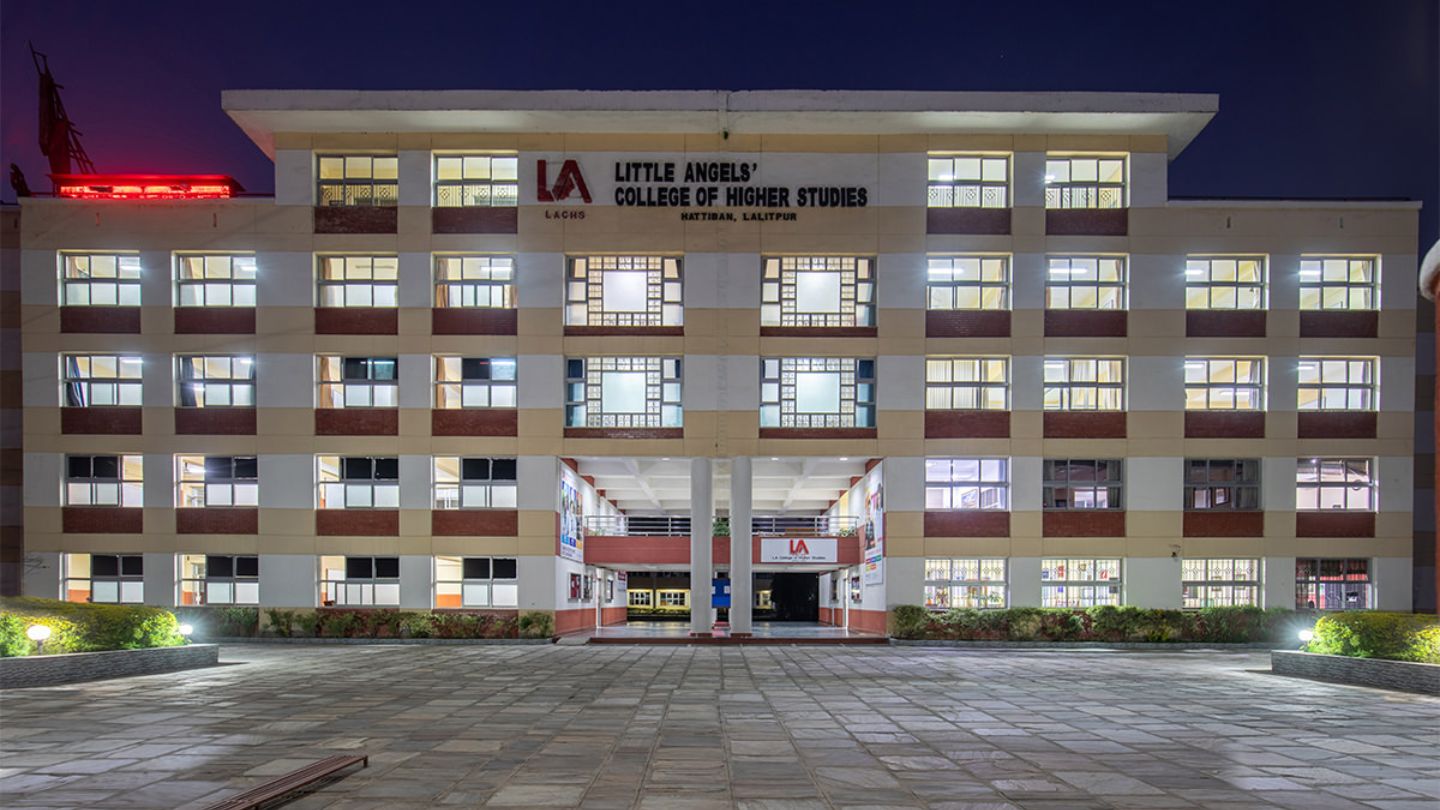
Little Angels’ College of Management (LACM) is an undergraduate college located at Hattiban, Lalitpur. It operates within the Little Angels’ Education Group and is affiliated with Kathmandu University for its undergraduate programs in business administration, business information systems, and hospitality management.
The college offers Bachelor of Business Administration (BBA), Bachelor of Business Information System (BBIS), and Bachelor in Hospitality Management (BHM). Its academic approach combines classroom study with case work, presentations, projects, internships, industrial visits, seminars, and program-specific practical activities. Admission, entrance requirements, eligibility, curriculum, examinations, results, and degree awards for these programs follow the rules and regulations of Kathmandu University.
| Field | Details |
|---|---|
| College | Little Angels’ College of Management (LACM) |
| Location | Hattiban, Lalitpur |
| Affiliation | Kathmandu University |
| Academic connection | Kathmandu University School of Management (KUSOM) |
| Programs | BBA, BBIS, BHM |
| BBA seats | 80 |
| BBIS seats | 80 |
| BHM seats | 30 |
| Level | Undergraduate |
| Duration | Four years |
| Academic rules | As prescribed by Kathmandu University |
| Contact email | info@lacm.edu.np |
| Website | www.lacm.edu.np |
Little Angels’ College of Management developed within the wider Little Angels’ Education Group in Hattiban, Lalitpur. The group began its academic activities with Little Angels’ School in 1981 and later expanded into higher secondary and undergraduate education.
The institutional timeline records several stages in this development:
1981: Little Angels’ School began its academic activities.
1995: construction of the Little Angels’ campus in Hattiban began.
1997: Little Angels’ College was launched for 10+2 education.
1999: Little Angels’ College of Management was established with affiliation to Kathmandu University.
2019: Bachelor in Hospitality Management was introduced to the undergraduate program portfolio.
This development places LACM within a larger educational network while retaining its own academic role as a Kathmandu University-affiliated college for undergraduate management, information systems, and hospitality education.
Its Hattiban location also connects the college with the wider Little Angels’ campus, where academic facilities, student activities, information technology resources, and hospitality training facilities support the undergraduate programs.
LACM is affiliated with Kathmandu University (KU), and its management programs are academically connected with Kathmandu University School of Management.
The affiliation determines the formal academic framework followed by the college. LACM does not operate an independent system for eligibility, entrance, curriculum, examinations, results, or degree awards for the three undergraduate programs.
Kathmandu University rules and regulations govern:
admission eligibility;
entrance and selection requirements;
curriculum and academic structure;
examinations and assessment;
result administration; and
degree awards.
This arrangement separates the responsibilities of the university and the college clearly. Kathmandu University provides the academic framework, while LACM delivers the programs within its college setting.
Students studying BBA, BBIS, or BHM at LACM therefore complete their education under the academic requirements established by Kathmandu University.
LACM offers three undergraduate programs under Kathmandu University. The programs cover three different areas: general business administration, business information systems, and hospitality management.
| Program | Duration | Seats |
|---|---|---|
| Bachelor of Business Administration (BBA) | 4 years | 80 |
| Bachelor of Business Information System (BBIS) | 4 years | 80 |
| Bachelor in Hospitality Management (BHM) | 4 years | 30 |
BBA and BBIS are four-year, 120-credit undergraduate degrees. BHM is also a four-year undergraduate program, with greater emphasis on hospitality operations and practical training.
The Bachelor of Business Administration at LACM is a four-year, 120-credit undergraduate program focused on business and management education.
The program develops knowledge across areas associated with management, organizational work, entrepreneurship, leadership, and business problem-solving. Academic study is supported by activities that require students to apply concepts, communicate ideas, work in groups, and examine organizational situations.
Classroom learning is complemented by:
case studies;
group assignments;
presentations;
seminars;
project work;
internship experience; and
industrial visits.
Case-based work allows students to consider management issues through specific situations rather than relying only on conceptual explanations. Presentations and group assignments require students to organize information, discuss ideas, and communicate their findings.
The internship component places part of the undergraduate learning process in an organizational setting. Industrial visits also allow students to observe workplace practices and relate academic subjects to organizational activities.
The BBA curriculum, eligibility requirements, entrance procedures, examinations, results, and degree award follow Kathmandu University rules and regulations.
The Bachelor of Business Information System at LACM is a four-year, 120-credit undergraduate program combining business studies with information systems.
BBIS brings management and technology-related learning into the same academic structure. The program covers the use of information systems in organizational settings, including areas connected with digital business, data-related analysis, systems management, and organizational decision-making.
The program differs from a general management degree because information systems form part of its academic focus. Students study business concepts while also examining how organizations use technology and information to support operations and decisions.
Learning activities include case work, presentations, group assignments, seminars, internship experience, projects, and industrial interaction. These activities allow students to work with both conceptual and applied aspects of the program.
The college’s information technology infrastructure also supports an academic setting relevant to BBIS study.
Eligibility, admission, entrance requirements, curriculum, examinations, results, and degree awards for BBIS remain governed by Kathmandu University rules and regulations.
The Bachelor in Hospitality Management is LACM’s hospitality-focused undergraduate program. It was introduced into the college’s academic offering in 2019.
The four-year program combines management education with operational areas of hospitality. Its academic scope includes hotel operations, food production, front office work, housekeeping, event management, and tourism entrepreneurship.
Because hospitality education requires operational practice alongside classroom learning, LACM maintains dedicated practical facilities for the program. These include:
a culinary kitchen;
an equipped bar; and
hospitality laboratories.
The facilities support practical activities associated with food production and other hospitality operations. Students are therefore able to connect academic concepts with practical procedures within the program.
Internship experience also contributes to the applied component of BHM. It gives students exposure to professional settings connected with hospitality and related operations.
The program remains governed by Kathmandu University. Eligibility, entrance, admission, curriculum, examinations, results, and the award of the degree follow university rules and regulations.
Admission to BBA, BBIS, and BHM at LACM is conducted within the academic requirements of Kathmandu University.
The university framework applies across the main stages of admission and academic progression.
| Academic Area | Governing Framework |
|---|---|
| Eligibility and admission | Kathmandu University rules and regulations |
| Entrance requirements | Kathmandu University rules and regulations |
| Curriculum | Kathmandu University academic framework |
| Examinations and results | Kathmandu University rules and regulations |
The approved seat distribution is:
BBA: 80 seats
BBIS: 80 seats
BHM: 30 seats
The same university framework continues after admission. Students complete the prescribed curriculum, examinations, and other academic requirements according to Kathmandu University regulations.
The curriculum of each LACM program follows the academic requirements established by Kathmandu University.
The three programs have different subject orientations:
BBA focuses on business administration and management.
BBIS integrates business studies with information systems.
BHM combines management education with hospitality operations.
BBA and BBIS each comprise 120 credits across four years. Their academic structure includes management-related coursework together with practical components such as projects and internships.
BHM follows a four-year structure with additional attention to operational hospitality learning. Areas such as food production, hotel operations, housekeeping, front office work, and events require practical training alongside academic study.
The curriculum delivered at LACM is therefore part of the Kathmandu University academic system rather than an independently designed college curriculum.
LACM uses several learning methods across its undergraduate programs. Classroom teaching is supported by activities that require students to discuss, present, apply, and interpret course content.
The teaching and learning process includes:
lectures;
case-study work;
group presentations;
public speaking activities;
peer learning;
seminar sessions;
group projects;
internships;
industrial visits; and
interaction with visiting faculty and professionals.
Case studies bring practical situations into academic discussion. Students can examine a defined problem, consider available information, discuss alternative responses, and explain their reasoning.
Presentations create a different academic requirement. Students need to organize information, communicate ideas clearly, and respond to questions or discussion.
Group assignments introduce collaborative work into the learning process. They require students to divide tasks, coordinate work, combine findings, and prepare a common academic output.
Seminars provide another setting for discussion and subject-focused interaction beyond conventional lectures.
LACM includes a Case Learning Unit within its academic setting. Case-based learning supports discussion, teamwork, and the application of management concepts to defined situations.
This method is relevant to business education because management issues often involve more than one factor. Students may need to interpret information, identify a problem, compare possible actions, or explain a decision.
Case work complements lectures rather than replacing them. Classroom teaching provides the theoretical and conceptual foundation, while case discussions allow students to apply that understanding in a structured context.
Peer learning forms another part of this process. Students working in groups or discussing cases encounter different interpretations of the same subject. This gives the academic environment both individual and collaborative dimensions.
Internships are part of the practical learning approach at LACM. Group projects and industrial visits provide additional exposure to organizational settings.
Internships allow students to observe workplace practices, interact with professionals, and relate academic learning to organizational activities. This gives students experience outside the regular classroom while remaining connected with their academic program.
Industrial visits provide shorter periods of organizational observation. Students can see how different activities are carried out in practice and connect what they observe with subjects studied in class.
Group projects require students to work together on defined academic tasks. They involve planning, allocation of responsibilities, preparation, and presentation of findings.
LACM also maintains relationships with corporate organizations that support professional interaction, internship exposure, and industrial learning. These activities form part of the educational process and are separate from any guarantee of employment after graduation.
The practical requirements of BHM differ from those of BBA and BBIS. Hospitality education includes operational areas that need purpose-built training spaces.
LACM maintains a culinary kitchen, an equipped bar, and dedicated hospitality laboratories for practical learning.
These facilities support training connected with areas such as food production and hospitality operations. They allow students to practise procedures that cannot be covered through classroom explanation alone.
The practical component remains integrated with the academic degree. BHM is not presented as stand-alone occupational training; it is a four-year undergraduate program under Kathmandu University in which operational practice forms part of the broader curriculum.
Information technology forms part of LACM’s academic infrastructure. The college also uses a virtual classroom system.
One function of the virtual classroom is to provide class notes and related academic material to students who miss scheduled classes. It therefore serves as a support mechanism alongside classroom teaching.
The system operates within a wider learning environment that also includes faculty interaction, lectures, case work, seminars, projects, presentations, internships, and practical activities.
For BBIS students, access to information technology infrastructure also corresponds with the program’s academic connection between business and information systems.
LACM includes co-curricular and extracurricular activities alongside its formal academic programs.
Student participation may include:
social events;
educational trips;
leisure trips;
presentations;
seminars; and
informal interaction sessions.
Some of these activities have a direct academic connection. Presentation sessions and seminars, for example, support communication and subject discussion. Educational trips provide a setting for learning outside scheduled classroom sessions.
Social and informal activities create additional opportunities for students to interact beyond their immediate course groups.
These activities complement the formal curriculum without replacing the academic requirements prescribed by Kathmandu University.
LACM’s teaching team includes academically qualified and professionally experienced faculty members. Their work includes classroom instruction as well as coordination of cases, presentations, seminars, projects, and other academic activities.
The college also conducts sessions involving visiting faculty, including faculty from abroad. These sessions introduce students to additional academic and professional perspectives related to their areas of study.
Faculty capacity-building activities are also part of the academic setting.
For students, this creates several forms of academic interaction beyond a lecture-only model. Course delivery can involve discussion, presentation, case analysis, project supervision, seminars, and other structured activities.
The three programs share the same university affiliation but differ in their academic direction.
| Program | Main Academic Focus | Practical Orientation |
|---|---|---|
| BBA | Business administration and management | Cases, projects, presentations, internship |
| BBIS | Business and information systems | Technology-related business study, projects, internship |
| BHM | Hospitality management and operations | Hospitality labs, culinary practice, internship |
BBA provides a broad management-focused curriculum.
BBIS combines management study with information systems and technology-related applications in organizations.
BHM places management within the context of hospitality operations and includes dedicated practical training.
Students considering the programs can therefore distinguish them primarily by subject focus rather than by university affiliation, as all three operate under Kathmandu University.
Little Angels’ College of Management is located at Hattiban, Lalitpur.
The Hattiban campus is also associated with the wider development of the Little Angels’ Education Group. LACM operates its undergraduate programs, management learning activities, information technology facilities, hospitality practical spaces, and student activities from this setting.
Its location within the wider campus connects the college with the institutional history of the Little Angels’ Education Group while retaining its separate academic role as a Kathmandu University-affiliated undergraduate college.
College: Little Angels’ College of Management (LACM)
Location: Hattiban, Lalitpur
Phone: 01-5912723
Mobile: 9851365447, 9851322721
Email: info@lacm.edu.np
Website: www.lacm.edu.np
LACM offers three Kathmandu University-affiliated undergraduate programs: Bachelor of Business Administration (BBA), Bachelor of Business Information System (BBIS), and Bachelor in Hospitality Management (BHM).
BBA has 80 seats, BBIS has 80 seats, and BHM has 30 seats.
Little Angels’ College of Management is affiliated with Kathmandu University, with its management education academically connected with Kathmandu University School of Management.
All three programs have a duration of four years. BBA and BBIS each comprise 120 credits.
Eligibility for BBA, BBIS, and BHM follows the rules and regulations of Kathmandu University.
Entrance and admission procedures for the three undergraduate programs are governed by Kathmandu University rules and regulations.
The curriculum and formal academic structure of the BBA, BBIS, and BHM programs follow Kathmandu University requirements.
Examinations, results, and degree awards are governed by Kathmandu University rules and regulations.
The learning process includes case studies, group assignments, presentations, seminars, internships, industrial visits, projects, peer learning, and professional interaction.
BHM students have access to a culinary kitchen, an equipped bar, and dedicated hospitality laboratories for practical training connected with the program.
Little Angels’ College of Management is located at Hattiban, Lalitpur.

.png)