National Open College (NOC) is located in Sanepa, Lalitpur, Nepal. Established in 2000 A.D., the college is affiliated with Pokhara University and offers undergraduate, postgraduate, and postgraduate diploma programs in business administration, public health, and healthcare management.
Healthcare management has a substantial place in the college's academic portfolio, alongside public health and business administration. Its current programs are Bachelor of Business Administration (BBA), Bachelor of Public Health (BPH), Bachelor of Health Care Management (BHCM), Master of Healthcare Management (MHCM), and Post Graduate Diploma in Healthcare Management (PGDHCM).
NOC figures record more than 3,500 graduates, more than 400 students, and more than 65 faculty members. The college also provides classroom, library, laboratory, digital-learning, internship, seminar, and sports facilities as part of its academic environment.
| Area | Details |
|---|---|
| College | National Open College (NOC) |
| Established | 2000 A.D. |
| Location | Sanepa, Lalitpur, Nepal |
| Affiliation | Pokhara University |
| Academic areas | Business Administration, Public Health, Healthcare Management |
| Programs | BBA, BPH, BHCM, MHCM, PGDHCM |
| Graduates | 3,500+ |
| Students | 400+ |
| Faculty | 65+ |
| Practical learning | Internships, seminars, presentations, projects |
| Academic resources | Library, basic science labs, e-portal, Wi-Fi |
| Sports | Basketball, table tennis, badminton |
National Open College was established in 2000 A.D. by a group of academic professionals. Its educational direction developed around professional and management education, with particular attention to healthcare administration.
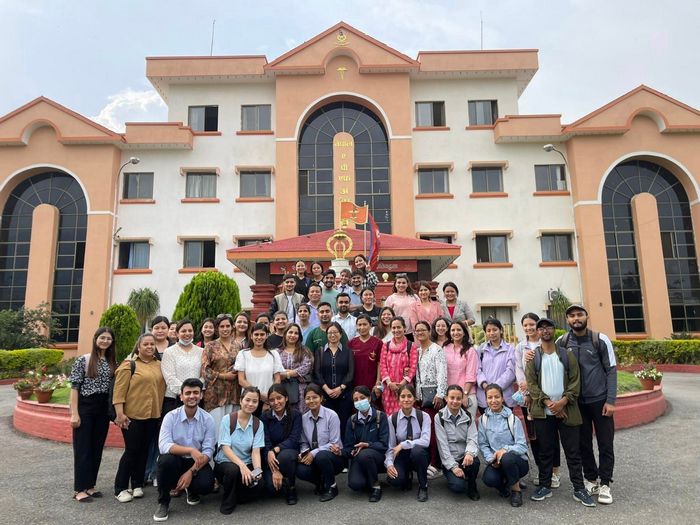
The college operates from Sanepa, Lalitpur and has built an academic portfolio that connects three related but distinct areas: general business management, healthcare management, and public health. Students can therefore study management in a broad business context through BBA, approach organizational and administrative issues within the health sector through BHCM, MHCM, or PGDHCM, or follow a public-health pathway through BPH.
NOC's stated academic approach gives attention to intellectual development, ethical practice, social responsibility, practical education, research-oriented learning, and professional preparation. Classroom instruction is supplemented by presentations, seminars, practical activities, projects, internships, and access to academic resources.
The college also uses a participatory approach in which students and faculty take part in learning activities beyond conventional lectures. This includes collaborative work, presentations, practical assignments, seminars, and activities connected with real organizational settings.
NOC recorded more than 3,500 graduates, more than 400 enrolled students, and more than 65 faculty members. At that time, MHCM had reached its 40th batch, PGDHCM its 33rd batch, BHCM its 26th batch, BBA its 25th batch, and BPH its 17th batch.
National Open College is affiliated with Pokhara University. Its five current academic programs fall within this university affiliation.
The program mix gives NOC two broad academic directions. One is general business and organizational management through BBA. The other is health-related education through BPH, BHCM, MHCM, and PGDHCM.
Within the health-related group, the programs also serve different academic purposes. BPH concentrates on public health, while BHCM, MHCM, and PGDHCM focus on healthcare administration and management.
This distinction matters for students comparing programs with similar health-sector connections. A public-health degree and a healthcare management degree do not have the same academic focus. One addresses population and public-health concerns, while the other concentrates more directly on managing healthcare organizations, services, resources, and administrative processes.
National Open College currently offers five programs under Pokhara University.
| Program | Seats | Academic Focus |
|---|---|---|
| Bachelor of Business Administration (BBA) | 96 | Business and management |
| Bachelor of Public Health (BPH) | 20 | Public health |
| Bachelor of Health Care Management (BHCM) | 48 | Healthcare management |
| Master of Healthcare Management (MHCM) | 30 | Postgraduate healthcare management |
| Post Graduate Diploma in Healthcare Management (PGDHCM) | 30 | Postgraduate healthcare management |
Seat numbers subject to Medical Education Commission determination can change between admission cycles. Where MEC rules apply, the approved seat allocation for the relevant academic year takes precedence over an earlier published figure.
The Bachelor of Business Administration is the college's general business and management program. Its academic areas include finance, marketing, human resource management, accounting, and other subjects connected with organizational management.
BBA differs from the college's healthcare-focused programs because its scope is not limited to health institutions. It provides a broader business-management pathway for students studying organizational functions and managerial responsibilities.
The program sits alongside healthcare management at NOC, giving students in the college exposure to different applications of management education. While BBA approaches management from a general organizational perspective, BHCM and the postgraduate healthcare management programs apply managerial study specifically to health-service settings.
The stated intake for BBA is 96 seats.
The Bachelor of Health Care Management concentrates on the administrative and managerial side of healthcare. Its academic areas include health policy, healthcare finance, healthcare ethics, quality management, organizational management, and related healthcare administration subjects.
BHCM is distinct from clinical education. Its academic orientation is toward how healthcare services and organizations are managed rather than toward direct patient treatment.
The program addresses subjects relevant to institutional planning, administration, finance, service delivery, human resources, policy, quality, and organizational responsibilities in healthcare settings.
Practical exposure also forms part of the learning environment associated with the program. Students may take part in activities such as seminars, hospital visits, internships, presentations, and other academic work outside routine classroom instruction.
The stated intake for BHCM is 48 seats.
The Bachelor of Public Health focuses on public and population health. Its subject areas include epidemiology, biostatistics, health promotion, and environmental health.
Its academic direction is different from BHCM. BPH concentrates on understanding public-health issues, population health, health promotion, and related areas, while BHCM approaches the health sector from an organizational and administrative perspective.
This distinction can help students choose between two health-related bachelor's programs according to the academic field they intend to study. Both relate to healthcare, but the course content and professional orientation are not identical.
Graduate examples connected with the program include public-health-related work, research, NGOs, INGOs, institutes, and universities. These examples represent settings in which NOC graduates have worked and do not constitute a placement assurance for individual students.
The stated intake for BPH is 20 seats.
The Master of Healthcare Management is the college's master's-level program in healthcare management. Its academic areas include healthcare marketing, law and ethics, financial management, and quality management.
MHCM extends the study of healthcare administration to postgraduate level. Its academic focus remains on the management of health organizations and services rather than clinical professional education.
The program addresses managerial subjects within the context of healthcare organizations, allowing students to study areas such as administration, finance, quality, ethics, and organizational responsibilities at an advanced level.
July 2025 figures identify MHCM as the 40th batch, the highest batch number among the five programs recorded by the college at that time.
The stated intake for MHCM is 30 seats.
The Post Graduate Diploma in Healthcare Management is another postgraduate option offered by NOC in healthcare management.
Its academic areas include healthcare policy, marketing, finance, and quality management. The program provides specialized study in healthcare administration without being presented as the same academic award as the master's program.
PGDHCM is also associated with professionals seeking further academic study related to healthcare management and administration.
July 2025 figures identify PGDHCM as the 33rd batch. The stated intake is 30 seats.
The college uses a participatory learning approach that includes academic work inside and outside the classroom. Students take part in presentations, discussions, projects, seminars, practical activities, and internship-related learning.
Academic activities include:
Classroom lectures and discussions
Individual and group presentations
Academic projects
Seminars and workshops
Special guest lectures
Internship opportunities
Computer-supported study
Library-based learning
Practical and observational activities
Access to an e-portal
This combination allows students to work with course concepts through more than one learning format. Management and health-related subjects often involve communication, organizational analysis, planning, decision-making, administration, and practical observation, making classroom interaction and applied learning relevant to the academic process.
The college also gives attention to research-oriented study. Library resources include theses, practicum materials, reports, textbooks, bulletins, and other academic materials that can support assignments, projects, and independent study.
NOC has classroom and academic facilities intended to support routine teaching, presentations, independent study, practical work, and college activities.
The classrooms are described as earthquake-resistant and are equipped with LED projectors, fans, and lighting. Projectors are used for classroom presentations and visual learning materials.
Other academic and campus facilities include:
Library with print and digital materials
Basic science laboratories
E-portal access
Wi-Fi within the college premises
Power backup through inverters and generators
Conference hall
Presentation equipment
Sound system
Facilities for seminars and workshops
The basic science laboratories contain apparatus for practical and observational learning. These facilities support academic activities where basic laboratory exposure is part of the learning process.
The conference hall is used for seminars, workshops, presentations, and other college programs. It includes a sound system, projector, and musical instruments.

The library provides a range of print and digital academic resources. Its collection includes:
Textbooks
Bulletins
Literature
Theses
Practicum materials
Reports
Other academic reference materials
These resources support classroom study as well as independent reading, projects, practical assignments, and research-related academic work.
Wi-Fi and e-portal access give students additional means of accessing digital learning resources within the college environment.
Power backup is also available through inverters and generators, supporting academic activities during interruptions to the regular electricity supply.
Internship opportunities form part of the college's approach to practical learning. Students can gain exposure to professional environments related to their academic programs.
For healthcare management students, this kind of exposure can connect classroom subjects with institutional administration and organizational processes. Public health students can encounter professional settings related to their academic field, while business students can observe organizational and managerial practices.
Other activities accompanying formal study include seminars, presentations, projects, and hospital visits where relevant to the program.
These forms of learning complement classroom instruction and provide students with experience in applying academic concepts to practical situations.
NOC also provides space for extracurricular and recreational activity.
Sports facilities include:
Basketball
Table tennis
Badminton
The conference hall is used for seminars, workshops, presentations, and other student or institutional activities.
These facilities give students opportunities to take part in activities beyond regular classes while remaining within the college environment.
National Open College has a scholarship arrangement linked to semester performance. Students securing the top position in their respective semester are eligible for a scholarship covering 60% of the tuition fee for the following semester.
The scholarship is tied to academic performance and can apply again in subsequent semesters when the student continues to meet the required semester-topper condition.
The scholarship arrangement applies across the programs identified at the college, including BBA, BPH, BHCM, MHCM, and PGDHCM.
For programs falling under Medical Education Commission scholarship and admission provisions, the applicable MEC rules for the relevant academic cycle also apply.
Where a medical education or nursing education bachelor's program falls within the Medical Education Commission admission system, admission is based on MECEE-BL. Master's-level admission within the corresponding regulatory scope is based on MECEE-PG.
Applicable admissions follow the prevailing rules, guidelines, code of conduct, scholarship provisions, seat-allocation system, fee structure, and admission procedures of the Medical Education Commission (MEC), Nepal.
MEC-related seats, fees, scholarships, examination provisions, and admission arrangements may change according to commission decisions and the official MEC calendar. Seat figures determined for one academic year should not be treated as permanently fixed for later intakes.
For health professions that require professional registration or licensing, graduates must meet the requirements of the applicable professional council before entering professional practice. The Nepal Health Professional Council (NHPC) applies to professions that fall within its regulatory jurisdiction.
NOC record more than 65 faculty members and more than 400 students at National Open College. The graduate count had exceeded 3,500.
NOC graduate examples include individuals working in healthcare administration, hospitals, public-health organizations, government-related institutions, NGOs, INGOs, universities, consultancy, and other organizational settings.
Some graduate records also identify professional connections with organizations in Nepal and abroad, including Massachusetts General Hospital in Boston.
These examples illustrate the range of professional environments represented among graduates. They do not guarantee a particular employment outcome for current or future students.
Students must attend 90% of classes to be eligible to attend board exam.
Leave application must be acknowledged by guardian.
Students must enter 5 minutes prior to class hours.
Students must be in the college dress code (uniform).
Mobile phones are prohibited to use in the class-room and library.
Inhuman activities, manners, habits, attitudes and behaviors are strictly subject to disciplinary action.
At least one assignment in each subject is a must per week.
At least one presentation in each subject is a must in a month.
Student must appear all internal exams (M1, M2 & M3) to be eligible to attend board exam.
Student must secure 70% marks in each subject in (M1, M2 & M3) exam.
Fees are to be paid at the time of the beginning of each semester within 15 days.
Internship, field visit, excursion and study visit expenses are not included in the college fee structure.
The college's stated educational direction combines academic study with ethical practice, professional preparation, practical learning, and research-related work.
Its broader areas of interest have included research, consultancy, training services, open education, distance education, short courses, and science and technology-related learning.
Within its current academic portfolio, however, the clearest concentration remains on business administration, public health, and healthcare management.
The combination of bachelor's, postgraduate diploma, and master's study in these areas gives NOC an academic structure covering general management, health-service administration, and public health within one institution.
College: National Open College (NOC)
Location: Sanepa, Ring Road, Lalitpur, near Sajha Petrol Pump, Nepal
Phone: +977-1-5183226, +977-1-5183298
Email: noc.sanepa@gmail.com
Website: www.noc.edu.np
National Open College is located in Sanepa, Lalitpur, Nepal. Its address is identified as Sanepa, Ring Road, near Sajha Petrol Pump.
National Open College was established in 2000 A.D.
National Open College is affiliated with Pokhara University.
The college offers BBA, BPH, BHCM, MHCM, and PGDHCM.
The stated seat figures are 96 for BBA, 20 for BPH, 48 for BHCM, 30 for MHCM, and 30 for PGDHCM. Where MEC seat determination applies, the approved allocation can change between academic years.
BPH focuses on public and population health, with areas such as epidemiology, biostatistics, health promotion, and environmental health. BHCM focuses on the management and administration of healthcare organizations and services.
The college has classrooms with LED projectors, a library, basic science laboratories, e-portal access, Wi-Fi, power backup, and a conference hall used for academic activities.
Yes. Internship opportunities are included within the college's practical learning environment, along with seminars, presentations, projects, and other applied academic activities.
Yes. A semester topper is eligible for a scholarship covering 60% of the tuition fee for the following semester, subject to meeting the applicable academic-performance condition.
The college has facilities for basketball, table tennis, and badminton.


.png)