Birat Medical College (BMC) is a private medical college located in Tankisinuwari, Biratnagar, Morang, Koshi Province, Nepal. The college was established in 2014 as an affiliated medical institution of Kathmandu University. Its clinical foundation dates to 1991, when the healthcare service associated with the institution began as a single-bed clinic and later developed into Birat Medical College Teaching Hospital.
BMC provides medical, nursing, physiotherapy, medical laboratory, medical imaging, and postgraduate medical education. Its academic setting combines classroom teaching, laboratory work, clinical learning, research activities, and community exposure.
The college campus covers about 22 bigha, stated as more than 33 acres. Facilities include academic buildings, laboratories, dissection halls, museums, practical rooms, a central library, student accommodation, administrative spaces, and areas for sports and recreation. Clinical education is connected with Birat Medical College Teaching Hospital.
| Field | Details |
|---|---|
| Institution | Birat Medical College (BMC) |
| Institution Type | Private medical college |
| Location | Tankisinuwari, Biratnagar, Morang, Koshi Province, Nepal |
| College Establishment | 2014 |
| Clinical Foundation | Healthcare service traced to 1991 |
| University Affiliation | Kathmandu University |
| Admission Framework | MECEE-BL and MECEE-PG, as applicable |
| Main Academic Areas | Medicine, nursing, physiotherapy, laboratory science, medical imaging, MD and MS specialties |
| Clinical Training | Birat Medical College Teaching Hospital |
| Campus Area | About 22 bigha, stated as over 33 acres |
| Professional Regulation | Relevant medical, nursing, and health professional councils |
The development of Birat Medical College is closely linked with the growth of its healthcare services. The clinical foundation began in 1991 as a small clinic. Birat Medical College was established in 2014 and operates as an affiliated medical institution of Kathmandu University.
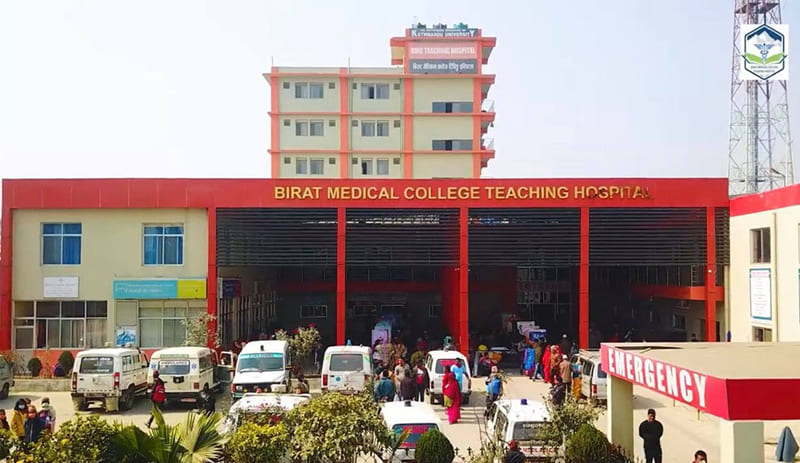
The academic college and teaching hospital together provide an environment in which students can move between basic sciences, laboratory study, clinical departments, patient-oriented learning, and community-based activities.
BMC serves national and international students. Its academic structure is designed to connect theoretical study with practical and clinical learning across different stages of medical and health professional education.
Birat Medical College is affiliated with Kathmandu University (KU). Curriculum, academic progression, examinations, and degree awards for KU-affiliated programs are governed by Kathmandu University rules and regulations.
Admission to medical and health professional programs is also connected with the national framework administered by the Medical Education Commission.
The academic and regulatory structure can be understood through three main areas:
Kathmandu University governs the university academic framework for affiliated programs.
The Medical Education Commission manages the applicable entrance, admission, scholarship, seat allocation, and related medical education procedures.
Relevant professional councils regulate licensing or registration requirements for graduates entering regulated health professions.
Admission to a program, completion of the university degree, and professional registration are therefore separate stages.
BMC offers undergraduate programs in medicine, nursing, physiotherapy, medical laboratory science, and medical imaging. Admission to applicable bachelor-level medical and health professional programs follows the MECEE-BL framework administered by the Medical Education Commission (MEC).
The stated undergraduate seat allocation is as follows:
| Program | Total Seats | Seat Distribution |
|---|---|---|
| Bachelor of Medicine, Bachelor of Surgery (MBBS) | 100 | Foreign 33; Paying 57; Scholarship 10 |
| B.Sc Nursing | 40 | Foreign 13; Paying 23; Scholarship 4 |
| BSc Medical Laboratory | 10 | Foreign 3; Paying 6; Scholarship 1 |
| BSc Medical Imaging Technology (BSc MIT) | 6 | Foreign 2; Paying 3; Scholarship 1 |
| Bachelor of Physiotherapy (BPT) | 15 | Foreign 5; Paying 8; Scholarship 2 |
Within the scholarship allocation, MBBS has 4 open and 6 reserved seats. BSc Nursing has 2 open and 2 reserved scholarship seats. BSc Medical Laboratory and BSc MIT each have 1 open scholarship seat, while BPT has 1 open and 1 reserved scholarship seat.
Laboratory-focused bachelor-level education also appears under the BSc Laboratory Medicine course title.
Seat numbers and category allocations are determined through MEC and can vary between admission cycles.
The MBBS program is one of the main academic programs at Birat Medical College. It is structured over five and a half years, including a compulsory one-year internship.
The program follows a community-focused curriculum with integrated teaching and learning. Its academic approach connects basic medical sciences with clinical, biological, and social aspects of medicine.
Students encounter learning methods such as:
problem-based learning;
group-based academic work;
patient-centred learning;
communication skills development;
ethics and professional development; and
progressive clinical exposure.
Early patient contact forms part of the learning process. Clinical exposure is therefore connected with academic study before the internship stage rather than being restricted to the final phase of the program.
The compulsory internship provides supervised clinical experience before graduates proceed to the applicable professional licensing or registration process.
BMC also offers undergraduate education in nursing, physiotherapy, laboratory science, and medical imaging.
The BSc Nursing program prepares students for nursing practice involving individuals, families, groups, and communities. Its academic scope includes preventive, promotive, curative, and rehabilitative aspects of health care.
The Bachelor of Physiotherapy (BPT) program focuses on physical function, rehabilitation, patient-centred care, health promotion, and prevention of injury. The program is structured over four academic years.
BSc Nursing is also structured as a four-year academic program.
Medical laboratory education supports the scientific and diagnostic side of health care, while BSc Medical Imaging Technology focuses on the use of imaging in disease assessment and clinical services.
These programs place medical, nursing, rehabilitation, laboratory, and imaging education within the same broader health sciences environment.
Birat Medical College offers postgraduate medical programs under Kathmandu University. Admission to applicable postgraduate programs follows the MECEE-PG system.
The stated postgraduate seat allocation is:
| Postgraduate Program | Seats |
|---|---|
| MD Anaesthesiology | 6 — 5 Open, 1 Foreign |
| MD Biochemistry / Clinical Biochemistry | 1 — Open |
| MD Community Medicine | 1 — Open |
| MD Dermatology | 1 — Open |
| MD Internal Medicine | 6 — Open |
| MD Microbiology / Clinical Microbiology | 1 — Open |
| MD Paediatrics | 6 — 5 Open, 1 Foreign |
| MD Pathology / Clinical Pathology | 3 — Open |
| MD Psychiatry | 2 — Open |
| MD Radiodiagnosis / Radiology | 4 — 3 Open, 1 Foreign |
| MS General Surgery | 9 — 8 Open, 1 Foreign |
| MS Obstetrics and Gynaecology | 4 — 3 Open, 1 Foreign |
| MS Ophthalmology | 1 — Open |
| MS Orthopedics / Orthopedics and Trauma Surgery | 2 — Open |
| MS Otorhinolaryngology (ENT) | 2 — Open |
The postgraduate range covers clinical medicine, surgery, diagnostic specialties, laboratory sciences, mental health, child health, women's health, orthopedics, ophthalmology, and ENT.
As with undergraduate programs, seat allocation is subject to MEC determination.
Admission to medical and health professional education at BMC follows the applicable national entrance and admission framework.
Bachelor-level programs covered by the common medical education entrance system follow MECEE-BL. Postgraduate medical programs follow MECEE-PG.
The admission process operates under the prevailing MEC provisions covering matters such as:
entrance examinations;
merit and selection procedures;
seat allocation;
scholarship provisions;
matching and admission procedures;
admission conduct and related guidelines; and
regulated fee arrangements where applicable.
No fee amount is included here.
Eligibility, curriculum, examinations, academic progression, and degree requirements are governed according to the applicable Kathmandu University rules and regulations.
Applicants therefore need to distinguish between four separate academic and professional requirements:
eligibility for the program;
qualification through the applicable MEC entrance and admission process;
completion of Kathmandu University academic requirements; and
professional licensing or registration after graduation where required.
Birat Medical College Teaching Hospital provides the main clinical setting associated with the college. Its healthcare foundation dates to 1991 and later developed into the teaching hospital connected with BMC.
The hospital provides clinical services across areas that include inpatient care, outpatient care, emergency services, diagnostics, surgery, and specialist services.
For students, the teaching hospital provides a setting for:
clinical observation;
supervised practical learning;
case-based teaching;
interaction with patients;
application of medical knowledge; and
progressive clinical training.
Clinical learning is particularly relevant to MBBS and postgraduate MD/MS education, while nursing and allied health students also require practical settings connected with their respective disciplines.
The relationship between the academic college and teaching hospital allows basic science education and clinical training to operate within one broader medical education system.
The Basic Science Building includes departments such as Anatomy, Biochemistry, Physiology, Pathology, Microbiology, Community Medicine, and Pharmacology.
Departmental facilities include:
faculty and departmental rooms;
laboratories;
preparation rooms;
demonstration rooms;
museums;
departmental library spaces; and
practical halls.
These facilities support laboratory work, foundational medical science teaching, practical demonstrations, anatomical study, and other forms of pre-clinical and para-clinical education.
The wider academic structure extends into clinical departments including Internal Medicine, Surgery, Paediatrics, Obstetrics and Gynaecology, Orthopedics, Ophthalmology, and Otorhinolaryngology.
The same range of clinical disciplines is reflected in the college's postgraduate MD and MS programs.
Birat Medical College has a Health Professions Education Department dedicated to medical teaching and educational development.
Its areas of work include:
faculty development;
curriculum development and review;
student-centred learning approaches;
medical education research;
assessment methods; and
academic feedback systems.
Problem-based learning, case-based learning, and simulation-based training are among the educational approaches associated with the department.
Faculty development workshops address teaching methods and instructional practice, while curriculum-related work focuses on the organization and review of medical education.
The department gives teaching methodology, assessment, and faculty development a defined place within the academic structure of the college.
Research is part of the academic environment at Birat Medical College. Faculty and student research activities are supported within the wider medical education setting.
Birat Journal of Health Sciences provides an academic publication platform associated with the institution.
Research activity also connects with the Health Professions Education Department, where areas such as teaching methods, assessment, student learning, and medical education practice receive academic attention.
BMC has community-based outreach activities intended to connect health professional education with rural and regional health settings.
Undergraduate students can gain exposure to health issues outside the conventional classroom and hospital environment through community-oriented activities.
This type of learning allows students to encounter areas such as:
community health needs;
health education;
disease prevention;
access to health services; and
practical conditions affecting health care delivery.
Community exposure also fits with the MBBS program's emphasis on understanding health and medical practice within the wider population.
The Central Library supports teaching, study, and research.
Its facilities include:
wired and Wi-Fi internet access;
HINARI access;
a separate faculty room;
photocopying facilities; and
seating capacity for more than 150 users at one time.
The library supports access to textbooks, journals, reference materials, research literature, and online resources used in medical and health sciences education.
Other academic learning spaces include laboratories, museums, dissection facilities, demonstration rooms, and practical halls.
Birat Medical College provides on-site student accommodation.
Hostel facilities include:
furnished rooms;
electricity supply;
internet access;
technician support;
a common recreational room;
canteen facilities; and
laundry services.
The campus also includes athletic and recreational areas.
The Administration Building contains space for general administration, finance, planning, examination-related functions, and meetings. These services are located within the broader academic campus.
The college's educational structure includes mentoring and academic advising.
Students may be assigned mentors concerned with academic development and personal welfare. This support operates alongside classroom teaching, practical work, clinical supervision, and departmental guidance.
Medical and health sciences students progress through several demanding stages, including basic sciences, practical study, clinical subjects, examinations, and internship. The mentoring structure provides an additional academic support mechanism during this progression.
Completion of a university degree does not by itself complete the professional registration process for regulated health professions.
Medical graduates are subject to the applicable requirements of the Nepal Medical Council.
Nursing graduates are subject to the professional requirements associated with the Nepal Nursing Council.
Graduates of relevant allied health programs come under the applicable framework of the Nepal Health Professional Council (NHPC).
Graduates entering regulated health professions must therefore meet the licensing or registration requirements of the concerned professional council before professional practice where such requirements apply.
The academic and admission structure at BMC involves Kathmandu University, the Medical Education Commission, and the professional council relevant to the student's field.
Applicants should understand the following:
Bachelor-level admission covered by the common medical education entrance framework follows MECEE-BL.
Postgraduate medical admission follows MECEE-PG.
MEC determines applicable seat allocation and scholarship provisions.
Seat numbers can change between admission cycles.
Kathmandu University governs curriculum, examinations, academic progression, and degree awards for affiliated programs.
Professional practice after graduation requires compliance with the applicable professional council rules.
Admission requirements, seat distribution, scholarships, and examination provisions remain subject to the prevailing rules of the responsible authority.
A seat figure or category distribution applicable to one admission cycle should therefore not be treated as a permanent intake arrangement.
Birat Medical College operates within Kathmandu University's academic framework and Nepal's national medical education admission system. Its academic environment combines medical and allied health education with laboratory learning, teaching-hospital exposure, community activities, research, and postgraduate specialty training.