Nepal College of Management (NCM) is a management-focused college located in Dhobighat, Lalitpur. Established in 1999 and promoted by the Gurukul Education Foundation (GEF), the college is affiliated with Kathmandu University. Its undergraduate academic portfolio includes business administration, hospitality management, and business information systems.
The Nepal College of Management, Lalitpur combines classroom study with practical work, projects, internships, research-related activities, hospitality training, and extracurricular participation. Admission, entrance requirements, eligibility, curriculum, examinations, academic progression, and degree awards for its programs operate according to the applicable rules and regulations of Kathmandu University.
| Area | Details |
|---|---|
| College | Nepal College of Management (NCM) |
| Established | 1999 |
| Promoted by | Gurukul Education Foundation (GEF) |
| Institutional model | Trust-run educational institution |
| Affiliation | Kathmandu University (KU) |
| Location | Dhobighat, Lalitpur, Nepal |
| Academic level | Undergraduate |
| Academic areas | Business, hospitality, and business information systems |
| Programs | BBA, BHM, BBIS |
| Academic governance | Kathmandu University rules and regulations |
| Learning components | Classroom study, projects, practical work, internships, research-related activities |
| Student facilities | Library, classrooms, canteen, hall, sports facilities, hospitality practical facilities |
Nepal College of Management was established in 1999 under the promotion of Gurukul Education Foundation. From its establishment, the college developed its academic identity around business and management education under affiliation with Kathmandu University.
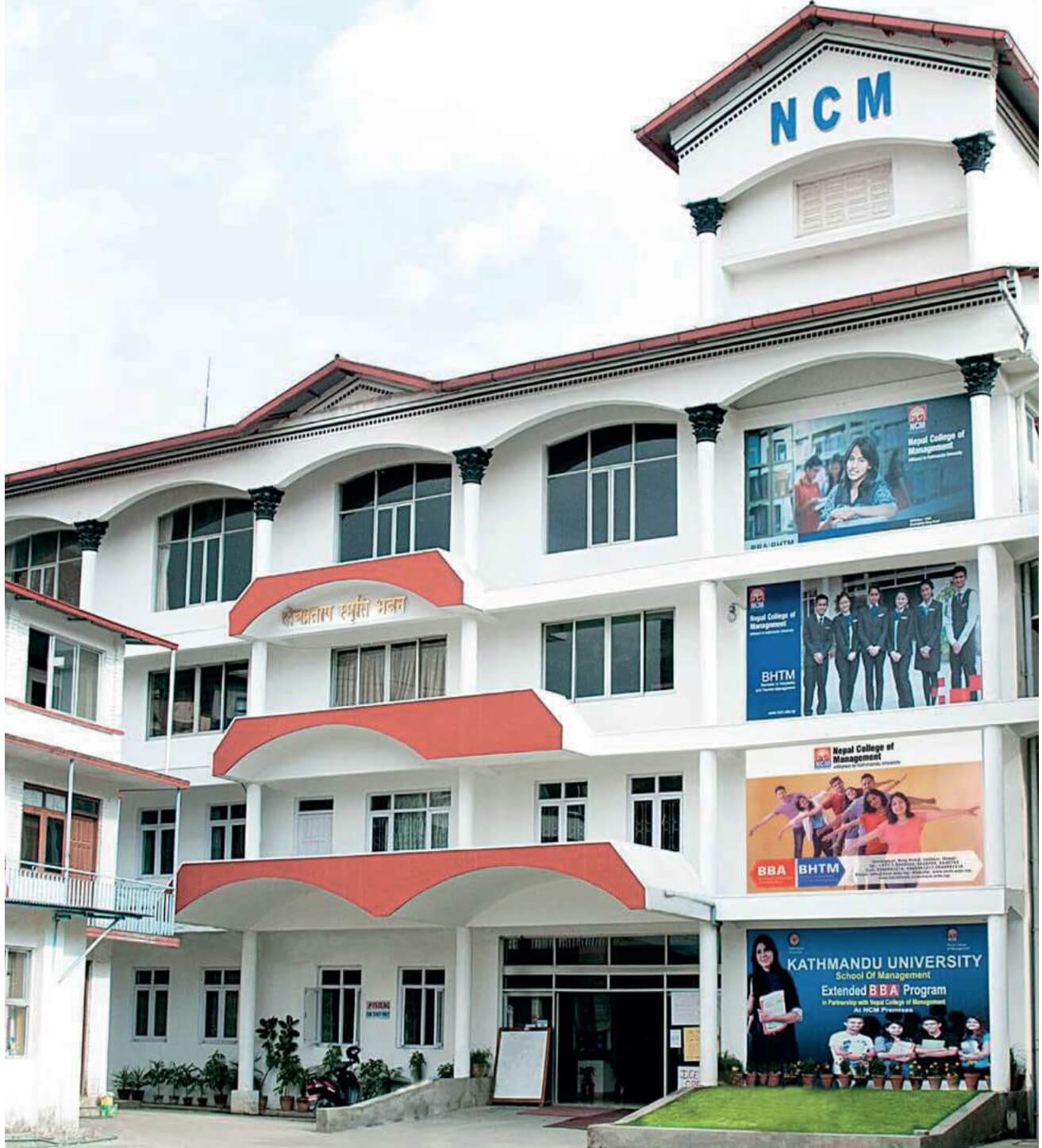
The college is located in Dhobighat, Lalitpur. Its trust-based institutional background is reflected in an educational approach that connects academic learning with professional preparation, responsibility, and participation beyond regular classroom study.
NCM's academic scope covers three undergraduate areas. The Bachelor of Business Administration provides a broad management education. The Bachelor in Hospitality Management combines management study with hospitality operations and practical training. The Bachelor of Business Information System brings business and management together with information systems.
These programs share a management foundation but follow different academic directions. Their curriculum, credits, practical components, assessment requirements, and completion conditions are determined within the Kathmandu University academic framework.
NCM is affiliated with Kathmandu University (KU). The affiliation provides the academic framework under which the college delivers its undergraduate programs.
Kathmandu University regulations govern the principal academic requirements associated with admission, eligibility, curriculum, examinations, academic progression, completion, and degree award.
| Academic area | Governing basis | Application at NCM |
|---|---|---|
| Admission and entrance | Kathmandu University | Applicants follow applicable KU requirements |
| Eligibility | Kathmandu University | Program eligibility follows KU rules |
| Curriculum | Kathmandu University | Programs follow the applicable KU curriculum |
| Examinations | Kathmandu University | Assessment follows KU academic regulations |
| Academic completion | Kathmandu University | Students must complete prescribed requirements |
| Degree award | Kathmandu University | Degree award follows KU regulations |
The affiliation is particularly relevant for students considering entrance requirements, academic eligibility, credit completion, assessment, and graduation. These requirements remain linked to Kathmandu University rather than operating as separate academic rules created independently by the college.
Nepal College of Management offers three undergraduate programs under Kathmandu University.
| Program | Academic structure | Seats |
|---|---|---|
| Bachelor of Business Administration (BBA) | 4 years, 8 semesters, 120 credits | 120 |
| Bachelor of Business Information System (BBIS) | 4 years, 8 semesters, 141 credits | 30 |
| Bachelor in Hospitality Management (BHM) | 4 years, 8 semesters, 132 credits | 30 |
Each program has a different academic emphasis. BBA concentrates on broad business and management areas, BBIS connects management with information systems, and BHM combines management education with hospitality operations and practical training.
The Bachelor of Business Administration (BBA) at Nepal College of Management is a four-year undergraduate program divided into eight semesters. The program carries 120 credit hours.
Its curriculum covers major areas of business and management, including accounting, economics, mathematics, communication, sociology, management, marketing, finance, human resource management, statistics, information systems, entrepreneurship, law, research, and strategic management.
The academic structure combines foundation subjects with functional and managerial areas. Students study quantitative subjects alongside courses dealing with organizations, markets, finance, people, business decisions, research, and strategy.
Learning at NCM also includes assignments, projects, presentations, practical exercises, case-based work, seminars, workshops, and internship-related activities. These components complement classroom instruction by connecting academic concepts with situations found in organizations and business environments.
Admission, entrance, eligibility, curriculum, examination requirements, academic progression, and degree award for BBA follow Kathmandu University rules and regulations.
The Bachelor of Business Information System (BBIS) at Nepal College of Management is a four-year program organized across eight semesters with a total requirement of 141 credit hours.
BBIS combines business and management education with information systems and information technology. Its academic structure is intended to connect organizational and managerial knowledge with the use and understanding of information systems.
Students study business subjects together with areas involving technology, analysis, communication, problem solving, decision making, and information systems. Social sciences and humanities also form part of the broader academic structure.
The program differs from a general management degree because information systems form a central part of its study. At the same time, its business orientation distinguishes it from a program focused only on technical computing.
Academic work includes written assignments, presentations, projects, tests, analytical tasks, and other forms of in-semester assessment together with end-semester evaluation. Examination and grading requirements remain subject to Kathmandu University academic regulations.
NCM has 30 seats for BBIS. Admission, entrance, eligibility, curriculum, examination requirements, academic completion, and degree award follow the applicable Kathmandu University rules and regulations.
The Bachelor in Hospitality Management (BHM) at Nepal College of Management is a four-year undergraduate program divided into eight semesters. It carries 132 credit hours.
The curriculum combines hospitality-specific study with general management education and practical training. Academic areas include food and beverage service, food production, room division, travel and tourism services, hospitality management, leadership, nutrition and sanitation, property and security management, hospitality accounting, tourism destination management, hospitality law, research, marketing, entrepreneurship, and related management subjects.
Practical learning is an important part of BHM. Students work with facilities designed for food production, food and beverage service, bakery work, reception-related practice, and other hospitality operations.
Industrial experience and internship-related components also form part of the academic structure. These elements connect classroom subjects with hospitality work settings and operational requirements.
BHM has 30 seats at NCM. Admission, entrance, eligibility, curriculum, examinations, academic completion, and degree award operate according to Kathmandu University rules and regulations.
Teaching at NCM combines classroom instruction with activities that require students to apply, discuss, present, analyze, and work with subject knowledge.
The specific balance between classroom learning, practical work, projects, and internship differs among BBA, BBIS, and BHM because each program has a different academic focus.
Learning activities include:
classroom teaching supported by audiovisual equipment;
assignments, presentations, tests, and project work;
case-based and practical exercises in management subjects;
hospitality practical work using dedicated operational facilities;
internship and industrial experience within relevant programs;
seminars and workshops;
research-related academic activities;
extracurricular and student-led activities.
BBA students work across business and management subjects and receive opportunities for practical exposure to organizational settings. BBIS students combine business study with information systems, analytical work, and projects. BHM students undertake a greater proportion of operational and practical learning because of the nature of hospitality education.
Internship and practical learning are incorporated into the academic experience at NCM.
For BBA students, internship-related activity provides a setting for connecting classroom concepts with organizational practices. It allows students to observe work environments and apply management knowledge outside regular classroom instruction.
BHM includes a substantial practical orientation. Students first study areas such as food production, service, room division, tourism, and hospitality management before progressing to industrial experience and related academic reporting.
The hospitality program also involves practical training, industry exposure, internship activity, and interaction with working environments relevant to hospitality operations.
BBIS includes applied learning through projects, analytical assignments, presentations, and work involving business information systems.
These components differ in form across the three programs, but each contributes to the connection between academic study and applied learning.
NCM has facilities intended to support classroom instruction, independent study, practical work, student activities, and hospitality training.
| Facility | Main use |
|---|---|
| Library | Books, journals, magazines, manuals, periodicals, publications, and reading materials |
| Classrooms | Regular teaching supported by audiovisual equipment |
| Hospitality practical block | Kitchen, bakery, reception, coffee lounge, bar, restaurant, and mock-room practice |
| Canteen | Meals, snacks, and beverages |
| Hall | College activities and gatherings |
| Sports facilities | Indoor and outdoor activities |
| Campus services | Campus security and electricity backup |
The college library contains books, magazines, journals, manuals, periodicals, publications, and other reading materials. An automated electronic system supports access to library resources.
The library provides a setting for coursework, reading, reference work, and independent study.
NCM's classrooms are equipped with audiovisual teaching support, including multimedia equipment. These facilities are used for regular lectures, presentations, discussions, and other academic activities.
BHM students use a separate practical block designed for hospitality training.
The facilities include:
basic and advanced kitchens;
bakery;
reception area;
coffee lounge;
bar;
restaurant;
mock room.
These facilities allow hospitality students to work with different operational areas covered within the program.
The college has a canteen providing meals, snacks, and beverages. A hall and indoor and outdoor sports facilities support student activities outside scheduled classes.
Campus security and electricity backup are also included among the available campus services.
College life at NCM includes activities outside regular lectures and examinations. Students can participate in programs organized through the students' council, sports, volunteer activities, cultural programs, and inter-college events.
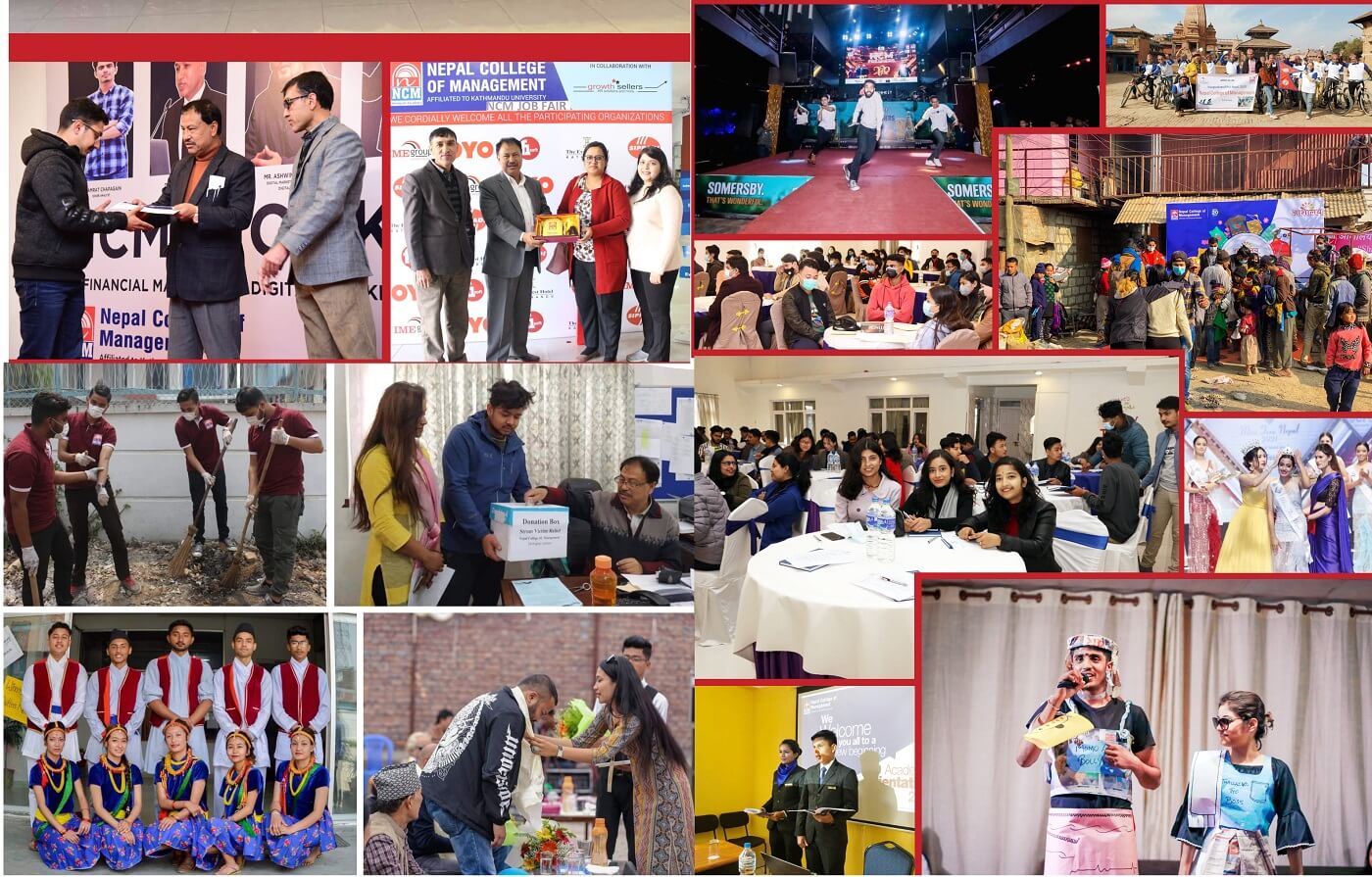
These activities provide settings for communication, participation, teamwork, coordination, and responsibility beyond academic coursework.
Sports activities involve participation and teamwork. Volunteer activities connect students with social responsibilities outside the classroom. Cultural and inter-college programs create opportunities for interaction among students from different backgrounds and institutions.
The institutional emphasis on social responsibility also extends into student life. NCM connects academic learning with participation in activities involving students, professionals, business representatives, community members, and other participants within its wider educational environment.
NCM includes several scholarship categories connected with academic merit, financial need, university scholarship arrangements, and institutional scholarship schemes.
| Scholarship | Main basis |
|---|---|
| Kathmandu University Scholarship | Applicable KU scholarship selection and academic requirements |
| Merit-Based Scholarship | Academic performance |
| Kshetra Pratap Adhikary Scholarship | Need, academic achievement, and contribution |
| Need-Based Scholarship | Financial need and institutional assessment |
The Kathmandu University Scholarship is available through the applicable university scholarship process. Selection and continuation are connected with the requirements established for the scholarship.
NCM has a merit-based scholarship arrangement for students demonstrating academic performance. Support under this category is linked with the applicable academic criteria.
The Kshetra Pratap Adhikary Scholarship was established in memory of the late founder chairman. Its stated considerations include financial need, academic achievement, and contribution to the college, society, or country.
Need-based scholarship support is intended for students with financial need and is considered through the relevant institutional assessment process.
Scholarship support does not replace the academic requirements that students must meet for admission, progression, examination, or graduation under Kathmandu University.
Admission to BBA, BHM, and BBIS at Nepal College of Management is governed by the applicable rules and regulations of Kathmandu University.
Prospective students must meet the requirements prescribed for the relevant program. This applies to eligibility, entrance requirements, admission procedures, academic progression, assessment, and completion.
| Requirement | Academic basis |
|---|---|
| Eligibility | Kathmandu University rules for the relevant program |
| Entrance | Applicable Kathmandu University entrance requirements |
| Admission | KU requirements and the college admission process |
| Curriculum | Applicable Kathmandu University curriculum |
| Examinations | Kathmandu University academic regulations |
| Academic completion | Prescribed program credits and requirements |
| Degree award | Kathmandu University |
Because admission and academic regulations are tied to Kathmandu University, the college does not operate an independent academic standard for these areas.
The same principle applies throughout a student's period of study. Students must complete the required curriculum, credits, assessments, internship or practical requirements where applicable, and other prescribed academic conditions before the degree can be awarded.
Examinations for NCM's Kathmandu University-affiliated programs operate within KU academic regulations.
Assessment may include in-semester academic work and end-semester examinations, depending on the structure of the individual program and course. Assignments, projects, presentations, tests, practical work, and other academic tasks may contribute to the learning and assessment process.
The exact academic progression of BBA, BBIS, and BHM differs because their curriculum and practical requirements are not identical.
Students are required to meet the applicable academic and credit requirements of their respective programs before completing the degree.
Although all three programs are delivered within the same college, their academic directions are distinct.
BBA has the broadest general management focus. Its subjects cover areas such as accounting, economics, marketing, finance, human resources, statistics, entrepreneurship, law, research, and strategy.
The program suits an academic path centered on understanding organizations and major business functions.
BBIS connects management with information systems. Students study business subjects together with technology-related, analytical, communication, and information-system areas.
Its academic structure is positioned between business management and information systems rather than concentrating exclusively on either field.
BHM combines management education with hospitality operations. Its curriculum includes food production, food and beverage service, room division, tourism, hospitality management, accounting, law, marketing, and practical training.
Its operational and internship components make practical hospitality learning a substantial part of the degree.
| Program | Main academic emphasis | Practical orientation |
|---|---|---|
| BBA | General business and management | Projects, cases, internship-related learning |
| BBIS | Business and information systems | Projects and applied analytical work |
| BHM | Hospitality management and operations | Practical training and industrial experience |
The programs should therefore be considered according to their individual curriculum, credit structure, practical requirements, and academic focus rather than as interchangeable management degrees.
NCM's educational direction connects management learning with leadership, creativity, critical thinking, professional capability, and social responsibility.
Its academic environment extends beyond lectures through research-related activities, projects, practical exercises, interaction with professional settings, extracurricular participation, and student activities.
The college's stated objective is centered on making learning purposeful and productive. Its wider institutional approach also connects professional education with responsible conduct and awareness of social and economic contexts.
Nepal College of Management is located in Dhobighat, Lalitpur, Nepal.
| Contact | Details |
|---|---|
| Address | GPO Box: 1138, Dhobighat, Lalitpur, Nepal |
| Phone | +977-1-5188274, +977-1-5188352, +977-1-5188353 |
| info@ncm.edu.np | |
| Website | www.ncm.edu.np |
Nepal College of Management is located in Dhobighat, Lalitpur, Nepal. Its postal address is GPO Box 1138, Dhobighat, Lalitpur.
Nepal College of Management was established in 1999 and is promoted by the Gurukul Education Foundation.
Nepal College of Management is affiliated with Kathmandu University. Its undergraduate programs operate according to the applicable KU academic rules and regulations.
NCM offers three undergraduate programs: Bachelor of Business Administration (BBA), Bachelor of Business Information System (BBIS), and Bachelor in Hospitality Management (BHM).
The BBA program has 120 seats. BBIS has 30 seats, and BHM has 30 seats.
All three programs run for four years across eight semesters. BBA carries 120 credits, BBIS carries 141 credits, and BHM carries 132 credits.
Admission, entrance, eligibility, curriculum, examinations, academic completion, and degree award are governed by the applicable rules and regulations of Kathmandu University.
Yes. Practical learning varies by program. BBA includes projects and internship-related exposure, BBIS includes projects and applied analytical work, while BHM includes hospitality practical training and industrial experience.
Hospitality facilities include basic and advanced kitchens, a bakery, reception area, coffee lounge, bar, restaurant, and mock room.
NCM includes Kathmandu University Scholarship, Merit-Based Scholarship, Kshetra Pratap Adhikary Scholarship, and Need-Based Scholarship categories.


.png)