The Bachelor of Business Administration (BBA) at Nepal College of Management is a four-year undergraduate management program affiliated with Kathmandu University. It is organized across eight semesters and requires 120 credit hours for completion.
The curriculum moves from foundational subjects in communication, economics, accounting, mathematics, sociology, and management to finance, marketing, human resources, operations, entrepreneurship, research, strategy, and specialized business courses. NCM has 120 seats for BBA. Eligibility, admission, entrance requirements, curriculum, examinations, academic progression, and degree award are governed by Kathmandu University rules and regulations.

| Area | Details |
|---|---|
| Program | Bachelor of Business Administration (BBA) |
| College | Nepal College of Management (NCM) |
| Location | Dhobighat, Lalitpur |
| Affiliation | Kathmandu University |
| Level | Bachelor's Degree |
| Duration | 4 Years |
| Semesters | 8 |
| Total Credits | 120 |
| Seats | 120 |
| Entrance | KUUMAT |
| Academic Focus | Business and management |
The BBA at Nepal College of Management, Lalitpur provides undergraduate study across the main functional areas of business and management.
The program begins with subjects that build a foundation in language, mathematics, economics, accounting, sociology, and management. Later semesters introduce finance, marketing, organizational behavior, information systems, statistics, human resource management, operations, entrepreneurship, research, strategic management, and other business areas.
This progression gives students exposure to both quantitative and management-oriented subjects. Rather than concentrating on a single business function from the beginning, the curriculum develops a broad base before moving into advanced and specialized coursework.
The program follows the curriculum and academic requirements of Kathmandu University.
Admission is open to eligible Nepali and non-Nepali applicants.
The stated academic requirements include:
10+2, Intermediate, or an equivalent qualification of at least two years in any discipline;
a minimum of 50% aggregate or CGPA of 2.0 on a 4.0 scale from a university or board recognized by Kathmandu University; or
GCE A Level with a minimum GPA of B or above;
qualification in KUUMAT, the Kathmandu University Undergraduate Management Admission Test.
Admission and eligibility remain subject to the applicable Kathmandu University rules and regulations.
Applicants seeking admission to the BBA program must meet the prescribed academic eligibility and qualify through KUUMAT.
The entrance examination forms part of Kathmandu University's undergraduate management admission framework. NCM has 120 seats for the BBA program.
The academic conditions covering entrance, selection, admission, examinations, progression, and degree completion are governed by Kathmandu University.
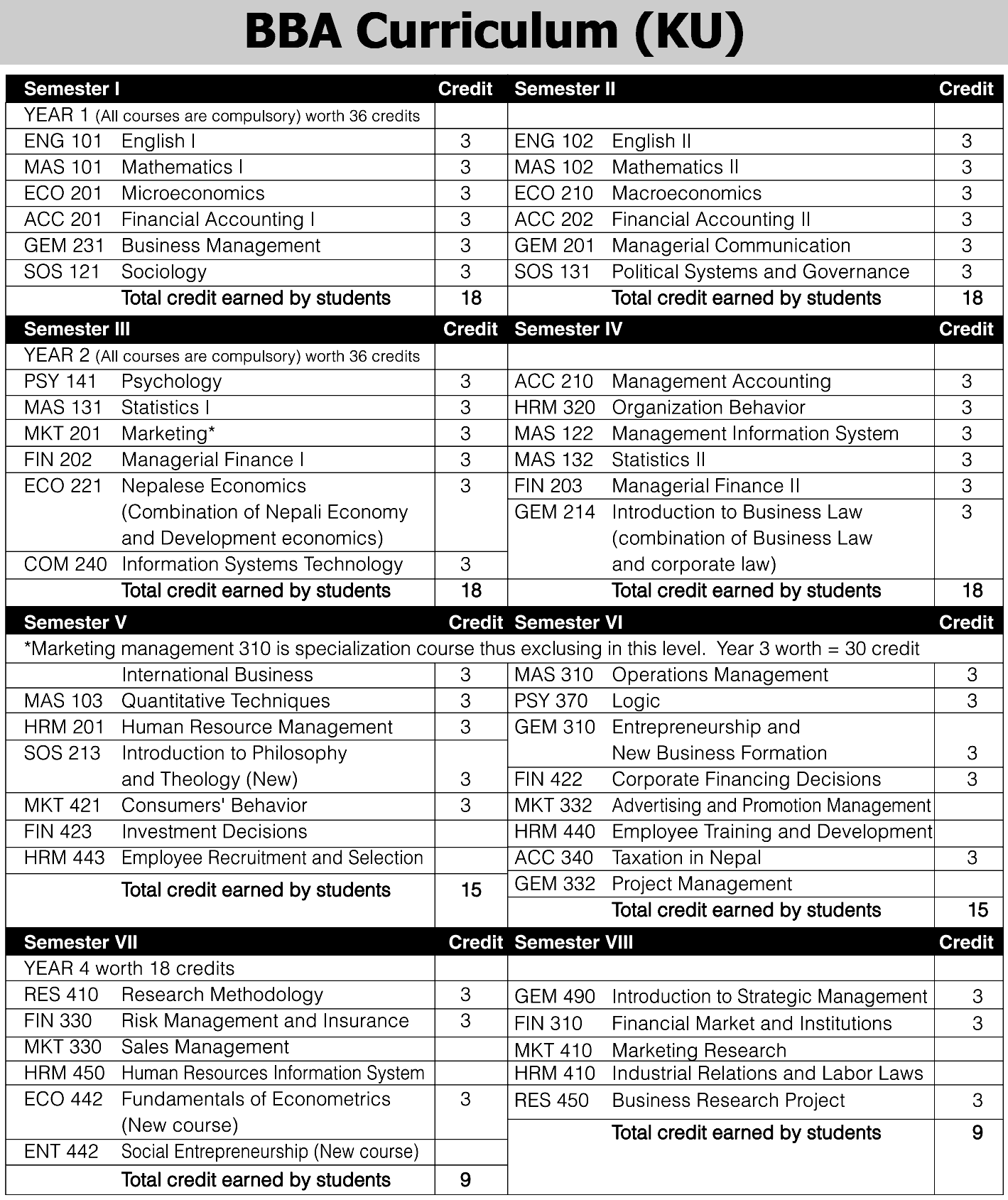
The BBA runs for four years across eight semesters and comprises 120 credit hours.
The semester distribution shown in the curriculum is:
| Semester | Credits |
|---|---|
| Semester I | 18 |
| Semester II | 18 |
| Semester III | 18 |
| Semester IV | 18 |
| Semester V | 15 |
| Semester VI | 15 |
| Semester VII | 9 |
| Semester VIII | 9 |
The eight-semester structure totals 120 credit hours.
The first semester introduces students to communication, quantitative study, economics, accounting, management, and society.
ENG 101 English I
MAS 101 Mathematics I
ECO 201 Microeconomics
ACC 201 Financial Accounting I
GEM 231 Business Management
SOS 121 Sociology
Total Credits: 18
The second semester continues the foundation through:
ENG 102 English II
MAS 102 Mathematics II
ECO 210 Macroeconomics
ACC 202 Financial Accounting II
GEM 201 Managerial Communication
SOS 131 Political Systems and Governance
Total Credits: 18
The third semester moves further into behavioral, quantitative, marketing, financial, economic, and technology-related study.
PSY 141 Psychology
MAS 131 Statistics I
MKT 201 Principle Marketing
FIN 301 Financial Management
ECO 221 Nepalese Economics
COM 240 Information Systems Technology
Total Credits: 18
The fourth semester covers:
ACC 210 Management Accounting
HRM 320 Organization Behavior
MAS 122 Management Information System
MAS 132 Statistics II
MFIN 4041 Nepali Financial System
GEM 214 Introduction to Business Law
Total Credits: 18
The fifth semester introduces international business, quantitative methods, human resource management, philosophy and theology, and specialization-related study.
Subjects shown in the curriculum include:
International Business
MAS 103 Quantitative Techniques
HRM 201 Human Resource Management
SOS 213 Introduction to Philosophy and Theology
specialization-related courses in areas such as marketing, finance, and human resources
Total Credits: 15
Semester VI includes managerial and business decision subjects such as:
MAS 310 Operations Management
PSY 370 Logic/Critical Thinking
GEM 310 Entrepreneurship and New Business Formation
FIN 422 Corporate Financing Decisions
additional courses drawn from areas including marketing, human resources, taxation, and project management
Total Credits: 15
The seventh semester places greater attention on research, finance, and specialized business study.
Courses shown include:
RES 410 Research Methodology
FIN 330 Risk Management and Insurance
specialization-related study in marketing, human resources, economics, and entrepreneurship
Total Credits: 9
The final semester includes:
GEM 490 Introduction to Strategic Management
FIN 310 Financial Market and Institutions
RES 450 Business Research Project
specialization-related courses in marketing and human resource management
Total Credits: 9
Across eight semesters, the BBA curriculum brings together several areas of business education:
accounting and financial management;
economics;
mathematics and statistics;
marketing;
human resource management;
organizational behavior;
information systems;
operations management;
entrepreneurship;
business law;
research methodology;
strategic management;
communication and social sciences.
This mix gives students a broad management curriculum rather than training limited to one business function.
The BBA learning environment at NCM also includes activities outside ordinary lectures.
Students may work through:
case studies;
projects;
presentations;
seminars and workshops;
interaction with business professionals;
internship-related workplace exposure.
The internship is intended to connect classroom learning with actual organizational situations. It is conducted under the joint supervision of a college faculty member and an official from the organization where the student undertakes the internship.
This component gives students an opportunity to observe how management concepts operate within a workplace and to relate academic study to organizational practice.
Research becomes more visible in the later part of the BBA curriculum.
Semester VII includes Research Methodology, while Semester VIII contains a Business Research Project. These subjects introduce students to structured research work within a business context.
Strategic Management is also placed in the final semester, bringing together concepts from different areas of management as students approach completion of the degree.
Nepal College of Management was established in 1999 and is located in Dhobighat, Lalitpur. Its undergraduate programs operate under affiliation with Kathmandu University.
For BBA students, the college environment includes classrooms supported by audiovisual teaching equipment and a library with books, journals, magazines, manuals, periodicals, publications, and other reading resources.
Students may also participate in extracurricular activities, sports, volunteer work, cultural programs, and inter-college activities alongside their academic studies.
Academic assessment and examinations for BBA operate according to Kathmandu University rules and regulations.
Students must complete the prescribed curriculum and meet the applicable academic requirements of the university before completing the program.
The degree award is governed by Kathmandu University after fulfillment of the required academic conditions.
BBA may be relevant to students who want broad undergraduate study in business rather than early specialization in one narrow area.
The curriculum requires students to work with both numerical and non-numerical subjects. Mathematics, statistics, accounting, economics, and finance appear alongside communication, marketing, human resources, sociology, organizational behavior, entrepreneurship, research, and strategy.
Students considering the program should therefore be prepared for a mixed academic workload involving calculations, written work, presentations, analysis, projects, and management subjects.
The BBA curriculum provides a foundation across several business functions, including finance, marketing, human resources, operations, research, entrepreneurship, and management.
This academic background can support further study in management and related business areas. Employment possibilities depend on a graduate's skills, academic performance, practical experience, interests, and available opportunities.
The program does not lead to one fixed occupational route; its curriculum is designed around broad business and management study.
BBA stands for Bachelor of Business Administration.
The BBA program runs for four years across eight semesters.
Students must complete 120 credit hours across the eight-semester program.
Nepal College of Management has 120 seats for the Bachelor of Business Administration program.
The BBA at Nepal College of Management is affiliated with Kathmandu University.
Applicants with a 10+2, Intermediate, or equivalent qualification of at least two years in any discipline need a minimum 50% aggregate or CGPA of 2.0 on a 4.0 scale from a university or board recognized by Kathmandu University. The stated requirements also include the applicable GCE A Level route and qualification in KUUMAT.
Yes. Applicants must qualify KUUMAT as part of the Kathmandu University undergraduate management admission process.
The curriculum covers accounting, economics, mathematics, statistics, marketing, finance, human resource management, information systems, operations, entrepreneurship, law, research, strategy, communication, and related areas.
Yes. Internship is an academic requirement associated with the program and is intended to give students workplace exposure under joint supervision from the college and the host organization.
Yes. The later semesters include Research Methodology and a Business Research Project.


.png)