



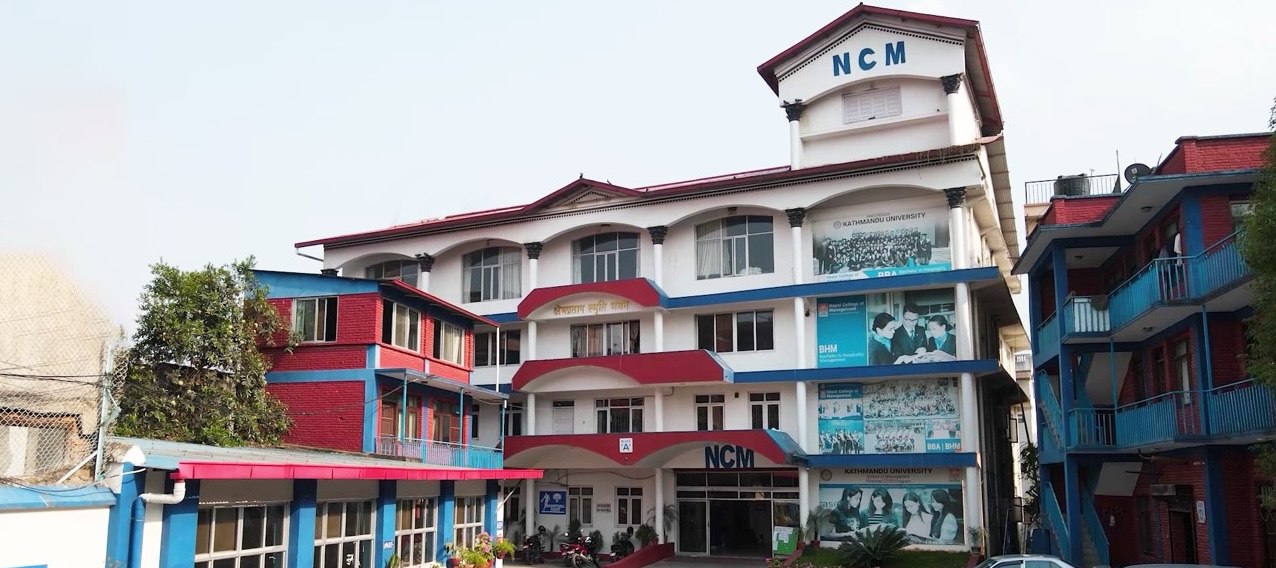
The Bachelor in Hospitality Management (BHM) at Nepal College of Management is a four-year undergraduate program affiliated with Kathmandu University. The program runs across eight semesters and requires 132 credit hours. It combines hospitality operations, tourism, management, communication, research, specialization courses, electives, and a two-semester industrial experience component.
NCM has 30 seats for BHM. Students study subjects ranging from food production and food and beverage service to room division, hospitality finance, tourism, marketing, service management, and research. Admission, entrance procedures, examinations, academic progression, and degree award follow Kathmandu University rules and regulations.
| Area | Details |
|---|---|
| Program | Bachelor in Hospitality Management (BHM) |
| College | Nepal College of Management (NCM) |
| Location | Dhobighat, Lalitpur |
| Affiliation | Kathmandu University |
| Level | Bachelor's Degree |
| Duration | 4 Years |
| Semesters | 8 |
| Total Credits | 132 |
| Seats | 30 |
| Internship | Two semesters with internship reports |
| Academic Areas | Hospitality operations, tourism, management, research, specialization and electives |
The BHM program at Nepal College of Management, Lalitpur combines hospitality-specific study with general management education and practical training.
The academic structure covers food production, food and beverage service, room division, tourism, hospitality leadership, financial management, accounting, communication, marketing, research, entrepreneurship, service management, and other operational and managerial areas.
Students progress from operational hospitality subjects in the earlier semesters to management, specialization, research, and industrial experience in the later stages of the program.
Nepali and non-Nepali applicants may apply if they have completed a 10+2, Intermediate, or equivalent qualification of at least two years in any discipline.
Applicants must have:
a minimum of 50% in aggregate; or
a CGPA of 2.0 on a 4.0 scale;
a qualification from a university or board recognized by Kathmandu University.
Admission and entrance requirements operate according to the applicable rules and regulations of Kathmandu University.
The 132-credit curriculum is divided among foundation study, core hospitality subjects, general management, specialization, electives, internship, and report writing.
| Component | Credits |
|---|---|
| Foundation Courses | 30 |
| Core Hospitality Courses | 32 |
| General Management Courses | 31 |
| Specialization | 6 |
| Elective | 3 |
| Internship and Report Writing | 30 |
The academic structure gives hospitality operations a substantial place while retaining business, management, communication, research, and tourism-related study.
Students begin with subjects covering the hospitality and tourism sector alongside core operational areas:
The Contemporary Hospitality and Tourism Industry
Room Division Operation I
Food & Beverage Service Operation & Mgmt I
Fundamental of Hospitality Mgmt & Leadership
Food Production Operation & Mgmt I
English for Hospitality
Total Credits: 18
The second semester continues operational hospitality study through:
Food & Beverage Service Operation & Mgmt II
Travel and Tourism Service Operation
Food Production Operation & Mgmt II
Food Science, Nutrition and Sanitation
Room Division Operation II
Success Skill (Professionalism in Hospitality)
Total Credits: 18
The curriculum then adds finance, software, communication, beverage knowledge, and foreign-language study:
Food Production Operation & Mgmt III
Financial Management in Hospitality Industry
Hospitality Business Software Applications
Business Communication & Writing Skills
Oenology & Beverage Knowledge
International Foreign Language (Chinese/German/French/Spanish)
Total Credits: 18
Semester IV combines management subjects with specialization choices:
Sustainable Hospitality Environment
Ethics and Fair Society
Property, Safety and Security Management
Managerial Accounting for Hospitality Industry
Two specialization courses
Specialization options include:
Food and Beverage Operation and Mgmt Advanced
Room Division Operation and Management
Management of Function & Events
Tourism Product Development
Airlines Operation and Management
Adventure Tourism
Total Credits: 18
The fifth semester shifts further toward management, research, law, and commercial aspects of hospitality:
Hospitality Industry Law
Behavioural Economic
Organizational Behavior and Productivity Mgmt
Research Methodology, Statistics
Marketing & Sales for Hospitality Businesses
Total Credits: 15
Semester VI combines research, entrepreneurship, tourism management, people management, and an elective:
Research Project and Diploma Paper
Entrepreneurship for Hospitality
Tourism Destination Management
Managing Productivity through People
One elective
Elective choices include Customer Relationship Management, Service Quality Management, E-Marketing and Distribution, Hospitality & Tourism Development Seminar, Information Technology in Hospitality, Hospitality Brand Management, and Social Media in Hospitality.
Total Credits: 15
The final two semesters are devoted to industrial experience and internship reporting.
| Semester | Academic Component | Credits |
|---|---|---|
| VII | Industrial Experience (Internship One) + Internship Report I | 15 |
| VIII | Industrial Experience (Internship Two) + Internship Report II | 15 |
Together, these semesters account for 30 credits of the degree. The structure gives students an extended period to connect hospitality study with workplace experience and prepare written internship reports.
Hospitality students at NCM have separate practical facilities designed for operational training. These include:
basic and advanced kitchens;
bakery;
reception area;
coffee lounge;
bar;
restaurant;
mock room.
The college also uses industry visits, practical training, internships, and interaction with professionals as parts of the BHM learning environment. Grooming, presentation, and discipline are also given attention within hospitality training.
These facilities support subjects such as food production, food and beverage service, room division, and other operational components included in the curriculum.
BHM is delivered within the academic framework of Kathmandu University. The university's applicable rules and regulations govern:
admission and entrance procedures;
eligibility requirements;
curriculum;
examinations and assessment;
academic progression;
completion requirements;
degree award.
Students must complete the prescribed 132 credit hours, including the industrial experience and internship report requirements, to satisfy the academic structure of the program.
The BHM curriculum covers several parts of hospitality and tourism operations rather than concentrating on a single function. Students study hotel operations, food production, food and beverage service, room division, tourism services, events, airlines, marketing, financial management, accounting, research, entrepreneurship, and service management.
This academic background may support work across hospitality and tourism-related organizations, depending on a graduate's skills, practical experience, performance, and available opportunities.
The program is particularly relevant for students interested in a degree that combines operational hospitality training with business and management subjects.
BHM stands for Bachelor in Hospitality Management.
The program runs for four years across eight semesters.
Students are required to complete 132 credit hours. This includes 30 credits for internship and report writing.
Nepal College of Management has 30 seats for the Bachelor in Hospitality Management program.
Applicants need a 10+2, Intermediate, or equivalent qualification of at least two years in any discipline with a minimum 50% aggregate or CGPA of 2.0 on a 4.0 scale from a university or board recognized by Kathmandu University.
Yes. Semesters VII and VIII contain Industrial Experience (Internship One and Two) together with Internship Report I and II. These components carry 30 credits in total.
BHM practical facilities include basic and advanced kitchens, a bakery, reception area, coffee lounge, bar, restaurant, and mock room.
The Bachelor in Hospitality Management at Nepal College of Management is affiliated with Kathmandu University.






