The Bachelor of Business Information System (BBIS) at Nepal College of Management, Lalitpur is a four-year undergraduate program affiliated with Kathmandu University. It combines business and management education with information systems and information technology, supported by study in social sciences and humanities.
The program carries 141 credit hours across eight semesters and has 30 seats at NCM. Its academic focus includes analytical thinking, problem solving, communication, presentation, management concepts, and the application of information systems in organizational settings. Admission, curriculum, examinations, academic progression, and degree requirements operate under Kathmandu University rules and regulations.
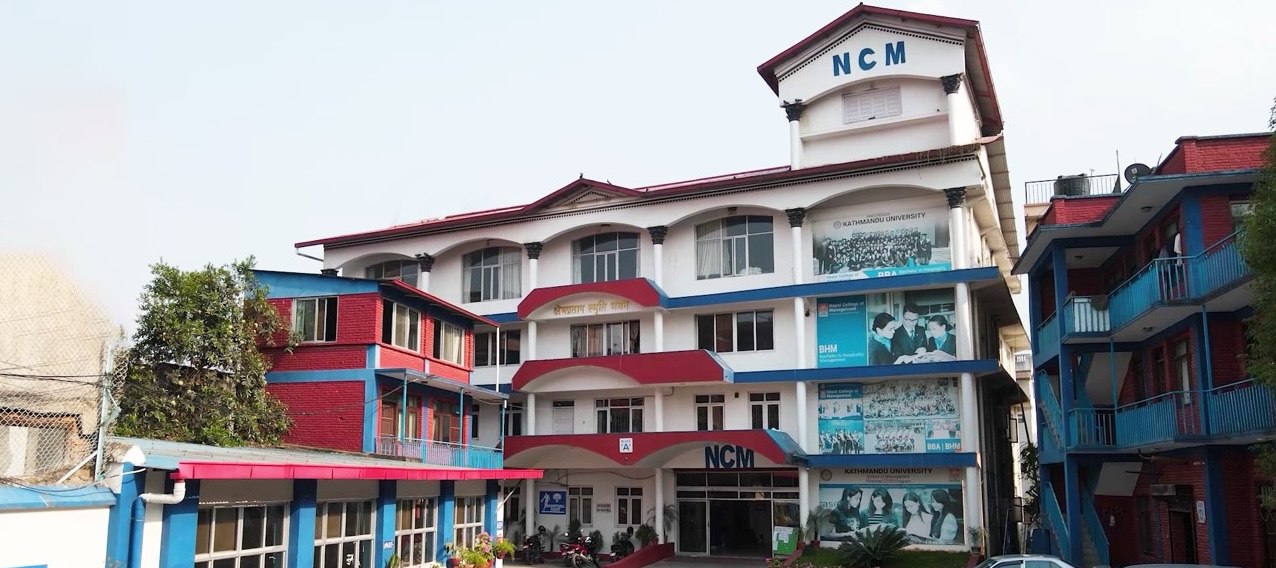
| Area | Details |
|---|---|
| Program | Bachelor of Business Information System (BBIS) |
| College | Nepal College of Management (NCM) |
| Location | Dhobighat, Lalitpur |
| Affiliation | Kathmandu University |
| Level | Bachelor's Degree |
| Duration | 4 Years |
| Semesters | 8 |
| Credit Hours | 141 |
| Seats | 30 |
| Entrance | KUUMAT followed by analytical writing and personal interview |
| Academic Focus | Business, management, information systems, and information technology |
The Bachelor of Business Information System (BBIS) at Nepal College of Management brings together two areas that are usually studied from different perspectives: business management and information systems.
Students are introduced to management concepts while also developing knowledge related to information systems and information technology. Social sciences and humanities form another part of the academic foundation, giving the program a broader interdisciplinary structure.
The program is intended to develop:
critical and creative thinking;
analytical and problem-solving abilities;
communication and presentation skills;
understanding of management concepts, tools, and techniques;
knowledge of information systems and their organizational role;
professional, social, and ethical awareness.
Rather than treating technology separately from organizational decision-making, BBIS connects the two within a single undergraduate program.
BBIS is completed over four years and eight semesters. The full program comprises 141 credit hours.
The curriculum combines:
business and management studies;
information systems;
information technology;
social sciences;
humanities;
analytical and problem-solving work;
communication and presentation;
project-based academic activities.
This combination distinguishes BBIS from a general business administration degree. Its management component remains important, but students also study the role of information systems and technology within business and organizational environments.
The curriculum, credit requirements, examinations, academic progression, and degree completion operate according to the academic framework of Kathmandu University.
BBIS is open to Nepali and non-Nepali nationals who meet the applicable academic and admission requirements.
Applicants may qualify through one of the following academic routes:
10+2, Intermediate, or an equivalent program of at least two years in any discipline, with a minimum of 40% aggregate or CGPA of 1.6 on a 4.0 scale and a minimum D+ grade in each subject from a university or board recognized by Kathmandu University;
GCE Advanced Level with at least three subjects at A Level and one General Paper at AS Level, meeting the applicable marks or grade requirements;
IB Level with all six courses passed, a minimum grade of 4 in each course, and at least 28 marks in aggregate.
Academic eligibility is followed by the university's undergraduate management admission process.
Admission to BBIS requires applicants to meet the academic eligibility criteria and complete the Kathmandu University undergraduate management selection requirements.
The stated selection requirements include:
A score of 50 percentile or above in the Kathmandu University Undergraduate Management Admission Test (KUUMAT).
After meeting the required KUUMAT score, a score of 50 percentile or above in analytical writing and the personal interview.
NCM has 30 seats for the BBIS program. Admission and entrance conditions remain governed by the applicable Kathmandu University rules and regulations.
BBIS is structured around the relationship between organizations and information systems. Students study management alongside information systems and information technology rather than approaching either area in isolation.
The program places particular attention on analytical thinking and problem solving. Communication and presentation also form part of its stated academic objectives.
Project-based learning further supports the applied side of the program. Mini-projects, assignments, presentations, and other academic exercises require students to work with course concepts rather than depend only on written examinations.
The course is therefore relevant to students who want an undergraduate education combining:
management and organizational understanding;
information systems knowledge;
technology within a business context;
analytical reasoning;
structured problem solving;
written and oral communication.
Student performance is assessed through both in-semester and end-semester evaluation.
In-semester assessment includes:
tests;
assignments;
presentations;
mini-projects.
These assessments are conducted by faculty during the semester.
End-semester assessment is conducted through a paper-and-pencil examination. The grading structure ranges from Grade A to Grade F, with corresponding grade points from 4.0 to 0.
Examination administration, academic progression, curriculum requirements, and degree completion are governed by Kathmandu University regulations.
Nepal College of Management is located in Dhobighat, Lalitpur. Established in 1999 and promoted by Gurukul Education Foundation, the college is affiliated with Kathmandu University.
For BBIS students, the wider academic setting includes classrooms with audiovisual teaching support and a library containing books, journals, magazines, manuals, periodicals, publications, and other reading materials.
The college also includes student activities beyond scheduled classes, including sports, volunteer activities, cultural participation, and inter-college programs.
These institutional resources sit alongside the course's own emphasis on presentations, assignments, analytical work, and projects.
The BBIS program is designed to build knowledge applicable across information systems, management, finance, and related organizational settings. Its stated academic objectives include preparing students for roles connected with finance, IT/IS, and other management sectors.
Career outcomes are not automatic and depend on a graduate's academic performance, skills, experience, and available opportunities. The program's value lies in its combination of management knowledge with information systems rather than preparation for one narrowly defined occupation.
BBIS also provides an academic foundation for master's-level study in management and information systems.
BBIS may suit students whose interests cross the boundary between business and technology.
It is particularly relevant for students who want to understand how organizations operate while also studying how information systems support business processes, analysis, communication, and decision-making.
Students should be comfortable working across both management and technology-related subject areas, as the program is intentionally interdisciplinary rather than confined to one academic field.
BBIS stands for Bachelor of Business Information System.
The program runs for four years across eight semesters.
The BBIS program comprises 141 credit hours.
The program is affiliated with Kathmandu University.
Nepal College of Management has 30 seats for the BBIS program.
Yes. Applicants are required to score 50 percentile or above in KUUMAT and then meet the stated analytical writing and personal interview requirement.
The program combines management, business, information systems, information technology, social sciences, and humanities, with emphasis on analytical thinking, problem solving, communication, and presentation.
Evaluation includes in-semester tests, assignments, presentations, and mini-projects, together with an end-semester paper-and-pencil examination.
The program includes preparation for master's-level study in management and information systems.