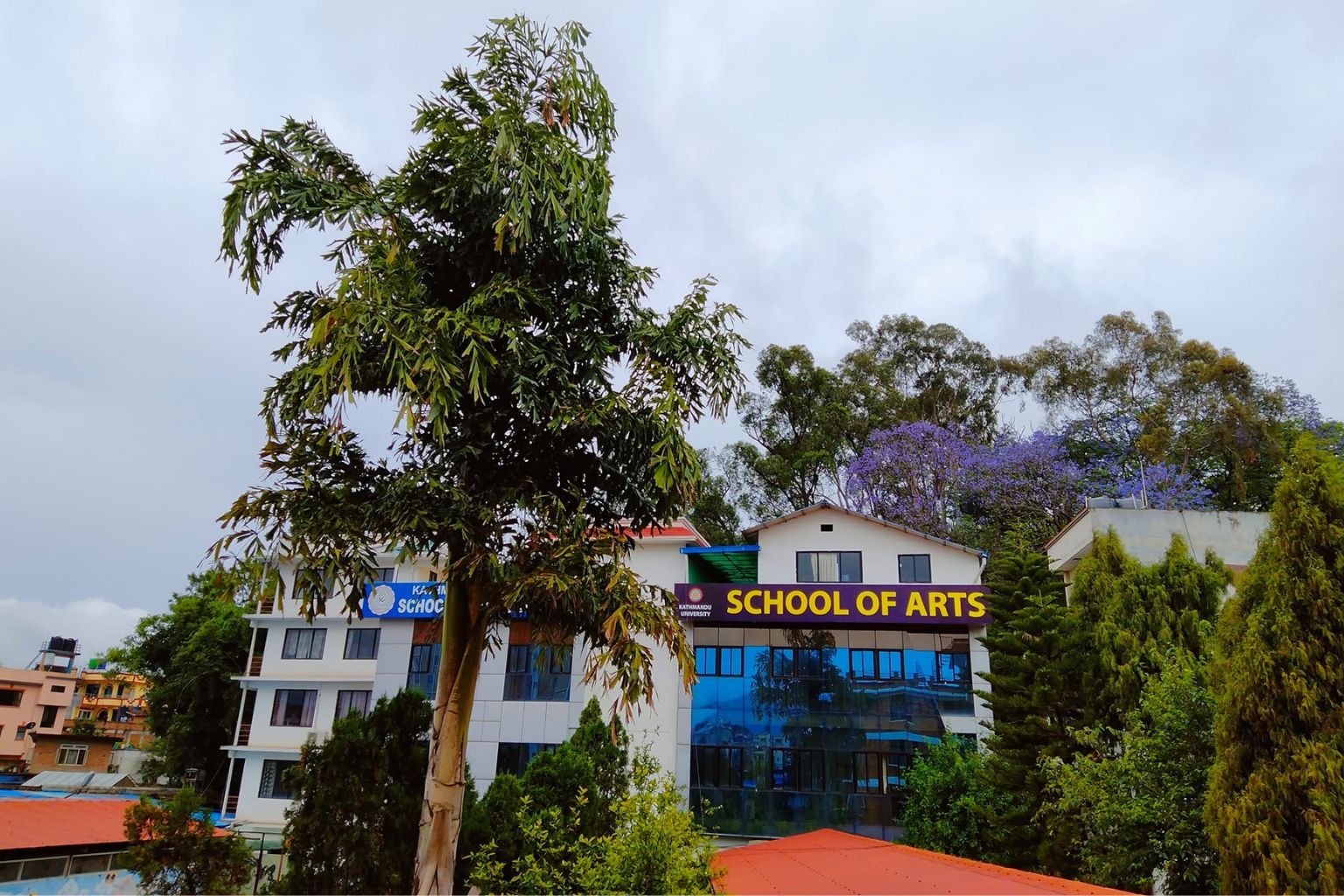
Kathmandu University School of Arts (KUSOA) is a constituent academic unit of Kathmandu University (KU), established in 1996 and located in Hattiban, Lalitpur, Nepal. The School works across liberal arts, social sciences, media and communication, music, fine arts and design, economics, development studies, urban studies, Buddhist studies, environmental studies, and other interdisciplinary fields.
KUSOA's academic portfolio is broader than a conventional arts college. Undergraduate students can study areas such as media, economics, community development, fine arts, music, yogic science, craft and design, environmental studies, Buddhist studies, and English with mass communication and journalism. Graduate study extends into media, film, development, human and natural resources, urban studies, economics, fine arts, music, Buddhist studies, history and philosophy, and landscape and heritage studies.
As a constituent School, KUSOA operates within Kathmandu University's academic framework. Admission, entrance procedures, curriculum implementation, examinations, results, and degree awards are governed by the rules and regulations of Kathmandu University together with the academic requirements of individual programs.
| Particular | Detail |
|---|---|
| Institution | Kathmandu University School of Arts (KUSOA) |
| Established | 1996 |
| Location | Hattiban, Lalitpur, Nepal |
| Institutional status | Constituent campus of Kathmandu University |
| University | Kathmandu University (KU) |
| Academic areas | Arts, culture, media, music, economics, development and social sciences |
KUSOA was established to provide university-level education across liberal arts, music, media, social sciences, and related professional and interdisciplinary areas. Its academic structure combines classroom study with research, field engagement, studio work, production, performance, projects, internships, and practical learning according to the nature of each program.
The differences between programs are substantial. Economics students work with economic theory, quantitative methods, and research. Media students combine journalism, communication theory, production, research, and media law. Fine Arts students progress through foundation and specialization stages. Community Development incorporates classroom study, fieldwork, projects, and internships. Music combines academic study with performance and ethnomusicological work.
At the graduate level, programs such as Development Studies, Human and Natural Resources Studies, Media Studies, Film Studies, and Urban Studies place stronger emphasis on research, analysis, policy, production, field engagement, and independent academic work.
The School's vision connects education with social and economic justice and the well-being of people and their environments.
Its academic mission emphasizes professional knowledge, understanding, and skills alongside scholarly activity, critical thinking, communication, practical intervention, assessment, evaluation, and the integration of social, economic, political, cultural, and environmental dimensions.
This academic direction can be seen through several recurring elements across KUSOA programs:
Research and analytical work in economics, media, development studies, human and natural resources, and urban studies.
Fieldwork, community engagement, internships, and project-based learning in community and development-oriented programs.
Studio, production, performance, and practice-based learning in fine arts, craft and design, music, film, media, and yogic science.
Interdisciplinary study combining areas such as English and journalism, cities and social sciences, craft and technology, human and natural resources, and yoga and human biology.
Independent projects, dissertations, internships, field placements, and applied research according to the structure of individual programs.
KUSOA therefore brings several academic traditions together within one university School rather than applying a single teaching model across all disciplines.
KUSOA offers undergraduate study in communication, creative practice, social sciences, economics, community development, music, wellbeing, environment, Buddhist studies, and design.
The undergraduate portfolio also includes the Bachelor in Environmental Studies (BES).
Bachelor in Media Studies follows a curriculum that progresses from foundational subjects into professional, analytical, production, and research-oriented areas.
Early study includes Introduction to Media Studies, Basic Journalism, Computer Application, English, Nepali, and Foundation of Social Sciences. Later coursework covers areas such as Professional Communication, Media, Culture and Society, Research Methodology, Social Media Networking, Communication Theories, Broadcasting, Development Communication, Comparative Study of Global and Nepali Media, Creative Writing for Media, Media Ethics, Film Production, Television Production, Human Rights, Press Freedom and Media Law, and Media and Convergence.
The curriculum therefore combines communication study with journalism, research, digital media, production, ethics, law, and broader social-science perspectives.
BA-EMCJ takes a different interdisciplinary approach. It is a four-year, eight-semester program carrying 120 credits and combines English with Mass Communication and Journalism.
Its academic scope includes language, literature, cultural studies, journalism, professional communication, and academic writing. The structure allows students to work across English studies and communication rather than treating either area as a minor addition to the other.
The program connects literary and cultural study with communication-oriented subjects and provides an academic base relevant to writing, journalism, communication, research, teaching, publishing, public relations, and related areas.
The Bachelor in Economics is a four-year degree designed around economic theory, markets, policy, quantitative analysis, and applied economic questions.
Its curriculum includes areas such as:
Microeconomics and macroeconomics
Econometrics
Mathematics and statistics
History of Economic Thought
Introduction to Nepal's Economy
Development Economics
Money and Banking
Financial Economics
Energy Economics
Health Economics
Environmental Economics
Labour Economics
Applied Economic Research
The program combines theoretical understanding with analytical and quantitative study. Communication, teamwork, research, problem-solving, and the interpretation of economic issues are also part of its academic orientation.
Internship-related learning and opportunities for deeper study in selected economic areas add practical and research components to the degree.
Bachelor in Community Development is a four-year undergraduate program carrying 126 credits.
Its subject areas include community development, environment, economy, health, population, conflict, poverty, disaster, equity, research, communication, community organization, social behaviour, and related development concerns.
The academic approach combines classroom study with practical and community-oriented learning. Teaching may involve:
Lectures and class discussions
Individual and group work
Student presentations
Workshops and seminars
Research activities
Field trips
Action-oriented project work
Interaction with development practitioners
Rural and urban internships
Field placements are an important part of the program. The structure allows students to examine community development through theoretical, analytical, practical, and field-based perspectives.
The Bachelor of Fine Arts is structured over four years and eight semesters with a total of 139 credits.
The first two years form the foundation stage, covering four semesters and 72 credits. The final two years form the specialization stage, covering four semesters and 67 credits.
Within Graphic Communication, students move from exploratory foundation study into more focused work in design concepts, visual communication, print design, studio courses, electives, and independent projects.
The later stage also includes professional exposure through internship activity. Students in the final semester undertake independent project work leading to a group show.
The structure reflects the practice-oriented character of Fine Arts, with studio work and independent creative development occupying an important place alongside academic study.
Bachelor of Craft and Design is a four-year undergraduate program that brings craft practice into direct contact with design, technology, materials, business, culture, sustainability, and professional development.
Students study the relationship between traditional craft knowledge, contemporary design, technological development, production processes, and changing approaches to material practice.
The curriculum includes areas such as:
Art and engineering studios
Design studios
Material sciences
Craft history and design history
Independent practice
Apprenticeship
On-the-job training
Professional development
Digital fabrication
Portfolio-related work
Students may work with metal, wood, jewellery, stone, ceramics, natural fibres, animal products, textiles, and digital fabrication processes.
The program also introduces technologies such as 3D modelling software, digital fabrication equipment, and computer-controlled machinery. The combination of material practice and newer production technologies gives the degree an interdisciplinary character.
Bachelor in Ethnomusicology is a four-year, eight-semester full-time program.
The curriculum is designed around Nepalese and South Asian music while also introducing students to other musical traditions and the methods and skills associated with ethnomusicology.
Instruction can include:
Lectures
Practical demonstrations
Seminars
Specified reading
Practical courses
Independent learning
Fieldwork
Performance-related study
Evaluation is continuous and can include class participation, assignments, examinations, term papers, project reports, practical work, and performance according to the course.
Admission to the program also considers musical aptitude and experience alongside academic qualifications and selection procedures.
Bachelor in Yogic Science and Wellbeing is jointly owned by Kathmandu University School of Arts and the School of Medical Sciences.
Its curriculum combines yogic traditions with human biology, philosophy, language, psychology, health, research, and practice.
Areas appearing within the curriculum include:
History and Foundation of Yogic Sciences
Sanskrit for Yogic Sciences
Human Biology for Yoga
Foundation of Asian Philosophies
Yoga in Practice
Biomechanics for Yoga
Psychology for Yoga
Health and Wellbeing
Buddhist Philosophy and Tibetan Yogic Practices
Nutrition and Diet
Research Methodology
Ayurveda and Herbal Science
Principles of Ethics
Research Applications in Yogic Sciences
Different Schools of Yoga Practices
The program therefore treats yogic science as a field involving practical study together with biological, philosophical, cultural, ethical, and research-based components.
KUSOA's graduate portfolio extends many of its undergraduate academic areas into more advanced research, analytical, production, policy, and professional study.
Other graduate programs include:
Master in Development Studies addresses contemporary development issues through theoretical study, analysis, research, and practical exposure.
Its curriculum includes development concepts, human development, gender and inclusion, population, economics, education and development, statistics, project management, research methodology, public policy, globalization, development finance, entrepreneurship, environment, climate change, and Nepal's development plans and policies.
Teaching methods include classroom lectures, case-study analysis, field surveys, seminars, community internships, presentations, and academic discussion.
The academic structure also provides options involving a dissertation or a combination of community internship and independent study.
Master in Human and Natural Resource Studies is an interdisciplinary and research-oriented professional program concerned with communities, human systems, and natural resources.
Its curriculum includes subjects connected with:
Development concepts
Human dimensions of development
Conflict and resource management
Environmental economics
Project management
Gender, inclusion, and ethnicity
Development communication
Natural resource systems management
Population and natural resource linkages
Forestry and wildlife management
Public policy
Environment and health
Climate change
Ecosystem analysis
The program combines academic coursework with field surveys, case studies, seminars, community internships, research, presentations, and discussion.
Its structure gives considerable attention to the social dimensions of natural resource management and to research concerned with practical situations.
The Master in Media Studies is a two-year program divided into four semesters and carrying 60 credit hours.
The curriculum combines media and communication theory with research, management, policy, technology, production, and professional practice.
Core areas include:
Communication and Media Theories
Media Literacy
Social Sciences for Media
Media and Globalization
Research Methodology
Communication Traditions in Nepal and Asia
Media, Identity and Diversity
Media, Technology and Culture
Global Media and International Communication
Media Management
Media Policy, Law and Ethics
Advanced Media Research
Media Production or Media Project
Internship
Dissertation
Students also choose electives from different areas of media and communication according to the program structure.
The final stages combine advanced research with project or production work, internship, and dissertation.
Master in Film Studies is a two-year, 66-credit graduate program combining theoretical, critical, research, and practical approaches to film.
Its curriculum includes film form and narrative, research methods, indigenous aesthetics, documentary study, screenwriting, audiovisual production, and related film-study areas.
The program integrates analysis and academic research with production-oriented work rather than treating filmmaking and film scholarship as separate tracks.
Students may also exit after completing one year and 30 credits with a Postgraduate Diploma.
Master in Urban Studies takes an interdisciplinary approach to cities by bringing together engineering, natural sciences, and social sciences.
The program examines:
Urbanization
Urban society
Governance
Planning
Infrastructure
Sustainability
Public policy
Land use
Climate resilience
Disaster risk
Service delivery
Urban culture
Research methods
Its academic approach gives students a framework for studying cities not only through physical infrastructure but also through social, economic, environmental, demographic, institutional, and governance perspectives.
The program combines theoretical understanding with research and practical approaches to urban development.
Admission to KUSOA programs takes place within Kathmandu University's academic rules and regulations. Eligibility, entrance procedures, curriculum requirements, examinations, results, academic progression, and degree awards follow KU regulations together with program-specific requirements.
For Bachelor in Media Studies, Bachelor in Economics, Bachelor in Community Development, and Bachelor in Yogic Sciences and Wellbeing, applicants must have completed 10+2 or an equivalent qualification in any discipline from a recognized institution with at least 45 percent aggregate marks or a 2.0 CGPA.
Admission requirements can differ according to the program.
Bachelor in Ethnomusicology, for example, considers academic background, interest and aptitude for music, entrance-test performance, interview, and musical experience. Musical aptitude is therefore an academic selection consideration for that particular program.
Applicants should review the eligibility and selection requirements of the program they intend to study rather than assuming that all courses use identical admission criteria.
Admissions Email: soa_admission@ku.edu.np
Admissions Phone: 9801298094
The School uses different teaching methods according to the academic demands of individual programs.
Economics incorporates classroom discussions, individual and group work, problem-solving, assignments, practical classes, and consultation.
Community Development combines classroom teaching with presentations, workshops, seminars, field trips, action-oriented projects, and internships.
Music uses lectures, practical demonstrations, seminars, performance-oriented study, reading, and fieldwork.
Fine Arts depends strongly on studio-based learning, specialization, electives, independent projects, and professional exposure.
Craft and Design includes design and art studios, material practice, apprenticeship, on-the-job training, independent work, digital fabrication, and professional development.
Development Studies and Human and Natural Resource Studies combine theoretical learning with research, case studies, field surveys, seminars, internships, presentations, and discussion.
Media Studies combines theory with research, production, internship, project work, and dissertation, while Film Studies brings together film analysis, research, screenwriting, production, and other forms of audiovisual practice.
The different learning models reflect the range of disciplines within KUSOA. Some programs require extensive reading and analytical writing, while others place greater emphasis on fieldwork, studio practice, performance, audiovisual production, projects, or independent research.
Academic evaluation at KUSOA follows Kathmandu University regulations together with the assessment requirements of individual programs.
Assessment methods vary by discipline and can include examinations, assignments, presentations, research papers, projects, fieldwork, internships, studio outputs, practical work, production, performance, and dissertations.
Bachelor in Ethnomusicology provides a specific example of continuous evaluation. Assessment may include class participation, home assignments, semester examinations, term papers, project reports, theoretical examinations, practical examinations, and performance-related assignments.
Students in that program are required to maintain at least 75 percent class attendance, and semester results are expressed through letter grades.
Other programs use assessment methods suited to their academic structure.
Degrees are awarded through Kathmandu University after students successfully complete the academic requirements prescribed for their respective programs.
Kathmandu University operates scholarship and financial-support arrangements across its Schools.
The Hinu Ramesh Nath Dhungel Scholarship Fund is associated with the School of Arts and School of Science.
KU's wider scholarship framework also includes:
Merit-based Scholarship
Need-based Scholarship
UGC Formula Funding Scholarship
Local Scholarship
Staff/Faculty Family Scholarship
Loan Scholarship
Endowment Fund-based scholarships for different Schools
Availability and continuation are governed by the applicable scholarship arrangements and university rules.
Within the Department of Music, a scholarship is also identified for the student securing the top position in the semester.
KUSOA has collaborated with universities and organizations in Nepal and abroad.
| Country | Universities and institutions |
|---|---|
| Switzerland | University of Zurich; University of Bern; Swiss Peace Foundation (SPF) |
| Denmark | Aarhus University; University of Copenhagen |
| India | North-Eastern Hill University |
| Nepal | Consortium for Land Research and Policy Dialogue (COLARP); Community Self-Reliance Centre (CSRC); Nepal Tourism Board (NTB); Nepal Institute of Development Studies (NIDS); Swiss National Centre of Competence in Research (NCCR North-South); South Asia Coordination Office |
| Australia | Western Sydney University |
These collaborations form part of the School's wider academic engagement across areas connected with social sciences, development, culture, media, heritage, and interdisciplinary study.
KUSOA brings together disciplines that use markedly different ways of learning.
Fine Arts and Craft and Design depend heavily on studio, material, and practice-based work. Media programs combine communication study with journalism, research, production, and media policy. Economics develops theoretical and quantitative understanding. Community Development and Development Studies incorporate field engagement, research, development issues, and policy-related study.
Music combines performance with ethnomusicological study. Human and Natural Resource Studies connects social questions with natural resource management. Film Studies combines critical study with audiovisual production. Urban Studies examines cities through social, environmental, infrastructural, governance, and planning perspectives.
The variety of academic approaches means students should consider both the subject and the learning model of a program when choosing a degree.
A student interested in creative production may approach KUSOA through a different academic route from someone interested in economics, media research, community work, urban development, resource management, music, Buddhist studies, or environmental concerns.
The same applies to graduate study. Programs such as MMS, MFS, MUS, MDEVS, Human and Natural Resource Studies, MFA, economics, music, Buddhist studies, history and philosophy, and landscape and heritage studies serve different academic purposes and require different combinations of reading, research, fieldwork, studio activity, production, analysis, or independent study.
Kathmandu University School of Arts is located in Hattiban, Lalitpur, Nepal.
KUSOA is a constituent unit of Kathmandu University rather than an independently affiliated college. Its programs operate within the University's academic framework.
Institution: Kathmandu University School of Arts (KUSOA)
Location: Hattiban, Lalitpur, Nepal
University: Kathmandu University
Admissions Email: soa_admission@ku.edu.np
Admissions Phone: 9801298094
Since its establishment in 1996, KUSOA has developed an academic portfolio extending across creative practice, communication, economics, social inquiry, development, environment, wellbeing, urban studies, heritage, music, and research.
Its programs differ considerably in structure and learning method.
BFA and Craft and Design are strongly practice-oriented. BMS and MMS combine communication and media study with research and production. Bachelor in Economics has a substantial theoretical and quantitative foundation. Community Development and Development Studies incorporate field-based and development-oriented learning. Human and Natural Resource Studies connects social and natural resource questions. Film Studies combines film scholarship with production, while Urban Studies examines cities through interdisciplinary study.
For prospective students, the important consideration is therefore not only the number or variety of programs available at KUSOA. Each course has its own academic purpose, curriculum, learning method, and selection requirements.
Admission, entrance, curriculum, examinations, results, academic progression, and degree awards operate under Kathmandu University rules and regulations, while individual programs retain their subject-specific structures and requirements.
Kathmandu University School of Arts (KUSOA) is a constituent academic unit of Kathmandu University. Established in 1996, it is located in Hattiban, Lalitpur, Nepal, and offers undergraduate and graduate study across arts, media, music, economics, development, social sciences, design, and related interdisciplinary fields.
KUSOA is a constituent unit of Kathmandu University rather than an independently affiliated college. Its academic programs operate within Kathmandu University's academic framework.
Kathmandu University School of Arts is located in Hattiban, Lalitpur, Nepal.
The undergraduate portfolio includes Bachelor in Media Studies, Bachelor in Economics, Bachelor in Community Development, Bachelor of Fine Arts, Bachelor in Ethnomusicology, Bachelor in Yogic Science and Wellbeing, Bachelor of Craft and Design, Bachelor in Environmental Studies, Bachelor of Arts in Buddhist Studies with Himalayan Language, and Bachelor of Arts in English, and Mass Communication and Journalism.
Graduate study includes Masters in Media Studies, Master in Film Studies, Master in Urban Studies, Master in Development Studies, Master in Human and Natural Resource Studies, Master of Fine Arts, Masters in Economics, Master of Arts in Music, MA in Buddhist Studies, MA in History and Philosophy, and Masters in Landscapes Management and Heritage Studies.
For Bachelor in Media Studies, Bachelor in Economics, Bachelor in Community Development, and Bachelor in Yogic Sciences and Wellbeing, applicants must have completed 10+2 or an equivalent qualification in any discipline from a recognized institution with at least 45 percent aggregate marks or a 2.0 CGPA. Individual programs may have additional requirements.
Admission and entrance procedures follow Kathmandu University rules and the requirements of the respective program. Some courses have additional selection components. Bachelor in Ethnomusicology, for example, considers academic background, musical aptitude, entrance-test performance, interview, and musical experience.
Teaching methods differ by program. They may include lectures, class discussions, research, seminars, workshops, studio work, field visits, internships, practical demonstrations, projects, production work, performance, and independent study.
Assessment follows Kathmandu University regulations and individual program requirements. Depending on the course, evaluation may include examinations, assignments, presentations, research papers, projects, fieldwork, practical work, studio outputs, production, performance, internships, and dissertations.
Kathmandu University awards degrees after students successfully complete the academic requirements of their respective programs under KU rules and regulations.
Kathmandu University's scholarship framework includes merit-based, need-based, UGC Formula Funding, local, staff/faculty family, loan, and endowment-fund-based scholarship arrangements. The Hinu Ramesh Nath Dhungel Scholarship Fund is associated with the School of Arts and School of Science.
Yes. Practical and field-based learning appears in several programs. Community Development includes field trips, projects, and internships; Fine Arts and Craft and Design involve studio and practice-based work; Music includes practical and performance-oriented study; while Media, Film, Development Studies, and Human and Natural Resource Studies include combinations of research, projects, production, fieldwork, or internships.