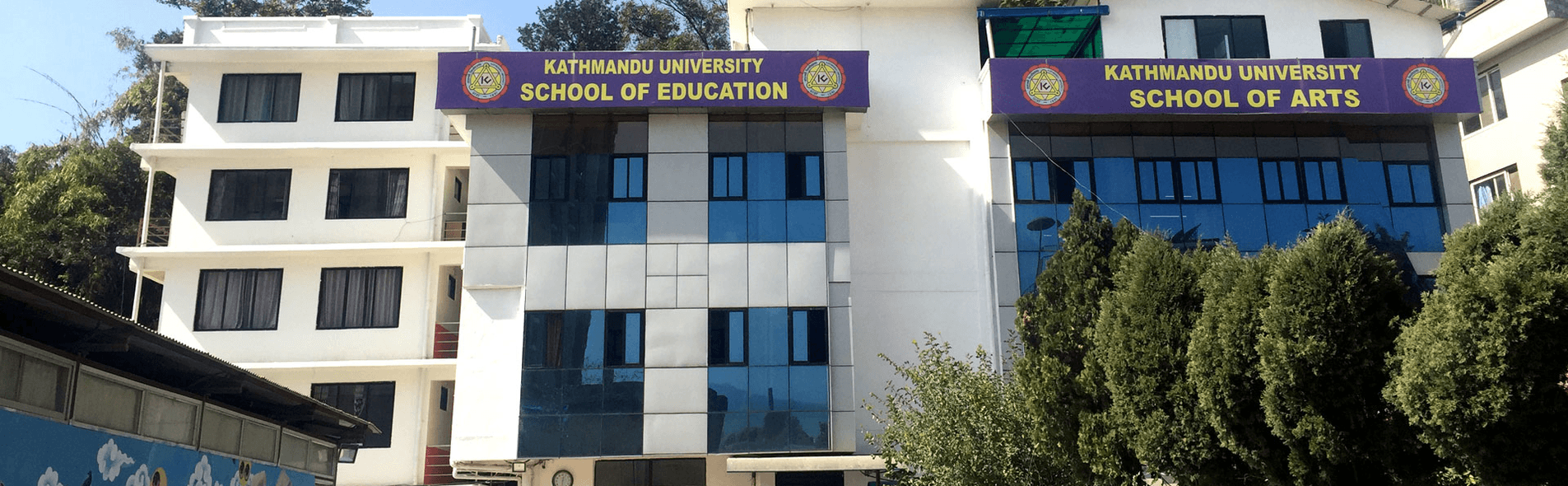
Master in Human and Natural Resource Studies (MHNRS) is a two-year, four-semester graduate program offered through the Department of Development Studies at Kathmandu University School of Arts (KUSOA), Hattiban, Lalitpur.
The 48-credit program connects human communities with natural resource management through development studies, environmental economics, resource systems, public policy, research, population, climate change, project management, and field-oriented learning. KUSOA is a constituent academic unit of Kathmandu University (KU).
| Particular | Details |
|---|---|
| Course | Master in Human and Natural Resource Studies (MHNRS) |
| Level | Master's |
| Institution | Kathmandu University School of Arts |
| Department | Department of Development Studies |
| University | Kathmandu University |
| Location: | Hattiban, Lalitpur, Nepal |
| Duration: | 2 years |
| Academic structure | 4 semesters |
| Total credits | 48 credit hours |
| Seats: | 15 |
| Final-stage options | Dissertation or Community Internship and Independent Study |
| Academic orientation | Interdisciplinary, research and field-based |
KUSOA places the program within its Department of Development Studies and identifies 15 seats for Master in Human and Natural Resource Studies.
MHNRS is an interdisciplinary graduate program concerned with the relationship between people, communities, development processes, and the natural resources on which society depends.
The program combines academic courses with action research. Its central concern is building research and analytical ability for studying the structure and functioning of rural society and its natural resource base. The course also examines how social, economic, environmental, institutional, and policy factors shape resource management.
The curriculum gives particular attention to the social dimension of natural resource management, action- and people-oriented research, disadvantaged and marginalized groups, real situations in Nepal, and the use of earlier studies and research findings.
Students work across human development, environmental economics, conflict, population, forestry and wildlife, climate change, public policy, research methodology, data analysis, environmental impact assessment, and related areas.
The program is designed to develop interdisciplinary understanding of human and natural resource management while building practical research abilities.
Its academic objectives include helping students:
Understand relationships between natural resources and communities.
Develop skills in information gathering and analysis.
Study indigenous and community-based knowledge systems and institutions.
Conduct basic and applied research.
Work independently and in teams.
Prepare and communicate research findings.
Examine resource-management questions through social and environmental perspectives.
Build an academic base for further study in related areas.
The program gives greater weight to practical exposure alongside theoretical study, making field surveys, community work, case analysis, and research important parts of the learning process.
MHNRS covers development, economics, environmental management, research, policy, population, community issues, and natural resource systems.
| Code | Course |
|---|---|
| HNRS 510 | Development Concepts |
| HNRS 511 | Human Dimensions of Development |
| HNRS 512 | Sociology of Conflict and Resource Management |
| HNRS 513 | Environmental Economics |
| HNRS 514 | Project Management |
| HNRS 515 | Gender, Inclusion and Ethnicity |
| HNRS 519 | Development Communication |
| HNRS 521 | Natural Resource Systems Management |
| HNRS 522 | Population, Development and Natural Resource Linkages |
| HNRS 524 | Forestry and Wildlife Management |
| HNRS 525 | Evaluation Methods |
| HNRS 529 | Entrepreneurship and Development |
| HNRS 530 | Nepal's Plans and Policies |
| HNRS 531 | Public Policy Issues in Resource Management |
| HNRS 532 | Rural-Urban and Highland-Lowland Relations |
| HNRS 533 | Environment, Health and Development |
| HNRS 535 | Climate Change and Development |
| HNRS 536 | Ecosystem Analysis |
| HNRS 539 | Management of Development Induced Displacement and its Impacts |
| HNRS 541 | Data Analysis |
| HNRS 542 | Research Methodology |
| HNRS 545 | Environmental Impact Assessment (EIA) |
| HNRS 549 | Rural Development and Alternative Energy |
The curriculum shows the program's interdisciplinary character. Environmental Economics, for example, examines economic activity in relation to natural resource use, externalities, environmental policy, resource allocation, and impact assessment. Natural Resource Systems Management addresses renewable and non-renewable resources, resource use, conservation, pollution, management practices, and the consequences of over-exploitation.
Population, Development and Natural Resource Linkages considers relationships among population change, development, and resource conditions. Project Management covers project cycles, planning tools, implementation, monitoring, and evaluation, while Development Communication addresses communication within development processes.
Duration: MHNRS runs for two years across four semesters.
Students must complete 48 credit hours to graduate. A three-credit course requires 48 contact hours.
The fourth semester provides two routes.
Students choosing this route complete HNRS 601 Dissertation, carrying nine credits.
A supervisor is assigned after successful defense of the dissertation proposal. The final dissertation must be submitted to the Department at the end of the two-year program.
The alternative route consists of:
HNRS 602 Community Internship — 3 credits
HNRS 534 Independent Study — 3 credits
The Community Internship is a structured and supervised placement in a selected development setting. Students identify a suitable community, undertake an approved project, and participate in workshops where their experiences and reports are discussed with faculty and fellow students. An internship coordinator is assigned to guide the process.
Students must complete all graduation requirements within five academic years from the date of enrolment.
Eligibility: Applicants must have completed one of the following:
A minimum three-year bachelor's degree;
A four-year bachelor's degree; or
A master's degree.
Applicants must have a minimum cumulative grade point average of 2.0 out of 4.0, an equivalent grade, or at least 45 percent marks.
The admission criteria allow applicants from different academic backgrounds to enter the program, subject to meeting the stated qualification and selection requirements.
Admission includes an entrance test and interview.
The entrance examination measures competencies that include:
Language proficiency
Analytical ability
Applicants must secure an acceptable ranking in the entrance test. Candidates who pass the written examination are selected for interview, and final selection is made after the interview stage.
Admission, curriculum, examinations, results, academic progression, and degree award operate under the rules and regulations of Kathmandu University.
The program combines theoretical learning with practical exposure. Students are expected to participate actively rather than relying only on lecture-based instruction.
Teaching and learning methods include:
Classroom lectures
Case-study analysis
Field surveys
Seminars
Community internships
Research activities
Results discussions
Presentations
Faculty members take a guiding role while students participate in the analysis and discussion of human and natural resource issues.
The practical orientation is visible in subjects such as Environmental Impact Assessment, research methodology, data analysis, project management, ecosystem analysis, and the community internship option.
HNRS 545 Environmental Impact Assessment introduces national and international EIA guidelines alongside sector-specific applications.
The course addresses areas such as:
Meaning and development of EIA
Criteria for assessing significant impacts
Types and nature of impacts
EIA study processes
Consideration of alternatives
Water, energy, and waste-management projects
EIA follow-up
Strategic Environmental Assessment
Social, legal, scientific, and administrative dimensions of EIA
This course connects environmental assessment with research, critical analysis, and resource-management decisions.
Academic evaluation follows the Kathmandu University grading framework.
Grades used in the program include A, A-, B+, B, B-, C+, C, C-, D, and F. The instructor determines the assessment method and the weighting given to different evaluation components and explains the course evaluation system at the beginning of the course.
Assessment methods can differ according to the character of the subject, particularly where coursework involves research, presentations, field activity, project work, or internship.
The structure of MHNRS supports development of skills connected directly with its academic work, including:
Basic and applied research
Information collection and analysis
Data analysis
Field survey work
Project planning and management
Environmental assessment
Resource-management analysis
Research presentation and communication
Team and independent work
Community-based investigation
Policy and development analysis
These abilities arise through coursework, research, field activities, internship or independent study, and the dissertation route.
The program prepares students for professional and research work concerned with human and natural resource management. Its objectives emphasize coordination, evaluation, research, problem identification, community engagement, and resource-management analysis.
Graduates may consider work connected with:
Human and natural resource management
Development projects and programs
Research and analysis
Project coordination and evaluation
Community and resource-based work
Environmental assessment
Public policy and resource-management issues
Development and environmental research
The graduate program in Human and Natural Resources Studies also includes PhD-level study, providing a route for graduates interested in further academic work in the field.
Career outcomes depend on individual skills, research experience, professional background, and available opportunities.
MHNRS may suit graduates interested in studying natural resources together with the social and community systems connected to them.
The course is particularly relevant to students whose academic interests include natural resource management, rural society, development, environmental economics, research, climate change, public policy, population-resource relationships, project management, forestry and wildlife, or environmental impact assessment.
Students should also be prepared for field surveys, research, presentations, analytical coursework, and either dissertation work or an internship and independent-study route.
MHNRS is a two-year program divided into four semesters.
Students must complete a total of 48 credit hours to graduate.
Applicants need a minimum three-year or four-year bachelor's degree, or a master's degree, with at least a 2.0 CGPA out of 4.0, an equivalent grade, or 45 percent marks.
Yes. Applicants take an entrance examination that assesses competencies including language proficiency and analytical ability. Candidates passing the written examination proceed to an interview.
The program has 15 seats.
Yes. Students may choose a nine-credit dissertation route in the fourth semester.
Yes. Students can choose Community Internship worth three credits together with Independent Study worth three credits.
Yes. Field surveys and community internships are part of the teaching framework, alongside case studies, seminars, research, discussions, and presentations.
The curriculum covers development, environmental economics, natural resource systems, population-resource linkages, forestry and wildlife, project management, public policy, climate change, ecosystem analysis, data analysis, research methodology, and Environmental Impact Assessment.
Yes. One of the program objectives is to prepare students for further studies in related areas, and Human and Natural Resources Studies at Kathmandu University also extends to PhD level.