Lotus Academic College is a higher-education institution located in Khwayabahil, Patan (Lalitpur), Nepal. It was established in 2007 and started under the wider academic and cultural work of the Lotus Research Center, with a stated purpose of supporting Buddhist studies through structured academic programs.
For students and researchers, the college matters for one clear reason: it brings Buddhist philosophy, history, texts, Nepalese Buddhist heritage, and applied themes into a formal learning setting that suits both fresh graduates and working adults. Alongside master’s-level study, it also offers a 10-month Post Graduate Diploma in Buddhist Studies for bachelor’s degree holders from any discipline who want a structured entry point before advanced study.
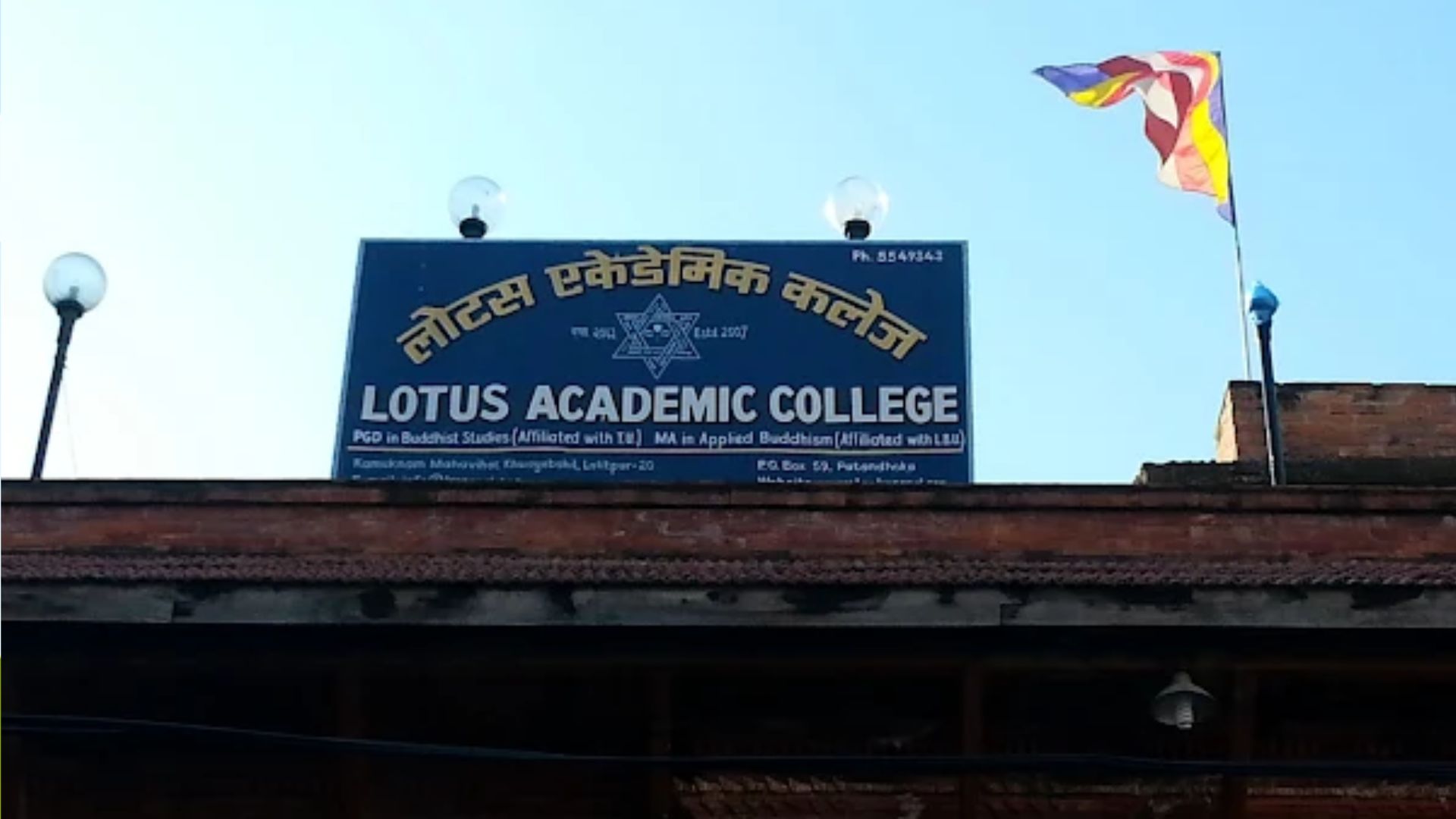
Established: 2007
Location: Khwayabahil, Patan, Lalitpur
Institutional link: Started by the Lotus Research Center
Core academic areas: Buddhist philosophy, history, literature, art/iconography, Nepalese Buddhism
Academic Programs:
Post Graduate Diploma in Buddhist Studies (10 months)
MA in Applied Buddhism
MA in Buddhist Studies
Affiliation stated for master’s study: Lumbini Buddhist University (LBU)
Admission path (master’s level): Bachelor’s degree (any discipline), written entrance exam, interview, intake cap stated as 35 per class
Lotus Academic College presents itself as a specialized college for Buddhist education in Lalitpur, positioned in Patan’s cultural setting and linked to the activities of the Lotus Research Center. Lotus Research Center as having a record of organizing international conferences (2000 and 2005) and beginning a digital archive effort focused on traditional Buddhist heritage related to the Nepal Mandala.
This background is relevant for students because Buddhist studies is not only classroom-based reading. In Nepal, learning is also tied to living heritage—texts, rituals, art history, iconography, and community practice. It reflects that direction by naming subject areas such as Buddhist philosophy, art, iconography, and “main aspects of Nepalese Buddhism,” along with study modes that include seminars and field visits.
Another defining point is its stated academic linkage with Lumbini Buddhist University for master’s-level programs. For many applicants, this kind of affiliation matters because it connects curriculum, examinations, and academic standards to the university framework.
Lotus Academic College supports learning routes at different stages—entry to Buddhist studies for graduates of other disciplines, and graduate-level study for students seeking depth in textual, historical, and applied fields.
The college provides a 10-month Post Graduate Diploma in Buddhist Studies for students who already hold a bachelor’s degree in any discipline.
Who this can suit:
Graduates who did not study Buddhism earlier but want an academic base before a master’s program
Professionals who want a structured academic introduction to Buddhist philosophy and Nepalese Buddhist heritage
Learners interested in Buddhist art, iconography, and texts who want guided academic reading rather than self-study
The MA in Applied Buddhism is described as a program that connects Buddhist principles with contemporary disciplines. The Applied Buddhism direction includes areas such as economics, management, health and hygiene, jurisprudence, and psychology, alongside Buddhist history, philosophy, and literature.
In one section, the program is presented with:
Course ID: MAB
Level: Graduate
Credit: 66
Method: Lecture, Online
The “applied” frame can be important for students who want Buddhist studies to connect with real social questions—mental wellbeing, ethics, community life, and public reasoning—while still staying anchored in core Buddhist knowledge. The college introduced Applied Buddhism “for the first time in Nepal.” Since this is a claim inside the provided text, it should be treated as the college’s stated position and can be verified through institutional records if needed for academic reporting.
The MA in Buddhist Studies is described as more academic in orientation, focusing on historical, philosophical, and cultural study.
Details:
Course ID: MBS
Campus listing: includes Lotus Academic College, Lalitpur (alongside central campus listing)
Level: Graduate
Method: Lecture, Seminar
First-semester set of papers under MBS with course codes and marks division:
MBS 511: History of Buddhism (3 credit hours shown, 40 internal / 60 external)
MBS 512: Buddhist Religiosity, Basic Teachings and Traditions (3, 40/60)
MBS 513: Buddhism in Asia (3, 40/60)
MBS 514: Buddhist Pāli Literature (3, 40/60)
MBS 515: Buddhist Art History and Iconology (3, 40/60)
Multiple “credit” expressions (for example, MBS credit appears as “4.000” in one section while the semester table shows several 3-credit papers). Students should confirm the full credit structure and semester breakdown during admission counseling.
For the master’s level, the applicants from any discipline who have completed a bachelor’s degree (or equivalent) from a recognized university are eligible to apply.
Semester-based admission approach and outlines these steps:
Fill out an application form (online availability)
Sit for a written entrance examination
Attend an interview
The maximum number for the master’s program in Buddhism at 35 students per class.
Details:
Call for admission: Oct 1
Admission deadline: Jan 2
Class starts: Jan 15
Semester end exam: May last week and Dec last week
Since academic calendars can change by year and campus, applicants should treat these dates as indicative and confirm the exact dates for the current intake.
Teaching approach that combines lectures with student participation and academic writing. Listed methods include:
Lectures and discussion sessions
Oral and written presentations
Audio-visual teaching
Term papers, seminar papers, book reviews
Field visits
From a student’s point of view, this matters because Buddhist studies is not only memorizing texts. A good program also trains:
Reading skills for primary and secondary sources
Writing skills for term papers and reviews
Public speaking and seminar participation
Field-based observation linked to Nepalese Buddhist sites and heritage contexts (where the program arranges field visits)
For MAB, online learning is part of the method alongside lectures.
Here is the evaluation practice at the course level:
Each course is evaluated against 50 marks
Marks division is stated as 60:40
Term-end examination (held by the university) carries 60%
Internal evaluation carries 40%
Pass mark in each subject is stated as 50 percent
It also states that internal assessment is based on ongoing monitoring using specified tools, and that the class professor is responsible for conducting internal assessment.
For prospective students, this structure signals two practical points:
Regular attendance, assignments, and seminar participation can affect internal marks.
Final exams still carry the larger share, so steady study across the semester is necessary.
The digital archive initiative started by the Lotus Research Center to collect information on traditional Buddhist heritage with the stated aim of preservation and promotion of Nepal Mandala heritage.
For student decision-making, it is reasonable to ask the college the following during a visit:
What library and reading resources are available on-site for MA and diploma students
Access rules for any archive-related materials
Availability of academic journals, Pāli/Sanskrit/Tibetan reference works, and online databases
Study space and seminar room access for presentations and term paper work
Lotus Academic College serves diverse learners, from recent graduates to professionals. This mix often shapes campus culture in a positive way, because classroom discussion includes both academic and lived perspectives.
The learning structure described—presentations, seminar papers, book reviews, and field visits—suggests that student life is strongly tied to academic routines rather than large-scale campus entertainment.
For many students in Buddhist studies, the “campus experience” is closely linked with:
Group reading and discussion
Research guidance for term papers
Visiting heritage spaces for observation and documentation
Academic events such as guest talks and conferences
For Buddhist studies, these academic activities function as skill-building in themselves:
Presentations train structured speaking and argument
Book reviews build critical reading
Seminar papers train academic formatting and referencing
Field visits connect classroom themes with Nepalese Buddhist art, iconography, and lived practice
For transparency and planning, applicants should request a written fee sheet that includes:
Program-wise tuition and university charges
Exam and semester fees
Any online learning charges (if applicable)
Refund policy and withdrawal rules
Scholarship or need-based support criteria (if available)
The college was established in 2007 in Khwayabahil, Patan, Lalitpur.
The Lotus Research Center is described as having organized international conferences in 2000 and 2005.
Lotus Research Center began a digital archive initiative related to traditional Buddhist heritage of Nepal Mandala.
Master’s-level study in Applied Buddhism at the college is presented as running under affiliation with Lumbini Buddhist University.
The program descriptions show both applied themes (economics, management, health and hygiene, jurisprudence, psychology) and core Buddhist areas (history, philosophy, literature, art/iconography).
Students usually compare colleges on three practical questions: “What will I study?”, “How will I be assessed?”, and “Will the program support my next step?”
Lotus Academic College can be considered by students who want:
A Buddhist studies pathway in Lalitpur, Patan, with a clear academic identity and a local heritage setting.
Master’s-level study linked with Lumbini Buddhist University through the affiliation.
Applied Buddhism themes that connect Buddhist thought with areas such as psychology, jurisprudence, economics, and health-related topics, while also studying Buddhist history and literature.
A learning routine that includes seminars, presentations, academic writing, and field visits, not only lectures.
A clear assessment pattern where internal evaluation and final exams both matter (60/40 split stated).
Here is the Official contact Details
Principal: Mr. Dharma Sundar Bajracharya
Contact: 9851105505 / 015549343
Email: dsbajracharya73@gmail.com
Campus Chief (Lotus Academic College): Bir Kaji Shakya
Contact: +977-9841245657
Email: birkaji001@gmail.com
Lotus Academic College is positioned as a specialized Buddhist studies college in Patan, Lalitpur, established in 2007 and linked with the Lotus Research Center’s heritage and academic work. It offers a 10-month postgraduate diploma (PGD) in Buddhist studies, and master’s-level programs that include MA in Applied Buddhism and MA in Buddhist Studies under an affiliation stated with Lumbini Buddhist University.
The college is located in Khwayabahil, Patan, Lalitpur, Nepal.
It was established in 2007.
The college offers a 10-month Post Graduate Diploma in Buddhist Studies, plus an MA in Applied Buddhism and an MA in Buddhist Studies.
Applicants need a bachelor’s degree (any discipline). Admission includes an application process, a written entrance examination, and an interview, with an intake cap stated as 35 per class.
Each course is evaluated against 50 marks, with a 60/40 split between term-end exam and internal evaluation, and a 50% pass mark in each subject.
It includes lectures, discussions, presentations, audio-visual teaching, term papers, seminar papers, book reviews, and field visits.
Contact Lotus Academic College's administrative office for detailed information on the course, admissions, location, fees, scholarships, facilities, counseling, or eligibility.
Lotus Academic College
Email Address: info@lrcnepal.com
Phone Number: +977-1-5005253
Website: http://lrcnepal.org.np
Location: Patan Dhoka-Madan Smarak Road, Patan, Khoyawahi, Lalitpur