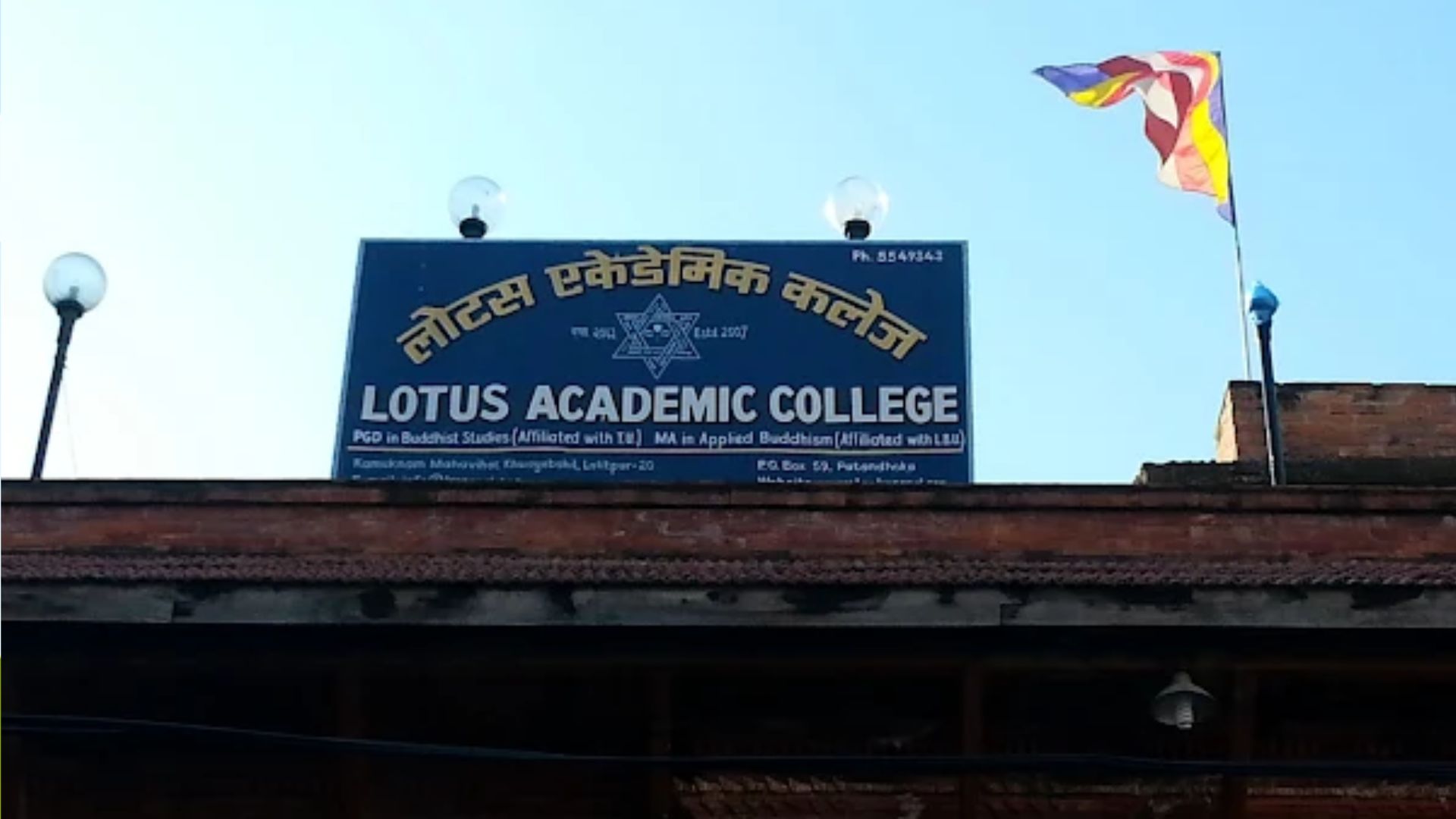
MA in Applied Buddhism at Lotus Academic College, Khwayabahil, Patan (Lalitpur), is a graduate program offered at the college campus under Course ID: MAB. The program runs in Fall and Spring semesters, carries 66 credits, and follows lecture and online learning modes.
MA in Applied Buddhism sits under the Lumbini Buddhist University (LBU) academic structure that distinguishes Core Buddhism and Applied Buddhism. Applied Buddhism links Buddhist principles to related subject areas such as economics, management, health and hygiene, jurisprudence, and psychology, while keeping Buddhist history, philosophy, and literature as a base.
Students usually care about one practical issue: you want learning that supports real academic work and real responsibilities, not only exam preparation. This course supports that need through cross-disciplinary reading, structured writing tasks, and classroom discussion where you learn to explain ideas clearly and support claims with study-based reasoning.
Program name: Master in Applied Buddhism (MAB)
Campus: Lotus Academic College, Lalitpur
Level: Graduate
Semesters: Fall and Spring
Total credit: 66
Learning mode: Lecture and Online
Entry route: bachelor’s degree (any discipline), written entrance exam, interview
Intake cap: maximum 35 students per class
Evaluation: university term-end exam (60%) + internal evaluation (40%); pass mark 50%
Fee line: according to the related campus
Applied Buddhism means you study Buddhist principles alongside related subjects that deal with daily life, society, and human behavior, while keeping Buddhist history, philosophy, and literature as a foundation. LBU’s broader structure also notes Core Buddhism as a separate category, described through major Buddhist traditions.
Economics
Management
Health and hygiene
Jurisprudence
Psychology
Buddhist history, philosophy, and literature
This mix matters for students in Nepal because many roles demand ethical reasoning and clear communication at the same time. Schools, community projects, heritage work, and research writing often require you to explain social questions using evidence and careful language.
MA in Applied Buddhism at Lotus Academic College follows a semester format. The program listing also records Fall and Spring semesters, 66 credits, and lecture plus online learning.
The broader program narrative records that LBU introduced Applied Buddhism in 2012 and later shifted the syllabus into a semester system. This matters for students because semester learning rewards steady reading and writing across weeks, not only preparation before finals.
The MA in Applied Buddhism curriculum outlines objectives that guide what you study and what you are expected to write about during the degree.
Students learn the principle of Applied Buddhism and basic knowledge of Buddhist philosophy, literature, and history.
Students study Buddhist perspectives across disciplines, including economics, management, health and hygiene, psychology, and jurisprudence.
Students gain fundamental ideas, meanings, and techniques connected to new Buddhist movements in the world.
You can use these objectives as a practical map for term papers and seminar topics. Students who select topics that match these directions usually find it easier to stay focused and produce stronger academic writing.
MA in Applied Buddhism supports students who want Buddhist studies that connect with daily realities and public responsibilities. The scope becomes clear in common student situations.
Students often need to write reports, prepare training notes, explain ethical concerns, or support heritage and community education work. Students also need a structured method to talk about mental wellbeing, social behavior, public habits, and decision-making without turning the subject into opinion. The cross-disciplinary themes named in the curriculum direction meet that need.
Patan and the Kathmandu Valley also carry living Buddhist heritage. Field visits and seminar work help students connect classroom learning to real contexts in a careful way.
Learning outcomes stay grounded in the curriculum direction, teaching practice, and evaluation system used in the MA.
Students completing MA in Applied Buddhism can reasonably expect outcomes such as:
You explain Applied Buddhism using Buddhist history, philosophy, and literature as a base for analysis and writing.
You connect Buddhist perspectives to cross-disciplinary areas, including economics, management, psychology, jurisprudence, and health and hygiene.
You strengthen academic writing through term papers, seminar papers, and book reviews used in coursework.
You build steady study habits because internal evaluation and term-end exams both carry weight.
The course uses repeated academic tasks that function as skill-building parts across semesters.
Term papers and seminar papers train you to choose a topic, read sources, structure arguments, and write clearly. This matters for teaching roles, heritage documentation, academic work, and policy or program writing where accuracy is essential.
Oral and written presentations help you speak with evidence, respond to questions, and keep your reasoning consistent. Students preparing for teaching or facilitation roles often depend on this skill as much as exam performance.
Field visits support observation and documentation. This practice helps you connect concepts to local sites, community practice, art, and cultural settings without guessing.
Book reviews develop close reading and fair evaluation. This skill protects you from weak sources and improves your ability to write balanced academic responses.
Teaching at this level relies on active learning tasks, not only lectures. The MA uses the following methods in its academic routine.
Lectures
Discussion sessions
Oral and written presentations
Audio-visual support
Term papers
Seminar papers
Book reviews
Field visits
Students benefit most when you keep weekly reading notes and link them to term paper planning. Internal evaluation depends on ongoing work, so steady participation protects your results across the semester.
Admission follows a clear academic pathway.
Eligibility: bachelor’s degree (or equivalent) from a recognized university; students from any discipline can apply.
Selection steps: written entrance examination and interview.
Intake cap: maximum 35 students per class.
Students who are returning to study after a gap can prepare better by revising basic concepts in Buddhism and improving academic writing habits before the entrance process.
Evaluation uses both university exams and internal work.
Each course is evaluated against 50 marks.
Marks share follows 60:40.
Term-end exam held by the University carries 60%.
Internal evaluation carries 40% and uses ongoing monitoring tools.
Pass mark in each subject is 50%.
This structure rewards steady writing, presentations, and reading work through the semester.
Career outcomes depend on your prior bachelor’s background and the way you use the MA skills. The MA supports paths where ethical reasoning, research writing, and cross-disciplinary understanding matter.
Teaching and academic support roles connected to Buddhist studies and related subjects, where seminar work and writing are routine tasks
Heritage and culture-related roles that require documentation, interpretation, and field observation
Education-support and counseling-linked contexts referenced in the program narrative, when your prior training and local role requirements match that work
The fee structure follows the related campus. The available text does not list scholarship categories or fee amounts, so students and parents should request the official fee sheet for the current intake to plan responsibly.
MA in Applied Buddhism fits students who want Buddhist studies that connect directly to real-world disciplines such as economics, management, psychology, jurisprudence, and health and hygiene, while keeping Buddhist history, philosophy, and literature at the foundation.
Lecture and online learning modes also support students who balance study with work or family responsibilities. The college profile also presents Applied Buddhism as introduced by the institution “for the first time in Nepal,” which reflects the institution’s stated position.
MA in Applied Buddhism at Lotus Academic College is a 66-credit graduate program delivered across Fall and Spring semesters through lecture and online learning modes. The curriculum direction connects Buddhist principles with economics, management, health and hygiene, jurisprudence, and psychology, while maintaining Buddhist history, philosophy, and literature as academic grounding.
Admission is open to bachelor’s graduates from any discipline through a written entrance exam and interview, with a maximum of 35 students per class. Evaluation uses a 60% university term-end exam and 40% internal evaluation, and the pass mark is 50%.
The MA in Applied Buddhism carries 66 credits.
The teaching mode is Lecture and Online.
Students from any discipline with a bachelor’s degree (or equivalent) from a recognized university can apply.
Admission includes a written entrance examination and an interview, with a maximum intake of 35 students per class.
Applied Buddhism connects Buddhist principles with economics, management, health and hygiene, jurisprudence, and psychology, alongside Buddhist history, philosophy, and literature.
Evaluation follows a 60% university term-end exam and 40% internal evaluation, and the pass mark is 50%.