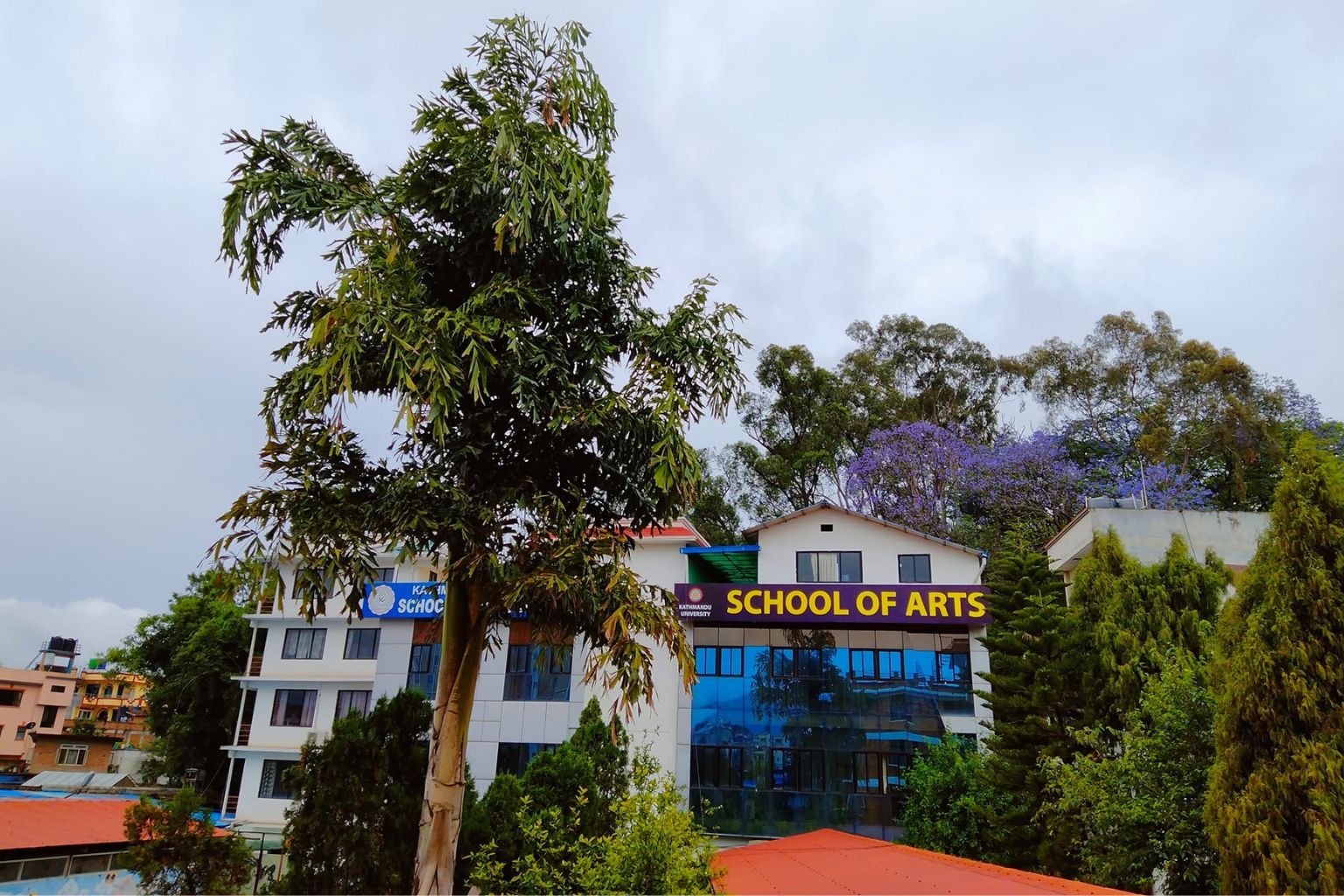
Bachelor in Media Studies (BMS) is a four-year undergraduate program offered by the Department of Languages and Mass Communication at Kathmandu University School of Arts (KUSOA), Hattiban, Lalitpur.
The program combines media theory with journalism, communication, research, digital media, broadcasting, photography, public relations, advertising, film and television production, media law, internship, and project work.
It is conducted within the academic framework of Kathmandu University (KU), with admission, examination, progression, and degree requirements governed by KU rules and the program's academic provisions.
| Particular | Details |
|---|---|
| Course | Bachelor in Media Studies (BMS) |
| Level | Bachelor's |
| Institution | Kathmandu University School of Arts |
| Department | Department of Languages and Mass Communication |
| University | Kathmandu University |
| Location | Hattiban, Lalitpur |
| Duration | 4 years |
| Academic structure | 8 semesters |
| Total credits | 126 credits |
| Seats | 30 |
| Eligibility | 10+2 or equivalent in any discipline |
| Minimum requirement | 45% aggregate or 2.0 CGPA |
| Admission | Entrance test and personal interview |
| Major practical components | Media production, internship and project work |
KUSOA places BMS under its Department of Languages and Mass Communication alongside other programs in communication, media, English, and film studies. The undergraduate framework uses a semester system and incorporates academic study, research, practical work, and internship experience.
BMS approaches media as an academic field, a communication practice, and a production-based discipline. Students begin with language, journalism, social sciences, computer applications, and introductory media courses before moving into communication theory, research, digital media, broadcasting, public relations, advertising, photography, film, television, media ethics, and media management.
The curriculum also gives social and cultural questions a place within media education. Courses such as Media, Culture and Society, Comparative Study of Nepali and Global Media, Development Communication, Behavior Change Communication, and Contemporary Development Discourse and Media connect communication practice with wider social issues.
The program's academic objectives include developing knowledge and practical ability for areas such as journalism, multimedia production, public relations, filmmaking, communication, media management, and media-related research. It also prepares students for further academic study in media and communication.
Duration: Four years
Semesters: Eight
Total Credits: 126
BMS progresses from broad foundation courses in the first year to specialized media subjects, production courses, research applications, internship, and a final project in the later semesters.
The 126-credit structure includes language and social-science courses alongside the main media curriculum. Most individual subjects carry three credits, while the final Project Work carries six credits.
| Semester | Courses | Credits |
|---|---|---|
| First Year, Semester I | Nepali I; English I; Introduction to Media Studies; Basic Journalism I; Computer Applications; Foundation of Social Sciences I | 18 |
| First Year, Semester II | Nepali II; English II; Nepal Studies; Basic Journalism II; Introduction to ICT; Foundation of Social Sciences II | 18 |
| Second Year, Semester I | Professional Communication; Media, Culture and Society; Research Methodology; Social Media Networking; Communication Theories | 15 |
| Second Year, Semester II | Public Relations; Advertising Principles and Practices; Photojournalism; New Media and Contemporary Society; Philosophical Approaches to Communication | 15 |
| Third Year, Semester I | Broadcasting; Development Communication; Comparative Study of Nepali and Global Media; Behavior Change Communication; Creative Writing for Media | 15 |
| Third Year, Semester II | Radio Production; Film Studies; Research Application in Media; Contemporary Development Discourse and Media; ICT for Development | 15 |
| Fourth Year, Semester I | Media Ethics; Film Production; Television Production; Human Rights, Press Freedom & Media Law; Media and Convergence | 15 |
| Fourth Year, Semester II | Advanced Journalism; Media Entrepreneurship and Management; Internship; Project Work | 15 |
The curriculum moves through several distinct strands: journalism and writing, communication theory, social-science study, media technologies, research, media production, development communication, legal and ethical issues, and professional practice.
Journalism appears throughout the degree rather than being confined to one semester. Students begin with Basic Journalism I and II and later encounter Broadcasting, Photojournalism, Creative Writing for Media, Radio Production, and Advanced Journalism.
Communication is studied from theoretical and applied perspectives. Professional Communication, Communication Theories, Philosophical Approaches to Communication, Development Communication, and Behavior Change Communication introduce different ways of studying and applying communication.
This combination allows students to examine both how communication operates and how media content is prepared for different formats and contexts.
The curriculum introduces computer applications and ICT early in the degree. Later courses address Social Media Networking, New Media and Contemporary Society, Broadcasting, Radio Production, ICT for Development, Film Production, Television Production, and Media and Convergence.
Practical work is connected with facilities and assigned field activities. BMS students work across classrooms, audio-visual and multimedia facilities, computer facilities, photography-related learning spaces, seminar settings, and field assignments.
Media production therefore sits alongside academic reading and analysis rather than being treated as a separate training component.
Research forms another continuing strand of the degree. Students study Research Methodology in the second year and Research Application in Media in the third year. Social-science foundations in the first year provide additional academic context for later research work.
The program also includes courses concerned with media and society, cultural analysis, communication theory, development, ethics, law, and comparative media study.
Teaching in theory-oriented courses can involve lectures, group discussions, student presentations, audio-visual material, readings, and references. Practical assignments may require students to work in the field and produce media content from observed contexts.
Eligibility: Applicants must have completed 10+2, Intermediate, or an equivalent qualification in any discipline from a recognized educational institution.
The minimum academic requirement is:
45% aggregate marks, or
CGPA 2.0
Students from different academic streams can therefore apply if they meet the stated academic threshold.
Applicants who have already appeared in their final qualifying examinations and are awaiting results may also apply for provisional admission under the applicable KUSOA conditions.
Eligible applicants proceed through the KUSOA admission process, which includes an entrance examination and personal interview.
The entrance route for BMS is identified as the Kathmandu University School of Arts Admission Test (KUSAAT). Applicants who meet the eligibility requirement are required to perform satisfactorily in the entrance examination and personal interview for selection.
The broader application process includes submission of the required application details and academic documents, followed by the written entrance process and interview. Admission remains governed by Kathmandu University and KUSOA academic rules.
BMS uses both academic and practical modes of learning. Students encounter classroom instruction alongside field-based assignments and media-production work.
Learning activities include:
Classroom lectures
Group discussions
Student presentations
Audio-visual learning materials
Practical media assignments
Field-based media production
Research activities
Computer and ICT-based work
Internship
Project work
Students are expected to use computer applications for media projects, while ICT is incorporated into wider academic and production activities. Research and critical analysis are also integrated into the learning process.
The presence of journalism, broadcasting, photography, radio, film, television, and digital-media subjects means practical learning changes according to the nature of each course.
Professional exposure becomes a formal part of the curriculum in the final year.
MEDS 441 Internship carries three credits, while MEDS 450 Project Work carries six credits. Together, these components allow students to apply learning accumulated through journalism, communication, research, and production courses.
Internship opportunities are connected with media organizations and other institutions relevant to the student's area of study.
The project component provides a substantial final academic requirement through which students work on an area connected with their media studies.
Student assessment follows Kathmandu University's academic system and includes internal or in-semester evaluation together with external end-semester examination.
External end-semester assessment is conducted through the Office of the Controller of Examinations. For successful course completion, students are required to obtain at least 40% in the relevant assessment components independently.
Attendance is also part of the academic requirement. Students are required to maintain at least 80% attendance in each registered course. Those who do not meet the attendance requirement are classified as “Not Qualified” for the external end-semester examination of the respective course.
Evaluation uses Kathmandu University's four-point letter-grading system. Degree completion and award remain subject to fulfillment of the prescribed BMS curriculum and KU academic regulations.
The combination of coursework, research, production assignments, internship, and project work can support development in areas such as:
News and journalistic writing
Professional communication
Media research
Photojournalism
Radio and television production
Film-related production
Public relations
Advertising
Digital and social media
Media analysis
Development communication
Creative writing
Communication planning
Media ethics and legal awareness
Media management
These abilities are developed through different academic components rather than through a single specialization.
The academic scope of BMS relates to several areas of media and communication. Depending on individual skills, experience, interests, and available opportunities, graduates may consider work connected with:
Journalism and news media
Radio and television
Digital media
Social media communication
Film and audiovisual production
Public relations
Advertising
Media research
Development communication
Communication-related organizations
Media management
Content production
The degree also provides an academic base for postgraduate study in media, communication, journalism, film, and related social-science fields. Students seeking postgraduate study within the same institutional setting can read about the Masters in Media Studies (MMS) at KUSOA.
The Department of Languages and Mass Communication manages Bachelor in Media Studies at KUSOA.
Department Email: dolmc@ku.edu.np
Department Phone: 9801370644
Admissions Office Email: soa_admission@ku.edu.np
Admissions Office Phone: 9801298094
Bachelor in Media Studies is a four-year undergraduate degree offered by the Department of Languages and Mass Communication at Kathmandu University School of Arts. It combines media theory, journalism, communication, research, digital media, and production-oriented study.
The program takes four years and is divided into eight semesters.
The Bachelor in Media Studies curriculum carries 126 credits across eight semesters.
BMS has 30 seats.
Applicants need 10+2 or an equivalent qualification in any discipline from a recognized institution with at least 45% aggregate marks or a CGPA of 2.0.
Yes. Eligible applicants take the Kathmandu University School of Arts Admission Test and go through a personal interview as part of the admission process.
Yes. The curriculum includes courses in broadcasting, photojournalism, radio production, film production, television production, digital media, and other production-related areas.
Yes. Internship is a three-credit course in the fourth year.
Yes. The final semester includes six-credit Project Work.
Students are required to maintain at least 80% attendance in each registered course to qualify for the applicable external end-semester examination.
Yes. The academic structure supports further study in media and communication, and KUSOA also offers Masters in Media Studies at the postgraduate level.