Nepal Police Staff College (NPSC) is a national-level institution focused on leadership learning and staff preparation within Nepal’s policing system. It was established in 2025 and is positioned to serve officers from Nepal Police and, as stated in its mandate, officers from other security agencies.
The college’s main academic and training pathway is the Police Leadership and Staff Course (PLSC), which brings together two components: the Master of Police Sciences (MPS), affiliated to Tribhuvan University (TU), and the Professional Leadership Course (PLC).
Alongside course delivery, the college identifies research as a priority area, with attention to policing practice, emerging challenges, and lessons that can be applied in Nepali contexts. The college location is Maharajgunj, Kathmandu, and its motto is “Knowledge, Integrity, Leadership.”
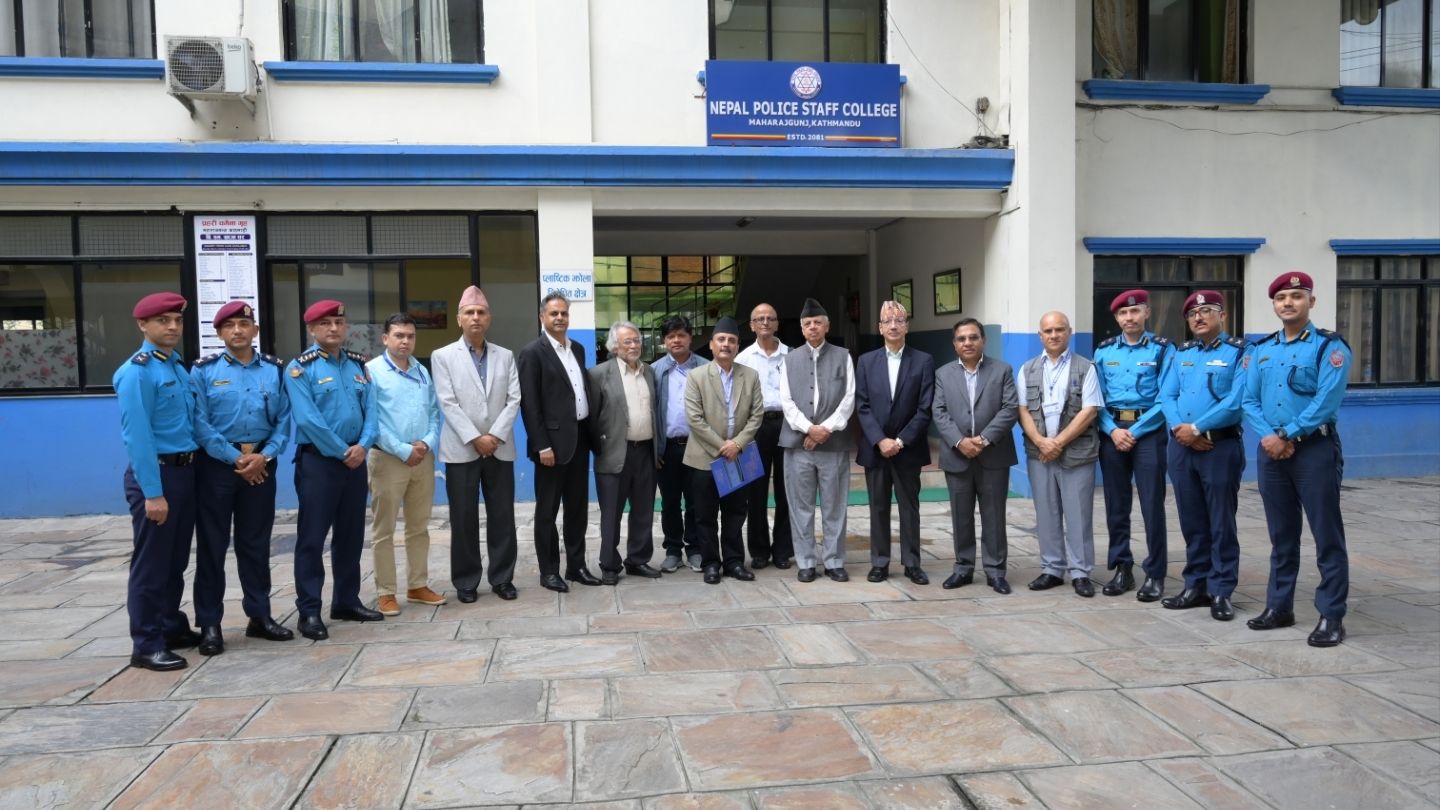
Official name: Nepal Police Staff College (NPSC)
Location: Maharajgunj, Kathmandu, Nepal
Primary course framework: Police Leadership and Staff Course (PLSC)
Academic program under PLSC: Master of Police Sciences (MPS), affiliated with Tribhuvan University
Professional program under PLSC: Professional Leadership Course (PLC)
Motto: Knowledge, Integrity, Leadership
Stated focus areas: leadership learning, research, and higher-level staff skills
PLSC is presented as the college’s main course structure for the professional growth of officers who are moving toward higher command and staff responsibilities.
Its structure is described as an integration of academic learning and professional training, with MPS and PLC as the two core components.
This structure matters for readers outside policing because it shows how a single program can connect university-level study with operational leadership learning.
MPS is described as a TU-affiliated master’s program delivered through Nepal Police Staff College under the PLSC framework. The subject list in the course structure shows that the degree crosses policing, governance, and management themes.
It includes police and policing, public affairs administration, police operations, public policy analysis, criminal law, legal system, and police staff duties and administration.
The curriculum also includes human resource management and organizational behavior, statistical methods, criminology and psychology, investigation management, major crime investigation, dimensions of security studies, and the United Nations system. In later semesters, the structure includes political system and governance, leadership and management, research methodology, and forensic science/forensic medicine.
A key academic marker is the thesis requirement shown in the fourth semester, with the thesis carrying credit weight within the program structure. The course outline also combines specialization options, including a disaster and conflict management route and an information technology–linked route that includes technology-based crime investigation, along with study tours as part of learning exposure.
PLC is the professional training component inside PLSC. In the course description, PLC is framed as staff-focused learning delivered by subject matter experts with internal faculty drawn from multiple domains. The domains listed include public administration/management, research methodology, crime investigation, criminology and legal studies, and police administration/management.
For stakeholders, PLC is a practical indicator that the college is not only running a university-affiliated master’s program, but also running structured leadership training that speaks directly to staff duties, operations, and leadership behaviour expected in policing.
Admission to Nepal Police Staff College programs is tied to professional selection within Nepal Police and related agencies, rather than a general open intake like many civilian colleges. The documentation describes PLSC as a program for mid-level and senior officers, which signals that participants are selected through internal service routes and eligibility screening.
The college materials state that candidates “must be selected” on the Central Management Admission Test (CMAT) entrance exam for the Master of Police Sciences (MPS). This linkage is also visible in officially published notices connected to Tribhuvan University’s Faculty of Management and Nepal Police channels. For example, a TU Faculty of Management notice for MPS (admission year 2026 A.D.) eligibility focused on senior police officers and outlines entry testing through CMAT.
The typical CMAT test components such as verbal ability, quantitative ability, logical reasoning, and general awareness, along with the test time and a stated test center. It also references online application links hosted on the Faculty of Management site (tudoms.org) and a Faculty of Management notice portal (fomecd.edu.np).
Because CMAT notices are time-bound and can change by admission year, readers should consult the latest official notices when planning for any intake cycle.
A clear example of selection activity appears in the PLSC Batch 01 timeline. The entrance exam for PLSC was conducted between March 20 and March 23, 2025, and results were published on April 1, 2025. The inauguration ceremony for PLSC Batch 01 is recorded as taking place on May 4, 2025 at Nepal Police Club (The Blue Pavilion), with the Home Minister noted as chief guest. This event is also published on the college’s official site under its news section.
NPSC describes course delivery through subject matter experts and internal faculty across multiple disciplines. In the program listing, internal faculty and advisors are named for the Master of Police Sciences, along with faculty members tied to specific subject areas.
The faculty list includes expertise areas such as human resource management, criminal law, international relations, public administration, legal studies, strategic management, police administration and security management, forensic medicine, public policy, research and statistics, psychology, research methodology, and international policing/United Nations systems.
From a learning-method perspective, the curriculum structure signals a mix of:
classroom instruction for law, policy, governance, and management topics
applied study of investigation management and major crime investigation
structured research writing through staged research methodology and a thesis
exposure activities listed as study tours within the specialization structure
These elements indicate that participants are expected to read policy and law texts, work with evidence, and communicate findings in academic formats, while also connecting learning back to operational staff work.
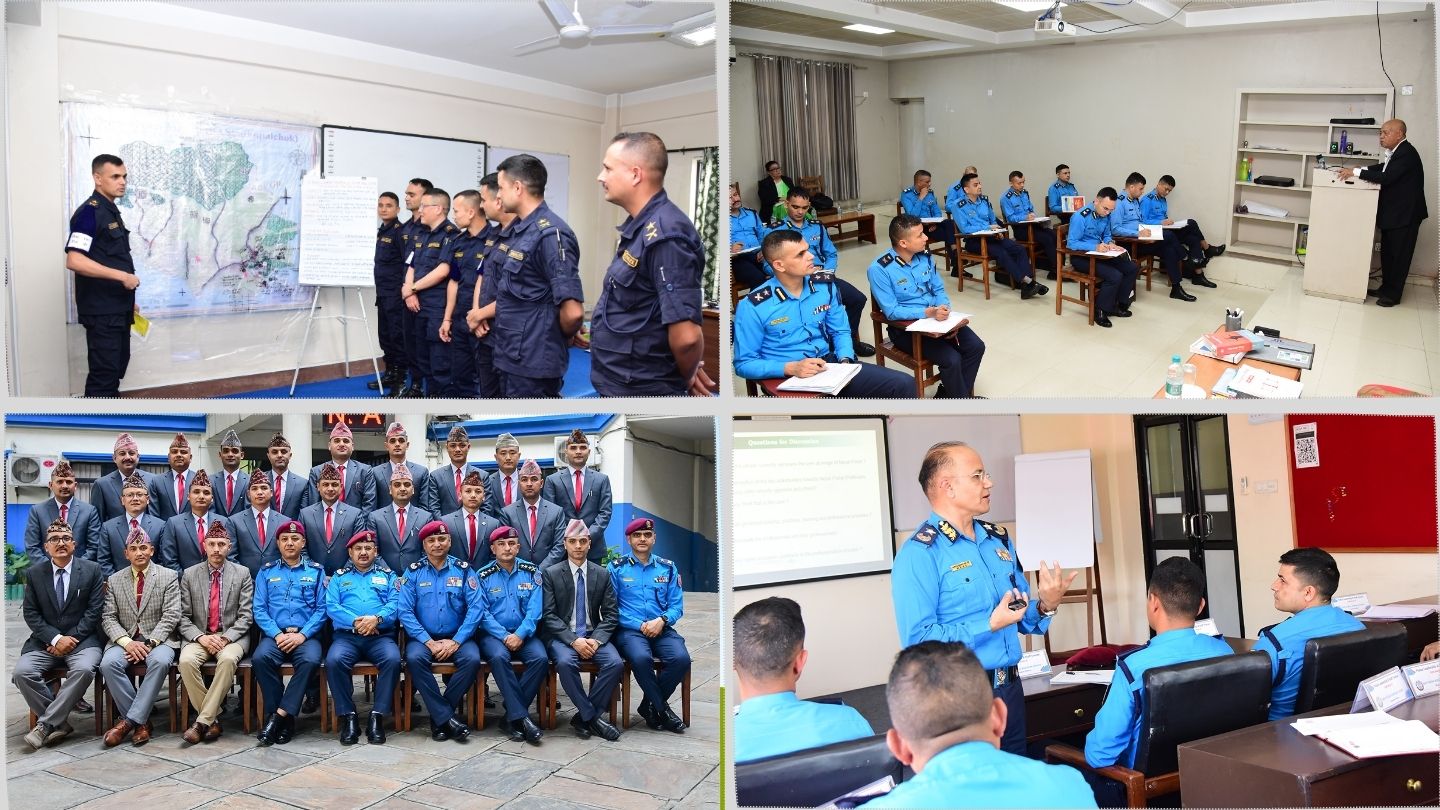
Nepal Police Staff College provides facilities that support both academic learning and extended professional training. The facilities list includes a conference hall and syndicates, which are typically used for seminars, group tasks, briefings, and staff planning exercises.
The NPSC has a library and a virtual classroom, supporting study, reference work, and technology-supported teaching. Residential and daily-life facilities are also listed: senior officers’ mess and mess lounge, a cafeteria, sports facilities, and a gym hall.
For external readers—parents, researchers, audit teams, and planners—these facilities are relevant because leadership courses depend on peer learning, structured schedules, and access to quiet study spaces as much as they depend on lecture rooms.
The institutional timeline shows that the Master of Police Sciences did not appear suddenly; it has a long planning background. A concept paper for conducting MPS is recorded as being prepared and submitted to Nepal Police Headquarters in 2001.
Tribhuvan University Academic Council decisions are also noted: the curriculum approval in January 2018 (decision no. 220 (Ga)) and the approval for running the program in September 2018 (decision no. 293 (KHA)).
In 2024, the timeline records steps that linked MPS more directly with Nepal Police training structures and with NPSC. It notes an action plan for running MPS 2081, the establishment of the Faculty of MPS office at the National Police Academy with a named program director, and a memorandum of understanding signed on September 6, 2024, between the Chief of Nepal Police and the then Dean of Tribhuvan University’s Faculty of Management to conduct MPS under Nepal Police Staff College. This MoU step is also shown on the college’s official history page.
For PLSC and PLC, the timeline includes approval of the PLSC operation procedure and entrance examination directive in December 2024, and approval of the PLC curriculum by the Inspector General of Police in February 2025. It also records the appointment of the College Director (DIGP Mr. Dr. Manoj Kumar K.C.) in December 2024.
The college’s motto—Knowledge, Integrity, Leadership—signals an identity built on learning, ethical conduct, and leadership responsibility. Its mission statement focuses on supporting senior officers through advanced knowledge and professional expertise in policing and law enforcement, while the vision frames the college as a centre for police training and research.
Among the listed objectives are maintaining law and order while upholding high standards of human rights, broadening understanding of technological change in policing, supporting research-based work, and strengthening administrative and staff qualities of officers. The course objectives also refer to Nepal Police Code of Conduct and accountability in policing work.
These points are central for public-sector evaluation because leadership and staff training in policing connects directly to community trust, lawful practice, and the quality of institutional decision-making.
The college materials link learning with research, both in its stated research focus and in the MPS structure that includes staged research methodology and a thesis. This matters for policy planners and researchers because it shows an institutional pathway for evidence-based study on policing, security studies, and operational practices.
The course list spans policing, public administration, public policy, law, investigation, security studies, international systems, forensic studies, and specialization options such as disaster management or technology-based crime investigation. This breadth reflects the reality that leadership roles in law enforcement require competence beyond field operations, including governance, legal interpretation, staff supervision, and planning under pressure.
Nepal Police Staff College stands as a structured institution for developing police leadership through two linked routes: a TU-affiliated master’s program (Master of Police Sciences) and a professional training component (Professional Leadership Course) under the Police Leadership and Staff Course framework.
It is listed as being in Maharajgunj, Kathmandu.
The NPSC offers the Police Leadership and Staff Course (PLSC) as its main framework, combining an academic program (MPS) and a professional course (PLC).
Yes. The MPS program is stated as affiliated to Tribhuvan University and delivered through the college.
The college materials state that candidates must be selected through the CMAT entrance exam for MPS, and official notices also describe CMAT-based entry for MPS.
The listed facilities include a conference hall, syndicates, senior officers’ mess, mess lounge, sports facilities, gym hall, cafeteria, library, and a virtual classroom.
The MPS structure includes policing, public administration, public policy analysis, criminal law and legal systems, investigation management, security studies, research methods, forensic studies, and specialization options such as disaster management or technology-based crime investigation.
The program description presents PLSC as a leadership and staff course intended for mid-level and senior police officers.