Oscar International College (College of Film Studies) is a specialized film college located at Sukedhara, on the Ring Road in Kathmandu. Established in 2005 (2061 BS), the institution runs the Bachelor in Film Studies (BFS) program under Tribhuvan University’s Faculty of Humanities and Social Sciences.
The BFS program at Oscar International College is recognized as the first academic degree in film studies approved by Tribhuvan University in Nepal. It is structured as a four-year undergraduate program that treats cinema as an academic field combining artistic, cultural, social, and technical perspectives.
The college focuses on preparing film professionals such as directors, screenwriters, actors, cinematographers, editors, and sound practitioners. Classroom learning, critical reading, screenings, fieldwork, and project-based production are integrated so that students can connect theory with practice and understand cinema as both creative expression and social document.
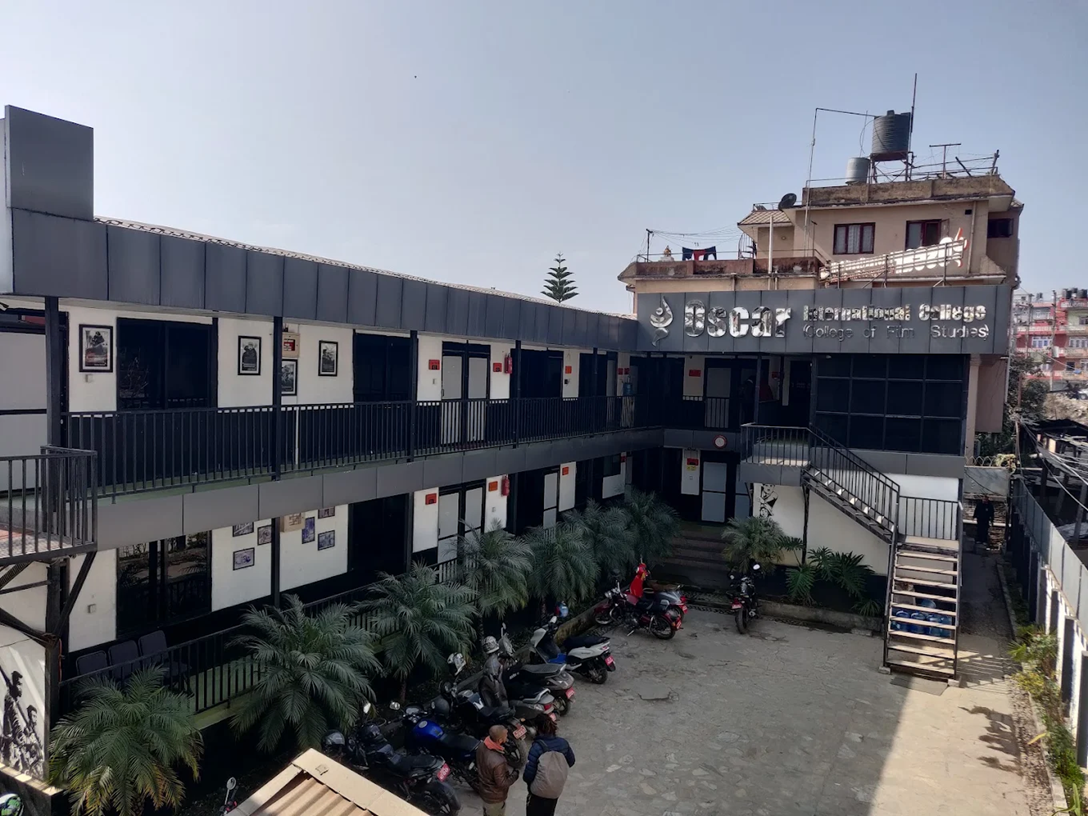
Established: 2005 (2061 BS)
Location: Sukhedhara, Kathmandu, Nepal
Affiliation: Tribhuvan University (Faculty of Humanities and Social Sciences)
Core program: Bachelor in Film Studies (BFS), four-year undergraduate degree
Academic focus: Film history, theory, criticism, aesthetics, and film-making practice
Major specializations: Acting, Cinematography, Screenplay Writing & Direction, Editing, and Sound Recording & Design.
Type of institution: Private college of film studies recognized by Tribhuvan University
Recognition: Listed among institutions whose students receive Film Development Board scholarships for film-related studies
Oscar International College is led by a team that combines academic management and active involvement in the film industry. The Principal, Ram Raja Dahal, oversees overall academic and administrative leadership. The Academic Director, Manoj Babu Panta, guides curriculum planning and academic quality, while the Academic Coordinator and Administrative Manager, Nawa Nidhi Dahal, looks after day-to-day academic and operational management.
Technical aspects of the program are supported by a dedicated head of the technical department, along with coordinators and heads for each specialization. Faculty members include screenwriters, directors, cinematographers, editors, sound designers, actors, and scholars who are active in feature films, documentaries, television, and digital media. Many have festival experience and professional portfolios in Nepali and international cinema, which they bring into classroom discussion and project supervision.
Alongside full-time faculty, the college invites visiting mentors and guest lecturers from different sectors of the film industry. Directors, producers, actors, cinematographers, and editors conduct workshops, masterclasses, and project consultations. This mix of academic and industry engagement helps students understand current practice, professional ethics, and evolving trends in storytelling and production.
Oscar International College runs the Bachelor in Film Studies (BFS) under Tribhuvan University. It is the first film degree in Nepal formally recognized by Tribhuvan University. The program has been developed as a four-year bachelor course focused on cinema as both an academic subject and a creative practice.
The college aims to prepare students for work in directing, scriptwriting, acting, cinematography, editing, and sound. BFS students study core subjects in film studies alongside general subjects such as English and Nepali. They also work through a sequence of practical courses that introduce them to the processes of film-making.
Over the four years, students move from basic concepts to more specialized study and a final graduation project. By the time they complete the program, they have taken both common courses and a full set of subjects in one specialization area.
The BFS curriculum is organized with core courses, specialization courses, and project-based work. All subjects listed in the official course structure carry 100 marks unless a different value is mentioned.
Key academic components include:
Compulsory English
Compulsory Nepali / Nepali Studies
Psychology and Film Studies
Introduction to Sociology and Visual Anthropology
Basic Film History
Film as an Art Form
Film Making Fundamentals I, II, III
Film Theory and Criticism
Research Methodology and Term Paper
During the four-year course, Oscar International College offers five specialization tracks within BFS:
Acting
Cinematography
Screenplay Writing & Direction
Editing
Sound Recording & Design
Students select one of these streams and follow the corresponding sequence of subjects and project work, while still sharing core film courses with other specializations.
The acting specialization is planned as a full four-year training in performance. The course aims to help students develop skills in: Acting for theatre, film, television, and radio, Voice, body movement, and stage/screen presence, Singing, research, and personal as well as professional growth.
The cinematography specialization focuses on the technical and creative side of camera and lighting work. Students learn to use the image as a storytelling tool and work with cameras, accessories, and lighting equipment in class and lab sessions.
Through these courses, students work on how camera and light can shape meaning and support narrative.
The screenplay writing and direction specialization addresses both story development and the directing process. The course looks at how to tell stories through the language of cinema and how a director turns ideas into concrete visual and sound experiences.
The editing specialization introduces both the technical and aesthetic sides of film editing. Over four years, students learn how different editing decisions influence story and rhythm. They work with editing software in class and lab environments.
The sound recording and design specialization focuses on how sound is created, recorded, and shaped for cinema. Students are introduced to sound devices, recording methods, and software for sound design in both theory and practical classes.
Applicants for the Bachelor in Film Studies program must meet the minimum entry requirement prescribed by Tribhuvan University. In practice, this means:
Completion of 10+2, PCL, or an equivalent qualification in any stream (Science, Management, Humanities, Education, or other approved disciplines) from a board or university recognized by Tribhuvan University.
Minimum grade of D+ in all subjects in Grade 11 and 12 or at least 40% aggregate marks in the last qualifying examination.
Students with higher academic qualifications may also apply as long as their previous degrees are recognized and they meet the BFS entry criteria. International applicants with equivalent secondary qualifications recognized by Tribhuvan University can seek admission through the same process.
While specific dates and procedures may change by academic year, the admission process usually follows these stages:
Collection and submission of the college application form along with required documents (academic transcripts, character certificates, copies of citizenship/passport, and photographs).
Screening of academic background and application details by the admissions office.
Written entrance examination that may include questions on language, general knowledge, film awareness, and creative aptitude.
Interview and/or practical task where applicants discuss their interest in film, previous creative work (if any), and long-term learning goals.
Final selection is based on the combined performance in the written test, interview, and academic record.
Teaching at Oscar International College is organized around studio practice, seminars, and project supervision. Lecturers deliver theoretical courses on film history, criticism, cultural studies, and aesthetics, while practical instructors guide workshops in acting, camera work, lighting, editing, and sound.
Students regularly watch films from Nepal and around the world, followed by group discussions and written assignments. Scene analysis, script breakdown, storyboarding, and detailed production planning are used to help students understand how ideas move from page to screen.
Project-based learning is central to the BFS program. From short exercises in the first year to more complex productions in later semesters, students work in small crews, rotate roles, and learn to collaborate under real production conditions. Faculty members and mentors provide feedback at different stages: concept, script, shooting plan, rough cut, and final screening.
Critical reflection is strongly integrated into teaching. Students maintain production journals, submit written reflections on screenings, and present their projects in review sessions. This combination of practice and reflection prepares graduates not only as technicians but as thoughtful film practitioners who can engage with social issues, cultural representation, and audience response.
Oscar International College conducts its academic work from its own campus in Sukhedhara, Kathmandu. The campus houses the teaching and administrative units and is used for regular classes, meetings with faculty, and project-related activities for Bachelor in Film Studies students.
Teaching takes place in classroom settings as well as in spaces used for practical work. Course descriptions show that students work with cameras, accessories, lighting equipment, sound devices, and editing software during film-making fundamentals and specialization subjects. These sessions are run as class, lab, or workshop activities under the guidance of faculty and technical staff.
Learning is further supported through scripts, course materials, and readings connected to film theory, criticism, and related subjects listed in the BFS structure. As students move through the program, they link these theoretical components with their ongoing practical exercises and project work, which helps them understand how ideas discussed in class appear in actual film practice.
Alongside formal coursework, students participate in film-related extracurricular activities. These include:
Internal short film screenings and critique sessions
Festival submissions of student projects at national and international film festivals
Youth short film competitions and thematic film events
Interactions with guest filmmakers, actors, producers, and critics
Participation in workshops and events organized in collaboration with film bodies and cultural organizations
These activities give students additional platforms to test their ideas, understand the festival circuit, and build professional networks while they are still in college.
Oscar International College students can access several scholarship schemes:
Scholarships from the Film Development Board (FDB), Government of Nepal, for undergraduate film students
Scholarships supported by international partners such as Infinite Studios, Singapore
College-level scholarships and reductions for meritorious or financially constrained students
Occasional scholarships initiated by alumni and well-wishers
Film Development Board scholarships regularly support BFS students at Oscar International College. Official notices show that OIC students have been selected for undergraduate film scholarships, with grants such as NPR 50,000 per student for designated years.
Eligibility, numbers of seats, and conditions for each scholarship category are announced through official notices by the Film Development Board and the college. Applicants should review current calls and prepare documents such as academic transcripts, recommendation letters, and proof of study at the college.
Oscar International College holds a distinct place in Nepali higher education as the first Tribhuvan University–affiliated college to offer a full Bachelor in Film Studies program.
Over the years, student films from the college have been screened and awarded at national and international film festivals. The college records a significant number of award-winning academic projects, and many graduates have gone on to direct feature films, documentaries, and music videos; act in mainstream and independent cinema; and work as cinematographers, editors, and sound professionals.
The college has also hosted and supported youth short film competitions and special screenings, helping to cultivate a culture of film appreciation among young audiences in Kathmandu
For students in Nepal and abroad who wish to study cinema in an academic setting, Oscar International College offers several clear advantages:
A focused four-year BFS degree fully affiliated with Tribhuvan University
A curriculum that combines film theory, criticism, and history with practical production work
Specialization options in acting, cinematography, screenplay writing and direction, editing, and sound
Faculty and mentors drawn from active film practitioners and scholars
Access to Film Development Board and other scholarship opportunities
Location in Kathmandu with direct connection to the country's film production centers
These features make the college an important option for learners who want structured film education with recognized academic credentials.
Namaste, I am Manoj Babu Panta. I am the Academic Director of Oscar International College, College of Film Studies. I would like to welcome you to this college.
Around two decades ago, at a time when many Nepali films were made as direct copies of Indian films, some serious creators came to an important realisation. If Nepali films continued in that same way, Nepali cinema would not be able to find its own identity.
If there is a need for original Nepali cinema, then there must be our own stories and our own way of telling those stories. For that, capable and skilled human resources are required. From the point where it was understood that such capable people can develop only through the study of cinema, film education started in Nepal.
The main credit for this goes to senior actor and director of Nepali cinema, Nir Bikram Shah. The college that started through his initiative has, up to now, produced its twelfth graduating batch, and the sixteenth batch has just begun its studies. Students of this college continue to work in the ongoing effort to build a distinct story and narrative style for Nepali cinema.
This is a bachelor-level film course affiliated with Tribhuvan University. The course is called Bachelor in Film Studies.
Although it is called Film Studies, we have imagined it as a kind of hybrid course that combines two areas: film studies and film making.
Under film studies, the syllabus is oriented towards all theoretical aspects related to cinema. Students study theoretical, critical, and historical approaches to film. They also study outstanding films made across the world and the master film makers associated with them in close detail. The aim is to build a sense and understanding of cinema and then apply that understanding to their own film making.
In film making, the course moves forward with the idea of learning film production through close study and practice of film-making techniques and crafts. Students do not only read about film making; they learn by working with the tools and processes involved.
In film making, we consider five main fields: screen writing and direction, cinematography, editing, sound design, and acting.
Alongside theoretical and practical classes in these fields, students work on many film productions over the four years. By studying theoretical approaches to cinema and different ways of sensing and reading films, and by learning the established crafts of film making at the same time, our syllabus has been structured with a clear purpose.
The purpose is that a clear film maker can emerge, someone who knows what kind of films to create and how to open new dimensions for Nepali cinema.
There is a saying that every person becomes a poet once in life. In a similar way, the wish to enter film also appears in almost everyone at least once in life.
The glamour and popularity of cinema create this attraction. The desire to become popular exists in all people. However, that alone is not sufficient to become a film student or a film maker.
For this, deep passion is required. Because this field has many ups and downs, patience is also necessary, along with a strong belief in one’s own creativity.
If you have these three elements within you—passion, patience, and confidence in your creativity—then this subject can be appropriate for you. If these elements are not present and you are thinking of studying film only because of the attraction of glamour and popularity, then this subject may not be suitable for you.
In our society, there is a belief that some subjects are superior to others. Because of the belief that such subjects secure the future of students, parents often push their children to study those subjects.
As a result, students may or may not have the desire to study those areas, yet they continue in them for the sake of fulfilling their parents’ dreams. We want that practice to come to an end.
Our college is a place where you live your own dream. It is a college where students follow their dreams and walk on the path of living those dreams.
Standing on this platform where we teach creative work and hold discussions about creation, we feel that the most valued work in the world is creative work. The most valued profession in the world is the one where a person is allowed to live inside their own dream.
When we talk about the environment of this college, students will find a setting that is different from the conventional structure of other colleges.
Most of the teachers and administrators involved here are themselves closely linked with the dream of cinema. Because of this, the environment goes beyond the usual relationship between teacher, administrator, and student. It becomes a space where seniors and juniors travel together in the same dream.
Even after students graduate, as long as they do not abandon their dream of cinema and remain active in film, that family-like environment and that sense of fraternity will continue.
We are cinephiles who take cinema seriously, who love cinema, respect cinema, and even revere cinema. Our wish and goal is that good creators emerge who can preserve cinema.
For good creators to emerge, deep study of cinema is necessary. This platform, this college, is a place to study cinema and to practise it with devotion.
We believe that if someone studies and practises cinema continuously for four years, that person will come out as an excellent creator of cinema. We trust that such a creator will play an important role in guiding and safeguarding Nepali cinema along a clear path.
We are confident that students who graduate from this college will play a significant role in giving clear direction to Nepali cinema.
Oscar International College, Sukhedhara, Kathmandu, has a distinct place in Nepal’s higher education system as a dedicated film college under Tribhuvan University. Its four-year Bachelor in Film Studies program offers structured academic study, subject-wise specialization, and learning opportunities connected to the film industry.
What is the main academic program at Oscar International College?
The main program is the Bachelor in Film Studies (BFS), a four-year Tribhuvan University–affiliated degree with specializations in acting, cinematography, screenplay writing and direction, editing, and sound recording and design.
Who is eligible to apply for the BFS program?
Applicants must have completed 10+2, PCL, or an equivalent qualification from a board recognized by Tribhuvan University, with at least D+ in all subjects or a minimum of 40% aggregate, and must pass the college entrance test and interview.
Does the college provide scholarships for film students?
Yes. Students may apply for Film Development Board scholarships, support from international partners, and college-level schemes, and BFS students at this college have received Film Development Board assistance in past years.
What kinds of careers do graduates pursue?
Graduates work in directing, scriptwriting, acting, cinematography, editing, sound, criticism, teaching, and related media fields, or move on to further study in film and allied areas.
Is the degree recognized for further study in Nepal and abroad?
Yes. The BFS degree is awarded under Tribhuvan University and is recognized within Nepal’s higher education system; it can be used for postgraduate applications in Nepal and other countries, subject to the rules of each institution.
Contact Oscar International College's administrative office for detailed information on the course, admissions, location, fees, scholarships, facilities, counseling, or eligibility.
Oscar International College
Email Address: mail@oscar.edu.np
Phone Number: +977-1-4371874, +977-1-4370409
Website: http://www.oscar.edu.np
Location: Sukedhara (Ring Road), Kathmandu