Devi Secondary School is a community-based secondary and higher secondary institution located in Birtamode-5, Jhapa. Established in 2019 BS (1962 AD) by the Government of Nepal, the school started with a clear aim: to widen access to formal schooling for children and adolescents in eastern Nepal and to prepare them for a future shaped by science, technology, and social change.
Over the decades, Devi Secondary School has expanded from a basic school to a full institution with classes from Grade 1 to Grade 10 and ten plus two (10+2) programs in Science, Management, Humanities, Education, and Travel and Tourism under the National Examination Board (NEB). In addition, the school runs a Pre-Diploma in Computer Engineering (Computer Sub-Overseer) under the Council for Technical Education and Vocational Training (CTEVT), offering a technical route for students interested in information technology.
The school works with children and young people from diverse backgrounds in Jhapa and neighbouring districts. Its focus on values, discipline, structured learning, and community engagement has helped it remain a trusted choice for families seeking an affordable and academically sound school in Birtamode. Photographs in the school profile show a large student body in uniform, active participation in events, and teachers working closely with learners, reflecting an active campus environment.
Location: Birtamode-5, Jhapa, eastern Nepal
Establishment: 2019 BS (1962 AD), founded by the Government of Nepal
Levels: Grade 1–10; ten plus two (+2) programs; technical pre-diploma
Affiliations:
National Examination Board (NEB) for 10+2 programs
CTEVT for Pre-Diploma in Computer Engineering (Computer Sub-Overseer)
Academic Streams (10+2): Science, Management, Humanities, Education, Travel and Tourism
Technical Program: Pre-Diploma in Computer Engineering (Computer Sub-Overseer)
Approximate Size: around 3,000 students, 150 teachers, 25 staff members and 2 accountants
Key Values: excellence in learning, integrity, respect, responsibility, teamwork, creativity, social responsibility, and all-round development
Facilities: computer lab, science labs, library, canteen, transportation, sports and ECA programs
The school runs classes from Grade 1 to Grade 10 following the national curriculum. At this stage, the focus remains on literacy, numeracy, science, social studies, health, moral education, and creative subjects. The aim is to build strong reading and writing skills, a sound base in mathematics and science, and habits of discipline and cooperation. Students complete their Secondary Education Examination (SEE) at the end of Grade 10 and can then progress to ten plus two programs offered within the same institution.
The Humanities stream is suitable for students interested in social sciences, communication, and human behaviour. The curriculum includes language studies, mass communication, sociology, psychology, economics, marketing, business mathematics, and contemporary society.
The program helps learners understand social structures, culture, media, and economic issues. The school’s profile notes that, across Nepal, enrolment in Humanities has declined in recent years as many SEE graduates shift toward technical or business-oriented fields. This context helps students and parents see both the strengths and the current challenges of Humanities as an academic pathway.
Eligibility for Grade 11 Humanities follows national guidelines: students who have completed Grade 10 and achieved at least GPA 1.6 in SEE from a recognised school can apply.
The Management stream is aimed at students planning careers or further study in business, banking, finance, hospitality, or entrepreneurship. Key subjects include accounting, economics, marketing, business studies, management principles, business mathematics, business law, organisational behaviour, finance, and entrepreneurship.
Through case discussions, numerical work, and project tasks, learners gain a foundation in how organisations function, how markets work, and how financial decisions are made. The curriculum prepares students for undergraduate studies such as BBA, BBS, B.Com and similar management degrees. At the same time, it helps them understand the language of business for direct entry into jobs in offices, retail, hotels, or small enterprises.
Students need a minimum GPA of 1.6 in SEE from a recognised institution to enrol in Grade 11 Management, as per the National Curriculum Development and Evaluation Council.
Travel and Tourism is a specialised stream for learners drawn to travel services, hospitality, and tourism-related careers. The course content covers tourism management, tourist geography, travel agency and tour operations, hotel management basics, customer service, event management, and cultural tourism.
Students learn how trips are planned, how itineraries are prepared, how tour operations are managed, and how tourism businesses interact with local culture and environment. The stream links well with Nepal’s large tourism sector and can lead toward roles in travel agencies, tour companies, airlines, hotels, resorts, and tourism marketing units.
The eligibility requirement is similar to other streams: completion of Grade 10 with GPA 1.6 or above in SEE.
The Science stream at Devi Secondary School prepares students for further study in medicine, engineering, agriculture, environmental science, biotechnology, and computing. The core subjects include physics, chemistry, biology, mathematics, and English, with an emphasis on laboratory work and analytical skills.
Students conduct experiments in physics and biology labs, practise numerical problem-solving, and learn to read and interpret scientific data. This grounding helps them sit for competitive entrance exams for MBBS, engineering, BSc and other science-related degrees. The school profile points out the need for regular updates in the science curriculum so that students stay in step with new developments in technology and research.
As with other NEB programs, entry to Grade 11 Science requires successful completion of SEE with at least GPA 1.6, along with performance in science and mathematics subjects.
The Pre-Diploma in Computer Engineering (Computer Sub-Overseer) is a vocational program under CTEVT that gives students intensive exposure to computer hardware, software, and networking.
Across one to two years of study, learners cover computer programming basics, hardware repair and maintenance, network setup and management, web development, database fundamentals, and system administration. They also practise troubleshooting and user support. The course targets entry-level technical roles such as computer technician, network assistant, IT support staff, and system operator in schools, offices, and small organisations.
Eligibility follows CTEVT guidelines: applicants must have completed Grade 10 from a recognised school and show interest in computer and information technology fields.
The school profile highlights that admission information, including an online application option, is available through the “Apply Now” feature and notices on the official portal. A typical admission cycle includes:
Publication of admission notices and deadlines on the notice board and website
Submission of an application form (online or through the school office) with SEE mark sheets or internal exam records
Short interaction or counselling session with students and parents, especially for Grade 11 stream selection
Confirmation of placement and fee-related formalities
Parents and applicants are advised to contact the school directly for the latest details on entrance tests, seat limits in each stream, and scholarship application windows. This practice helps keep the process transparent for families, auditors, and education authorities.
Devi Secondary School employs around 150 teachers and 25 support staff who work across basic education, NEB programs, and technical courses. Teachers follow the national curriculum while incorporating group work, project tasks, and practical exercises.
In science subjects, students use laboratories for physics, chemistry, and biology experiments. In technical and computer-related classes, they spend time in the computer lab, practising software tools and networking tasks. For Management and Humanities, the school uses presentations, discussions, and field visits where relevant.
Photographs in the brochure show hotel management practical sessions, where students are guided in cooking and service skills, and educational trips to Pokhara, which combine learning with exposure to new places. These activities add practical dimensions to classroom teaching and help students connect theory with daily life.
The school invests in basic infrastructure needed for teaching, learning, and student welfare:
Computer Lab – Equipped with modern computers and software to support ICT classes and technical programs. The description in the profile stresses repeated hands-on practice for digital literacy and technical skills.
Science Labs – Laboratories for physics and other sciences, where students conduct experiments and learn through observation and measurement.
Library – A quiet reading space with books, journals, and study materials that helps students cultivate reading habits and research skills.
Canteen – Provides simple, hygienic meals and snacks during school hours, as shown by photographs of students engaged in food-related practical work.
Transportation – School buses transport students from surrounding areas to the campus, helping families who live at a distance.
These facilities support daily learning, exam preparation, and co-curricular activities while keeping health and safety in mind.
Student life at Devi Secondary School combines classroom study with values-based activities, cultural events, and field exposure. The school’s core values include excellence in education, integrity, honesty, respect, kindness, responsibility, accountability, collaboration, creativity, care for the environment, and all-round development.
Morning assemblies, classroom rules, and participation in school programs help students practise punctuality, discipline, and mutual respect. The values statement underscores empathy, diversity, and kindness, encouraging learners to treat classmates and staff with fairness and courtesy.
Pictures of students on tours and in group formations show that the school environment is lively and collective in nature, where learners take part in group songs, cultural dress, and shared celebrations.
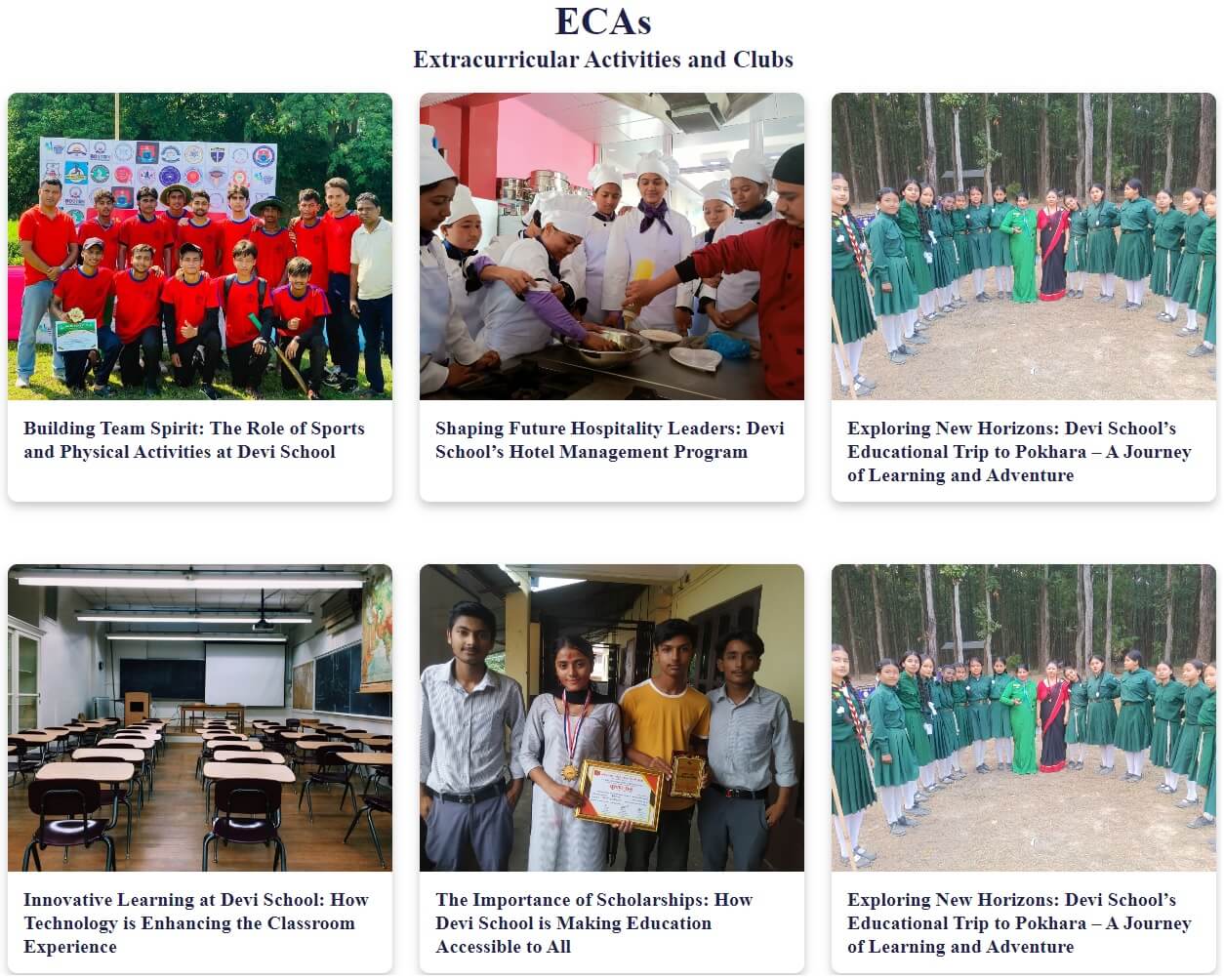
The school recognises that learning also happens outside textbooks. The profile lists several extracurricular areas and shows supporting images:
Sports and Physical Activities – Matches, drills, and outdoor activities help build team spirit, leadership, and physical fitness. A group photograph of students in sports uniforms highlights participation across grades.
Hotel Management and Hospitality Training – Practical kitchen sessions where students learn cooking, food presentation, and service skills connect well with the Travel and Tourism and Management streams.
Educational Trips – Visits such as the educational tour to Pokhara expose students to geography, culture, and local communities beyond Jhapa.
Technology-supported Learning – The section titled “Innovative Learning at Devi School: How Technology is Enhancing the Classroom Experience” highlights use of digital tools and ICT in teaching.
Cultural and Arts Activities – The Cultural and Arts Department organises events, music, dance, drama, and visual arts that link students with Nepali heritage and creative expression.
These activities help learners develop communication, cooperation, confidence, and creativity alongside academic progress.
Devi Secondary School treats scholarships as a practical way to keep education within reach for students from different backgrounds. The program recognises steady academic effort as well as the financial reality many families face, so support is not limited to top scorers alone.
Key features of the scholarship and financial support system include:
Scholarships are mainly available to students who are already enrolled at Devi Secondary School.
When the school reviews applications, it looks at both exam results and classroom performance along with the economic situation of the family.
Applicants are asked to submit recommendations from teachers or counsellors who understand their learning habits and personal circumstances.
Support can include full or partial waivers of tuition fees, depending on the decision of the scholarship committee.
In some cases, the school also helps with the cost of textbooks, notebooks, and other basic learning materials.
Through a link with Mewar University in India, eligible students can explore scholarship options for higher studies after completing their school-level programs.
Over more than six decades, Devi Secondary School has grown from a small local school into a large institution that offers both academic and technical pathways. Its development reflects the changing educational needs of Birtamode and surrounding areas.
Some of the key milestones and features are:
Long service to the community since 2019 BS, with gradual expansion from lower grades to full secondary and higher secondary levels.
Dual affiliation with NEB and CTEVT, which allows students to choose between general education streams and a technical route on the same campus.
Growth to around 3,000 students and about 150 teachers, as shown in the school’s statistics, indicating a large and diverse learning community.
Introduction of Travel and Tourism and hotel management-related activities that respond to labour market needs in tourism, hospitality, and service sectors.
An active scholarship program and higher-education linkages with Mewar University that create pathways for students who wish to continue their studies beyond school.
Prospective students and parents may consider Devi Secondary School for several reasons:
Single-campus pathway: Children can study from Grade 1 through Grade 12 in one institution and then move into a technical pre-diploma if they wish.
Wide range of streams: Science, Management, Humanities, Education, Travel and Tourism, and Computer Engineering cover both academic and skill-oriented interests.
Values-centred environment: The school places strong emphasis on integrity, responsibility, cooperation, and respect, which supports character development.
Practical exposure: Labs, hospitality sessions, sports, educational tours, and ICT-based learning provide applied learning opportunities.
Financial support: Structured scholarships and fee relief help reduce barriers for talented or needy students.
These points make Devi Secondary School a realistic option for families seeking a balanced mix of academic routes, values, and affordability in Birtamode.
Devi Secondary School, Birtamode, Jhapa stands as a long-serving NEB and CTEVT-affiliated institution that offers school-level, ten plus two, and pre-diploma programs on a single campus. Its combination of academic streams, technical education, values-based learning, scholarships, and co-curricular activities gives students various routes for their future studies and careers.

.png)