Soch College of IT is an IT-focused college in Ranipauwa, Pokhara, established in 2013 AD (2070 BS). Located in Pokhara Metropolitan City, the college offers the Bachelor of Science in Computer Science and Information Technology under Tribhuvan University. Its academic direction centers on accessible and affordable technical education, with emphasis on practical learning, discipline, and student development.
The college campus includes computer and digital labs, a library, sports facilities, lecture halls, and specialized labs for networking and applied technology work. Alongside classroom teaching, the academic approach gives weight to projects, presentations, case studies, seminars, and laboratory practice. With a focused academic portfolio, a dedicated IT environment, and a campus setting designed for study, Soch College of IT presents itself as a specialized option for students seeking undergraduate education in computer science and information technology in Pokhara.
Established: 2013 AD (2070 BS)
College Name: Soch College of IT
Location: Ranipauwa-11, Pokhara, behind Nepal Telecom Office, Kaski, Gandaki Province, Nepal
Academic Affiliation: Tribhuvan University, Institute of Science and Technology
Program Offered: B.Sc. CSIT
Academic Duration: 4 years, 8 semesters
Campus Area: 7 ropanis
Building Area: 15,000 square feet
Library Collection: More than 1,000 volumes
Computer Lab Capacity: 48 PCs with server and networking devices
Principal: Mr. Sushil Adhikari
Email: info@sochcollege.edu.np
Phone: +977-61-574096, +977-61-543120
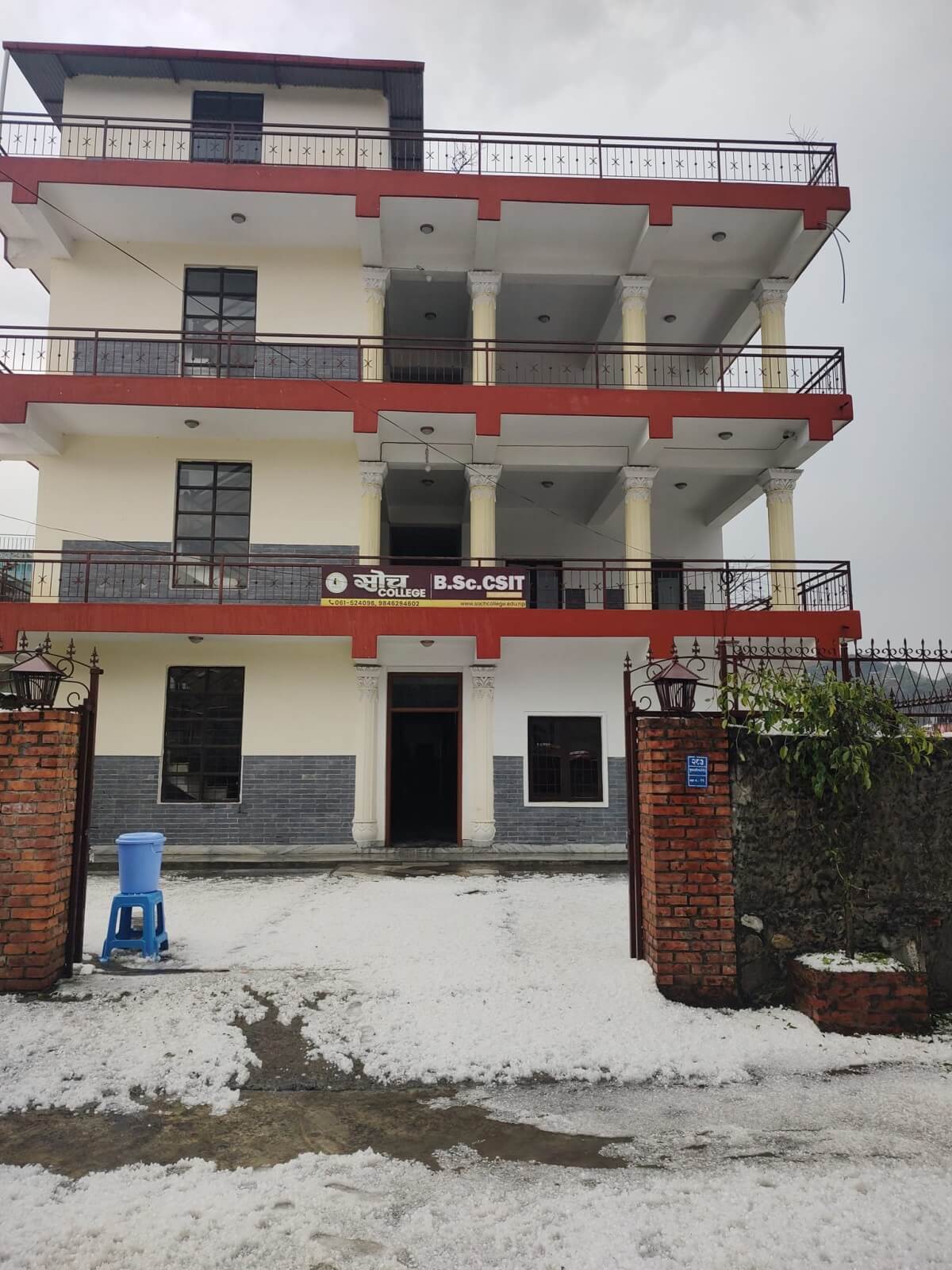
Soch College of IT was established with a defined focus on technical education. From its beginning, the college positioned itself around the idea that quality IT education should be accessible and affordable. This direction appears consistently in its mission, vision, and academic setup.
The college’s mission is to provide easy access to qualitative and affordable education and to produce skillful human resources. Its vision emphasizes advancing technical education through scholarship, leadership, and practical exposure. Its stated objectives place value on dignity and respect within the institution and on helping students achieve their full potential.
As an institution located in Pokhara, the college operates in a setting that combines urban accessibility with a relatively calm campus environment. The physical campus, practical facilities, and single-program academic focus indicate a college structure built around sustained undergraduate study in information technology and computer science.
The affiliation with Tribhuvan University connects the college to a nationally recognized public university system. For students pursuing undergraduate IT education in Pokhara, this affiliation places Soch College of IT within the academic and examination framework of a major Nepali university while maintaining its own campus-based teaching and learning environment.
Soch College of IT offers the Bachelor of Science in Computer Science and Information Technology. The program is available as BSc CSIT at Soch College of IT.
Program: Bachelor of Science in Computer Science and Information Technology (B.Sc. CSIT)
University System: Tribhuvan University, Institute of Science and Technology
Duration: 4 years
Structure: 8 semesters
Academic Load: 126 credit hours
The B.Sc. CSIT curriculum is designed to give students a broad foundation in computer science and information technology. It combines theory, programming, systems knowledge, mathematics, statistics, and practical work. The stated objective of the program is to provide intensive knowledge and skills in different areas of computer science and information technology, including design, theory, programming, and computer applications.
The early semesters include foundational subjects such as Introduction to Information Technology, C Programming, Digital Logic, Mathematics, Physics, Discrete Structure, Object-Oriented Programming, and Microprocessor. As students progress, the curriculum moves into Data Structure and Algorithms, Numerical Method, Computer Architecture, Computer Graphics, Theory of Computation, Computer Networks, Operating Systems, Database Management System, and Artificial Intelligence.
The later semesters include Design and Analysis of Algorithms, System Analysis and Design, Cryptography, Simulation and Modeling, Web Technology, Software Engineering, Compiler Design and Construction, E-Governance, NET Centric Computing, Technical Writing, Advanced Java Programming, Data Warehousing and Data Mining, Principles of Management, Project Work, Advanced Database, and Internship.
The curriculum also includes electives in areas such as Multimedia Computing, Wireless Networking, Image Processing, Knowledge Management, Applied Logic, E-Commerce, Automation and Robotics, Information Retrieval, Network Security, Introduction to Cloud Computing, Mobile Application Development, Network and System Administration, and Embedded Systems Programming.
The program structure shows a gradual movement from foundation courses to specialized applications, project work, and internship exposure. It also includes soft-skill development in teamwork, communication, and technology management through projects, lab work, presentations, case studies, and seminars.
Admission to the B.Sc. CSIT program follows the academic framework of Tribhuvan University and the Institute of Science and Technology.
Students should have successfully completed twelve years of schooling in the science stream or an equivalent qualification from a recognized board, university, or institution.
Applicants should have secured at least a second division.
Eligible students are required to complete the prescribed application process.
Admission includes the entrance examination conducted by the Institute of Science and Technology, Tribhuvan University.
After selection, students complete admission by submitting the required documents and paying the prescribed fees.
Academic registration, course delivery, examinations, and results follow the applicable university rules and academic calendar.
The B.Sc. CSIT program is semester-based. The course runs across eight semesters, and semester-end examinations are conducted by the Institute of Science and Technology, Tribhuvan University. The curriculum also includes internal evaluation and practical assessment where applicable.
Students applying for TU-affiliated bachelor-level admission generally submit the prescribed academic and identification records. For B.Sc. CSIT admission, the following documents are typically relevant:
Academic Transcript: Class 12 or equivalent grade sheet
Character Certificate: From the previous institution
Migration Certificate: If the previous board or institution is different
Transfer Certificate: From the previous school or college
Citizenship Certificate or Birth Certificate: Copy
Passport-size Photographs
Entrance Examination Scorecard: For the required entrance process
Completed Admission/Application Form
Admission Fee Payment Receipt
Equivalence Certificate: If the qualification is from a foreign board or institution
The college presents teaching and learning as a combination of classroom instruction and practical academic work. The B.Sc. CSIT program itself is structured around theory and lab components, which supports regular practice alongside conceptual study. Several subjects include laboratory work, and the later semesters add project work and internship, giving students academic exposure beyond routine lectures.
The teaching approach also places weight on presentations, case studies, seminars, and project execution. This suggests that students are expected to participate actively in applied learning rather than rely only on written examinations. Areas such as programming, networking, database systems, artificial intelligence, operating systems, and software engineering require both conceptual understanding and practical use.
The principal’s message also reflects the college’s academic direction. It highlights critical thinking, career preparation, values, and lifelong learning as part of the college experience. The message presents lecturers and staff as supportive of students and describes the institution as a place where academic learning is connected with personal growth, peer relationships, and professional networking.
The campus infrastructure supports the college’s IT-centered academic focus.
Campus Premises: The college has its own property spread over 7 ropanis of land.
Main Building: A newly constructed 15,000-square-foot building with modern amenities.
Environment: Green surroundings and a peaceful study setting.
Computer Lab: 48 PCs, one internet/file server, and switching/networking devices.
Connectivity: Optical fiber internet link for seamless access.
Digital Lab: Digital logic trainer kits and DYNA-85 Microprocessor kits for practical work.
Library: More than 1,000 volumes, including subject books, encyclopedias, biographies, dictionaries, and archived projects.
Reading Materials: National and international newspapers, magazines, and journals.
AI Lab: Facilities include 3D printers, Arduino boards, sensors, drones, digital equipment, high-performance servers, and advanced computers in collaboration with the All India Council for Robotics and Automation.
CISCO Network Lab: Switches, routers, and desktops for networking practice and troubleshooting skills.
Lecture Hall: Designed with light and ventilation for classroom use.
Canteen: Campus canteen serving food at reasonable prices.
Sports Facilities: Space and facilities for table tennis, cricket, five-a-side football, and indoor games such as chess.
Student life at Soch College of IT appears to be shaped by a relatively focused academic environment. Since the college is centered on IT education and offers B.Sc. CSIT as its main program, campus life is likely closely tied to regular classroom study, lab sessions, assignments, and project-based learning.
The physical environment adds another dimension to the student experience. The campus setting in Ranipauwa, Pokhara, with greenery and a purpose-built academic building, supports a study atmosphere that is separate from a crowded urban campus model. The presence of a library, lecture halls, practical labs, sports options, and a canteen allows students to spend a substantial part of their academic day within the campus environment.
The principal’s message also suggests that college life extends beyond academic results alone. It places value on friendships, networks, and the transition from student life into working life. This gives a fuller picture of the institution’s student culture: structured academics on one side and a campus environment that encourages peer connection and continuity on the other.
Table tennis
Cricket
Five-a-side football
Chess and other indoor games
Presentations
Case studies
Seminars
Project-based academic activities
The college’s mission emphasizes qualitative and affordable education.
Its vision includes advancing technical education through scholarship.
The institutional direction indicates an effort to keep technical education accessible to students.
Established in 2013 AD (2070 BS)
Developed as a specialized IT college in Pokhara
Affiliated with Tribhuvan University for the B.Sc. CSIT program
Built a 15,000-square-foot campus structure on 7 ropanis of land
Set up computer, digital, AI, and CISCO network labs for practical learning
Maintains a library with more than 1,000 volumes and archived academic materials
Students reviewing Soch College of IT may consider the following institutional features:
Specialized Academic Focus: The college is centered on IT education.
University Affiliation: The B.Sc. CSIT program runs under Tribhuvan University.
Semester-Based Structure: The program follows a four-year, eight-semester framework.
Practical Learning Setup: Labs, project work, seminars, and internship are part of the academic environment.
Campus Infrastructure: The college has dedicated academic space, lab facilities, and library support.
Location: The college is based in Pokhara, a major educational city outside Kathmandu.
Accessible Education Direction: The mission and vision place value on affordability and scholarship.
Supportive Academic Culture: The principal’s message presents the college as a place that supports critical thinking, values, and student growth.
Mr. Sushil Adhikari, who holds an M.Sc. in Computer Science from Technical University - Berlin, Germany, serves as the principal of the college.
In his message, he welcomes students, lecturers, visitors, staff, and parents to the institution. He describes the college as a place that encourages active participation in education, with emphasis on critical thinking, career preparation, values, and lifelong learning. He also notes the role of dedicated lecturers and staff in supporting students and views students as an investment in the years ahead.
The message also places importance on college life beyond academic success. It highlights friendship, networking, and the sense of belonging students can develop during their time at the college.
Soch College of IT is a Pokhara-based institution with a clear academic identity in undergraduate IT education. Its B.Sc. CSIT program under Tribhuvan University gives students access to a structured computer science curriculum that covers theory, programming, systems, practical work, electives, project work, and internship.
The college’s academic profile is supported by its campus infrastructure, including computer and digital labs, AI and networking facilities, library resources, sports options, and a study-friendly environment. Its mission, vision, and principal’s message present a college that values accessible education, practical exposure, respect, and student development. For students seeking a TU-affiliated IT program in Pokhara, Soch College of IT offers a focused institutional setting with a defined undergraduate academic pathway.
Contact Soch college of IT's administrative office for detailed information on the course, admissions, location, fees, scholarships, facilities, counseling, or eligibility.
Soch college of IT
Email Address: info@sochcollege.edu.np
Phone Number: +977-61-574096, +977-61-543120
Website: www.sochcollege.edu.np
Location: Ranipauwa -11, Pokhara, (Behind Nepal Telecom Office), Kaski, Nepal
Soch College of IT is located at Ranipauwa-11, Pokhara, behind Nepal Telecom Office, in Kaski, Gandaki Province, Nepal.
The college was established in 2013 AD (2070 BS).
The college is affiliated with Tribhuvan University for the B.Sc. CSIT program under the Institute of Science and Technology.
The college offers the Bachelor of Science in Computer Science and Information Technology (B.Sc. CSIT).
The program runs for 4 years and is divided into 8 semesters.
Applicants should have completed twelve years of schooling in the science stream or an equivalent qualification, secured at least a second division, and passed the entrance examination conducted by the Institute of Science and Technology, Tribhuvan University.
The college offers computer and digital labs, an AI lab, a CISCO network lab, a library, lecture halls, a canteen, sports facilities, and a campus building with modern amenities.
The principal is Mr. Sushil Adhikari.
Students are required to maintain 80 percent attendance in each course separately.
Students can contact the college by email at info@sochcollege.edu.np or by phone at +977-61-574096 and +977-61-543120.