The MD in Paediatrics program at Chitwan Medical College (CMC), affiliated with the Tribhuvan University Institute of Medicine (TU IOM), is a comprehensive postgraduate medical program that addresses Nepal's critical shortage of qualified pediatricians.
This program equips medical graduates with the advanced skills and knowledge required to diagnose, manage, and treat diseases in the pediatric population, including neonatal and pediatric emergencies. The course integrates clinical training, research, and community-based practices to ensure graduates are well-prepared to provide secondary and tertiary care while contributing to public health initiatives focused on child health.
The MD in Paediatrics program aims to produce pediatric specialists who can function as consultants, medical educators, and leaders in child health services. These specialists will ultimately contribute to improving child health outcomes nationally and globally.
Total Duration: 3 Years (Full-Time Program)
The program consists of:
Advanced theoretical knowledge
Clinical rotations across core paediatric specialties
Research work and thesis submission
Continuous assessments and final summative examination
To qualify for the MD in Paediatric program, candidates must meet the following criteria:
Academic Qualification: MBBS or equivalent degree from an institution recognized by the Government of Nepal.
Registration:
Nepalese candidates must be registered with the Nepal Medical Council (NMC).
Foreign candidates must hold registration from the respective Medical Council of their home country.
Professional Experience: Minimum one year of clinical experience (excluding MDGP and MD/MS in Basic Medical Sciences).
Entrance Examination:
Conducted by the Medical Education Commission (MEC).
Minimum passing marks: 50%.
Exam Format:
Type: Single best response, Multiple Choice Questions (MCQs).
Total Questions: 200
Duration: 3 hours (with one voluntary toilet break allowed after 1 hour).
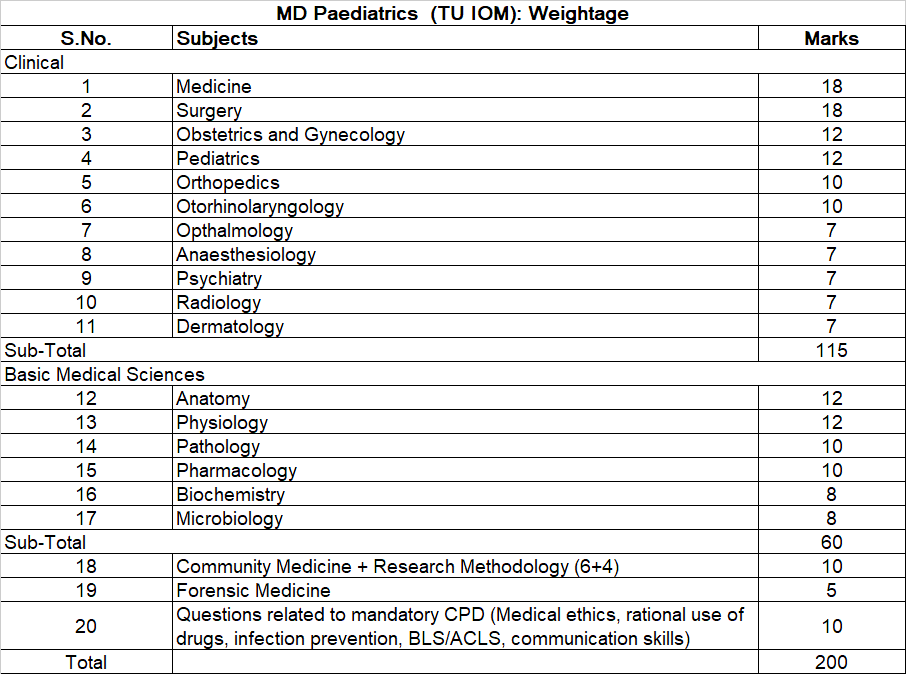
| Subjects | Marks |
|---|---|
| Medicine | 18 |
| Surgery | 18 |
| Obstetrics and Gynecology | 12 |
| Pediatrics | 12 |
| Orthopaedics | 10 |
| Otorhinolaryngology | 10 |
| Ophthalmology | 7 |
| Anaesthesiology | 7 |
| Psychiatry | 7 |
| Radiology | 7 |
| Dermatology | 7 |
| Clinical Sub-Total | 115 |
| Anatomy | 12 |
| Physiology | 12 |
| Pathology | 10 |
| Pharmacology | 10 |
| Biochemistry | 8 |
| Microbiology | 8 |
| Basic Medical Sciences Sub-Total | 60 |
| Community Medicine + Research | 10 |
| Forensic Medicine | 5 |
| CPD (Medical Ethics, BLS, ACLS) | 10 |
| Total | 200 |
Entrance Exam: Candidates must pass the Medical Education Commission (MEC) entrance examination with at least 50% marks.
Application Submission: Submit the following documents:
MBBS Certificate and Transcript
Internship Completion Certificate
NMC Registration Certificate (or respective Medical Council registration for international candidates)
Experience Certificate (minimum one year)
Citizenship or Passport for verification purposes.
Selection Process: Admission is based on merit from the entrance examination results.
Confirmation: Selected candidates must complete the fee payment to secure admission.
The MD in Paediatric program combines rigorous academic learning, extensive clinical rotations, and research work.
General Paediatrics
Neonatology
Pediatric Physiology and Anatomy
Clinical Diagnostics and Investigations
Emergency Paediatric Medicine
Research Methodology
Paediatric Intensive Care Unit (PICU)
Neonatal Intensive Care Unit (NICU)
Paediatric Cardiology
Paediatric Gastroenterology
Paediatric Pulmonology
Paediatric Nephrology
Paediatric Neurology
Paediatric Hematology
Clinical Teaching and Case Presentations
Advanced Neonatal Care
Community-Based Child Health Services
Paediatric Endocrinology
Rehabilitation of Disabled Children
Thesis Work and Research Submission
Leadership and Policy Implementation in Child Health
General Paediatrics
Neonatology
Paediatric Intensive Care
Paediatric Cardiology
Paediatric Gastroenterology
Paediatric Pulmonology
Paediatric Nephrology
Paediatric Hematology
Paediatric Endocrinology
Emergency Paediatric Medicine
Community-Based Child Health
Research Methodology and Thesis Work
The MD in Paediatric program aims to:
Train paediatric specialists capable of diagnosing and managing paediatric diseases and emergencies.
Develop leadership skills to provide secondary and tertiary care for child health.
Promote research initiatives to advance knowledge in paediatric care and related fields.
Equip graduates to plan and implement preventive and promotive child health services.
Prepare professionals to educate and train future healthcare workers in child health.
Strengthen the human resource pool for paediatric healthcare in Nepal.
Teaching methods include clinical rotations, case-based discussions, bedside teaching, weekly seminars, journal clubs, symposia, community-based outreach programs, and thesis-guided research work.
Graduates of the program will:
Diagnose and manage paediatric diseases and emergencies independently.
Provide leadership in planning and implementing child health programs.
Deliver tertiary-level care in paediatric intensive care units.
Conduct research and contribute to paediatric healthcare advancements.
Educate and train health workers in child health practices.
Collaborate with communities to promote child health awareness.
Utilize evidence-based medicine in paediatric healthcare delivery.
Implement ethical practices in clinical and research settings.
Paediatric specialists play a critical role in improving child health outcomes. Graduates can pursue academic roles, advanced specializations, or leadership positions in child health programs at national and international levels.
MD in Paediatric graduates can work as:
Paediatricians in hospitals and healthcare centers.
Consultants in tertiary care hospitals.
Faculty members in medical colleges and teaching hospitals.
Researchers in child health and paediatric care.
Public health specialists focusing on paediatric healthcare policies.
Child health program managers in governmental and non-governmental organizations.
Scholarships are available through the Medical Education Commission (MEC) and institutional grants based on merit and financial need.
The program fees are determined by the Medical Education Commission (MEC) guidelines.
Students participate in health camps, community-based child health programs, paediatric workshops, and conferences to enhance their clinical exposure and practical learning.
Graduates apply their skills to manage paediatric cases, conduct child health research, and contribute to improving healthcare delivery for children.
The program equips specialists to promote child health awareness, reduce preventable paediatric diseases, and contribute to sustainable healthcare initiatives.
Students develop clinical, diagnostic, research, leadership, and communication skills essential for paediatric care and child health management.
The program prepares paediatricians to meet global standards, allowing them to work in international healthcare settings.
Advanced paediatric ICUs and NICUs
Experienced and dedicated faculty
Research support and thesis guidance
Well-equipped laboratories and libraries
Community outreach and clinical rotations
The program offers a robust combination of comprehensive clinical training, immersive research opportunities, and advanced leadership skill development to address paediatric healthcare challenges effectively. Candidates gain essential exposure to managing critical paediatric cases through hands-on rotations in neonatal and paediatric intensive care units.
The curriculum emphasizes evidence-based medical practice, ensuring students acquire skills to diagnose, treat, and prevent various diseases in infants, children, and adolescents. Furthermore, the program fosters interdisciplinary collaboration, preparing graduates to take on leadership roles in hospitals, academic institutions, and child health initiatives at local and global levels. With intent on patient-centered care and innovation, the MD in Paediatric program empowers future paediatricians to meet the developing healthcare needs of children worldwide.
This program is ideal for candidates who are deeply committed to improving child health outcomes and are driven to develop specialized expertise in paediatrics. It is designed for individuals passionate about understanding the complexities of paediatric diseases, including neonatal and critical care. The program suits those who strongly desire to contribute to community health by addressing preventable diseases, implementing child health policies, and advancing medical research in paediatrics.
With a balanced focus on clinical practice, research, and leadership, this program is ideal for medical graduates seeking to make a meaningful impact on child healthcare systems both nationally and globally. Candidates should possess dedication, empathy, and a keen interest in lifelong learning to excel in this demanding yet rewarding field.
The future of this program is auspicious as paediatricians continue to be in high demand worldwide to address the complex and ever-growing challenges in child health. With increasing populations, emerging paediatric diseases, and heightened focus on child mortality and morbidity, there is a rising need for skilled specialists who can provide advanced care in diverse clinical settings.
Paediatricians are critical in managing neonatal and paediatric emergencies, implementing preventive healthcare measures, and driving public health initiatives. Furthermore, advancements in technology and research in paediatrics create new opportunities for innovation in diagnostics, treatments, and critical care. This program equips graduates to meet these demands effectively, whether in hospitals, academic roles, or global health organizations, shaping a brighter future for paediatric healthcare.
To excel in medical education, actively engage in clinical rounds, case discussions, and practical training. Utilize resources like journals and textbooks to stay updated on evidence-based practices—practice time management to balance academics, clinical work, and research. Collaborate with peers for group discussions and knowledge sharing. Seek feedback from mentors to refine your clinical and diagnostic skills. Participate in workshops and conferences to broaden your understanding of child health. Lastly, maintain a positive attitude, focus on lifelong learning, and apply theoretical knowledge to real-world clinical cases for effective patient care.
The MD in Paediatrics program at Chitwan Medical College offers a well-rounded education. It combines clinical expertise, research opportunities, and community engagement to produce paediatric specialists ready to address global child health challenges.