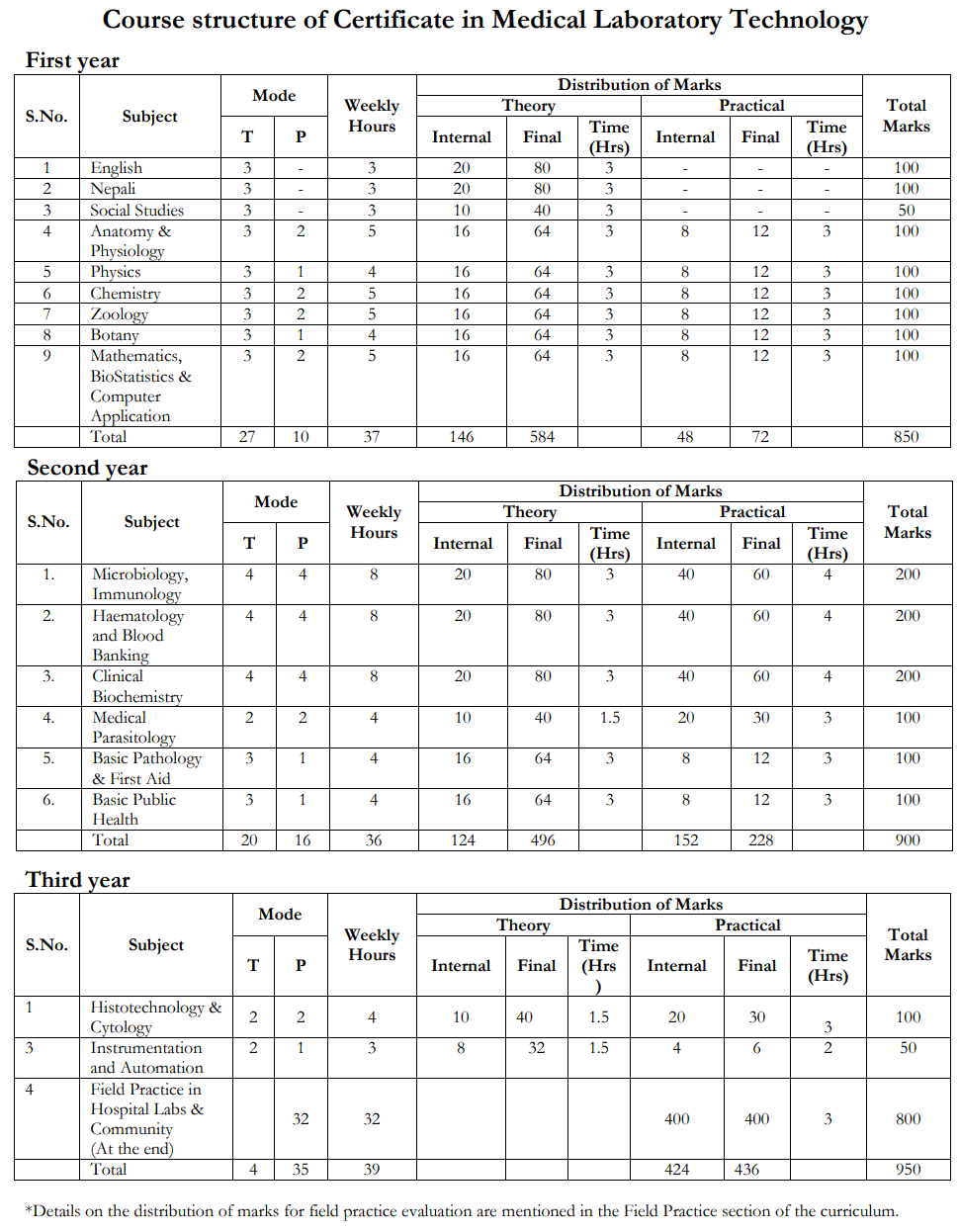
Chitwan Medical College (CMC), Chitwan, offers a Certificate in Medical Laboratory Technology (CMLT), which is a three-year vocational program affiliated with the Council for Technical Education and Vocational Training (CTEVT). This program aims to produce skilled professionals capable of performing diagnostic laboratory tests critical for medical care.
Graduates are eligible to work in laboratories across Nepal and internationally after passing the licensing exam conducted by the Nepal Health Professionals Council. This program emphasizes theoretical knowledge and practical application, preparing students for real-world challenges in medical laboratory settings.
Duration: Three academic years
Structure:
Year 1: Focus on foundational subjects and basic sciences.
Year 2: Basic laboratory subjects with simultaneous theory and practical sessions.
Year 3: Comprehensive application of skills through practical settings in hospitals and laboratories.
Secured at least grade C in Compulsory Mathematics, Compulsory English, and Compulsory Science in the School Leaving Certificate (SLC / SEE) examination with an average GPA of 2 or higher.
For Pre-Diploma graduates in Lab Technology, a first-division pass is required.
Must have passed the entrance examination administered by CTEVT.
Submit the following documents:
SLC pass certificate
Character certificate
Citizenship certificate
Physical fitness certificate
Pass the CTEVT entrance examination.
Admission is merit-based and follows the CTEVT policy for student quota.
The CMLT curriculum includes theoretical learning with practical exposure:
Year 1: Basic sciences such as Anatomy, Physiology, Biochemistry, and Microbiology.
Year 2: Laboratory techniques covering Hematology, Histopathology, and Cytology.
Year 3: Advanced laboratory applications in clinical settings.
Anatomy
Physiology
Biochemistry
Microbiology
Hematology
Histopathology
Cytopathology
Serology
Medical Ethics
Laboratory Management
To empower students with the skills to perform routine and special laboratory investigations.
Develop competencies in interpreting test results and maintaining quality control.
Enable students to set up clinical laboratories in primary health centers and district-level facilities.
Prepare students for middle-level laboratory management roles.
The teaching methodology combines classroom instruction, hands-on laboratory work, and field training. Students engage in lectures, interactive discussions, demonstrations, and supervised practical sessions. Additionally, clinical exposure in hospital laboratories helps reinforce theoretical concepts.
Graduates of this program will be able to:
Perform laboratory investigations independently.
Prepare and standardize laboratory reagents.
Maintain quality control in diagnostic procedures.
Establish and manage clinical laboratories.
Assisted in research activities and interpreted laboratory findings.
Graduates can pursue:
Advanced education, such as a Bachelor of Medical Laboratory Technology (BMLT).
Employment in public and private healthcare sectors.
Research opportunities in clinical and diagnostic laboratories.
Entrepreneurship by establishing diagnostic centers.
Positions as Medical Laboratory Technicians in hospitals, clinics, and diagnostic centers.
Opportunities in research institutions and public health organizations.
Employment in pathology, microbiology, and biochemistry departments.
Roles in blood banks, histology, and cytology laboratories.
CTEVT offers scholarships to deserving candidates, including those from marginalized communities. Merit-based scholarships are available for students with outstanding academic performance.
CTEVT guidelines determine fees and include tuition, laboratory fees, and examination charges. Financial aid options are available.
Students participate in workshops, seminars, and health camps to enhance their practical knowledge and community engagement skills. Co-curricular activities include laboratory demonstrations, presentations, and collaborative projects.
The program emphasizes real-world application through hospital-based training, where students gain hands-on experience handling clinical specimens and operating advanced laboratory equipment.
Graduates contribute to public health by ensuring accurate diagnostic testing and promoting disease prevention. Their work supports sustainable healthcare systems and improves community health outcomes.
The program hones analytical, technical, and managerial skills. Students develop expertise in laboratory techniques, problem-solving, and teamwork, preparing them for diverse healthcare roles.
The curriculum aligns with international standards, enabling graduates to compete globally. The program fosters an understanding of global health challenges and solutions.
CMC provides state-of-the-art laboratory facilities, a well-stocked library, and experienced faculty. Students also benefit from career counseling and placement support.
This program stands out for its comprehensive curriculum, practical training, and focus on quality diagnostics. It prepares students for diverse roles in healthcare and ensures job readiness.
If you are interested in science and aspire to contribute to healthcare through diagnostics, this program offers the perfect blend of theoretical knowledge and practical skills.
With medical technology emerging, the demand for skilled laboratory technicians is rising. Graduates will have opportunities in emerging fields such as molecular diagnostics and personalized medicine.
To excel in this field, focus on consistent study habits, hands-on practice, and participation in workshops and seminars. Stay regularly updated on advancements in medical technology and seek guidance from mentors.
The Certificate in Medical Laboratory Technology (CMLT) program at CMC provides a solid foundation for a career in healthcare diagnostics. Its integration of academic rigor and practical training ensures that graduates are well-equipped to meet the demands of the healthcare sector. Whether you aim to advance your education or start a rewarding career, this program is a gateway to numerous opportunities.