Requesting scholarship
Sir I am sujal poudel
I am here to study diploma in electrical engineering




Nepal Polytechnic Institute (NPI) is a technical education institute based in Bharatpur, Chitwan. Established in 2052 B.S., it operates under a public limited company model and provides university-level, diploma, pre-diploma, certificate, and technical training programs.
The institute was initiated by a group of academicians, bureaucrats, and entrepreneurs. It was registered under the Nepal Company Act 2021 B.S. and the Nepal Industrial Act 2049 B.S. Its academic areas cover agriculture, veterinary science, engineering, nursing, medical sciences, and vocational education.
| Field | Details |
|---|---|
| Institution name | Nepal Polytechnic Institute |
| Abbreviation | NPI |
| Established | 2052 B.S. |
| Location | Bharatpur, Chitwan |
| Institution type | Technical education institute operating under a public limited company |
| University affiliation | Purbanchal University |
| Technical education affiliation | Council for Technical Education and Vocational Training |
| Academic levels | Bachelor, Diploma, Certificate, Pre-Diploma, and short-term training |
| Academic areas | Agriculture, Veterinary Science, Engineering, Nursing, Health Sciences, and Technical Education |
NPI has been affiliated with Purbanchal University since 2066 B.S. for bachelor-level programs in agriculture, engineering, medical sciences, and veterinary science.
The institute has also been affiliated with the Council for Technical Education and Vocational Training since 2052 B.S. for diploma, certificate, pre-diploma, and technical and vocational programs.
This combination allows NPI to run university degree programs alongside technical courses with a stronger occupational and practical orientation.
NPI was established to prepare technical and vocational human resources at different academic levels. Its stated mission focuses on improving learners’ living standards through technical education and preparing graduates for work in Nepal and abroad.
The institute also aims to provide consultancy and technical services in the disciplines it teaches. Its academic objectives are centred on three areas:
Preparing skilled professionals in agriculture, veterinary science, engineering, health, and medical sciences
Supporting research workshops, training, seminars, consultancy, and collaborative academic activities
Conducting short-term training and skill-development programs
Its vision connects wider access to technical education with individual development and participation in community and national development.
NPI has a broad academic portfolio, ranging from bachelor’s degrees to occupational pre-diploma courses. The programs are organised mainly under agriculture and veterinary science, engineering, nursing and health sciences, and technical education.
The bachelor-level courses affiliated with Purbanchal University include:
Bachelor of Veterinary Science and Animal Husbandry (BVSc & AH)
Bachelor of Computer Engineering
PBNS is also included among the institute’s Purbanchal University programs.
The diploma and certificate-level portfolio covers engineering, agriculture, animal science, laboratory technology, and general medicine:
The engineering diploma courses address civil construction, computer systems, electrical systems, electronics, circuit-related work, and technical maintenance. Agriculture programs cover plant production, crop science, animal science, livestock management, and related practical work.
NPI also runs pre-diploma courses designed around field-level technical work:
These courses focus on basic technical knowledge and practical competencies in crop production, animal care, livestock production, land measurement, mapping, and surveying.
The stated program and quota record includes the following approved seat numbers:
| Program | Approved seats |
|---|---|
| B.Sc. (Hons.) Agriculture | 96 |
| B.V.Sc. & A.H. | 48 |
| BE Civil | 96 |
| BE Electrical | 48 |
| BE Computer | 48 |
PBNS is recorded among the institute’s Purbanchal University programs without a corresponding seat figure in the same entry.
The BSc (Hons.) Agriculture program follows a four-year semester system under the Faculty of Science and Technology of Purbanchal University. English is used for instruction, tests, and examinations.
The curriculum combines classroom courses, laboratory practicals, project work, field exposure, electives, research, and an internship. Project work begins from the third semester, alongside laboratory components.
Early semesters include subjects such as plant physiology, microbiology, soil science, crop science, animal science, rural sociology, economics, biochemistry, horticulture, farm power and machinery, and agricultural meteorology.
As students progress, the course covers plant genetics, plant pathology, entomology, irrigation and water management, crop production, plant propagation, animal nutrition, plant breeding, crop disease management, biotechnology, agroforestry, aquaculture, post-harvest technology, seed technology, agricultural marketing, and agricultural policy.
The seventh semester includes research-related core courses and an elective area. Available elective fields include:
Sustainable Agriculture
Horticulture
Plant Breeding
Plant Protection
Animal Science
Soil Science
Agricultural Economics and Business Management
Development Studies
The final semester includes a field-based internship and thesis work. Internship placements may involve agro-based industries, research farms, private farms, and organisations working in different agro-ecological settings.
For admission, the curriculum specifies at least 45 percent, or second division, in +2 Science or an equivalent qualification. Enrolment is based on performance in the entrance examination conducted by Purbanchal University.
NPI offers bachelor’s programs in civil, electrical, and computer engineering under the Faculty of Engineering of Purbanchal University. The available course structures are effective from the 2021 batch and organise study through credit hours, lectures, tutorials, practical sessions, internal evaluation, and final examinations.
The civil engineering curriculum begins with mathematics, chemistry, applied mechanics, civil engineering materials, basic electrical engineering, engineering drawing, and workshop technology.
Later study moves into areas such as building technology, strength of materials, fluid mechanics, surveying, engineering geology, hydraulics, probability and statistics, and computer programming. This structure connects scientific foundations with drawing, measurement, materials, mechanics, construction, and field-related technical work.
The computer engineering course begins with mathematics, physics, technical communication, computer programming, computing technology, engineering drawing, and workshop practice.
The next stages introduce object-oriented programming with C++, digital logic, basic electrical engineering, applied mechanics, data structures and algorithms, object-oriented analysis and design, computer graphics, electronic devices and circuits, database management systems, Python programming, discrete structures, and microprocessors.
Practical and project components are included alongside theory and internal assessment.
The electrical engineering curriculum includes mathematics, physics, technical communication, computer programming, computing technology, engineering drawing, and workshop technology in its foundation stage.
Its discipline-focused courses include basic electrical engineering, digital electronics, network analysis, electronic circuits, electrical engineering materials, microprocessors, electromagnetics, numerical methods, and electrical machines.
The course structure assigns separate lecture, tutorial, and practical hours where applicable and uses both internal and final assessment.
Practical work is a central part of the institute’s academic setting. NPI maintains discipline-specific spaces and field facilities that support agriculture, veterinary science, engineering, and health education.
Its facilities include:
Livestock farm
Agricultural fields and fieldwork areas
Plant clinic
Veterinary teaching hospital
NPI-Narayani Samudayik Hospital
Engineering workshops
Subject-specific laboratories
Classrooms
Library
Internet facilities
Administrative building
Playground
Standby power generator
NPI-Narayani Samudayik Hospital is a 200-bed general hospital located at Bharatpur-10, Chitwan. It serves as a practical setting connected with the institute’s health and medical education activities.
The plant clinic, livestock farm, veterinary teaching hospital, and agricultural fields support observation and practice in crop health, animal care, livestock production, and agricultural operations. Engineering workshops and laboratories provide space for drawing, measurement, computing, electrical work, materials-related exercises, and technical practicals.
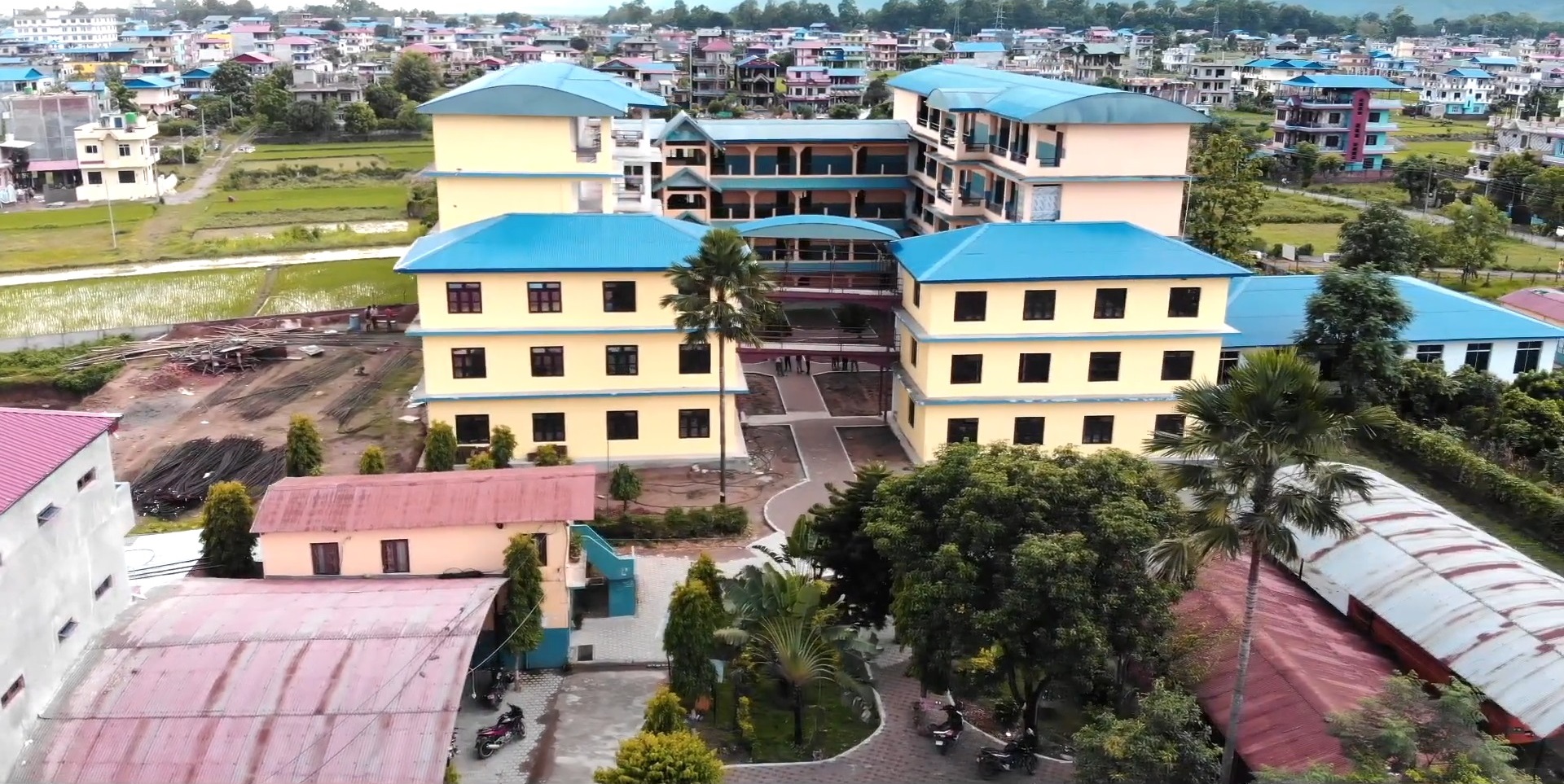
NPI operates from its own land and buildings in Bharatpur. Its academic infrastructure is distributed across multiple blocks and buildings, with separate spaces assigned to different faculties and disciplines.
The physical setting includes classrooms, practical fields, laboratories, workshops, a library, internet access, and administrative areas. The standby generator supports continuity of electricity during power interruptions.
Field visits are also used as part of course-related learning. These visits connect classroom topics with farms, worksites, laboratories, hospitals, and other settings relevant to the students’ disciplines.
The library serves students and teaching staff across the institute’s academic areas. Its collection includes books, journals, research papers, and discipline-related reading materials. Internet and electronic resources are also available within the library setting.
Laboratories are organised according to the requirements of different faculties. Their role is especially important in medical laboratory technology, agriculture, veterinary science, computer engineering, electrical engineering, electronics, and civil engineering.
Classrooms are supported by teaching aids, while workshops and practical areas allow students to work with tools, technical drawings, equipment, samples, measurements, and field materials related to their courses.
NPI identifies several scholarship categories for eligible students:
Academic excellence scholarship
Merit-based scholarship
Need-based scholarship
Ethnic minority scholarship
Gender-based scholarship
The categories address academic performance, demonstrated talent, financial circumstances, ethnic minority status, and access for female students facing financial barriers.
The institute’s structure brings degree education and technical training into the same institutional setting. Agriculture and veterinary students have access to farms, fields, a plant clinic, and veterinary services. Engineering students use laboratories, workshops, drawing courses, computing courses, and practical assessments. Health science students study within an environment connected with a general hospital and laboratory facilities.
This arrangement gives NPI a multidisciplinary academic character. Its programs range from field-level pre-diploma training to bachelor’s degrees with research, projects, practical examinations, internships, and thesis requirements.
Sir I am sujal poudel
I am here to study diploma in electrical engineering