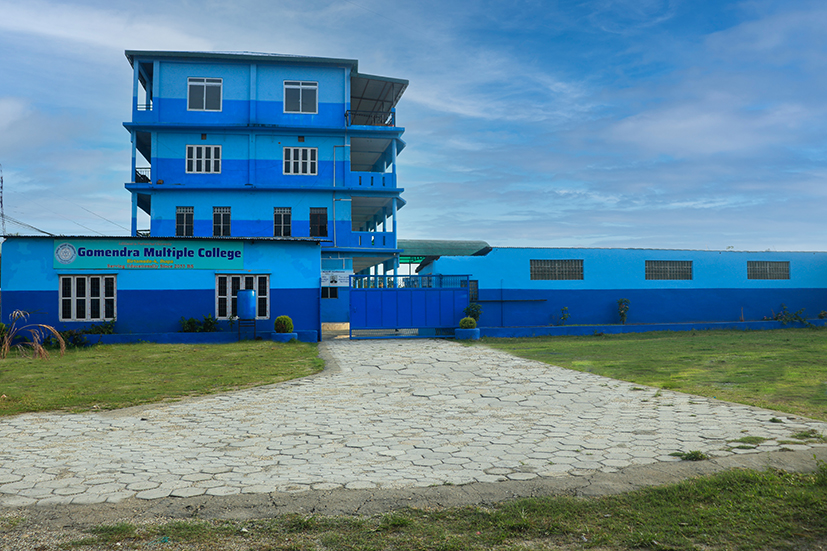
The Bachelor of Business Administration (BBA) at Gomendra Multiple College is a four-year, full-time undergraduate program affiliated with Purbanchal University. The course runs across eight semesters and carries 120 credit hours, including foundation subjects, core management courses, capstone study, specialization courses, and an internship.
Gomendra Multiple College offers 96 seats in the BBA program at its campus in Birtamode, Jhapa. English is the medium of instruction and examination. The curriculum brings together accounting, economics, finance, marketing, communication, human resource management, business law, information systems, entrepreneurship, research, and strategic management.
| Field | Details |
|---|---|
| Course | Bachelor of Business Administration (BBA) |
| College | Gomendra Multiple College |
| Location | Birtamode, Jhapa |
| Affiliation | Purbanchal University |
| Faculty | Faculty of Management |
| Level | Undergraduate |
| Duration | Four academic years |
| Academic structure | Eight semesters |
| Total credit hours | 120 |
| Course components | 40, including internship |
| Seat capacity | 96 |
| Medium | English |
| Minimum attendance | 80 percent |
Purbanchal University’s BBA is structured as a professional management program for business and non-business organizations. It develops a base in management education while giving students regular exposure to accounting, economics, communication, quantitative analysis, finance, marketing, organizational behaviour, information systems, and entrepreneurship.
The curriculum also includes research and report writing, specialization subjects, an organizational internship, and capstone courses. These components require students to connect management concepts with cases, presentations, written analysis, organizational study, and practical assignments.
The program aims to develop managerial and entrepreneurial abilities, effective communication, analytical thinking, and socially responsible professional conduct.
Applicants must have:
Completed twelve years of schooling or an equivalent qualification from a university, board, or institution recognized by Purbanchal University
Secured at least 40 percent in 10+2, PCL, or an equivalent program
Passed the entrance examination conducted by Purbanchal University
Applicants holding foreign academic qualifications must submit an equivalence certificate and subject-wise grading, CGPA, or total percentage records from the concerned authority.
Admission involves the entrance and academic procedures prescribed by Purbanchal University and Gomendra Multiple College.
Applicants must meet the minimum academic requirement, appear in the university entrance examination, and complete the required college formalities. The college administration manages document submission and other institutional admission procedures.
The 120-credit curriculum contains five main academic components.
| Curriculum area | Credit hours |
|---|---|
| Foundation courses | 18 |
| Core courses | 76 |
| Capstone courses | 6 |
| Specialization courses | 15 |
| Internship | 5 |
Foundation courses develop competence in communication, mathematics, statistics, and economics. Core courses cover the principal functional areas of management, while capstone subjects draw together knowledge from earlier semesters.
Specialization courses allow students to study one management area in greater depth. The internship places students in an organization for practical observation, analysis, report preparation, and evaluation.
| Semester | Courses | Credits |
|---|---|---|
| First | Business Mathematics; English; Business Economics; Financial Accounting-I; Principles of Management | 15 |
| Second | Business Communications; Macro Economic Analysis and Policy; Business Statistics; Principles of Marketing; Financial Accounting-II | 15 |
| Third | Cost and Management Accounting; Business Finance; Database Management System; Marketing Management; Business Environment of Nepal | 15 |
| Fourth | Business Law; Financial Management; Taxation and Auditing; Human Resource Management; Quantitative Techniques for Business | 15 |
| Fifth | Research Methodology and Report Writing; Production and Operations Management; Banking and Insurance; Project Management; Organizational Behavior | 15 |
| Sixth | Management Information System; Public Finance; Total Quality Management; Tourism Management; Entrepreneurship Development | 15 |
| Seventh | Supply Chain Management; E-commerce; Internship; Specialization I; Specialization II | 15 |
| Eighth | International Business; Strategic Management; Specialization III; Specialization IV; Specialization V | 15 |
The sequence begins with business foundations and gradually moves toward functional management, research, operations, entrepreneurship, technology, specialization, and strategic study.
The foundation component contains six courses:
Business Mathematics
English
Business Economics
Business Communications
Macro Economic Analysis and Policy
Business Statistics
These subjects support written and oral communication, quantitative reasoning, economic analysis, and the interpretation of business information.
The core component covers accounting, finance, marketing, human resource management, taxation, auditing, project management, organizational behaviour, operations, banking, insurance, information systems, public finance, quality management, tourism, and entrepreneurship.
Database Management System and Management Information System introduce the use of information and technology in business operations and managerial decision-making. Research Methodology and Report Writing develops the academic basis required for organizational study and internship reporting.
Students select one specialization and complete five subjects from the available courses in that area. Two specialization courses are studied in the seventh semester, followed by three in the eighth semester.
The available areas are:
Marketing
Finance
Human Resource Management
Accounting
International Business
Marketing specialization courses cover consumer behaviour, advertising and sales promotion, sales and distribution management, marketing of services, brand management, and retail management.
Finance options include capital structures, working capital management, financial institutions and markets, financial derivatives and risk management, capital investment and financing decisions, and security analysis and portfolio management.
The Human Resource Management area includes designing and managing HR systems, training and development, organization development, leadership and team building, industrial relations, and conflict management and negotiation.
Accounting specialization subjects include advanced cost accounting, advanced management accounting, taxation practices in Nepal, auditing, budgeting, and company accounts.
International Business courses cover international marketing, international finance, cross-cultural negotiations, export promotion management, foreign exchange management, and a foreign language other than English from the UN languages.
International Business and Strategic Management are taught in the eighth semester as capstone courses.
International Business examines management and commercial activity across national markets. Strategic Management brings together organizational analysis, business direction, competitive considerations, and long-term managerial decisions.
These subjects appear near the end of the program because they draw on knowledge gained from finance, marketing, economics, operations, human resources, and the business environment.
The internship carries five credit hours and is completed after the seventh semester. Students spend eight weeks in an organization for practical exposure and business orientation.
During the placement, students study an organization or a selected department, observe assigned work, examine management-related issues, and connect practical experience with concepts studied in class. Each student prepares an internship report and presents the work in a seminar organized by the college.
The internship is evaluated out of 100 marks:
Organization supervisor’s evaluation: 20 marks
Written internship report: 40 marks
Viva-voce examination: 40 marks
The written report is assessed for its format, content, writing, and analytical work. The viva evaluates presentation, understanding of the organization and assigned tasks, communication, and responses to questions.
Theory courses use internal assessment and a semester-end examination.
| Assessment component | Marks |
|---|---|
| Internal assessment | 30 |
| Semester-end examination | 70 |
| Total | 100 |
Students must secure at least 12 out of 30 in internal assessment. A student who does not pass the internal component is not permitted to sit for the semester-end examination in that course.
The internal assessment includes class tests or a term paper, attendance, group discussion or class participation, and a presentation.
The university conducts the semester-end examination at the end of each semester. The written examination carries 70 marks, has a pass mark of 28, and runs for three hours. Questions assess reasoning, subject understanding, application, interpretation, and problem-solving.
Students must maintain at least 80 percent attendance in each course to qualify for the semester-end examination.
Attendance applies to lectures, tests, tutorials, and other required academic sessions. A shortage in one course may prevent a student from appearing in the examinations for that semester, subject to the university provisions governing exceptional absences.
The BBA curriculum develops knowledge across several connected areas:
Financial and management accounting
Business economics and public finance
Marketing and consumer-related study
Business finance and financial management
Human resource management
Business law, taxation, and auditing
Operations and project management
Banking and insurance
Entrepreneurship
Organizational behaviour
Business statistics and quantitative techniques
Information systems and databases
Research and report writing
Supply chain management
E-commerce
International business
Strategic management
The subjects require a mix of numerical work, written assignments, case analysis, presentations, classroom participation, research, and organizational study.
Gomendra Multiple College is a privately owned institution established in 1996 AD in Birtamode, Jhapa. It is affiliated with Purbanchal University and offers management and technology-related programs.
The college supports regular classroom study with research, projects, workshops, presentations, guest lectures, and field-based activities. Its BBA intake is 96 students.
Scholarship opportunities are available for academically meritorious students, economically disadvantaged students, and students from marginalized communities. The applicable criteria and procedures are managed by the college administration.
The BBA program runs for four academic years and is divided into eight semesters.
The BBA at Gomendra Multiple College is affiliated with Purbanchal University.
The curriculum carries 120 credit hours across 40 course components, including an internship.
Applicants must have completed twelve years of schooling or an equivalent qualification and secured at least 40 percent in 10+2, PCL, or an equivalent program.
Yes. Applicants must pass the entrance examination conducted by Purbanchal University.
Gomendra Multiple College has an intake capacity of 96 students for the BBA program.
English is the medium of instruction and examination.
Students must maintain at least 80 percent attendance in each course to qualify for the semester-end examination.
Yes. Students complete an eight-week, five-credit internship after the seventh semester.
Students can specialize in Marketing, Finance, Human Resource Management, Accounting, or International Business.