



The Bachelor of Technology in Artificial Intelligence at Gomendra Multiple College is a four-year undergraduate program affiliated with Purbanchal University. Conducted through the Faculty of Science and Technology, the course combines programming, mathematics, computer systems, data science, and specialised artificial intelligence subjects.
Students move through eight semesters that include laboratory work, semester projects, an internship, electives, and a professional project. The program is taught and examined in English. Gomendra Multiple College offers 48 seats for the course at its Birtamode, Jhapa location.
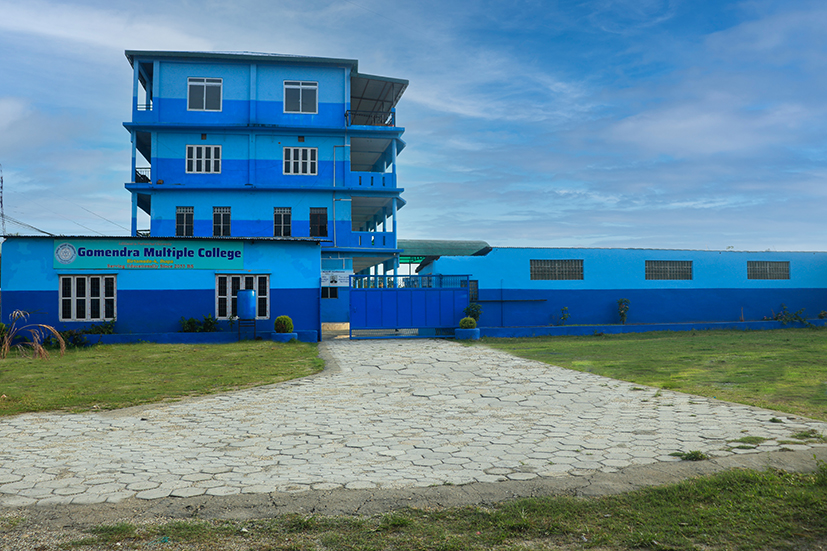
| Field | Details |
|---|---|
| Course | Bachelor of Technology in Artificial Intelligence |
| College | Gomendra Multiple College |
| Location | Birtamode, Jhapa, Koshi Province |
| Affiliation | Purbanchal University |
| Faculty | Faculty of Science and Technology |
| Level | Undergraduate |
| Duration | Four years |
| Academic structure | Eight semesters |
| Medium | English |
| Seat capacity | 48 |
| Minimum attendance | 80% |
The course is intended for students from a science background who are interested in programming, mathematics, computer systems, data analysis, and artificial intelligence.
The curriculum requires students to work with both mathematical and computing subjects. Regular laboratory sessions and project assignments also make the program suitable for learners prepared to spend time on programming practice, technical reports, group work, research, and presentations.
Applicants must have completed twelve years of schooling in the science stream and meet either of the following academic requirements:
A minimum D+ grade in every subject of 10+2 with a CGPA of at least 2.0
At least second division, or 45%, in 10+2, PCL, or an equivalent qualification in a science discipline
Students awaiting a Grade 12 supplementary examination may apply, but they must submit all required documents during admission. Those who have appeared in the final examination and are waiting for results or certificates may sit for the entrance examination under the same document-submission condition.
Applicants holding foreign qualifications must submit an equivalence certificate and a record showing subject-wise grades, CGPA, or total percentage from the concerned authority.
Admission requires applicants to pass the entrance examination conducted by Purbanchal University.
The entrance requirement applies in addition to the academic eligibility criteria. Applicants must complete the university and college admission formalities before enrolment.
The first year builds a foundation in programming, digital systems, mathematics, communication, ethics, and introductory artificial intelligence. Project work begins in the second semester.
| Semester | Main subjects | Credits |
|---|---|---|
| Year I, Semester I | Introduction to Programming, Digital Logic, Calculus, Introduction to Artificial Intelligence, Technical Report Writing and Presentation, Society and Professional Ethics | 18 |
| Year I, Semester II | Object Oriented Programming, Artificial Intelligence and Intelligent Systems, Microprocessor and Assembly Language, Probability and Statistics, Linear Algebra, Project I | 17 |
The second year moves into computer systems, databases, algorithms, networking, numerical methods, programming tools, and data science.
| Semester | Main subjects | Credits |
|---|---|---|
| Year II, Semester I | Database Management System, Data Structure and Algorithm, Computer Organization, Operating System, Differential Equations, Project II | 17 |
| Year II, Semester II | Numerical Methods, Computer Networks, Design and Analysis of Algorithms, Programming for AI, Introduction to Data Science, Project III | 17 |
The third year concentrates on specialised artificial intelligence and software subjects, supported by research and project work.
| Semester | Main subjects | Credits |
|---|---|---|
| Year III, Semester I | Machine Learning, Optimization Techniques, Embedded Systems, Pattern Recognition and Image Processing, Data Warehousing and Mining, Project IV | 17 |
| Year III, Semester II | Object Oriented Software Engineering, Computer Vision, Deep Learning, Speech and Natural Language Processing, Research Methods, Project V | 17 |
The final year includes an internship, advanced subjects, electives, and a professional project.
| Semester | Main subjects | Credits |
|---|---|---|
| Year IV, Semester I | Internship, Reinforcement Learning, Cloud Computing, Project VI | 11 |
| Year IV, Semester II | IoT for Smart City, Elective I, Elective II, Professional Project | 12 |
The final semester provides elective choices across several academic areas. The available options include:
Image and Video Processing
Surveillance Video Analytics
People Detection and Biometric Recognition
Introduction to Statistical Learning
Optimization Methods in Machine Learning or Convex Optimization
Kernel Methods
Bayesian Data Analysis
Smart Product Development
Predictive Analysis and IoT
Modeling and Simulation
Pervasive Computing
Fundamentals of Big Data Analytics
Data Analysis and Visualization
Business Intelligence
Social Media Analytics
Project work forms a continuing part of the course. Students begin with Project I and progress through six semester projects before completing a professional project in the final semester.
These assignments involve planning, research, technical development, implementation, report writing, and presentation. Project groups may include up to three students working under the guidance of an adviser.
The seventh semester also includes an internship with practical and fieldwork components. This gives students a structured opportunity to connect their academic study with a working or project-based setting.
Students must maintain at least 80% attendance in lectures, tests, and tutorial classes to qualify for the final examination of a subject.
Assessment continues throughout each semester through class participation, assignments, laboratory work, tests, and quizzes. The marking structure depends on the course type:
Combined theory and laboratory courses: 20% internal, 20% practical, and 60% final examination
Pure theory courses: 20% internal and 80% final examination
Pure laboratory or practical courses: 60% continuous internal evaluation and 40% final viva
Grades are calculated through the credit-hour and grade-point system. Students must maintain a cumulative grade point average of at least 2.0 throughout the program. Falling below this requirement may result in withdrawal from the course under the university regulations.
After completing the program, graduates may continue into postgraduate study in areas including:
Master of Technology in Artificial Intelligence
Master of Science in Artificial Intelligence
Master of Computer Application
Master of Information Technology
Master of Science in Computer Science
Master of Science in Computer Information Systems
Master of Business Administration
Admission to a postgraduate program remains subject to the requirements of the university or institution offering it.
The course runs for four academic years and is divided into eight semesters.
The program at Gomendra Multiple College is affiliated with Purbanchal University and conducted under its Faculty of Science and Technology.
Gomendra Multiple College offers 48 seats for the Bachelor of Technology in Artificial Intelligence.
Yes. Applicants must have completed twelve years of schooling in the science stream and satisfy the prescribed grade or percentage requirement.
Yes. Applicants must pass the entrance examination conducted by Purbanchal University.
Students must maintain at least 80% attendance to qualify for the final examination of a subject.
Yes. The curriculum includes laboratory components, six semester projects, an internship, electives, and a professional project.
English is the medium of instruction and examination throughout the program.






