



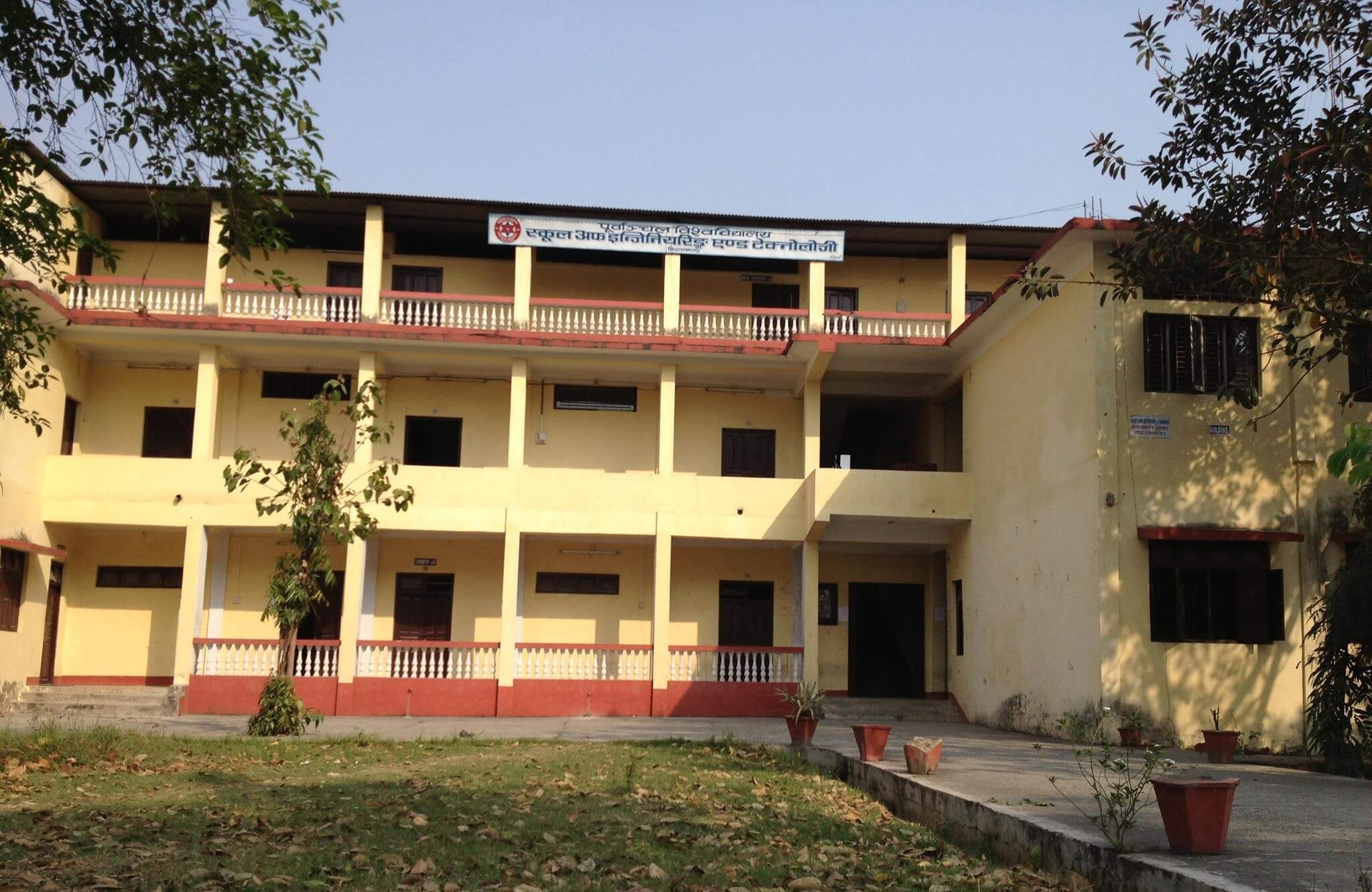
The Bachelor of Technology in Artificial Intelligence is a four-year undergraduate program offered by Purbanchal University School of Science and Technology (PUSAT) in Biratnagar, Morang. The program operates under the Faculty of Science and Technology of Purbanchal University.
The eight-semester curriculum begins with programming, mathematics, digital logic and introductory artificial intelligence before moving into databases, algorithms, data science, machine learning, image processing, natural language processing, cloud computing and other specialized subjects. Project work starts in the second semester and continues throughout the remaining semesters, alongside an internship and a professional project in the final year.
| Field | Details |
|---|---|
| Course: | Bachelor of Technology in Artificial Intelligence |
| Level: | Bachelor's |
| Institution: | Purbanchal University School of Science and Technology |
| Location: | Biratnagar, Morang |
| University: | Purbanchal University |
| Faculty: | Faculty of Science and Technology |
| Duration: | 4 academic years |
| Structure: | 8 semesters |
| Seats: | 48 |
| Medium: | English |
| Attendance: | Minimum 80% |
| Admission: | Purbanchal University entrance examination |
The minimum eligibility criteria effective from the 2082-2083 intake provide several routes for applicants.
Applicants may qualify after Grade XII with Physics, Chemistry and English together with Biology, Mathematics or Computer Science, with a GPA of 2.00 or at least 45 percent marks.
The criteria also include:
+2 Science, I.Sc. or PCL with Physics, Chemistry and English together with Biology, Mathematics or Computer Science, with a GPA of 2.00 or 45 percent marks.
Diploma in Engineering or equivalent with the specified subjects and a GPA of 2.00 or 45 percent marks.
A Level with Physics, Chemistry and English together with Biology, Mathematics or Computer Science, with a GPA of 2.00 or 45 percent marks.
Applicants must also pass the entrance examination conducted by Purbanchal University.
The program extends over eight semesters, covering four academic years. English is the medium of instruction and examination.
Students must maintain at least 80 percent attendance in lectures, tests and tutorial classes to qualify for the final examination of a subject.
Academic performance is evaluated through continuous assessment and end-semester examinations. For courses combining theory and laboratory or practical work, the distribution is 20 percent internal assessment, 20 percent practical and 60 percent final examination. Pure theory courses use 20 percent internal assessment and 80 percent final examination, while laboratory courses use continuous internal evaluation and a final viva.
The first semester introduces the mathematical, technical and communication areas needed for later study. Subjects are:
Introduction to Programming
Digital Logic
Calculus
Introduction to Artificial Intelligence
Technical Report Writing and Presentation
Society and Professional Ethics
The second semester includes:
Object Oriented Programming
Artificial Intelligence and Intelligent Systems
Microprocessor and Assembly Language
Probability and Statistics
Linear Algebra
Project I
Semester III moves into core computing systems and software subjects:
Database Management System
Data Structure and Algorithm
Computer Organization
Operating System
Differential Equations
Project II
Semester IV includes:
Numerical Methods
Computer Networks
Design and Analysis of Algorithms
Programming for AI (Tools, Techniques and Libraries)
Introduction to Data Science
Project III
The third year brings more specialized artificial intelligence subjects.
Semester V includes Machine Learning, Optimization Techniques, Embedded Systems, Pattern Recognition and Image Processing, Data Warehousing and Mining, and Project IV.
Semester VI includes Object Oriented Software Engineering, Computer Vision, Deep Learning, Speech and Natural Language Processing, Research Methods, and Project V.
Semester VII includes:
Internship
Reinforcement Learning
Cloud Computing
Project VI
The eighth semester includes IoT for Smart City, two elective courses and a Professional Project.
Project work begins in the second semester and continues during the remaining semesters. Students apply concepts from their courses through project planning, research, teamwork, implementation, assessment, report writing and presentation.
Projects are undertaken in groups of up to three students under the guidance of a group advisor.
The seventh semester also includes an internship carrying three credits, with practical and field work. The final semester concludes with a Professional Project.
The final-semester curriculum allows students to select two electives. The available areas include:
Computer Vision: Image and Video Processing, Surveillance Video Analytics, People Detection and Bio-metric Recognition
Mathematics: Introduction to Statistical Learning, Optimization Methods in Machine Learning/Convex Optimization, Kernel Methods, Bayesian Data Analysis
Computing/IoT: Smart Product Development, Predictive Analysis and IoT, Modeling & Simulation, Pervasive Computing
Data Science: Fundamentals of Big Data Analytics, Data Analysis and Visualization, Business Intelligence, Social Media Analytics
The program uses letter grades A+, A, B+, B, C, D, F and I. A+ represents a grade value of 4.00, while F carries 0.00.
The regulations require students to maintain a cumulative grade point average of 2.0 or above during the study period.
After completing the program, graduates may pursue postgraduate study in areas identified in the academic regulations, including:
Master of Technology in Artificial Intelligence
Master of Science in Artificial Intelligence
Master of Computer Application
Master of Information Technology
Master of Science in Computer Science
Master of Science in Computer Information Systems
Master of Business Administration
PUSAT offers 48 seats in the Bachelor of Technology in Artificial Intelligence program. The institution's academic setting includes computer laboratories, library resources, broadband internet, science laboratories and project space.
These facilities are relevant to a curriculum containing programming laboratories, project courses, an internship and practical components across several technical subjects.
The program runs for four academic years and is divided into eight semesters.
The program has 48 seats.
The 2082-2083 criteria require Physics, Chemistry and English together with Biology, Mathematics or Computer Science under the applicable Grade XII, +2 Science, I.Sc., PCL, diploma or A Level route.
Yes. Applicants must pass the entrance examination conducted by Purbanchal University.
Yes. Project work begins in the second semester and continues through the later semesters. The final year also includes an internship and Professional Project.
Yes. Machine Learning is included in Semester V, while later study includes Reinforcement Learning and other specialized artificial intelligence subjects.
Yes. Semester VIII includes two electives selected from areas covering image processing, statistical learning, computing, IoT and data science.
Students must maintain at least 80 percent attendance in lectures, tests and tutorial classes to qualify for the final examination of a subject.






