



The Master of Tourism Studies (MTS) at Kathmandu Academy of Tourism and Hospitality (KATH College) is a two-year postgraduate program structured across four semesters.
It is affiliated with Purbanchal University and offered at KATH in Hattisar, Kathmandu. The curriculum covers tourism management, research, marketing, finance, sustainable tourism, policy and planning, ecotourism, project management, and selected tourism specialisations. The program has an approved intake of 30 students.
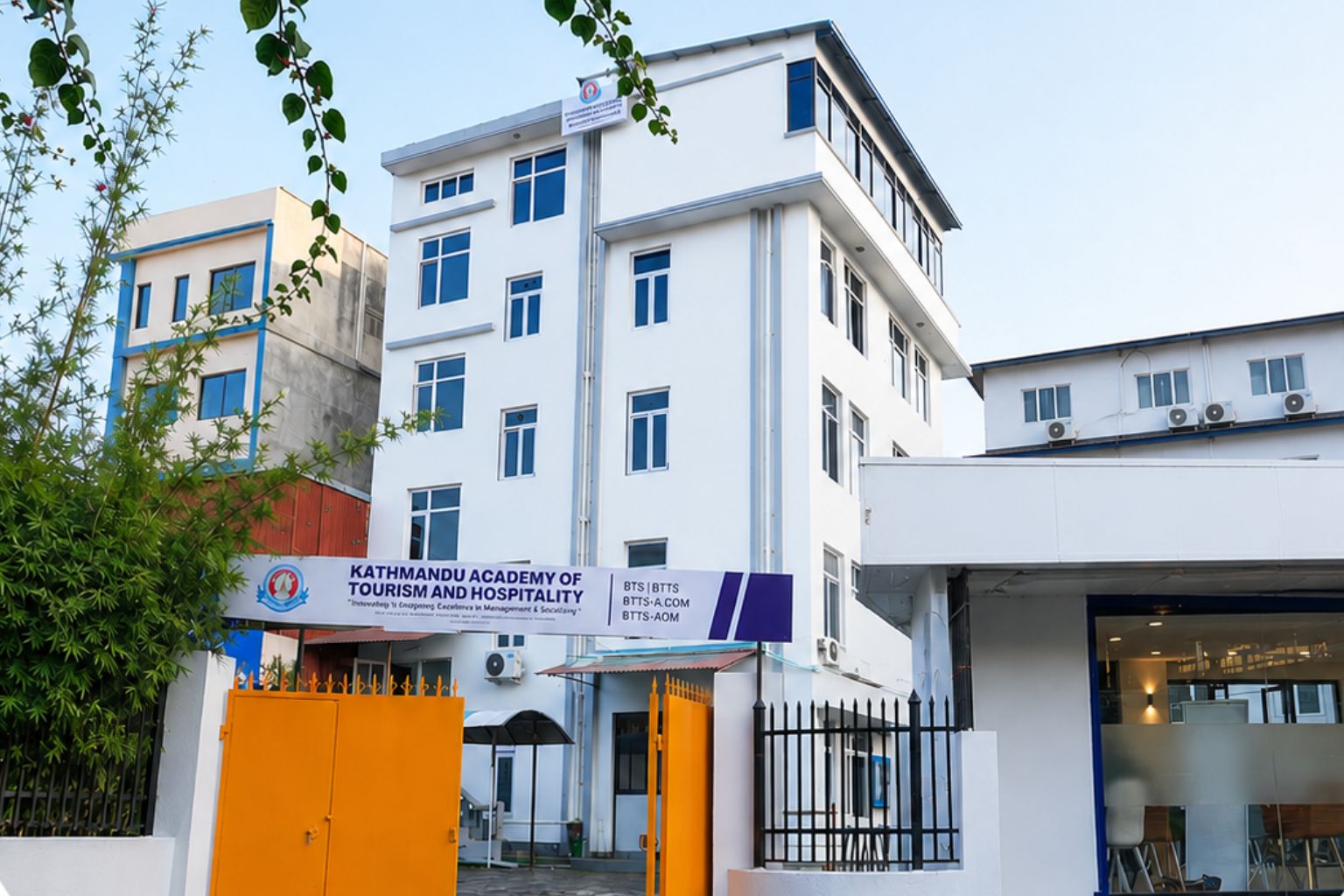
| Field | Details |
|---|---|
| Course: | Master of Tourism Studies (MTS) |
| College: | Kathmandu Academy of Tourism and Hospitality |
| Location: | Hattisar, Kathmandu |
| Affiliation: | Purbanchal University |
| Level: | Master's |
| Duration: | 2 years |
| Academic Structure: | 4 semesters |
| Approved Seats: | 30 |
| Eligibility: | Bachelor's degree or equivalent |
| Specialisation: | Five tracks in Semester IV |
MTS is KATH's postgraduate program in tourism studies. Its academic structure moves from tourism analysis and management subjects in the first year to sustainable tourism, policy, project planning, ecotourism, and specialised study in the later semesters.
Students encounter both tourism-specific and management-oriented subjects. Research Methodology and Statistical Methods appears in the first semester, while Tourism Project Planning and Management is included in Semester III. The final semester combines core tourism subjects with two electives from a selected specialisation track.
Applicants must hold a bachelor's degree or an equivalent qualification from a recognized university. Graduates from tourism, hospitality, business, or related academic backgrounds are given preference.
The MTS program runs for two years across four semesters. The first three semesters consist of core and compulsory subjects covering tourism, management, communication, finance, research, sustainability, entrepreneurship, and planning.
Semester IV includes four core subjects and two electives. Students select one specialisation track, with each track containing two related elective subjects.
Tourism: Its Trends and Issues
Tourism Resources of Nepal
Anthropology and Sociology of Tourism
Strategic Management
Research Methodology and Statistical Methods
Tourism Business Communication
Managerial Economics
Tourism Marketing
Financial Management in Tourism
HRD in Tourism
Management Information System
Entrepreneurship and Tourism
Sustainable Tourism Development
Tourism Project Planning and Management
Tourism Policies and Planning
Ethical & Regulatory Aspects in Tourism
Case Studies of Selected Tourism Countries
Ecotourism Principles and Practices
Ecotourism Planning and Management
Specialisation Elective I
Specialisation Elective II
Students select one specialisation track during Semester IV. Each track includes two elective subjects.
| Specialisation Track | Elective I | Elective II |
|---|---|---|
| Travel Agency Management | Travel Agency Management | Tour Operation |
| Airlines Management | Airline Operation and Management | Airlines Marketing |
| Hospitality Management | Hospitality Management | Hotel and Resort Marketing |
| Tourism Marketing | Hospitality and Travel Marketing | Destination Marketing |
| MICE Tourism | MICE Tourism and Its Operation | Conference and Convention Planning, Promotion and Management |
The elective structure allows students to concentrate on an area connected with their academic interests, including travel operations, airlines, hospitality, tourism marketing, or meetings and events.
Research and planning appear at different stages of the MTS curriculum. Research Methodology and Statistical Methods introduces research-related study in Semester I, while Semester III includes Tourism Project Planning and Management.
Subjects such as Case Studies of Selected Tourism Countries, Tourism Policies and Planning, Sustainable Tourism Development, and Ecotourism Planning and Management also connect the program with policy, destination, sustainability, and management issues within tourism.
KATH's broader teaching environment includes lectures, case studies, assignments, field trips, workshops, seminars, industrial orientation, and interaction with tourism professionals. The college also has classrooms with audiovisual teaching facilities, a computer laboratory, library resources, and a cafeteria.
KATH provides a 50% tuition fee exemption to one MTS student based on academic performance and conduct. The exemption applies for one semester and may continue when the required academic and conduct standards are maintained.
Special discounts are also available to eligible students from touristically potential remote areas of Nepal. The criteria include academic record and economic condition.
MTS fees are charged on a semester-wise basis.
The MTS curriculum relates to work across travel operations, airlines, hospitality, tourism marketing, destination management, tourism planning, events, and tourism-related projects.
Graduates may explore roles or professional pathways connected with:
Travel agencies and tour operations
Airlines
Hotels and resorts
Destination management
Tourism boards and tourism offices
Tourism marketing
MICE and event-related operations
Tourism projects
NGOs and organizations working in tourism-related areas
Career outcomes depend on individual experience, academic performance, professional skills, and available opportunities.
The Master of Tourism Studies at KATH is a two-year program divided into four semesters.
The MTS program is affiliated with Purbanchal University.
Applicants must have a bachelor's degree or equivalent from a recognized university. Preference is given to graduates from tourism, hospitality, business, or related fields.
The approved intake for the MTS program is 30 students.
Students can select from Travel Agency Management, Airlines Management, Hospitality Management, Tourism Marketing, or MICE Tourism in Semester IV.
Yes. Research Methodology and Statistical Methods is included in Semester I, while Semester III includes Tourism Project Planning and Management.
KATH provides a 50% tuition fee exemption to one MTS student based on academic performance and conduct. The exemption applies for one semester and can continue when the required conditions are maintained.






