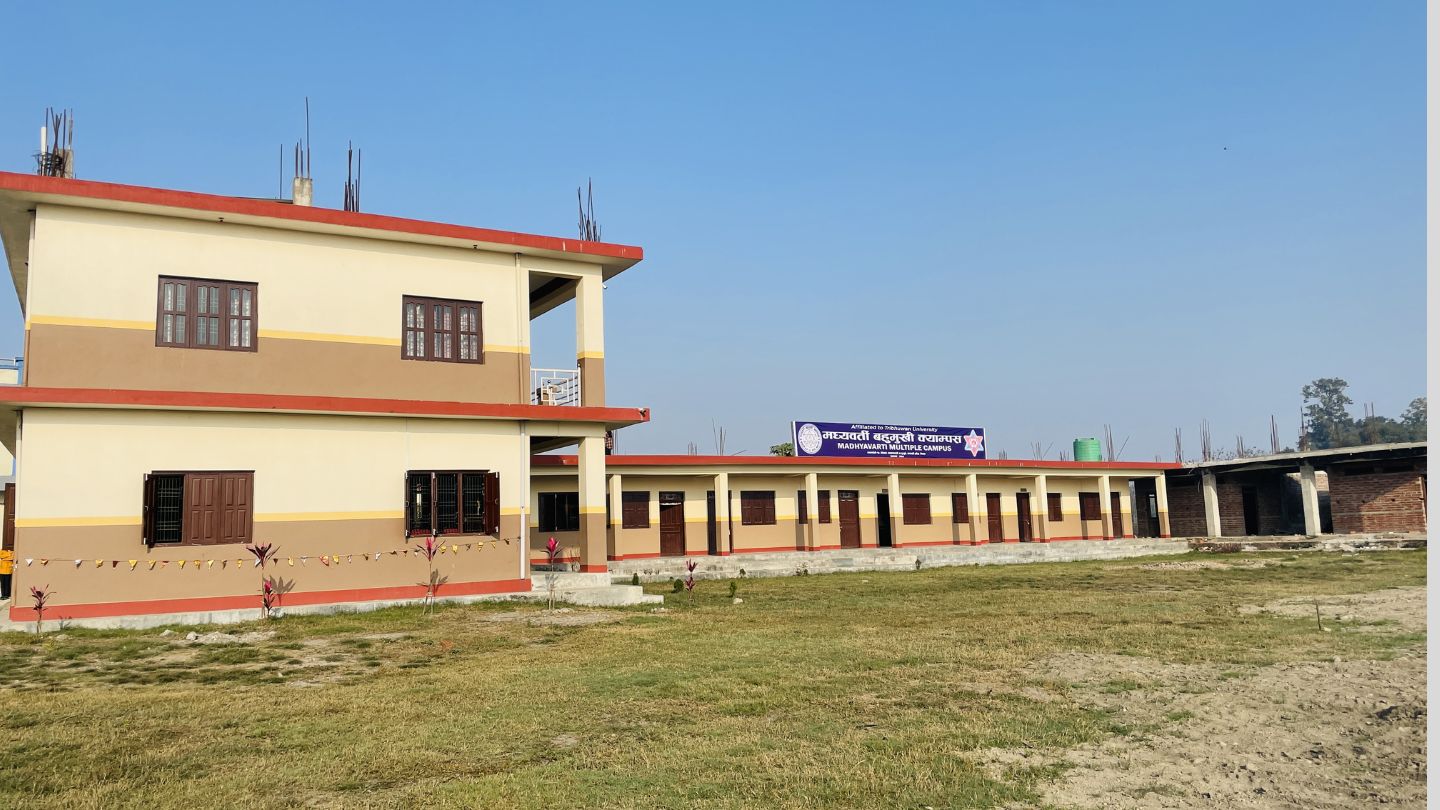
The Bachelor of Business Studies (BBS) at Madhyavarti Multiple Campus is a four-year undergraduate program under the annual system of Tribhuvan University. At this campus in Kawasoti Municipality–17, Gochhada, Nawalparasi (East of Bardaghat Susta), the program operates within a community-based academic setting shaped by local access needs in a rural and buffer-zone area.
The course brings TU management education to students from nearby communities who want bachelor-level study in business and administration without leaving the region. At the campus level, the program is linked with classroom teaching, project work, ICT-supported instruction, computer lab access, and scholarship support for deserving and economically disadvantaged students.
Course: Bachelor of Business Studies (BBS)
Campus: Madhyavarti Multiple Campus
Location: Kawasoti Municipality–17, Gochhada, Nawalparasi (East of Bardaghat Susta), Gandaki Province
Affiliation: Tribhuvan University
Faculty: Faculty of Management
Academic System: Annual
Duration: Four academic years
Study Level: Bachelor’s level
Course Structure: Foundation courses, core business studies, concentration courses, and final project work
Learning Support: Computer lab, multimedia projector, and ICT-supported teaching
Student Support: Scholarships for deserving students and tuition support priority for economically disadvantaged students
The BBS curriculum follows the standard TU Faculty of Management structure. It combines business foundations, core management study, concentration-area learning, research, and final project work across four academic years.
First Year: Business English, Business Statistics, Microeconomics for Business, Financial Accounting and Analysis, Principles of Management
Second Year: Business Communication, Macroeconomics for Business, Cost and Management Accounting, Organizational Behavior and Human Resource Management, Fundamentals of Financial Management
Third Year: Business Law, Foundation of Financial Systems, Business Environment and Strategy, Taxation in Nepal, Fundamentals of Marketing
Fourth Year: Entrepreneurship, Business Research Methods, Final Project, and three concentration courses
The program includes four main curriculum areas:
Foundation and allied business areas
Core business studies
Concentration-area study
Final project work
The fourth-year concentration options include:
Accounting
Finance
Management
Marketing
Build conceptual knowledge of business and administration
Develop a general management perspective
Strengthen attitudes, abilities, and practical business skills
Encourage entrepreneurial capability
Prepare students for higher study in management, teaching, research, and consultancy
The BBS program covers language, economics, accounting, finance, law, management, marketing, taxation, entrepreneurship, research, and concentration-based study. Its academic scope is broad within undergraduate management education and is designed to move from foundation subjects in the early years to focused study and project work in the final year.
At Madhyavarti Multiple Campus, the scope of the program is also shaped by place. The campus was established to expand access to higher education in a rural area near the Narayani River and the Chitwan National Park buffer zone. That local role gives the BBS program added relevance for students seeking a TU-affiliated management degree within their own region.
Understand major concepts of business and administration
Build working knowledge across accounting, finance, management, marketing, economics, and business law
Complete concentration-area study in the final year
Carry out business research and final project work
Develop a foundation for management-related work and higher study
Business communication
Quantitative and statistical analysis
Financial and management accounting
Organizational and human resource understanding
Financial management
Marketing and taxation
Business research and report writing
Project-based academic work
The BBS program at Madhyavarti Multiple Campus follows the TU management teaching pattern while drawing on the campus’s available academic resources. Teaching is supported through classroom delivery, project work, and ICT-based tools already in use on the campus.
Lecture-based teaching
Group discussion
Problem-solving exercises
Practical work where applicable
Project work in the final year
Guest lectures
Case-based teaching where required
Multimedia projector and ICT-supported instruction
Entry-level roles in business organizations
Work in industry and government offices
Entrepreneurship and self-employment
Further study in management
Teaching, research, and consultancy pathways
Scholarship scheme for deserving students
Tuition support priority for economically disadvantaged students
The program brings TU management education to a rural area of Nawalparasi
It is offered within a community-based campus created to expand local access to higher education
The campus provides a defined BBS pathway under the Faculty of Management
Computer lab access, multimedia support, and ICT-based teaching are already part of the academic setting
Scholarship support is built into the campus student-support approach
The campus has recorded notable BBS examination performance within a short institutional history
Apply after the campus publishes its admission notice
Submit the prescribed application form
Meet the BBS eligibility requirement
Complete document submission as required by the campus
Pay the prescribed admission fees
Complete academic registration under TU rules and the campus schedule
Additional entry requirements may apply according to the Faculty Board or the campus
Class 12 / 10+2 or equivalent academic transcript
Character certificate
Migration certificate, if applicable
Transfer certificate
Citizenship certificate or birth certificate copy
Passport-size photographs
Completed admission form
Admission fee payment receipt
Equivalence certificate, if applicable
Entrance scorecard, if required
The BBS program follows the annual examination system of Tribhuvan University. Final examinations are conducted through the Office of the Controller of Examinations. To qualify for the annual examination, a student must maintain at least 70 percent attendance in the classes actually held. A student cannot appear in the second-year final examination without first appearing in the first-year final examination.
The fourth year includes final project work as a compulsory academic requirement. Students complete field-based study for a fixed period set by the campus, prepare a project report in the prescribed format, and submit it for evaluation. The report may also be presented before the class or faculty members. Students must pass theoretical, practical, and project components separately where those components apply.
The BBS program at Madhyavarti Multiple Campus offers a structured TU management degree in a campus built through community effort in Nawalparasi. Its value lies not only in the curriculum but also in the access it provides to students from nearby rural communities who want bachelor-level study in business without moving away from the region.
With its four-year annual structure, concentration options, final project requirement, and campus-level academic support, the program provides a clear route for undergraduate study in management within a local community campus setting.
The BBS program runs for four academic years under the annual system of Tribhuvan University.
The program is affiliated with Tribhuvan University under the Faculty of Management.
The course includes business communication, statistics, economics, accounting, management, finance, business law, taxation, marketing, entrepreneurship, research methods, concentration courses, and final project work.
The final-year concentration options include Accounting, Finance, Management, and Marketing.
Yes. Final project work is a required part of the fourth year along with Business Research Methods and concentration-area study.
The campus supports BBS students through ICT-based teaching, multimedia use, computer lab access, and scholarship support for deserving and economically disadvantaged students.