Madhyavarti Multiple Campus (मध्यवर्ती बहुमुखी क्याम्पस, नवलपरासी) is a community-based bachelor-level institution in Kawasoti Municipality–17, Gochhada, Nawalparasi (East of Bardaghat Susta), Gandaki Province. Established in 2070 B.S. (2014 A.D.), the campus was created through local initiative to expand access to higher education in a rural area on the banks of the Narayani River and within the buffer zone of Chitwan National Park.
It is affiliated with Tribhuvan University and currently offers the Bachelor of Business Studies program under the Faculty of Management. Its institutional story is closely tied to community participation, local fundraising, and the gradual development of academic infrastructure for students who would otherwise need to travel farther for university-level study.
Established: 2070 B.S. (2014 A.D.)
Institution Type: Community-based campus
Location: Kawasoti Municipality–17, Gochhada, Nawalparasi (East of Bardaghat Susta), Gandaki Province, Nepal
Affiliation: Tribhuvan University
Faculty: Faculty of Management
Program Offered: Bachelor of Business Studies (BBS)
Academic Structure: Four-year annual system
Campus Chief: Hem Raj Mahato
Academic Context: Bachelor-level education in a rural and buffer-zone setting
Scholarship Support: Scholarship scheme for deserving students
Financial Support Priority: Tuition support for economically disadvantaged students
Contact Email: info@madhyavarti.edu.np
Phone: +977-9847087506, +977-9847006752
Madhyavarti Multiple Campus was established through the collective effort of local residents, education advocates, social workers, and community stakeholders. The campus began without initial capital investment and emerged from a local effort to make university education available in an area affected by distance, limited resources, and uneven access to higher education. Early academic activities started after the construction of a four-room academic block through voluntary contributions and collaboration among local residents, the community forest committee, the Madhyawarti Consumer Committee, and representatives from local wards.
The campus secured affiliation from Tribhuvan University on Kartik 11, 2070 B.S. (October 27, 2013 A.D.) to operate the Bachelor of Business Studies program under the Faculty of Management. Since then, BBS has continued as the core academic offering. The institution is community-owned in orientation and has continued to function through local support, donations, and the service of teaching and administrative personnel.
Its location shapes much of its institutional role. The campus sits in a socially and environmentally sensitive region on the banks of the Narayani River and within the Chitwan National Park buffer zone. The surrounding area includes communities such as Tharu, Bote, Majhi, Musahar, and Dalit groups, along with households whose livelihoods are connected to agriculture, tourism, and small-scale economic activity. The region also faces pressure from riverbank erosion, seasonal flooding, and wildlife risk. In this setting, the campus has taken on a practical role as a local route to bachelor-level education.
The campus also draws institutional continuity from the educational history of Saraswati Secondary School, whose land and local academic base supported the establishment of the college. This background helps explain why Madhyavarti Multiple Campus developed as a community-supported institution rather than as a privately capitalized campus.
Madhyavarti Multiple Campus currently offers one bachelor-level program:
Bachelor of Business Studies (BBS)
The BBS program runs under Tribhuvan University and follows the annual system. It is a four-year full-time undergraduate program within the Faculty of Management.
The structure of the BBS program is designed around foundation, core, concentration, and project components. Across four academic years, students study language, economics, accounting, business law, finance, management, marketing, taxation, entrepreneurship, research methods, and project work. In the final year, students move into concentration-based study and complete a final project.
The broad academic pattern includes:
Foundation and allied business areas
Core business studies
Concentration-area courses
Final project work
The year-wise progression includes:
First Year: Business English, Business Statistics, Microeconomics for Business, Financial Accounting and Analysis, Principles of Management
Second Year: Business Communication, Macroeconomics for Business, Cost and Management Accounting, Organizational Behavior and Human Resource Management, Fundamentals of Financial Management
Third Year: Business Law, Foundation of Financial Systems, Business Environment and Strategy, Taxation in Nepal, Fundamentals of Marketing
Fourth Year: Entrepreneurship, Business Research Methods, Final Project, and three concentration courses
The concentration options named in the BBS structure are:
Accounting
Finance
Management
Marketing
The campus has also undertaken preparatory work for future undergraduate expansion in Bachelor in Hotel Management (BHM) and Bachelor in Computer Application (BCA), though these are not part of the current confirmed offered program list.
Admission to the BBS program follows the regulations of Tribhuvan University, the Faculty of Management, and the campus.
After the publication of the campus admission notice, eligible applicants submit the prescribed application form with the required academic documents.
BBS applicants must have successfully completed 10+2 in business or commerce, or an equivalent course from a board or university recognized by Tribhuvan University.
Additional entry requirements or criteria may apply according to the Faculty Board or the campus.
Depending on campus policy, the admission process may include an entrance examination, merit-based selection, or both.
Selected applicants complete admission by submitting the required documents and paying the prescribed fees.
Academic registration, examinations, and result procedures follow Tribhuvan University rules, guidelines, and the applicable academic calendar.
Academic Transcript (Grade Sheet) of Class 12 / +2 or equivalent
Character Certificate from the previous institution
Migration Certificate, if the previous board or university is different
Transfer Certificate (TC) from the previous school or college
Citizenship Certificate or Birth Certificate copy
Passport-size photographs
Entrance Examination Scorecard, if required by the program or campus
Completed campus admission or application form
Admission fee payment receipt
Equivalence Certificate, if the qualification is from a foreign board or university
Madhyavarti Multiple Campus has continued its academic operation through the service of assistant professors and administrative staff working in a resource-constrained setting. This is an important part of the campus identity. The institution developed in an area where students from surrounding rural and mid-hill communities needed a local bachelor-level option, and its academic operation reflects that context.
The BBS program follows the teaching pattern used for Tribhuvan University management education. Instruction combines lectures with group discussion, problem-solving exercises, practical work, project work, guest lectures, and case-based teaching where appropriate. The fourth year includes business research methods and a final project, which connects classroom study with field-based observation and report writing.
The campus also refers to digital learning practices through the use of multimedia projectors and ICT-based support. These elements fit the management studies context, where students are expected to work across business communication, accounting, economics, finance, management, and research-oriented coursework.
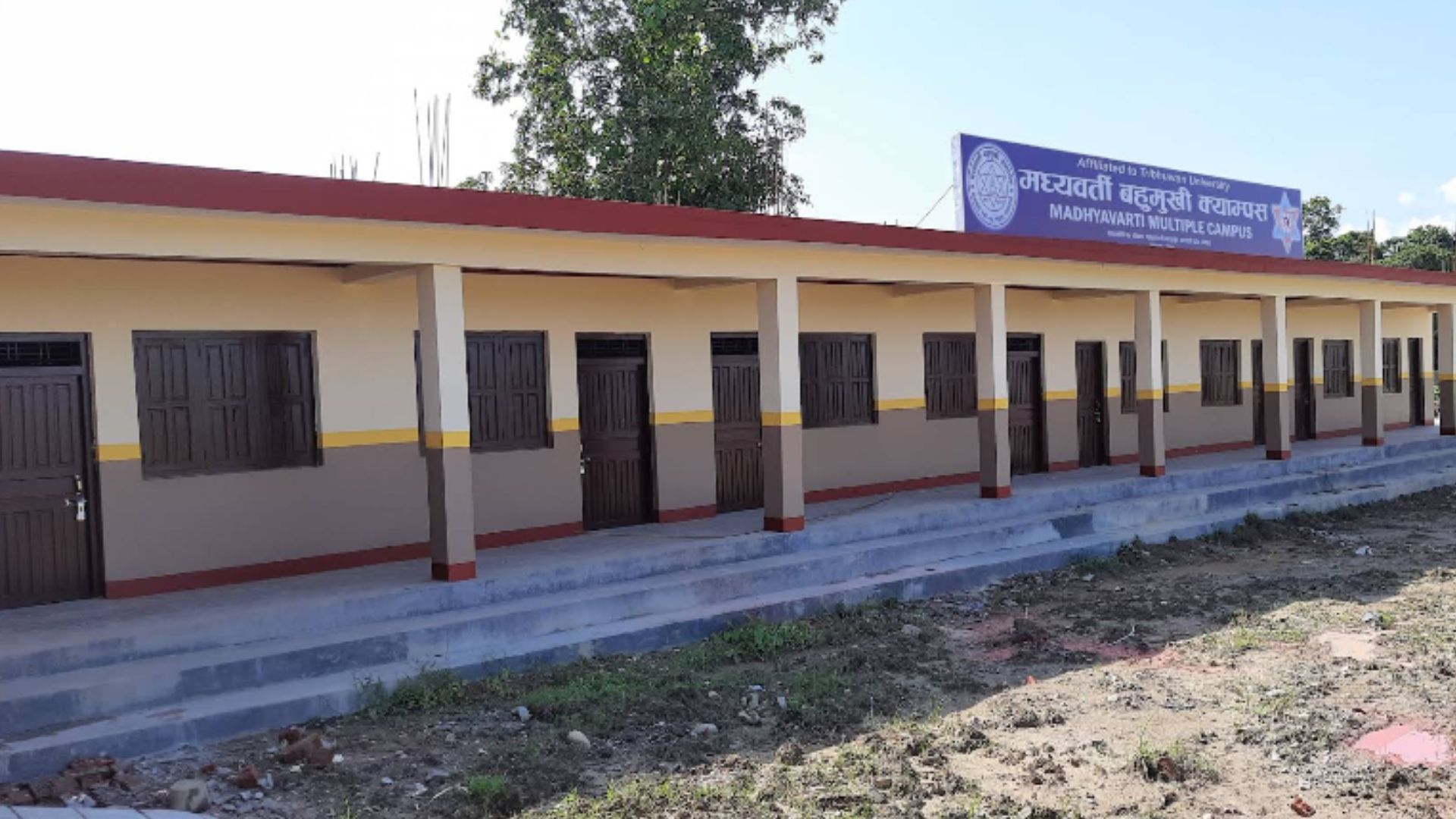
Four-room academic building developed through community collaboration
Four-room administrative building
Campus Administration Office
Accounts and Book Office
Computer Laboratory in functional use
Additional classroom space within the administrative building
Multimedia projector-based academic support
ICT-supported learning environment
Bicycle parking facility
Basketball court
Badminton court
168-meter perimeter wall around the campus premises
Ongoing construction of an additional two-room building
Student life at Madhyavarti Multiple Campus is shaped less by large-scale urban campus culture and more by its local educational role. The campus serves students from a catchment area that includes Ward No. 17 and Ward No. 15 of Kawasoti Municipality, covering around 17,000 people in roughly 4,000 households. For many students in this region, the campus provides a practical local path to university education without the added cost and disruption of leaving the area.
The social setting around the campus also matters. Students study in a region marked by agricultural livelihoods, tourism-related activity, and a mixed rural population that includes historically marginalized communities. That gives the campus a broader social function beyond classroom delivery. Access to higher education here is closely tied to local mobility, community confidence, and the possibility of continuing formal study within one’s own region.
Because the campus developed through public participation, student experience is also linked to a sense of local ownership. Community contributions, local committees, guardians, and supporters have all played a role in sustaining operations and infrastructure. This creates a campus environment where institutional growth and student opportunity are closely connected to the surrounding community.
Basketball activities supported by the campus basketball court
Badminton activities supported by the campus badminton court
Awareness and sensitization programs on social issues
Cleanliness and sanitation campaigns
Wildlife and biodiversity conservation initiatives in the buffer-zone context
Collaborative participation in local development activities
Support-related participation during natural disasters
Scholarship scheme for deserving students
Moderate fee structure for the BBS program
Priority on tuition support for economically disadvantaged students
Institutional effort to reduce financial barriers related to textbooks and academic resources
Established in 2070 B.S. (2014 A.D.) through community initiative
Secured Tribhuvan University affiliation to run the BBS program on Kartik 11, 2070 B.S. (October 27, 2013 A.D.)
Developed from an initial four-room academic block into a broader campus setup with academic and administrative infrastructure
Administrative building developed with support from the Federal Member of Parliament’s Infrastructure Development Fund
Additional support received from Kawasoti Municipality Ward No. 17 during Fiscal Year 2020/21
In the Four-Year BBS examination for Academic Session 2076, the campus secured first position in Gandaki Province with a 100 percent pass rate and distinction-level results
The campus also recorded a 100 percent result again in 2078 B.S.
Preparatory work initiated for future academic expansion in BHM and BCA
The campus has expressed intent to begin the Quality Assurance and Accreditation process under the University Grants Commission (UGC)
It brings Tribhuvan University bachelor-level management education to a rural area of Nawalparasi
It was created through local initiative and remains closely connected to its community base
It offers a defined BBS pathway under the Faculty of Management
Its location reduces the need for students from nearby rural areas to travel farther for bachelor-level study
The campus combines classroom teaching with project-based academic requirements under the TU annual system
Computer lab and ICT-supported learning are already part of the campus setup
The institution has recorded notable BBS examination results within a short period of establishment
Scholarship and tuition-support priorities are built into its student support approach
Campus Chief Hem Raj Mahato presents the campus as a response to the need for university-level education in the southern rural and buffer-zone area of Nawalparasi (East). His message places higher education within a wider social frame, linking it to local opportunity, human resource development, and the ability of students to contribute meaningfully to society.
He also acknowledges the role of donors, educationists, social workers, local representatives, parents, entrepreneurs, and well-wishers in sustaining the institution. In his account, the progress of the campus is tied to the effort of students, lecturers, administrative staff, and the wider community that helped establish and maintain it.
His message also looks ahead to technical and skill-oriented expansion. He connects future academic growth with the campus goal of producing technically capable human resources suited to changing regional and national needs.
Madhyavarti Multiple Campus stands out for the way it was built and the role it serves. It was established not as an extension of an already large institution, but as a locally created answer to limited access to higher education in a rural and environmentally sensitive region. That origin still shapes its academic character.
For students seeking a TU-affiliated BBS program in Nawalparasi, the campus offers a focused management degree within a community-backed setting. Its history of local support, gradual infrastructure growth, scholarship orientation, and documented academic results gives it a distinct place in the educational landscape of its surrounding area.
Madhyavarti Multiple Campus is located in Kawasoti Municipality–17, Gochhada, Nawalparasi (East of Bardaghat Susta), Gandaki Province, Nepal.
The campus was established in 2070 B.S. (2014 A.D.).
The campus is affiliated with Tribhuvan University under the Faculty of Management.
The campus currently offers the Bachelor of Business Studies (BBS) program.
The BBS program follows the four-year annual system under Tribhuvan University.
Applicants must have successfully completed 10+2 in business or commerce, or an equivalent course from a board or university recognized by Tribhuvan University. Additional entry requirements may apply according to the Faculty Board or the campus.
Required documents generally include the Class 12 or equivalent transcript, character certificate, migration certificate if applicable, transfer certificate, citizenship or birth certificate copy, passport-size photographs, completed admission form, admission fee receipt, and equivalence certificate if applicable. An entrance scorecard may also be required depending on campus policy.
The campus provides a scholarship scheme for deserving students and prioritizes tuition support for economically disadvantaged students.
The campus has academic and administrative buildings, a computer laboratory, classroom space, multimedia and ICT-supported learning tools, bicycle parking, and basketball and badminton courts.
The Campus Chief is Hem Raj Mahato.