



Bachelor of Science in Environmental Sciences (BSc Env Sc) is a four-year undergraduate program offered by the Graduate School of Science and Technology (GSST), Mid-West University, Birendranagar, Surkhet, Nepal. The program is structured around environmental science, ecology, biology, chemistry, geology, mathematics, research, fieldwork, and practical learning.
It is designed for students from the science stream who want to study environmental systems, biodiversity, pollution, climate change, natural resources, environmental policy, and sustainability through classroom, laboratory, project, and field-based learning.
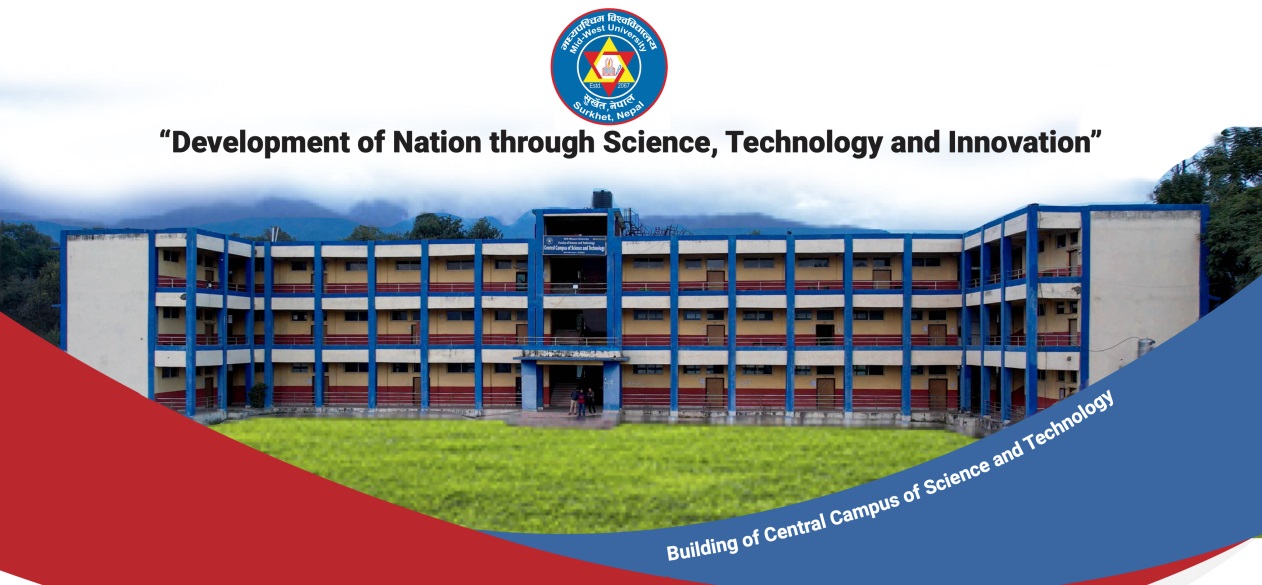
| Field | Details |
|---|---|
| Course | Bachelor of Science in Environmental Sciences |
| Official academic title | B.Sc. in Environmental Science |
| Short form | BSc Env Sc / B.Sc. Environmental Science |
| Institution | Mid-West University School of Science and Technology |
| Academic unit | Graduate School of Science and Technology |
| University | Mid-West University |
| Location | Birendranagar, Surkhet, Nepal |
| Level | Bachelor’s degree |
| Duration | 4 years |
| Number of semesters | 8 |
| Total credit hours | 128 |
| Eligibility | Secondary level, Grade 12, +2, or equivalent from Science Stream with an aggregate of 50% or 2.00 GPA out of 4.00 |
| Total fee | NRs 205,000 for 4 years |
| First semester fee | NRs 30,350 |
| Second to eighth semester fee | NRs 24,950 per semester |
B.Sc Environmental Science at GSST-MU gives students a structured academic base in environmental systems and related scientific fields. The curriculum combines biology, chemistry, ecology, geology, mathematics, social science, environmental economics, environmental policy, biodiversity conservation, pollution studies, watershed management, climate change, remote sensing, GIS, environmental assessment, internship, and final-year project work.
The program connects theory with practical learning through laboratory work, field surveys, projects, group discussions, assignments, presentations, case studies, and research activities. It also includes a Labor Market Driven Program (LMDP) approach connected with the Nurturing Higher Education Project (NEHEP) of the University Grants Commission (UGC), Nepal.
Candidates must have passed secondary level, Grade 12, +2, or an equivalent qualification from the Science Stream with an aggregate of 50% or 2.00 GPA out of 4.00.
Applicants need the following documents for the application process:
A copy of citizenship
Marksheets of Grades 11 and 12
Character certificate
Provisional certificate
Two copies of passport-size photos
Eligible applicants are notified through public announcements and the official website of Mid-West University. After the application deadline, the Entrance Committee conducts the entrance examination. All applicants must appear in the entrance examination, and admission is based on the merit list and available seats.
| Subject Area | Weightage |
|---|---|
| General Knowledge | 10% |
| English | 10% |
| Biology | 20% |
| Chemistry | 20% |
| Mathematics | 20% |
| Physics | 20% |
| Total | 100% |
B.Sc Environmental Science is a four-year program divided into eight semesters. The total credit hour of the program is 128. The curriculum includes common foundation courses, skill development, basic science courses, core environmental courses, and cross-cutting courses.
| Year | Semester | Credit Hours |
|---|---|---|
| Year I | Semester I | 15 |
| Year I | Semester II | 18 |
| Year II | Semester III | 18 |
| Year II | Semester IV | 17 |
| Year III | Semester V | 18 |
| Year III | Semester VI | 18 |
| Year IV | Semester VII | 15 |
| Year IV | Semester VIII | 9 |
| Total | 8 semesters | 128 |
| Course Code | Course Name |
|---|---|
| ENV410 | Computer Applications |
| ENV411 | Ecological Concepts and Principles |
| ENV412 | Mathematics of Environmental System |
| ENV413 | Biology of Environmental System |
| ENV414 | General Chemistry |
| Course Code | Course Name |
|---|---|
| ENV420 | Basic Statistics |
| ENV421 | Atmospheric and Hydrological Processes |
| ENV422 | Environmental Geology and Geomorphology |
| ENV423 | Contemporary Environmental Issues |
| ENV424 | Evolutionary Biology |
| ENV425 | Thermodynamics and Kinetics |
| Course Code | Course Name |
|---|---|
| ENV430 | Research Methodology |
| ENV431 | Environmental Economics |
| ENV432 | Environmental Pollution |
| ENV433 | Microbial Ecology and Ecotoxicology |
| ENV434 | Freshwater Ecology |
| ENV435 | Biogeography and Phylogenetics |
| Course Code | Course Name |
|---|---|
| ENV440 | Scientific Communication |
| ENV441 | Energy and Environment |
| ENV442 | Biodiversity Conservation |
| ENV443 | Physiology and Biochemistry |
| ENV444 | Soil Science |
| ENV445 | Environmental Project |
| Course Code | Course Name |
|---|---|
| ENV450 | Computer Programming |
| ENV451 | Climate Change |
| ENV452 | Remote Sensing and GIS |
| ENV453 | Watershed Management |
| ENV454 | Pollution Monitoring and Controls |
| ENV455 | Mountain Environment |
| Course Code | Course Name |
|---|---|
| ENV461 | Environmental System Modelling |
| ENV462 | Environmental Policy and Governance |
| ENV463 | Environmental Biotechnology |
| ENV464 | Drinking and Waste Water Technologies |
| ENV465 | Green Infrastructure and Economy |
| ENV466 | Environmental Assessments |
| Course Code | Course Name |
|---|---|
| ENV471 | Environmental Hazards and Disasters |
| ENV472 | Restoration Ecology |
| ENV473 | Natural Resources Accounting |
| ENV474 | Climate Modelling |
| ENV475 | Environmental Entrepreneurship |
| Course Code | Course Name |
|---|---|
| ENV481 | Final Year Project |
| ENV489 | Internship |
The program aims to develop students’ knowledge and skills in environmental science and contemporary environmental issues. Students are expected to build competency in environmental science subjects, research design, data collection, analysis, technical interpretation, environmental impact assessment, policy-related understanding, and technology-related environmental work.
The course also supports learning in environmental monitoring, conservation, pollution control, sustainability, communication, teamwork, and field-based observation.
The program uses different teaching and learning methods, including:
Lecture and tutorial
Presentation
Assignment
Project work
Guest lecture
Group discussion
Experimental method
Field survey
Case study
The program gives attention to practical learning through fieldwork, laboratory experiments, and practical projects. More than 60% of teaching and learning is based on practical approaches.
The academic structure includes laboratory facilities and fieldwork gear required for the course. Laboratory areas include facilities for monitoring and testing water, air, soil, and waste, along with ecology, microbiology, geology, and computer-related facilities.
The physical and e-library provision follows a learning resource ratio of one item per four students at most.
The B.Sc. in Environmental Science program is open for inbound and outbound credit transfer under mutual understanding with higher education institutions offering similar programs. Students may earn approved credits through regular classes and assessment systems at other institutions, subject to the credit transfer process of GSST-MU.
A two-way full transfer of credits is also permitted with approval from the Academic Council of Mid-West University.
| Fee Category | Amount |
|---|---|
| Total fee for 4 years | NRs 205,000 |
| First semester fee | NRs 30,350 |
| Semester II to Semester VIII fee | NRs 24,950 per semester |
Graduates of B.Sc Environmental Science can consider academic and professional pathways related to environmental research, policy work, conservation, environmental education, sustainability, environmental monitoring, pollution control, resource management, and project-based environmental work.
Career direction depends on academic performance, skills, further study, experience, available opportunities, and the requirements of the concerned organization or sector.
Location: Graduate School of Science and Technology, Mid-West University, Birendranagar-8, Surkhet
Phone: +83-520176, 9745504642
Email: dean.gsst@mu.edu.np
Website: mugsst.edu.np
B.Sc Environmental Science is a four-year undergraduate program offered by the Graduate School of Science and Technology at Mid-West University, Birendranagar, Surkhet. It covers environmental systems, ecology, biodiversity, pollution, climate change, resource management, policy, fieldwork, and research.
Applicants must have passed secondary level, Grade 12, +2, or equivalent from Science Stream with an aggregate of 50% or 2.00 GPA out of 4.00.
The program duration is 4 years.
The program has 8 semesters.
The total credit hour of the program is 128.
The entrance test includes General Knowledge, English, Biology, Chemistry, Mathematics, and Physics.
Yes. The program includes Environmental Project in Semester IV, Final Year Project in Semester VIII, and Internship in Semester VIII.
The total fee for the four-year program is NRs 205,000.
Bachelor of Science in Environmental Sciences (BSc Env Sc) Syllabus.PDF






